
Evangelion Episode 7: A Human Work
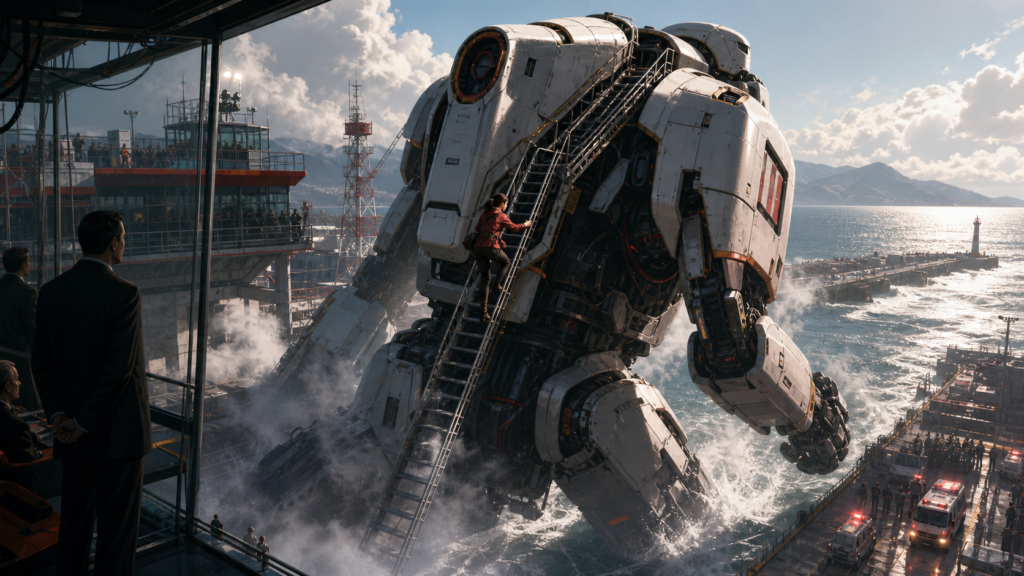
Evangelion Episode Reaction
Jet Alone is supposed to prove adults can replace the Evangelions. The demonstration instead proves that institutions would rather manufacture a disaster than admit they need each other.
Bottom Line
The adults build a safer robot and make the world less safe
Episode 7 looks like a break after Operation Yashima, but the episode is really an autopsy of institutional pride. Jet Alone is presented as the responsible alternative to Evangelion. The machine does not need a child pilot, does not suffer synchronization failures, and does not expose a teenager to an Angel. Those are good goals. Then the adults responsible for Jet Alone turn the demonstration into a sales pitch, while NERV treats competition as an attack that must be neutralized.
The complaint is not that organizations compete. NERV holds enormous power, hides information, and repeatedly places children in danger. Any outside group should question whether one secretive agency deserves control over humanity’s defense. The complaint is that neither side cares enough about public safety to cooperate. One institution wants prestige. The other wants monopoly. Ordinary people become the audience, the market, and finally the evacuation list.
What the episode gets right is how professional language can hide petty behavior. The Jet Alone team talks about cost, efficiency, reliability, and human control. NERV talks about security and classified technology. Every term sounds serious. Underneath the vocabulary, executives and commanders are fighting over status. The machines are larger than buildings, but the motives behind them are painfully small.
Misato is the one adult who treats the crisis as a crisis. She does not stop to protect NERV’s reputation or enjoy a rival’s failure. She climbs into a nuclear-powered machine that could melt down because people will die if nobody acts. Her courage is real. The system’s dependence on her courage is another failure.
Jet Alone
A practical idea wrapped in corporate arrogance
Jet Alone begins with a reasonable question: why should humanity’s defense depend on mysterious giants that only a few traumatized children can operate? A conventional machine could be manufactured, repaired, and controlled by trained adults. A nuclear reactor could free the weapon from external power cables. Remote operation could keep pilots away from direct combat. On paper, Jet Alone addresses several problems NERV refuses to discuss in public.
The presentation ruins the argument by treating safety as a weapon against a competitor. The representatives do not invite scrutiny of both systems. They use NERV’s failures as advertising copy. Ritsuko responds with technical contempt instead of admitting that Evangelions also carry catastrophic risks. The room becomes a contest between people who want to win the meeting, not people trying to build the best defense.
Jet Alone’s design reflects that conflict. The machine looks industrial rather than divine, which should make the project more honest. Humans built the reactor. Humans wrote the software. Humans can document the parts. Yet the project team presents that human origin as proof of control, even though human institutions are exactly where the danger enters. A machine can be understandable while the people managing it remain reckless.
The runaway demonstration turns the sales pitch inside out. Jet Alone walks past its test boundaries while the control team loses access. A nuclear-powered body becomes a moving countdown. The same independence praised minutes earlier now prevents anyone from shutting the machine down. Engineering did not betray the project. The promise of effortless control did.
The episode avoids making Jet Alone completely foolish. Misato’s intervention shows the machine has real systems, real safeguards, and real design logic. The shutdown should work. The password rejection exposes interference rather than simple incompetence. That detail matters because the larger threat is not technology. The threat is a political environment where sabotage is more useful than improvement.
Misato Katsuragi
The bravest person in the room is the one with the least control
Misato spends much of Episode 7 surrounded by adults who believe authority means distance from consequences. Executives sit in a presentation hall. Engineers watch monitors. NERV leaders make calls from protected spaces. Misato boards an aircraft, lands on the runaway machine, and enters the reactor compartment herself. She closes the distance everyone else created.
Her decision is not clean heroism. Misato has a habit of accepting impossible risk because action feels better than helplessness. The Second Impact killed her father and taught her that catastrophe can arrive while adults fail to explain anything. Jet Alone gives her a problem she can touch. A reactor has controls. A machine has panels. People can be saved if she moves fast enough. The mission fits the wound.
Shinji watches Misato place herself in danger, and his reaction quietly changes how he sees her. At home, Misato can appear messy, loud, and unserious. At work, she becomes focused without losing empathy. Shinji learns that her disorder is not the whole person. The adult who drinks too much and leaves cans around the apartment is also willing to enter a reactor because strangers deserve to survive.
The rescue also reverses the usual pilot arrangement. Shinji uses Unit-01 to hold Jet Alone steady while Misato performs the dangerous internal work. The child remains involved, but the adult takes the most immediate personal risk. That does not repair NERV’s exploitation, yet the division feels more humane than an adult commander ordering a child to absorb every consequence.
Misato’s physical struggle with the control rods strips the crisis of corporate language. There is no branding inside the machine. There is heat, weight, metal, and a body trying to move something before time runs out. The scene makes public safety concrete. Someone eventually has to touch the problem that leaders created from a distance.
The Setup
NERV wins because NERV cannot allow another answer
The rejected password changes the episode. Misato enters the correct shutdown code and the system refuses her. A different program has been inserted. Later, Ritsuko and Gendo speak as though the outcome followed a scenario. The implication is brutal: NERV sabotaged Jet Alone, endangered the demonstration site, and relied on Misato to prevent a nuclear disaster.
The story does not give viewers a courtroom confession, which is the right choice. Institutions that operate through secrecy rarely explain the whole crime. They leave patterns, protected conversations, missing access, and convenient results. Jet Alone fails in public. NERV’s Evangelion helps save the day. The rival project becomes proof that only NERV can be trusted. Every benefit flows in one direction.
Ritsuko’s role is especially uncomfortable. She understands the technical weakness, knows the password should work, and recognizes what happened. Her loyalty to Gendo and NERV places her against Misato, even while Misato risks her life cleaning up the sabotage. Their friendship exists beside a chain of command that teaches one woman to use the other as an expendable solution.
Gendo’s victory reveals what NERV protects. The organization claims to defend humanity from Angels, but Jet Alone is not an Angel. Jet Alone is an alternative. A secure institution would test the rival technology, expose its flaws, and incorporate anything useful. NERV destroys the alternative because shared authority would threaten the plan hidden behind public defense.
This is where Episode 7 connects to real social structures. Agencies often treat funding, jurisdiction, and public trust as resources to defend. Companies suppress safer products when those products threaten established profit. Leaders frame oversight as interference. A system can become so focused on preserving its mission that preserving the institution replaces the mission.
A believable better outcome would require independent safety review, shared emergency protocols, transparent testing, and criminal accountability for sabotage. Jet Alone’s nuclear risks deserve serious criticism. Evangelion’s child-pilot system deserves the same scrutiny. Neither program should be allowed to grade its own homework while the public absorbs every failure.
Home After Work
Shinji learns that adulthood is mostly contradiction
The domestic ending keeps the episode from becoming a simple conspiracy story. Shinji hears classmates admire Misato and realizes he has access to a version of her they do not see. He knows the arguments, the drinking, the laziness, and the embarrassment. He also knows she came home alive after doing something extraordinary. Familiarity does not make her smaller. Familiarity makes the courage more complicated.
That lesson matters for Shinji because he tends to sort adults into rescuers and threats. Gendo rejects him. Misato shelters him. Ritsuko explains machines. Episode 7 blurs those roles. Misato can care for him and still work for NERV. Ritsuko can be friendly and still protect a plan that almost kills Misato. Adults are not stable symbols. They make choices inside systems that reward some loyalties and punish others.
The episode does not ask Shinji to forgive everything because Misato is brave. Her willingness to take risks does not erase the way she pressures him to pilot. Instead, the story gives him a fuller picture. Affection becomes possible when another person is allowed to remain inconsistent. That is a harder form of connection than worship or resentment.
Jet Alone also exposes the danger of confusing adult operation with ethical operation. Replacing a child pilot with remote controls removes one obvious abuse, but adults can still design reckless incentives, hide reactor problems, and stage unsafe demonstrations. A machine becomes safer only when the institution around the machine accepts limits. Age alone does not produce responsibility. Accountability does.
The public demonstration deserves special side-eye because the audience is part of the product. Executives want witnesses when the machine succeeds, yet those same guests become potential victims when control is lost. Public relations turns proximity to danger into proof of confidence. The event looks polished because the risk has been pushed out of the presentation and into assumptions nobody wants to question on stage.
That pattern appears far beyond military technology. Companies launch unfinished systems to meet a deadline, governments approve projects before emergency plans are ready, and organizations call preventable failures unforeseeable. Jet Alone is science fiction, but the excuse is ordinary: everybody followed procedure until the procedure stopped protecting anyone.
Ritsuko’s silence is the episode’s most painful professional choice. She knows enough to recognize sabotage and enough to understand what Misato is entering. Telling the truth could expose Gendo’s operation, damage NERV, and threaten her own position. Staying quiet leaves Misato alone inside the machine. The scene asks whether expertise has value when the expert protects authority before people.
The episode leaves Misato outside that protected circle, which is why her rescue feels both heroic and unfair. She has enough authority to carry the risk but not enough authority to know why the risk exists. Organizations love that kind of employee. They praise initiative, depend on courage, and withhold the information that would let courage become informed judgment about the lives placed in her hands.
RaeRae’s Verdict
The monster of the week is institutional self-preservation
Episode 7 has no Angel, and the absence is the point. Humanity does not need an outside enemy to create a mass-casualty threat. Competition, secrecy, ego, and sabotage can build one before lunch. Jet Alone is dangerous, but the machine is less frightening than the people who need it to fail.
Misato saves the episode from becoming cynical sludge. Her decision proves that individual responsibility still matters even when institutions behave terribly. She does not fix NERV or redeem Jet Alone. She prevents strangers from paying the final price for somebody else’s power game. That is not a motivational victory. It is emergency repair.
My bottom line: Jet Alone was never the real rival to Evangelion. Transparency was. A human-built machine could be questioned, audited, and replaced. NERV’s power depends on mysteries nobody outside the organization can inspect. Episode 7 shows how far the organization will go to keep those mysteries in control.
Episode File
Episode 7, “A Human Work”
Original air date: November 15, 1995. Runtime: about 22 minutes. Watch: Netflix. Next: Episode 8, “Asuka Strikes!”