
Evangelion Episode 5: Rei I
RaeRae Reacts · Animated Series
Shinji wants a simple answer about Rei. NERV gives him a hospital room, a burned hand, a pair of glasses, and a father who can smile for someone else.
Bottom Line
Rei is not a puzzle box for Shinji to open
Episode 5 looks quiet after four episodes of panic, running, and Angel attacks, but the quiet is doing sharp work. Shinji sees Rei Ayanami talking to Gendo Ikari with an ease that he has never received from his own father. That small smile rearranges the whole room. Shinji is curious about Rei, jealous of her connection with Gendo, and embarrassed by how badly he wants to understand both. The episode refuses to turn Rei into a reward for his curiosity. She remains private because privacy is one of the few things NERV has not taken from her.
The complaint starts there. Too many stories treat the silent girl as a locked file that the male lead deserves to access because he noticed her sadness. Evangelion flirts with that structure, then makes the access ugly. Shinji enters Rei’s apartment on an errand, handles Gendo’s broken glasses, catches Rei naked, falls on top of her, and receives no cute romantic release. Rei is not charmed. Shinji is not heroic. The scene lands as an invasion shaped by awkwardness, loneliness, and a workplace that treats two children like equipment.
Rei Ayanami
Silence can be armor, injury, and refusal at the same time
Rei’s apartment tells us more than a speech could. The room is dim, bare, and neglected. Medical supplies sit close to ordinary household objects. Bloodstains and bandages suggest that recovery never became care. Rei has a place to sleep, but the space does not feel like a home built for a child. NERV can maintain a giant biological weapon beneath a city, yet nobody seems responsible for making sure an injured pilot has clean surroundings, food, or an adult checking whether she is all right.
That contrast is the real horror of Episode 5. NERV’s technology is advanced enough to rebuild a city after attacks, monitor a pilot’s nervous system, and prepare weapons against beings that ignore conventional warfare. The institution still fails at the ordinary work of care. Rei’s condition is not an accident hiding at the edge of the operation. Her condition is what the operation accepts as normal. The adults praise endurance because endurance is cheaper than protection.
Rei’s silence gets described as mysterious because mystery sounds prettier than neglect. She speaks when a task requires speech. She follows orders because obedience gives her a stable shape inside an unstable life. The series does not ask us to admire that arrangement. Rei’s calm can look almost holy from a distance, but Episode 5 keeps bringing the camera back to the practical damage. Her body is bandaged. Her home is empty. Her relationship with Gendo is built around a rescue that left his hands burned and her loyalty fixed to the man who reached into the wreckage.
What the episode gets right is that trauma does not always announce itself with screaming. Rei can be wounded without performing pain for Shinji or for us. She does not owe the audience a confession. Her reserve also creates a problem that later episodes must answer: when a character speaks so little, viewers can turn every gesture into a fantasy about purity, submission, or secret affection. Evangelion makes that projection part of the discomfort. Shinji wants meaning from her because he cannot get honesty from Gendo.
Gendo Ikari
The burned hands explain a bond, not a good father
Ritsuko tells Shinji how Gendo opened the overheated entry plug and burned his hands saving Rei. The story matters because Gendo’s action was real. He risked himself, and Rei remembers. Evangelion does not flatten him into a man who has never cared about anyone. The harder truth is that a person can perform one brave act and still build a system that harms children. A rescue does not erase the conditions that required rescue, and tenderness toward Rei does not excuse cruelty toward Shinji.
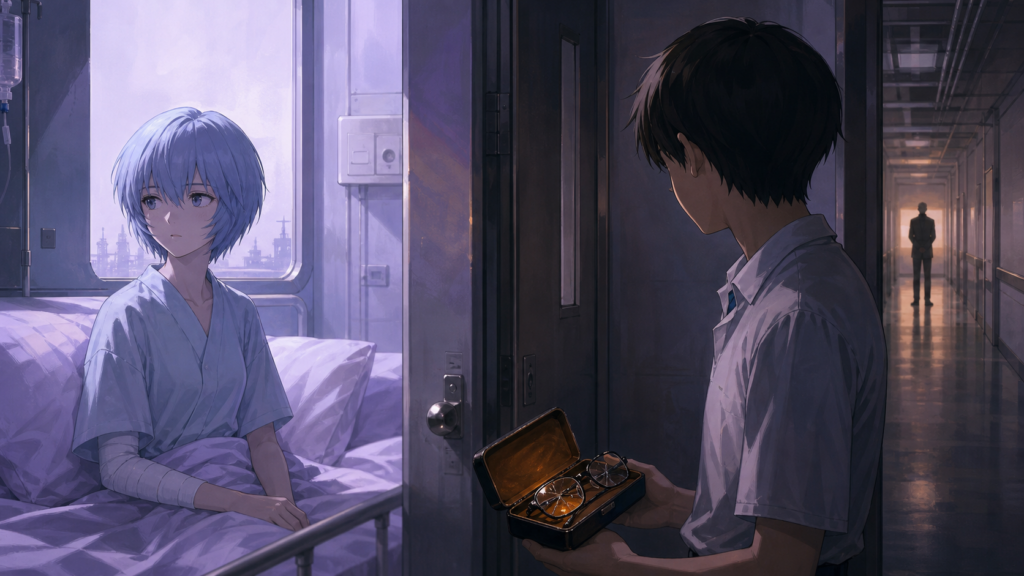
Shinji studies Gendo’s glasses because the object seems to contain proof that his father can love. Rei keeps the damaged pair, and Gendo wears gloves over the scars. Three people carry the same incident in different ways. Rei holds the memory of being saved. Gendo hides the physical cost. Shinji inherits jealousy over a moment he never witnessed. Nobody says what the moment means, so the glasses become a container for every need the family refuses to name.
This is where the episode connects its fantasy to a real social structure. Institutions often survive through selective intimacy. A leader may protect one worker, mentor one junior employee, or show warmth to one favored person while remaining abusive to everyone else. Witnesses then question their own experience. If the powerful person can be kind, perhaps the harmed person caused the harm. Shinji is vulnerable to that logic. Gendo’s smile toward Rei makes Shinji wonder what is wrong with him, not what is wrong with a father who withholds basic affection from his son.
Ritsuko knows enough to explain the accident but does not challenge the emotional arrangement. Misato cares about Shinji but works inside the same command structure. Rei trusts Gendo because he saved her. Every adult has a fragment of the truth, and no adult assembles those fragments into protection for the pilots. NERV’s secrecy is not only about Angels and classified experiments. Secrecy also prevents people from comparing notes about how they are being used.
The Apartment Scene
Embarrassment does not cancel a boundary
Shinji arrives to deliver Rei’s new security card. The errand gives him a reasonable reason to knock, but not permission to explore. Once inside, he notices the glasses and picks them up. Rei walks in from the shower. Their collision sends him to the floor above her, one hand placed where no accidental comedy can make the contact harmless. The scene uses the familiar anime setup of accidental nudity, yet the emotional temperature stays cold. There is no playful reset and no romantic misunderstanding that flatters the boy.
Rei’s lack of theatrical outrage can be misread as consent or indifference. The better reading is that her reaction belongs to her, not to a genre checklist. She retrieves the glasses because Gendo’s object matters more to her than Shinji’s panic. Later, when he criticizes Gendo, she slaps him. The slap is not proof that she secretly loves the commander in a cute way. The slap shows where Rei has placed loyalty, identity, and safety. Shinji touched the one relationship she understands and called the relationship false.
The trope gets one thing right: teenagers can cross boundaries through confusion rather than calculation. Shinji is not stalking Rei or planning to humiliate her. The trope gets plenty wrong across anime when accident becomes a free pass, the girl’s body becomes a sight gag, and the boy’s embarrassment replaces her dignity as the main concern. Episode 5 is stronger when read as an awkward violation inside a larger system that gives both children poor models for privacy, consent, and honest conversation.
A more believable system would not leave pilots isolated between missions and then act surprised when they fail to communicate. Rei would have independent medical advocacy, a safe guardian, and a home inspected for basic care. Shinji would have a supervisor who is not also his father’s subordinate. Boundaries would be taught before a crisis instead of punished after harm. NERV does none of that because emotionally dependent pilots are easier to direct than healthy children with outside support.
Angel Five
Ramiel arrives like a problem that cannot be punched
The final attack changes the rhythm immediately. Ramiel appears as a geometric shape without a readable face, limbs, or human posture. The Angel fires before Shinji can understand the threat. Unit-01 takes the blast, and the cockpit becomes a trap of heat, alarms, and pain. After an episode built around Shinji trying to read Rei and Gendo, the enemy offers nothing recognizable to read. Ramiel is distance made lethal.
That design is an innovation hiding in plain sight. A conventional monster invites viewers to imagine muscles, rage, hunger, or animal instinct. Ramiel presents clean geometry and overwhelming force. The Angel does not need facial expression because the attack itself is communication. The series turns abstraction into terror, then forces NERV to respond with planning rather than another burst of pilot courage. Episode 5 closes before the solution, making the cliffhanger feel earned instead of decorative.
Shinji’s position is cruelly consistent. He spends the episode searching for proof that Gendo values him, then receives another order that places his body between the city and an enemy nobody properly explained. The institution measures his usefulness in synchronization and survival. His emotional questions remain uncounted. Ramiel’s beam makes the hidden arrangement visible: adults decide, children absorb the impact, and everyone calls the result duty.
RaeRae’s Verdict
A quiet episode that exposes who receives care
Episode 5 works because Rei does not become simple when Shinji gets closer. Her apartment, bandages, glasses, and loyalty create context without reducing her to a diagnosis. Gendo’s rescue complicates him without forgiving him. Shinji’s curiosity makes sense without granting him ownership over Rei’s story. The episode keeps every relationship uncomfortable because comfort would be dishonest this early.
The weakest material is the accidental-contact setup, which carries the baggage of a genre habit that often treats girls as props for a boy’s embarrassment. Evangelion gives the scene colder consequences than most shows, but viewers still have to resist the camera’s invitation to turn invasion into novelty. Rei deserves to be read as a person whose muted reaction does not make the situation harmless.
The strongest material is the connection between personal neglect and institutional power. NERV does not need to twirl a mustache while exploiting the pilots. The organization only needs to keep treating care as optional and obedience as essential. Rei’s devotion, Shinji’s jealousy, and Gendo’s authority grow inside that imbalance. Ramiel arrives at the end as the obvious danger, but the episode has spent most of its time showing a quieter danger that already lives inside headquarters.
My bottom line is simple: “Rei I” is not the episode where Shinji discovers the mysterious girl. This is the episode where Shinji discovers that Gendo can reach toward someone, then mistakes access to Rei for access to the answer. Rei refuses to become that answer. Her silence leaves the question where the question belongs, with a father who knows how to open a burning entry plug but still will not open a conversation with his son.
RaeRae rating: 4.5 out of 5. The episode turns a pair of broken glasses into a map of rescue, loyalty, jealousy, and control, then lets Ramiel burn through every illusion that the children are safe.
What Changes After This Episode
Shinji now knows the triangle exists
Before Episode 5, Shinji could tell himself that Gendo simply lacked warmth. Seeing Gendo laugh with Rei destroys that excuse. His father has warmth, chooses when to show warmth, and has chosen not to show the same warmth to his son. That discovery will shape how Shinji reads Rei from this point forward. Attraction, concern, competition, and the need for parental approval become tangled before he has the language to separate them.
Rei also learns something about Shinji. He is willing to question Gendo, even when the question is clumsy and loaded with resentment. Her slap shuts the conversation down, but the disagreement matters because Shinji does not accept the commander as a sacred figure. Rei has been living inside Gendo’s version of events. Shinji brings another version into her apartment, and no amount of silence can make that version disappear.
The episode could become even stronger by giving Rei one private action unrelated to Gendo or NERV. A small preference, unfinished book, favorite food, or rejected order would remind viewers that secrecy and emptiness are not the same thing. Later material adds layers, but Episode 5 deliberately keeps her world narrow. That choice creates tension while also showing how easily a neglected child can be turned into a symbol by everyone around her.