
Evangelion Episode 23: Rei III
Evangelion Episode Reaction
Rei dies choosing someone else, returns as proof that Gendo planned for her death, and loses the one thing a replacement body cannot restore.
Bottom Line
Rei becomes human by refusing the job she was made to perform
Episode 23 delivers one of Evangelion’s cruelest answers to a question the series has carried since Rei first appeared in bandages. Gendo can replace her body. NERV can move another copy from a tank into a hospital bed, repeat the same name, and expect everyone to accept administrative continuity. The replacement does not make the death smaller. The replacement proves that the adults prepared for Rei to die before they ever asked what she wanted from being alive.
RaeRae’s bottom line begins with Rei’s choice. Armisael invades Unit-00 and turns loneliness into a physical shape. Rei recognizes feelings she has spent the series treating as foreign data, then destroys herself to keep the Angel from reaching Shinji. That sacrifice is not proof that self-erasure was her natural purpose. Her decision matters because Rei finally acts outside Gendo’s script, protects a relationship he did not authorize, and dies as a person rather than surviving as equipment.
The episode then brings Rei back and dares viewers to call the restoration comforting. Rei III remembers facts, commands, rooms, and names, but Shinji’s tears confuse her. The emotional continuity built through Rei II is gone. A body can be reproduced inside NERV’s laboratory. A relationship cannot be copied from a file. Evangelion refuses the cheap science-fiction trick where identical appearance cancels grief.
The Recap
Armisael turns connection into contamination
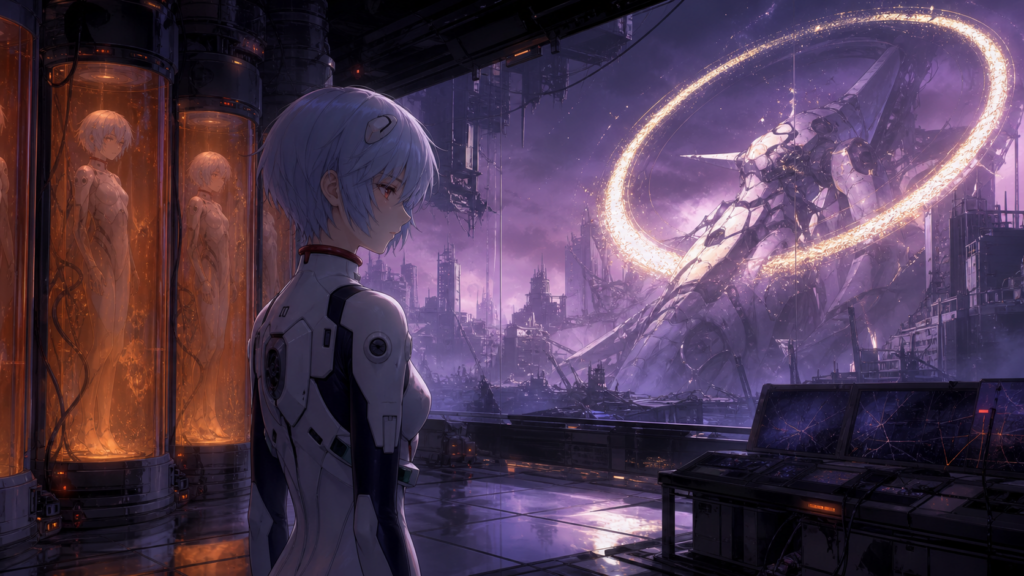
The sixteenth Angel appears as a shining ring and attacks Rei in Unit-00. Armisael pierces the Eva and begins merging with pilot and machine. Inside the contact, Rei encounters a second version of herself that speaks with the loneliness she has never named. The Angel does not merely read thoughts. Armisael gives her isolation a voice and asks whether the ache she feels for Shinji belongs to love, dependence, or fear of disappearing unnoticed.
As the infection spreads, shapes resembling earlier Angels push out from Unit-00’s body. The image turns accumulated battles into a biological archive. Rei carries every experiment, command, and invasion that NERV has normalized. Shinji launches to help, which forces Rei to confront the possibility that Armisael could move through her and consume him. She reverses Unit-00’s containment field, traps the Angel inside, and initiates self-destruction.
The explosion erases Tokyo-3’s remaining surface and leaves another crater where a city once tried to pretend daily life was possible. Misato mourns Rei while Gendo reports a story designed for SEELE. Soon afterward, Shinji finds Rei alive in a hospital room. She identifies herself as the third, wipes away tears she does not understand, and reveals through confusion that the girl Shinji knew did not return with the body.
Ritsuko finally takes Misato and Shinji into the hidden chamber containing the Rei clones. She explains that the bodies are empty vessels tied to the Dummy Plug system, then destroys them while laughing, crying, and directing her rage at Gendo, Rei, her mother, and herself. The orange liquid fills with collapsing copies. A secret technology becomes a graveyard in front of the two people NERV worked hardest to keep ignorant.
Rei Ayanami
The numbered name cannot hide a broken life
Rei’s arc is often reduced to learning emotion, but Episode 23 shows something sharper. Rei has always felt. The problem is that nobody gave her language, safety, or permission to treat feeling as evidence of personhood. Gendo values obedience. Ritsuko studies her as a technical problem. Classmates keep their distance. Shinji’s ordinary concern becomes extraordinary because Rei’s environment made ordinary care almost impossible.
Armisael’s internal dialogue resembles therapy performed by an enemy. The Angel identifies loneliness, the desire for touch, and the pain connected to Shinji. Yet the invasion offers no consent and no care. Rei receives language through violation. The scene mirrors Asuka’s attack in Episode 22, but each girl responds according to the survival system she built. Asuka fights exposure because pride protects her. Rei accepts recognition because self-denial has protected everyone except Rei.
Her sacrifice also complicates the franchise’s repeated praise of selflessness. Rei saves Shinji, but viewers should not treat death as the proof that she finally loved correctly. NERV created a girl who believed her life was replaceable, then placed her in a machine where replacement became official policy. The beautiful choice and the abusive structure exist together. Rei’s agency deserves respect without turning the institution that narrowed her options into a noble cause.
Rei III exposes the final theft. The new body inherits a room, a school uniform, and a role beside Gendo. She does not inherit Rei II’s relationship with Shinji. When tears appear, the body seems to remember grief that the conscious mind cannot explain. Evangelion leaves the boundary unsettled, but the emotional result is clear. Shinji stands beside someone who looks identical to the person he lost and cannot ask her to perform that lost intimacy for his comfort.
Armisael
The Angel makes loneliness visible and calls the wound a bridge
Armisael appears graceful, almost delicate, until the ring becomes a spear. The design matters because connection arrives as penetration. The Angel wants contact, yet contact destroys the boundaries that make relationships possible. Rei’s body begins changing under the pressure, and the Eva becomes a surface where previous Angels reappear as tumors. Every earlier threat returns inside the pilot who spoke the least about what those battles cost.
The Angel’s questions sound compassionate because Armisael notices emotions NERV ignores. Recognition alone does not equal care. Armisael uses truth to gain access, just as institutions use evaluations, files, and private disclosures to decide whether a person remains useful. Rei is seen completely but not respected as separate. The attack offers merger as relief from loneliness, which previews Human Instrumentality’s larger promise.
Evangelion keeps returning to the difference between intimacy and collapse. Real connection requires distance, refusal, misunderstanding, and the chance to leave. Armisael removes those conditions. Rei responds by making the most final boundary possible. She destroys the body being invaded rather than allowing the Angel to pass through her into Shinji. The act says that love cannot mean unrestricted access to another person.
Ritsuko Akagi
Ritsuko destroys the evidence after helping build the crime
Ritsuko’s tour of the clone chamber is confession, revenge, and emotional collapse at the same time. She has protected NERV’s secrets because professional authority gave shape to a life organized around Gendo’s approval. Her mother made a similar bargain. Both women treated technical access as intimacy and discovered that Gendo could use their brilliance without loving either of them.
The Rei bodies embody that humiliation. Ritsuko sees Yui’s face, Gendo’s obsession, Naoko’s murder, and her own disposability inside every floating copy. Destroying the clones looks like rebellion, but the act targets bodies with no power rather than the man who designed the system. Rage travels downward because confronting Gendo directly would force Ritsuko to admit how much of her identity still depends on him.
Her explanation to Shinji and Misato also arrives too late to count as protection. Shinji learns that the Dummy Plug technology used to mutilate Toji’s Eva depends on manufactured Rei bodies. Misato learns that another layer of command operated beneath her authority. Ritsuko tells the truth only after secrecy stops rewarding her. The delay does not erase the value of disclosure, but the delay belongs in any honest judgment of her choices.
The clone destruction is one of the series’ ugliest images because the bodies smile as they break apart. NERV engineered innocence into inventory. The scene denies viewers an easy answer about whether the vessels count as living people, then shows the ethical failure of building a system where the question can be treated as a technical footnote.
The System
Replacement culture protects the institution from grief
NERV survives by replacing people faster than anyone can mourn them. Pilots are assigned numbers. Rei receives iterations. Tokyo-3 retracts buildings and rebuilds streets after attacks. Command issues cover stories. The organization treats continuity of operation as proof that damage was contained. Episode 23 tears apart that fantasy. Repetition can keep a program running while every human relationship inside the program collapses.
Modern workplaces use softer language for the same habit. A worker burns out, leaves, or dies, and the position reopens before colleagues understand the loss. Schools replace exhausted teachers. militaries rotate wounded personnel. Entertainment companies train another young performer to occupy a familiar role. Replacement may be necessary for an institution to function, but necessity becomes cruelty when leaders use replacement to deny responsibility for the conditions that destroyed the previous person.
Rei III also challenges the idea that identity belongs to appearance, job title, or stored information. A database can preserve dates and competencies. A clone can reproduce a face. Neither method recreates the private history formed when two people chose how to respond to each other. Shinji’s grief is therefore rational even while Rei stands in front of him. He is not rejecting the new Rei. He is recognizing that the previous relationship ended.
The better system would treat continuity and grief as separate responsibilities. NERV would tell the truth about Rei II’s death, protect Rei III from inherited expectations, and allow Shinji to build a new relationship without pretending nothing changed. Such honesty would disrupt Gendo’s plan because Gendo needs every person to remain a role. The episode shows why humane systems must tolerate disruption when a role contains a human life.
The episode also asks whether memory alone defines a person. Rei III knows enough to resume the assignment, yet knowledge without lived attachment leaves every familiar gesture altered. The distinction matters beyond science fiction. Families confronting dementia, trauma, or brain injury often learn that identity cannot be reduced to a perfect archive of facts. A person remains worthy of care when memory changes, while loved ones remain entitled to grieve the relationship that no longer works in the same way. Evangelion holds both truths without demanding a clean answer.
Shinji’s response is unusually restrained, which makes the hospital scene hurt more. He does not accuse Rei III of fraud or demand that she reproduce Rei II. His tears acknowledge absence before he has language for the clone system. The reaction is one of his more mature moments because grief does not become ownership. He recognizes the face, senses the difference, and allows confusion to remain. NERV has trained every pilot to obey fast, but humane recognition sometimes begins by refusing a quick conclusion.
Verdict
Episode 23 makes resurrection feel more frightening than death
“Rei III” works because every revelation changes an emotional fact, not only a lore fact. The clone tank explains Rei’s returns, the Dummy Plug, and Gendo’s confidence. More importantly, the chamber explains why Rei was denied an ordinary childhood and why her growing attachment to Shinji threatened the system. A replaceable tool is easiest to manage when the tool believes relationships do not matter.
The episode’s strongest choice is refusing to let Rei’s sacrifice settle into inspirational tragedy. Rei II makes a brave decision. The next scene reveals machinery built to absorb that death. Celebration turns into nausea. Ritsuko’s breakdown then proves that the adults maintaining the machinery are also being consumed by the same hierarchy, even though their suffering does not excuse their participation.
My criticism concerns the compression surrounding Rei III. The episode delivers enormous consequences quickly, and the new Rei receives little space to define herself outside everyone else’s shock. That absence may be intentional, but later material must carry the burden. A replacement character should not exist only to prove that the original mattered.
Episode 23 earns an essential verdict because the story finally connects cloning, the Dummy Plug, Ritsuko’s resentment, Rei’s loneliness, and Gendo’s private plan through one emotional idea. A system that can replace a body still cannot replace a person. NERV learns nothing from that truth. Shinji, Misato, Ritsuko, and the audience have no choice but to look.