
RAERAE REACTS · EPISODE 17
Evangelion Episode 17: Fourth Children
NERV does not ask Toji Suzuhara to become a pilot. The adults build a situation where saying no would feel like abandoning his injured sister, then call the result a choice.
BOTTOM LINE
The Fourth Child was selected before anybody told him the price
Episode 17 looks quiet because nobody is screaming inside an Eva yet. That calm is the trick. While Shinji worries about missing classmates and Misato avoids a conversation she owes him, NERV quietly turns Toji into its next piece of equipment. The adults never drag him into a cage. They use hospital care, secrecy, and a child’s sense of duty until the cage starts looking like the only decent answer. Toji accepts because his little sister needs help. NERV gets a pilot and keeps its hands clean on paper.
That makes “Fourth Children” one of the ugliest episodes in the series, even before Unit-03 arrives. The story exposes how institutions recruit children without needing cartoon villains in every room. A system can exploit a family through benefits, timing, and selective information. The contract may contain a signature. Consent can still be rotten. Evangelion understands that coercion works best when the person being used believes sacrifice proves love.
THE CLASSROOM
Shinji’s school is starting to look like a recruitment pool
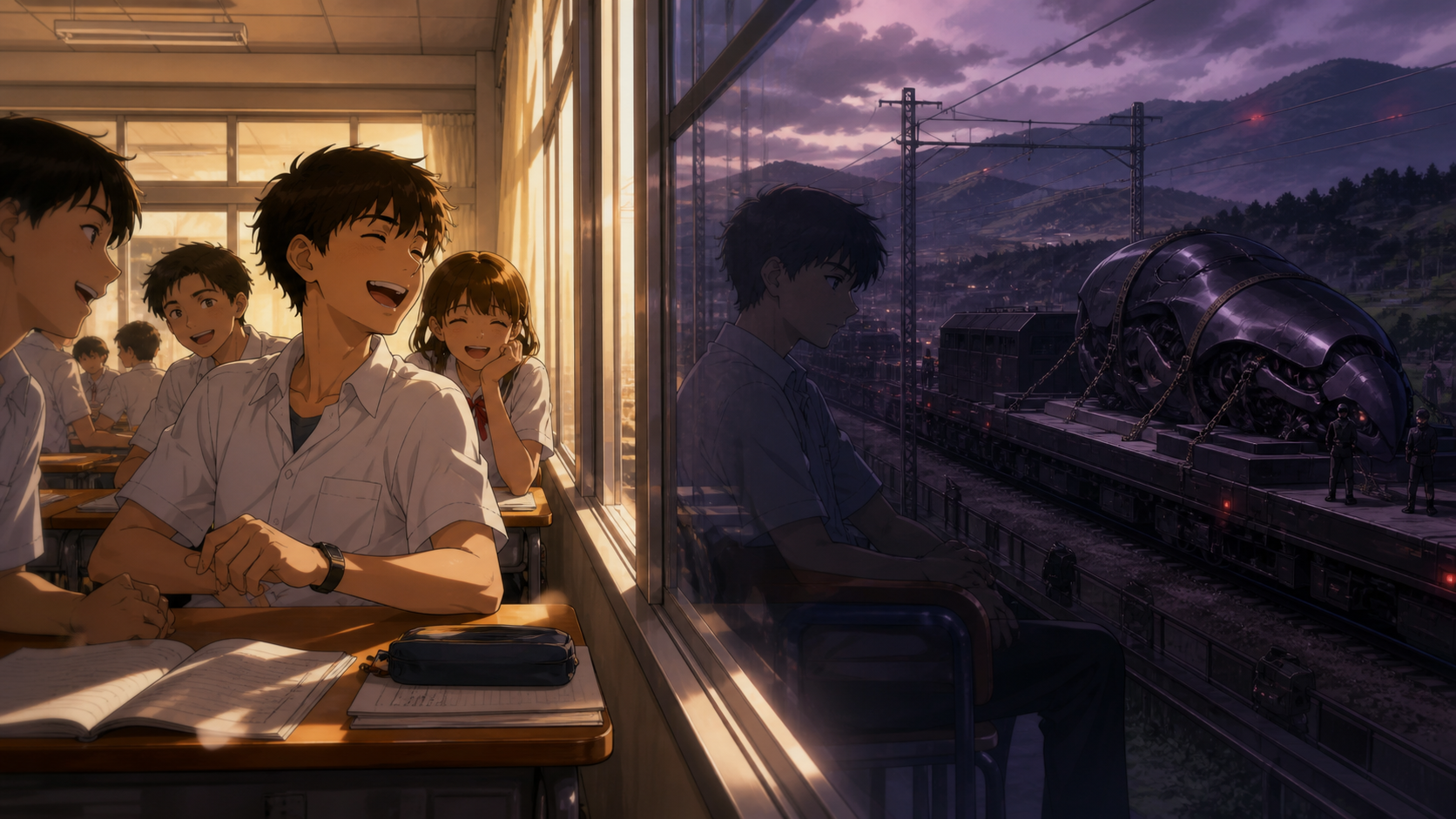
Shinji notices classmates disappearing from school, and the pattern should bother him more than any Angel alert. Tokyo-3 was already a strange place to raise children. Episode 17 makes the arrangement feel deliberate. The pilots are not random teenagers pulled from across Japan. NERV has placed possible candidates close enough to monitor, test, and collect. Their classroom looks ordinary because ordinary routines keep the children from asking who designed the roster.
Kensuke still dreams about piloting an Eva. He sees the uniform, the access, and the chance to become important. His fantasy is not foolish so much as painfully incomplete. NERV lets the public see machines that defend humanity, but the organization hides the blood, panic, invasive testing, and emotional damage from the children who might volunteer. Kensuke wants the visible status because the hidden cost has been carefully removed from view. A teenager cannot weigh risks that adults refuse to name.
Shinji knows the cost, yet even Shinji cannot explain the whole danger to his friends. Trauma has taught him silence almost as effectively as NERV’s rules. He does not arrive at school and tell Kensuke about drowning in LCL, feeling an Angel inside his mind, or waking after Unit-01 acts without permission. The gap between what Shinji has survived and what his classmates imagine protects NERV. Secrecy is not merely a policy at headquarters. Secrecy follows the pilots back into class and keeps the next child recruitable.
THE OFFER
Medical care becomes leverage when a family has no equal bargaining power
Toji’s younger sister was injured during Shinji’s first battle. Her recovery has hovered over Toji from the beginning, shaping his anger and then his loyalty. NERV knows exactly where that wound sits. When Toji is selected, improved medical treatment for his sister becomes part of the arrangement. The benefit sounds generous until the power imbalance comes into focus. A child should not have to trade his body for a sibling’s care. An institution responsible for the original harm should not present basic support as payment for new danger.
Toji accepts with the rough practicality that defines him. He does not suddenly crave glory. He calculates what his family needs and recognizes that he possesses something NERV wants. That calculation gives him agency, but agency does not erase coercion. People make real choices inside unfair structures every day. A worker may accept dangerous labor because rent is due. A patient may sign a terrible loan because treatment cannot wait. Toji’s decision belongs to him, yet NERV built the pressure surrounding that decision.
The episode refuses to stage a dramatic recruitment speech because bureaucratic exploitation rarely announces itself with thunder. Toji is informed, assessed, and folded into a system already moving toward activation. The calm pace makes the process worse. Nobody pauses to ask whether a fourteen-year-old can understand neural synchronization, physical feedback, psychological invasion, or the possibility that an Eva may move on its own. NERV treats compatibility as qualification. A body that can connect to a weapon is not the same as a child prepared to carry the consequences.
THE LUNCH
Hikari offers care without turning Toji into a debt
Hikari’s feelings for Toji bring warmth into an episode built around hidden transactions. She plans food for him because she likes him and wants to show that care in a form she understands. Her lunch does not demand access to his body, obedience, or gratitude. That simple difference matters. NERV also claims to care for children, but NERV’s care arrives with conditions. Hikari gives because Toji matters to her. NERV gives because Toji can be used.
The tragedy sits in how little Hikari knows. She sees Toji’s ordinary stubbornness and imagines an ordinary chance to get closer. Toji is already carrying a decision that could remove him from school, injure him, or kill him. Their possible teenage relationship exists beside a military system that treats adolescence as spare capacity. Evangelion keeps returning to this cruelty. The children are still trying to have crushes, share lunches, and survive embarrassment while adults schedule experiments around them.
Toji’s softer behavior around Hikari also proves that he is more than the loud classmate who punched Shinji. He has a sister he protects, friends he watches, and feelings he cannot express cleanly. Making him the Fourth Child threatens a whole network of relationships, not one replaceable pilot slot. NERV’s charts can record synchronization rates. No chart in headquarters measures the lunch Hikari prepared or the classroom seat that may stay empty.
THE ADULTS
Misato’s silence protects NERV before that silence protects Shinji
Misato knows Toji has been selected, and she knows Shinji deserves to hear the truth. She delays. Her hesitation is understandable because Shinji is fragile, Toji is his friend, and the coming activation test carries risk. Understanding her fear does not excuse the choice. By withholding the information, Misato repeats the same pattern she condemns in Gendo. She decides that managing Shinji’s reaction matters more than respecting his right to know.
Adults often call secrecy protection when the truth would create conflict they do not want to handle. Shinji may object, panic, or question the pilot program. Those reactions would be reasonable. Misato avoids them until circumstances can make the decision irreversible. Her silence preserves operational calm, which benefits NERV. Shinji’s emotional safety becomes the explanation, but institutional convenience becomes the result.
Gendo barely needs to appear as an active monster because the organization now reproduces his values without constant instruction. Staff members process candidates, arrange transfers, and prepare tests. Everybody performs a limited job. That division of labor lets each adult believe somebody else owns the moral decision. The hospital handles care. the school maintains attendance. NERV selects compatibility. Misato manages pilots. No single desk contains the full violence, so the machine keeps moving.
Ritsuko’s technical confidence adds another layer. Unit-03 is treated as equipment arriving from the United States, with contamination risk and activation procedures to manage. The possible Angel infection matters, but Toji’s fear receives less attention than the Eva’s operational status. NERV has learned to worry about machines in detailed language and children in vague language. That imbalance is a warning long before the activation test fails.
UNIT-03
A new Eva arrives carrying every problem the adults refuse to name
Unit-03 moves toward Matsushiro under a cloud of technical concern. The transport expands Evangelion’s world beyond Tokyo-3 and reminds us that the Eva program is international. Nations exchange weapons, facilities, and risk while teenagers remain the irreplaceable interface. The hardware can cross an ocean. The emotional burden still lands on a child selected from Shinji’s classroom.
The ominous presentation tells viewers that the machine is not arriving cleanly. Evangelion does not need to reveal the disaster yet. The audience already knows enough to dread the test. Toji does not. That difference creates the episode’s central horror. We watch a boy agree to a bargain while possessing less information than everybody around him, including the viewer. Dramatic irony becomes an ethical accusation.
Episode 17 also understands how disasters gain momentum. The dangerous choice is not one button pressed by one villain. The chain begins with selection, secrecy, transport, scheduling, and confidence that procedures will contain whatever happens. Each step looks manageable alone. Together they carry Toji toward Unit-03. By the time alarms sound, adults will describe the crisis as sudden even though the system spent an entire episode constructing the conditions.
WHAT THE EPISODE GETS RIGHT
Children can consent to a task and still be exploited by the offer
Stories about chosen teenagers often treat willingness as a moral permission slip. If the child volunteers, the adults are absolved. Evangelion refuses that shortcut. Toji’s answer matters, but the offer itself remains corrupt. He is young, his sister needs care, and the organization controls information about the danger. A fair choice requires alternatives. NERV offers one path with resources attached and leaves the other path shaped by helplessness.
The episode also gets friendship right by showing how incomplete friendship can be. Shinji and Toji care about each other, but neither knows how to speak across shame. Toji does not tell Shinji he has been selected. Shinji does not tell Toji the full cost of piloting. Their silence is not proof that the friendship is fake. Their silence shows two boys trained to carry problems privately because the adults around them model secrecy as competence.
Hikari’s presence prevents the episode from reducing Toji to future tragedy. She sees a boy worth feeding before the plot turns him into a pilot. That attention matters. A weaker story would introduce tenderness only to make the coming violence sadder. Evangelion uses tenderness to show what the institution fails to count. Toji has a life with small possibilities, and every small possibility deserves weight.
WHAT COULD BE BETTER
The episode withholds so much that Toji’s own voice nearly disappears
The restraint creates dread, but Toji deserves more room to explain what he understands about the bargain. We see the result of his decision more clearly than the conversation that shaped the decision. A few additional minutes with his sister, the hospital staff, or the recruiter could have sharpened the mechanics of coercion. The episode knows why he agrees. The audience should hear more of that reasoning in his words.
Hikari also functions mainly as emotional contrast. Her crush and lunch are meaningful, yet she remains outside the information system entirely. Giving her one moment of suspicion could deepen the school’s role. She manages the class, notices absences, and pays attention to Toji. A person that observant might recognize that something has changed even if she cannot name NERV’s plan.
Those limitations do not weaken the main argument. They reveal how strongly the episode centers institutional secrecy. Everybody knows only a fraction, including the viewer. The cost is that Toji becomes quiet at the exact moment when his interior life matters most. Episode 18 will make his body central. Episode 17 could have made his reasoning central before the machine takes over.
RAERAE’S VERDICT
NERV recruits a child by turning love for his sister into usable pressure
“Fourth Children” is the setup episode that proves setup can carry its own violence. No Angel attacks the city. No Eva tears open another body. Adults make phone calls, move equipment, arrange medical support, and postpone honest conversations. Those ordinary actions build the trap. By the closing stretch, Toji is walking toward Unit-03 while Shinji still does not know his friend has been selected.
The episode lands because NERV does not need to threaten Toji. The organization only needs to control the resources his family needs and the facts he receives. That is how power often behaves outside fantasy. Institutions rarely describe exploitation as exploitation. They call the offer an opportunity, the danger a duty, and the child mature for accepting.
Next episode will deliver the visible catastrophe. Episode 17 delivers the paperwork behind that catastrophe. The paperwork is not neutral. Every hidden fact, delayed conversation, and conditional benefit helps place Toji inside the entry plug. NERV will blame an Angel for what happens to Unit-03. The adults still own the road that put a boy there.