
RaeRae Reacts · Animated Series · Episode 16
Evangelion Episode 16: Splitting of the Breast
Shinji finally believes he belongs in Unit-01. Leliel answers by swallowing him whole and forcing the boy to meet every voice he has been avoiding.
Bottom Line
Shinji wins one scrap of confidence and the series immediately asks who owns that confidence
Episode 16 begins with Shinji feeling useful. His synchronization score is strong, Misato praises him, and the boy who entered Tokyo-3 apologizing for taking up space starts to believe he has earned a place. Evangelion does not punish confidence because confidence is wrong. The episode tests whether Shinji built that confidence from an inner sense of self or from another round of adult approval.
Leliel appears as a floating black-and-white sphere, yet the visible sphere is only a shadow. The actual Angel is the dark shape spread across the street. That reversal establishes the chapter’s argument before Shinji disappears. What looks solid may be projection. What looks empty may contain an entire interior world. NERV’s instruments can describe the geometry, but the machines cannot tell Shinji who he is when nobody outside can answer.
RaeRae’s bottom line: this is the episode where Evangelion stops using psychology as subtext and makes the internal argument part of the battlefield. Leliel traps Shinji inside a space with no ordinary exit. The Angel does not need to defeat Unit-01 through force. Isolation lets Shinji’s own need for approval do the work.
The Battle
Being praised makes Shinji reckless because praise still feels temporary
Shinji moves first against Leliel and ignores Asuka’s warning. His choice looks like arrogance, but the speed of the mistake matters. A child who has never trusted his worth may cling to fresh praise as if one perfect performance can make belonging permanent. Shinji does not simply want to defeat the Angel. He wants to prove Misato’s confidence was correct before the confidence can disappear.
Asuka recognizes the danger because his improved standing threatens her own. She mocks him, then watches the ground consume Unit-01. Her rivalry is cruel and perceptive at the same time. Shinji has started chasing the same external ranking system that controls her. The pair react differently to insecurity, yet both treat performance as the safest way to ask whether adults still want them.
Leliel’s attack destroys the visual logic of combat. The Eva sinks into a flat shadow while bullets and missiles pass through the floating sphere. NERV can mobilize weapons, barriers, aircraft, and enormous amounts of electricity. None of that power matters until Ritsuko understands that the organization has aimed at the projection instead of the body.
The mistake mirrors NERV’s approach to the pilots. Command measures synchronization, obedience, and battle results because those numbers are visible. Fear, loneliness, resentment, and attachment remain harder to chart. The adults keep attacking the measurable surface while the real crisis spreads underneath.
The Dirac Sea
A scientific label cannot make the unknown feel controlled
Ritsuko calls Leliel’s interior a Dirac Sea, an imaginary-number space connected to ordinary reality through the Angel’s shadow. The language gives NERV a working model, but the model also protects the adults from admitting how little they know. Naming a phenomenon is useful. Naming can also create the appearance of mastery long before mastery exists.
Inside the Angel, Unit-01 has limited power and no normal route home. The entry plug becomes a shrinking room where life support, time, and hope all run down together. Shinji has spent the series treating the cockpit as the place where he earns connection. Leliel turns that same cockpit into solitary confinement.
The contrast is brutal. NERV built Unit-01 as a weapon, Shinji experiences the Eva as duty, and something inside the machine experiences him as a child worth protecting. Three meanings occupy the same body. The institution controls the launch. Shinji carries the pain. The buried presence decides what happens when control fails.
Inside Shinji
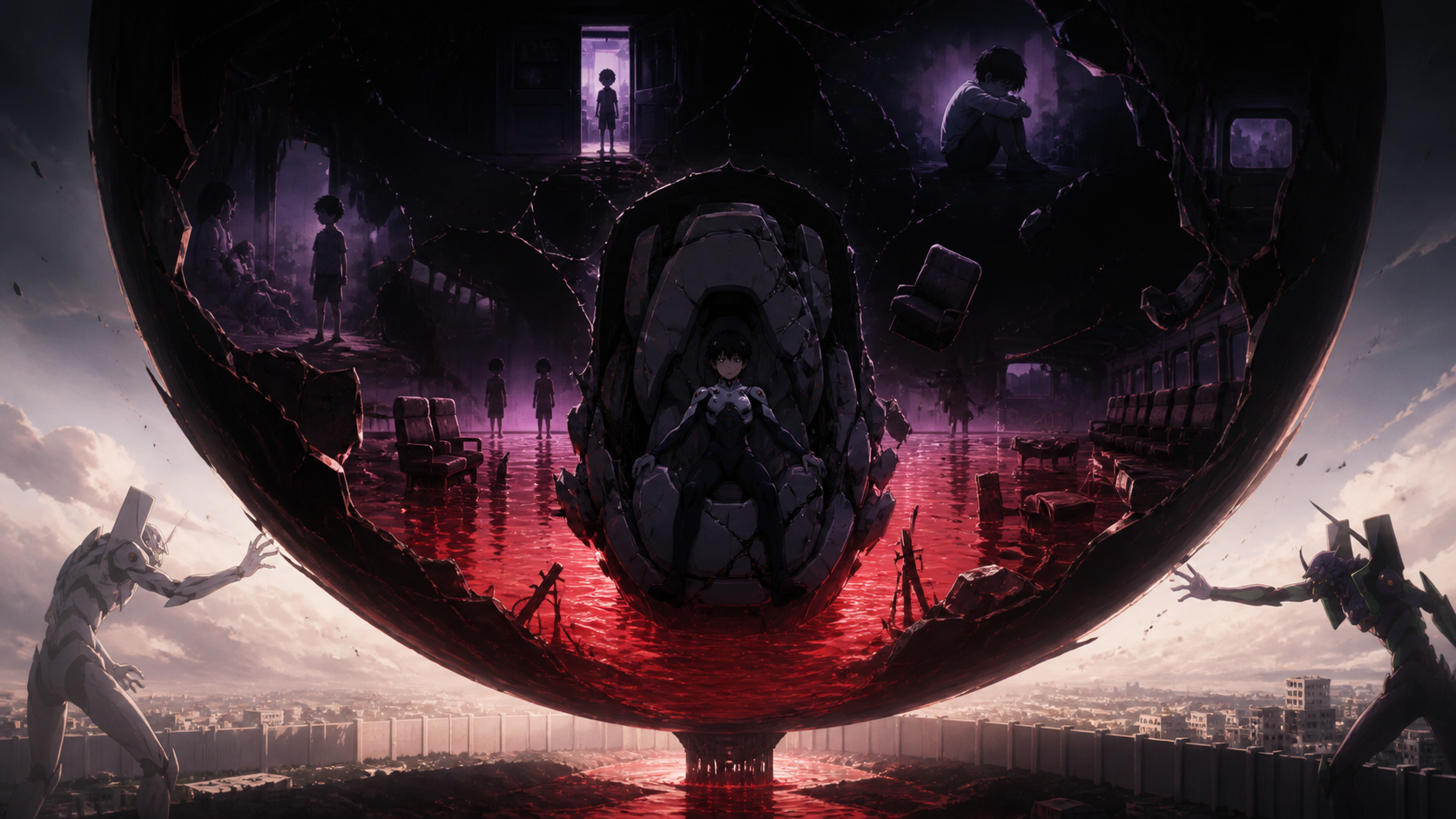
The striped train becomes a courtroom where every witness has his face
Shinji’s internal sequence uses a train car, empty seats, shifting versions of himself, and voices that refuse to stay outside. The setting resembles ordinary transit, but no destination appears. A train usually promises movement along an established route. Shinji’s train circles questions about identity because every route offered by the adults leads back to their needs.
One Shinji asks who he is. Another asks why he pilots. The easy answer is that everyone praises him when he succeeds. The harder answer is that he fears the rejection waiting beyond failure. He wants connection, but he expects connection to be conditional. That expectation makes obedience feel safer than desire.
The sequence does not reveal a hidden, complete Shinji waiting beneath the surface. Evangelion treats identity as something formed through relationships, memory, and repeated choices. Shinji cannot define himself without other people because nobody can. The danger begins when other people become the only source allowed to define him.
Gendo’s rejection remains the deepest wound. Shinji wants his father to look at him and confirm that abandonment was a mistake. Misato’s praise reaches the same wound from another direction. Her approval feels warm, but warmth tied to piloting can still teach the boy that usefulness buys love. The problem is not that Misato cares. The problem is that NERV turns care into part of the command system.
The internal voices accuse Shinji of running away even while he remains trapped inside a weapon. That contradiction exposes the cruelty of the rule. Adults tell him not to run, yet they define every exit as cowardice. If Shinji refuses, humanity may die. If he obeys, the Eva consumes more of his body and identity. A command with no safe refusal is not a meaningful choice.
The Red Sphere
Shinji meets an image of the self before he meets the mother beneath the machine
A red sphere appears during the interior dialogue, visually reducing Shinji to a boundary floating in darkness. The chapter asks where the self begins and ends. Bodies create separation. Separation creates loneliness. Separation also creates the possibility of consent, recognition, and love between distinct people.
Evangelion will return to that argument through Instrumentality, but Episode 16 gives the question a personal scale. Shinji does not need a cosmic answer yet. He needs permission to exist without earning every breath through service. Leliel’s space removes the audience and leaves him with the terrifying possibility that he has no script beyond being needed.
A maternal voice appears when Shinji is closest to death. The voice does not deliver a lecture. The presence calls him back through recognition. That difference matters. NERV motivates him with responsibility, disaster, and praise. The mother inside Unit-01 reaches him as a person before reaching him as a pilot.
The Rescue Plan
Ritsuko is willing to destroy the Eva because the project matters more than the child
Outside Leliel, NERV prepares to drop hundreds of depth charges into the shadow while the remaining Evas disrupt the Angel’s field. The plan may destroy Unit-01 and kill Shinji. Ritsuko frames the risk through priorities the audience cannot fully see. Misato hears the gap and realizes Ritsuko knows more about the Evas than she has disclosed.
The argument sharpens the difference between command and care. Misato can send pilots into battle, but she still treats Shinji’s survival as the central goal. Ritsuko treats Unit-01 as an irreplaceable part of a larger project. Both women work for NERV. Only one has enough classified knowledge to understand which loss the institution fears most.
Misato’s anger is justified, but the episode refuses to make her innocent. She praised Shinji before the battle and watched his confidence become recklessness. She loves him, commands him, and depends on his compliance. The roles cannot be separated by good intentions. Her horror inside the control room comes partly from recognizing that affection gave the order more power.
A trustworthy system would have an independent advocate for every child pilot, clear thresholds for acceptable risk, and disclosure rules that prevent one department from hiding the nature of a weapon from field command. NERV has none of those protections. The organization relies on personal loyalty until personal loyalty collides with classified purpose.
Unit-01
The machine rejects NERV’s rescue and gives birth to itself
Before the operation can begin, Unit-01 tears out of Leliel. Blood erupts across the city while the Eva howls beneath a red sky. The image looks less like a military victory than a birth scene staged as horror. Unit-01 does not wait for permission, power, or a human plan. The buried life chooses its own rescue.
The moment terrifies everyone because NERV’s authority depends on the belief that Evas can be activated, restrained, and explained. A weapon that moves without external power is not equipment. A mother that protects a child through violence is not a passive component. Ritsuko’s expression confirms that the event belongs to knowledge she has withheld.
Shinji emerges alive, but the rescue does not prove NERV’s system works. The system failed. Unit-01 saved him for reasons the command staff cannot publicly acknowledge. Adults will record the survival as an operational result, yet the truth is intimate and uncontrollable.
The scene also changes the emotional meaning of berserk Unit-01. Earlier violence could be mistaken for emergency automation. Episode 16 connects autonomous action to Shinji’s interior cry and the maternal voice. Protection exists inside the Eva, but protection remains frightening because love has been imprisoned inside a weapon.
What the Episode Gets Right
Isolation is not only being alone. Isolation is losing the right to define the room
Stories often treat inner battles as motivational pauses where a hero remembers friendship and returns stronger. Episode 16 refuses that clean journey. Shinji does not solve his dependence on approval. He survives an encounter with the dependence. The questions remain because survival is not therapy and maternal rescue is not self-knowledge.
The episode gets institutional loneliness right. Shinji is surrounded by adults, classmates, pilots, and technicians. He still lacks a relationship where refusal would not threaten love, employment, public safety, or somebody’s plan. A full room can therefore produce the same isolation as Leliel’s void.
The chapter also gets the fantasy of measurable merit right and wrong. Synchronization scores give pilots feedback and help NERV deploy scarce resources. The score becomes dangerous when a child reads the number as a measurement of human worth. A believable support system would explain what the metric can and cannot mean, then make belonging independent from the result.
Evangelion does not offer that support because the absence is part of the critique. NERV needs pilots who confuse performance with love. The adults may care, but the institution benefits when a child believes one more victory will finally make abandonment impossible.
Culture and Structure
The obedient-child fantasy breaks when obedience becomes the only identity available
Japanese group culture is sometimes flattened into a stereotype about conformity, but Episode 16 targets a broader structure. Families, schools, armies, companies, and governments can all reward young people for meeting collective needs while leaving private needs unnamed. The tension is not uniquely Japanese. The presentation draws from a culture where endurance and role duty carry strong meaning, then connects those values to systems familiar across the world.
Collective responsibility can protect people. Shinji’s work genuinely matters during an Angel attack. The failure arrives when responsibility flows downward while truth and power remain above. Children carry consequences. Adults keep secrets. Leaders praise sacrifice while preserving the right to decide what the sacrifice serves.
A stronger social contract would share information in proportion to risk, give the pilots real representation, and separate emotional care from performance management. Such changes would not remove the Angels or make combat gentle. The changes would make the human system more believable and less predatory.
Verdict
Evangelion’s first full descent into the mind earns every strange minute
Episode 16 is a turning point because spectacle and psychology stop taking turns. Leliel’s body is a conceptual trap, Shinji’s dialogue is the battle, and Unit-01’s escape is character revelation delivered through monster imagery. The episode can be discussed as science fiction, family trauma, workplace secrecy, or spiritual symbolism without any one layer canceling the others.
The strongest choice is the refusal to cure Shinji. He recognizes that praise drives him, but recognition does not create independence. He hears a maternal voice, but the comfort leads back into a body NERV owns. He survives, but the institution that created the danger remains in place.
The weakest point is the scientific vocabulary. The Dirac Sea and imaginary-number language can sound like an explanation while functioning mostly as atmosphere. That limitation does not break the episode because Ritsuko’s uncertainty is part of the tension. NERV has a label, not control.
RaeRae’s verdict: do not reduce Episode 16 to the first mind-trip episode. The chapter exposes the bargain beneath Shinji’s confidence. He can feel valuable as long as he performs, and he can feel protected as long as the mother inside the weapon chooses him. Neither condition gives the boy a life that belongs to him. Leliel swallows the Eva, but NERV built the emptiness first.
Continue the route: Return to Evangelion Episodes 1–26, revisit Episode 15, or watch on Netflix.