
Evangelion Episode 13: Lilliputian Hitcher
Evangelion Episode Reaction
An Angel enters NERV through contamination instead of force, and Ritsuko must argue with the three pieces of her mother still running the organization.
Bottom Line
The smartest Angel attacks the argument NERV calls a computer
Episode 13 strips away the launch cages, rifles, knives, and citywide spectacle that usually define an Angel battle. Ireul begins as contamination inside a testing facility and grows through the systems meant to identify, contain, and destroy threats. NERV cannot punch the enemy because the enemy has entered the organization’s nervous system. Every automated defense becomes another surface the Angel can learn.
Ritsuko takes command because the crisis belongs to her field. The pilots remain present, but Shinji, Asuka, and Rei cannot solve an infection that moves through microscopic structures and software. Their bodies have been reduced to naked test subjects during a simulation, which also removes the uniforms and machines that normally define their value. The episode lets the adult scientist carry the story while reminding fans that NERV has built an entire military institution on technology nobody fully controls.
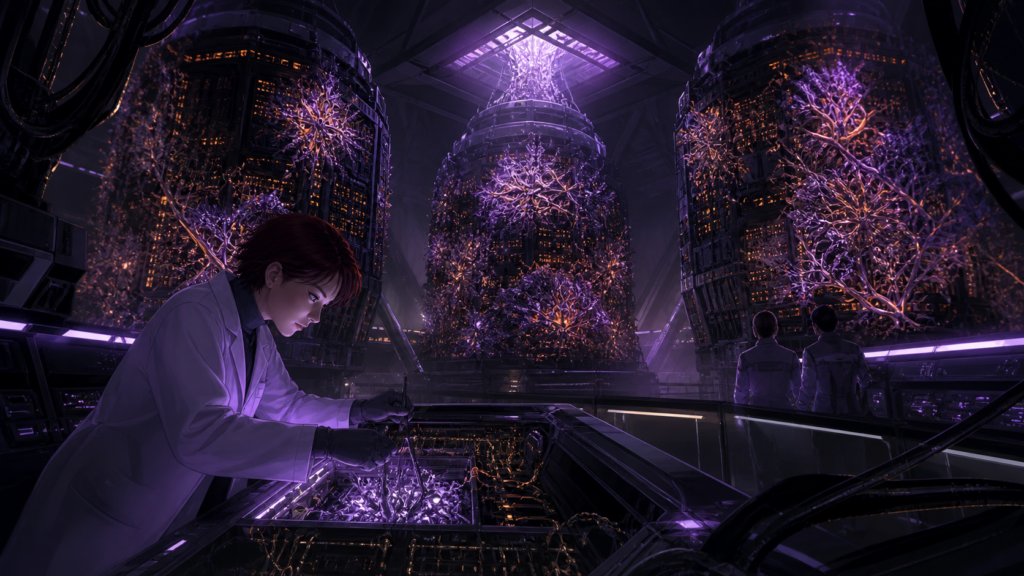
The real reveal concerns the MAGI. NERV presents the three supercomputers as a rational decision system, yet each unit contains a different modeled part of Naoko Akagi: scientist, mother, and woman. The machine does not remove human contradiction from command. The machine preserves one woman’s contradictions and gives them voting rights. Ritsuko has spent her career working inside an architecture made from her mother’s divided self.
Ireul wins access by evolving faster than NERV can classify the attack. Ritsuko responds with another evolutionary trap, pushing the Angel toward a dead end before the MAGI can be fully captured. The victory proves her brilliance. The same victory exposes the loneliness beneath that brilliance. Ritsuko saves everyone by understanding her mother’s code, her mother’s habits, and the private compromises hidden inside the institution.
Ireul
Evolution becomes an invasion strategy
Ireul arrives without the grand entrance NERV expects. The Angel appears as a spreading stain in the Pribnow Box during simulation testing. Early signs resemble corrosion or biological contamination, which encourages technicians to treat the problem as maintenance. That misreading gives the Angel time. NERV’s categories become weaknesses because staff members react according to the label already attached to the symptom.
The Angel changes at the speed of a network attack. Chemical defenses work once, then fail after Ireul adapts. Physical barriers delay the spread, then become new territory. Data gathered from each countermeasure teaches the enemy how the facility responds. Ireul behaves like malware, antibiotic resistance, and invasive biology at the same time. The horror comes from intelligence expressed through adjustment rather than speech.
Evangelion gets an uncomfortable truth right here. Powerful organizations often prepare for the last disaster. NERV built armor against impacts, weapons against giant bodies, and procedures for threats entering from outside. A microscopic enemy begins inside those assumptions. The staff has immense resources and almost no useful script because the attack does not respect the institution’s preferred scale.
The infection also makes secrecy expensive. A facility that depends on tightly connected systems can coordinate quickly during normal operations. The same connections allow Ireul to move. Every shortcut built for command speed becomes a path toward the MAGI. Security and efficiency have been treated as if both goals always agree, but an organization cannot maximize access and isolation at the same time.
The MAGI
Three computers vote because one woman could not be reduced to one answer
Melchior, Balthasar, and Casper do not represent neutral logic. Naoko designed the system around three versions of herself: the scientist who evaluates evidence, the mother who protects and nurtures, and the woman whose desires do not fit neatly inside either role. Decisions emerge from disagreement among those identities. NERV calls the result computation, but the architecture begins with a human admission that no serious choice belongs to one clean category.
The design is innovative because contradiction becomes a feature. A single model could answer quickly and repeat the same blind spot forever. Three models can challenge one another and make uncertainty visible. The voting system resembles checks and balances more than a conventional computer. NERV gains resilience when the three units disagree for meaningful reasons.
The problem concerns ownership. Naoko’s interior life became infrastructure after her death. Her daughter works beside those preserved fragments every day. Nobody asks whether a person should become permanent organizational property, whether family members can consent to that arrangement, or whether later leaders should depend on a dead employee’s modeled psychology. NERV treats intimate memory as a technical asset because the asset remains useful.
Casper’s resistance matters most during Ireul’s takeover. The final holdout is associated with Naoko as a woman, the part tied to desire, pride, jealousy, and choices that polite institutions prefer to hide. The episode refuses the idea that professional identity alone defines intelligence. Naoko’s messiest self contains information Ritsuko needs to understand the system.
The MAGI therefore operate as both breakthrough and family tomb. Their power comes from preserving complexity. Their cruelty comes from forcing Ritsuko to inherit that complexity as workplace equipment. Every alarm is also a conversation with a mother who can vote but cannot answer her daughter.
Ritsuko
Competence becomes the language she uses when family history refuses to speak
Ritsuko rarely receives the emotional framing given to Misato or Shinji. She explains systems, corrects assumptions, and keeps NERV functional while other characters carry visible wounds. Episode 13 reveals that technical control is one of her survival strategies. Understanding a machine gives her a relationship with boundaries, even when the machine contains her mother.
Her solution requires speed and nerve. Ireul is taking the MAGI one unit at a time, so Ritsuko cannot wait for perfect certainty. She proposes accelerating the Angel’s evolution until adaptation turns against itself. The plan uses the enemy’s greatest strength as a trap. Faster change can escape one defense, but uncontrolled change can also produce instability and death.
Ritsuko enters the machinery because abstract instructions are not enough. She handles old notes, remembers Naoko’s habits, and works inside a design whose undocumented choices belong to family memory. Modern organizations depend on this kind of invisible knowledge more often than leaders admit. A system may look formal from outside while daily survival rests on one worker knowing which undocumented step prevents collapse.
That dependence becomes dangerous when expertise has no backup. If Ritsuko were absent, NERV might lose the MAGI because nobody else combines technical authority with personal knowledge of Naoko. Calling one person indispensable sounds like praise, yet the label often reveals institutional failure. A healthy organization spreads knowledge, documents exceptions, and trains successors. NERV concentrates knowledge because secrecy protects command, even when secrecy makes everyone fragile.
Ritsuko’s victory does not free her from Naoko. Success pulls her deeper into the inheritance. She proves that she understands her mother well enough to save the organization her mother helped build. The episode never promises that understanding produces peace. Knowledge can keep a person alive while preserving the wound that made such knowledge necessary.
Systems
NERV survives because women repair structures men claim to command
Gendo occupies the highest office, but Episode 13 belongs to Ritsuko, Maya, and Naoko’s encoded legacy. Their labor keeps NERV thinking while the Angel moves through the institution. The command hierarchy remains visible, yet practical authority shifts toward the people who understand the system well enough to touch the dangerous parts.
The episode gets workplace culture right when pressure exposes the gap between status and knowledge. Executives can authorize a response, but authorization cannot replace expertise. Operators can follow procedures, but procedure cannot answer a threat that rewrites the conditions. Survival depends on whether experts can speak plainly and whether leaders will surrender control long enough to listen.
NERV partly succeeds because Ritsuko receives room to act. NERV also created the crisis by building an interconnected command center around proprietary knowledge, secrecy, and one family’s intellectual inheritance. The organization rewards brilliance after designing conditions where brilliance must arrive as rescue. That pattern appears in hospitals, software companies, militaries, and public agencies whenever staffing cuts and hidden dependencies turn ordinary failures into emergencies.
A more believable and responsible NERV would maintain segmented systems, independent backups, documented recovery procedures, and teams able to challenge the MAGI without relying on Ritsuko alone. Ethical review would also govern the use of Naoko’s modeled mind. Those changes would not make Ireul harmless. Better structure would clarify which damage comes from the Angel and which damage comes from choices NERV made before the attack.
The episode’s lasting innovation is making infrastructure personal. The MAGI are not background computers that flash during a crisis. Their architecture carries gender, family, memory, and institutional power. Ireul attacks a network, but the network answers through a daughter reading the unfinished argument of her mother’s life.
Inheritance
A daughter can inherit skill without consenting to inherit the damage
Evangelion keeps returning to inheritance because the younger generation does not begin with a clean world. Shinji inherits Gendo’s abandonment and Unit-01. Misato inherits the cross and unfinished argument left by her father. Ritsuko inherits Naoko’s profession, access, secrets, and proximity to the same powerful man. Episode 13 makes that pattern mechanical. The MAGI are inheritance bolted to the floor.
Fans can admire the bond between Ritsuko and Naoko’s work without romanticizing the arrangement. A child following a parent into the same profession can carry pride and pressure together. Shared talent may open doors while making every achievement feel like comparison. Ritsuko cannot simply become a scientist. She becomes the scientist responsible for maintaining the system her mother defined.
The MAGI give her access to Naoko’s reasoning, but access is not intimacy. A model can preserve preferences and conflict patterns. A model cannot revise a relationship, acknowledge harm, or decide that a daughter deserves freedom from the parent’s expectations. Ritsuko receives enough of Naoko to remain entangled and not enough to receive closure.
That difference matters as artificial intelligence becomes part of real memorial culture. People already preserve messages, recordings, search histories, and digital traces after death. A future system could imitate a person’s voice or choices convincingly enough to feel present. The ethical question would not stop at technical accuracy. Families would need control over consent, access, correction, and the right to refuse a permanent simulation of someone they lost.
Episode 13 does not solve that question, which is why the story still feels modern. NERV values Naoko’s mind because the mind remains productive. Ritsuko values the MAGI because the machines contain work, memory, and the closest version of her mother still available. Utility and grief reinforce each other until separation looks impossible.
Verdict
The smallest Angel exposes NERV’s largest dependency
“Lilliputian Hitcher” works because the threat remains visually restrained while the consequences keep expanding. Ireul does not need a roar. A changing pattern on a wall becomes terrifying once fans understand that the pattern can seize the systems controlling Tokyo-3 and the Evangelions.
Ritsuko earns the center of the episode. Her intelligence feels specific rather than magical because the solution grows from biology, programming, and intimate knowledge of the MAGI. The story respects her competence while refusing to pretend competence protects her from family history.
The episode also deepens Evangelion’s argument about bodies and machines. Naoko’s identities exist inside computers. Ireul behaves like biology expressed through code. The pilots train through simulation bodies. Every boundary NERV depends on begins to blur. Human and machine, mother and infrastructure, enemy and data cannot remain separate categories.
RaeRae verdict: Episode 13 proves NERV’s strongest defense is not another weapon. The strongest defense is a woman who understands exactly how much of her mother the institution buried inside a machine.
Episode File
Original air date: December 27, 1995
Angel: Ireul
Core conflict: An evolving microscopic Angel infects the MAGI, forcing Ritsuko to turn accelerated evolution into a counterattack.
Watch: Netflix
Previous: Episode 12, Don’t Make Others Suffer
Next: Episode 14, Weaving a Story