
Evangelion Episode 12: Don’t Make Others Suffer
Evangelion Episode Reaction
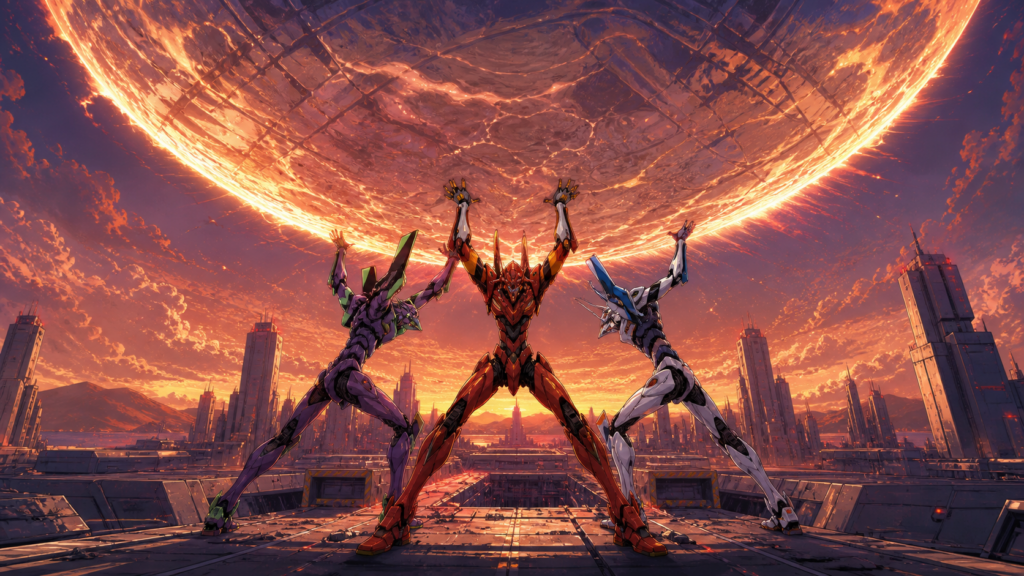
Misato turns childhood grief into a battle plan, three pilots catch an Angel falling from orbit, and one sentence from Gendo reaches Shinji harder than the impact.
Bottom Line
A spectacular victory cannot settle why Misato keeps choosing war
Episode 12 gives Evangelion one of its cleanest heroic victories and refuses to let victory clean up the adults behind the mission. Sahaquiel descends from orbit like a living extinction event. Misato cannot intercept the Angel with a conventional weapon, cannot predict the impact point with confidence, and cannot promise that any pilot will survive. Her answer is to send all three Evangelions racing across Japan so they can catch the falling body with their A.T. Fields and destroy the core at arm’s length.
The plan works. Shinji, Asuka, and Rei arrive within seconds of one another, absorb an impossible impact, stabilize the Angel, and attack together. Tokyo-3 survives because three children perform exactly the kind of impossible labor NERV has trained everyone to treat as routine. The sequence feels triumphant because the pilots finally operate as a team without a synchronization gimmick or an adult controlling each movement.
Misato’s command remains the harder story. A flashback reveals her father saving her during Second Impact while dying with the expedition he led. Misato has spent years hating the man who neglected his family and carrying the cross he gave her during his final act. Her war against the Angels grows from gratitude, resentment, survivor guilt, and a desire to make his death mean something. Ritsuko names the danger directly: personal hatred can turn other people into tools.
The episode does not prove Misato is wrong to fight Sahaquiel. Millions of lives depend on stopping the Angel. The criticism concerns how easily a necessary defense can hide a private need. Misato can make the correct tactical choice while using the mission to settle an emotional debt nobody else agreed to inherit. That split between public duty and private motive gives the episode more weight than the giant impact alone.
Misato’s Anger
Her father saved her once and shaped every danger she chooses afterward
Misato’s promotion gives the staff a reason to celebrate, yet the episode immediately questions what advancement means inside NERV. A higher rank rewards competence, but the same rank also places more children under her authority. Misato has become skilled at converting fear into orders. The organization reads that skill as leadership because NERV needs someone who can decide before certainty arrives.
Second Impact created the wound beneath that competence. Misato remembers her father as a distant researcher whose work consumed the family. His final decision saved her life, leaving her unable to keep a simple moral account. The father she resented became the person who placed her in an escape capsule and died outside. Gratitude did not erase neglect. Neglect did not erase sacrifice. The cross around her neck preserves both truths because neither truth can finish the argument.
Her hatred of Angels becomes a way to direct grief toward an enemy with a visible body. Angels cannot apologize, explain, or complicate the story. Destroying them gives Misato a measurable result that mourning cannot provide. Every victory can feel like payment toward a debt, even though no number of dead Angels can answer what she wanted from her father while he lived.
Ritsuko understands the pattern because she watches Misato volunteer the pilots for a plan with terrible odds. Her warning is not a demand for passivity. Ritsuko asks whether Misato’s private anger changes the amount of risk she is willing to assign to other people. That question should exist inside every military command, emergency agency, hospital, and political office. Leaders always bring personal history into public decisions. Ethical systems do not pretend otherwise. Ethical systems build review, dissent, and accountability around that fact.
NERV lacks those protections. Gendo is absent, conventional command channels offer no better solution, and Misato can authorize the mission because the emergency rewards speed. Nobody representing the pilots can refuse on their behalf. Nobody outside NERV can examine whether the impact prediction justifies the selected risk. The story remains believable because the Angel leaves almost no time, yet the same urgency makes institutional abuse easy to hide.
The Falling Angel
Sahaquiel turns probability into a weapon
Sahaquiel attacks from beyond the range where NERV usually controls a battlefield. The Angel drops pieces of itself to test trajectories before committing its full mass. Each smaller impact gives the organization data while reminding everyone that data arrives through destruction. The enemy behaves less like a monster charging a wall and more like a strategist calibrating artillery.
The orbital position also attacks NERV’s belief that every threat will enter the city through a route the GeoFront can manage. Tokyo-3 can retract buildings, raise armor, and launch Evangelions through prepared channels. None of those systems matter when the sky itself becomes the weapon. The defense network must respond across open land, which forces the pilots to run instead of waiting inside launch cages.
Prediction becomes the central gamble. The MAGI produce several possible impact zones rather than one certain answer. Misato places each pilot along a different route and trusts them to correct course once the Angel commits. The plan depends on machines calculating probability, operators relaying updates, and children making physical decisions at extreme speed. One broken link would turn the mission into a mass casualty event.
The visual scale works because the pilots remain tiny beneath Sahaquiel. Their Evangelions usually tower over buildings, yet the falling Angel makes them look like people holding up a collapsing ceiling. Size stops being a promise of control. The scene reminds fans that the Evas are powerful enough to save a city and still small enough to be crushed by the world arriving from above.
Three Pilots
Teamwork becomes trust measured in seconds
Shinji reaches the impact point first. His speed matters, but arrival does not make him the only hero. Unit-01 catches Sahaquiel long enough for Asuka and Rei to reinforce the A.T. Field. The sequence gives Shinji initiative without turning his teammates into spectators. His choice creates the seconds they need, and their arrival prevents his courage from becoming a suicide.
Asuka brings aggression that finally serves the group. She attacks the core when the Angel has been stabilized, using the role her confidence fits. Rei supports the structure without demanding recognition. The division of labor respects their differences. Nobody needs to imitate another pilot’s personality for cooperation to work.
The mission also shows how much the trio has learned outside formal training. Shinji reads Misato’s intent, Asuka accepts a shared victory, and Rei adjusts without waiting for praise. Their relationships remain abrasive and incomplete. Dependability grows before intimacy. That order feels honest for children who have been placed together by an institution rather than friendship.
NERV celebrates the result as evidence that the system works. The opposite reading deserves space. The pilots succeed because they compensate for the system’s uncertainty with judgment, pain tolerance, and trust. Their bodies absorb the gap between a statistical prediction and an exact landing point. Calling the mission successful without naming that cost allows leadership to plan the next impossible assignment as if no debt remains.
Gendo’s Praise
One sentence becomes a reward Shinji cannot stop wanting
Gendo praises Shinji after the battle, and the words land with more force than the Angel. Shinji has wanted recognition from his father since the first episode. NERV can offer housing, meals, a school, and operational approval, but none of those substitutes reaches the abandoned child beneath his compliance. Gendo’s brief acknowledgment proves that the reward still exists and can still be withheld.
The praise creates a dangerous loop. Shinji risks his life, performs well, receives a fragment of paternal approval, and learns that combat may be the route back to his father. Gendo does not need to issue an explicit threat. Intermittent affection can control more efficiently than constant punishment because the child keeps working for the next rare moment.
Shinji’s happiness should not be mocked. Wanting a parent to notice him is ordinary. The cruelty belongs to an adult and an institution that attach that ordinary need to lethal performance. A believable safeguarding system would separate family authority from operational command, provide an independent advocate for every minor pilot, and prevent a parent from evaluating a child whose affection creates an obvious conflict of interest.
The episode closes around celebration, food, and a sense that the team has earned a normal evening. That warmth matters because exploitation does not always feel cold. Systems become harder to leave when danger produces belonging afterward. Shinji can recognize the mission’s violence and still treasure the praise, meal, and companionship that follow. Both responses can be true.
Public Duty
A disaster plan becomes dangerous when sacrifice has no constituency
Japanese disaster fiction often turns national vulnerability into a problem of coordination. Sirens sound, agencies argue, maps fill with predicted damage, and ordinary life waits for institutions to decide whose neighborhood can be lost. Evangelion uses that familiar machinery while placing teenagers at the final point of failure. Adults calculate, authorize, and watch. Children become the physical barrier between a city and annihilation.
That arrangement connects the episode to real public systems without reducing Sahaquiel to a lecture. Emergency plans always distribute risk. Flood walls protect one district while redirecting water. Evacuations favor people who can leave quickly. Military defenses protect a population by placing service members in danger. The moral problem begins when the people carrying the greatest risk have the least power to shape the plan. Shinji, Asuka, and Rei are informed of Misato’s operation, but nobody meaningfully represents them during the decision.
The episode gets the fantasy right by making cooperation necessary. No lone pilot can catch Sahaquiel. Technical staff, the MAGI, field crews, and all three children contribute to the victory. The story becomes less believable only when the organization treats survival as proof that its process was acceptable. A successful emergency response can still expose reckless preparation, missing safeguards, or leaders whose personal motives distorted the mission.
Evangelion would become sharper, not softer, if NERV showed the consequences after victory. A formal inquiry could force Misato to defend her risk calculation. A pilot advocate could ask why minors lacked refusal rights. Staff could debate whether Gendo’s absence created a command failure. Those structures would give later violations something concrete to break. The drama would move beyond vague corruption and show how institutions convert extraordinary rescues into permission for the next gamble.
Verdict
The city survives, but nobody answers who owns the children’s courage
Episode 12 earns its spectacle. Sahaquiel feels enormous, the running sequence turns geography into suspense, and the three-Eva catch delivers a victory built through distinct roles. The episode gives fans a reason to cheer without pretending the cheer resolves Misato’s grief or Shinji’s hunger for approval.
The strongest choice is the argument surrounding the mission. Misato can be brave, capable, loving toward the pilots, and still use them inside a private war. Gendo can offer genuine praise and still benefit from making praise scarce. Evangelion refuses the comfort of sorting adults into helpers and villains when power allows care and harm to occupy the same relationship.
A better NERV would keep Misato’s decisiveness while placing limits around unilateral risk. Independent review would examine emergency plans after every mission. Pilots would have advocates with authority to challenge assignments. Commanders would disclose conflicts that could distort judgment. Mental health care would not report through the same chain that assigns combat. Those safeguards would not remove tragedy from the story. They would make every violation clearer and every adult choice more accountable.
RaeRae verdict: Catching Sahaquiel proves the pilots can hold up the world together. The painful question is why every adult system keeps arranging the world so children must catch the fall.
Episode File
Original air date: December 20, 1995
Angel: Sahaquiel
Core conflict: Misato sends all three Evangelions to catch an Angel falling toward Tokyo-3 from orbit.
Watch: Netflix
Previous: Episode 11, The Day Tokyo-3 Stood Still
Next: Episode 13, Lilliputian Hitcher