
Evangelion Episode 11: The Day Tokyo-3 Stood Still
Evangelion Episode Reaction
Tokyo-3 loses power, NERV loses its technological armor, and three children must find the headquarters before an Angel dissolves the city from above.
Bottom Line
The fortress works because people keep moving after the fortress fails
Episode 11 removes electricity from Tokyo-3 and exposes how much NERV mistakes automation for security. Lights die, doors lock, ventilation stops, elevators freeze, communications vanish, and the Evangelions become inaccessible weapons buried beneath layers of machinery. The city designed to survive Angels cannot manage an ordinary blackout without trapping workers inside the systems meant to protect them. Matarael arrives during the failure and begins dripping corrosive fluid toward NERV, turning one broken utility into a countdown.
The episode could have treated the blackout as proof that technology is unreliable. The sharper point is that technology inherits every weakness in the organization controlling it. NERV centralizes power, access, transportation, communication, and defense because centralization makes command efficient. The same design creates one enormous point of failure. When the grid disappears, nobody has enough local control to open a door, call another department, or confirm whether sabotage caused the outage.
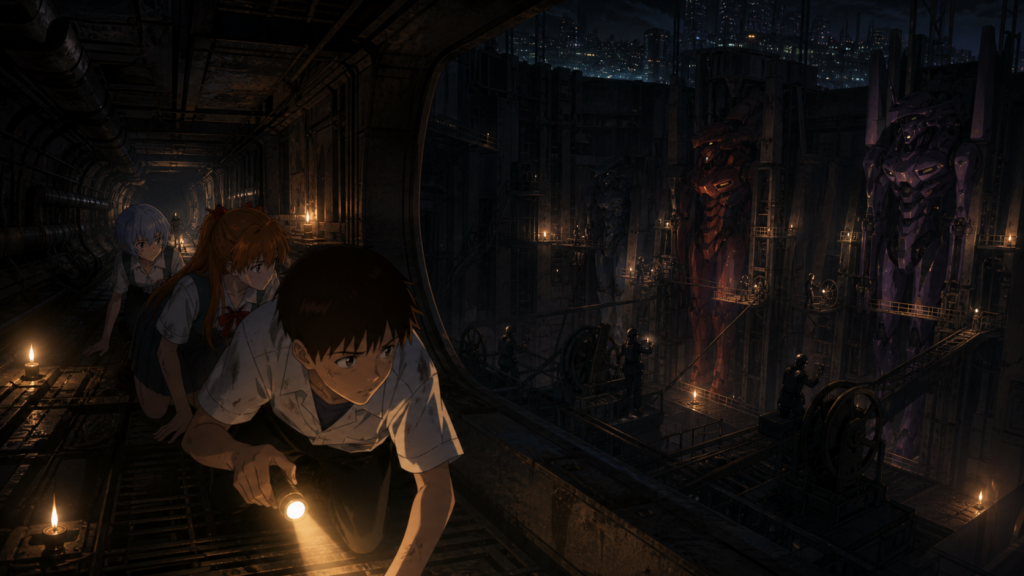
The people compensate. Gendo and Fuyutsuki help prepare the Evangelions by hand. Staff members crawl through maintenance routes. Misato, Kaji, Ritsuko, and operations personnel improvise without screens. Shinji, Asuka, and Rei navigate the dark city, reach headquarters, and launch through manual systems. The episode’s heroes are not brilliant because they restore normal operations. They are brilliant because they stop waiting for normal operations.
The complaint is simple. NERV built a defense network with no believable low-tech fallback for the people inside it. Emergency systems exist, but they still depend on centralized access and perfect knowledge. A realistic fortress would assume that power, networks, and command chains can fail together. Staff would train with physical maps, independent radios, mechanical releases, distributed generators, and clear local authority. NERV trains everyone to obey the center, then discovers the center cannot speak.
The Blackout
Every convenience becomes a locked door
The power failure arrives without spectacle. Tokyo-3 simply stops. Trains halt, traffic systems fail, public spaces darken, and the enormous mechanical city becomes still. That quiet is more unsettling than another explosion because nobody knows whether the cause is technical, political, or hostile. NERV suspects sabotage, which means the enemy may already understand the city’s infrastructure better than the people living inside it.
Daily life collapses before combat begins. People cannot reach their assigned stations, identify one another across departments, or tell whether loved ones are safe. The episode pays attention to heat and air as the headquarters grows uncomfortable. Those details matter. Disaster stories often jump from power failure to action without showing bodies sweating in sealed rooms. Evangelion understands that infrastructure disappears first as comfort, then as mobility, and finally as survival.
Kaji and Misato being trapped together turns a mechanical failure into an emotional pressure chamber. Their history surfaces because neither can escape into work. The blackout creates unwanted stillness, and stillness gives old relationships room to speak. NERV normally protects its adults from reflection by supplying permanent emergencies. A dead elevator interrupts that rhythm. Misato cannot command a screen, and Kaji cannot disappear down a hallway.
Ritsuko approaches the outage as a systems problem, yet even her expertise cannot restore information that no longer reaches her. She knows NERV’s architecture, but knowledge of the whole design does not place her beside every broken component. The episode separates intelligence from control. A person can understand a system and remain powerless when the system refuses to report its condition.
The blackout also reveals social inequality. NERV personnel occupy a hardened facility with emergency procedures, while civilians wait in a city whose movement depends on mechanisms they do not control. Tokyo-3 asks residents to trust that hidden experts will keep the fortress operating. Nobody can evaluate that promise during the outage. Centralization turns public safety into faith.
The Children
Three pilots become a working team without an adult choreographer
Shinji, Asuka, and Rei begin outside headquarters, which makes their route toward NERV the emotional center of the episode. They do not receive a rescue team or reliable instructions. They choose to move toward the danger because they understand that the Evangelions cannot launch without pilots. The choice is brave, but NERV has trained them to see institutional need as personal obligation. None of them seriously considers staying safe.
Asuka declares herself the leader because rank, confidence, and visibility matter to her. Her leadership is loud and sometimes wrong, yet she keeps the group moving. Rei supplies practical knowledge and calm observation. Shinji mediates between them and recognizes routes through spaces that once intimidated him. The trio works because each person brings a different survival skill. Episode 9 forced Shinji and Asuka into synchronized choreography. Episode 11 allows all three pilots to coordinate through argument, correction, and shared purpose.
Their journey through access shafts and maintenance passages makes NERV look less like a futuristic command center and more like the inside of a machine. The children squeeze through the parts adults rarely see. That visual choice matters because pilots normally experience the organization through polished control rooms, launch cages, and orders. The blackout removes the presentation. Pipes, ladders, sealed doors, and manual mechanisms become the real NERV.
Rei’s calm is useful but not magical. She can identify routes and procedures because she has spent years inside NERV’s systems. Familiarity does not mean the institution cares for her. Her value comes from being trained to function under deprivation. The episode shows why adults praise her reliability. Rei needs less reassurance because she has learned not to expect it.
Shinji demonstrates growth without a speech. Earlier episodes showed him freezing when instructions vanished. During the blackout, he keeps moving and helps the group reason through obstacles. He does not become fearless. He becomes capable of acting while uncertain. That difference is more believable than a sudden personality transformation.
Asuka’s leadership also becomes less performative once Matarael attacks. She coordinates the shield, rifle, and support roles based on what each Eva can do. The plan requires Rei to absorb danger, Shinji to fire, and Asuka to organize the timing. Nobody receives a glamorous role. Cooperation works because survival matters more than status for a few critical minutes.
NERV Without Power
The commanders finally touch the machinery
Gendo helping prepare the Evangelions by hand is one of the episode’s most revealing images. He usually commands from a raised platform, framed by screens and distance. Without electricity, the hierarchy compresses. His body must enter the labor chain. The scene does not redeem him as a father or leader, but it proves he understands the machines beneath the symbolism. Gendo can work when command loses its theatrical setting.
Fuyutsuki joins the effort, and staff members organize around physical tasks instead of digital status reports. The moment feels almost democratic because survival makes titles less useful. Everyone can see what needs lifting, opening, or connecting. That clarity disappears once power returns. NERV’s ordinary hierarchy depends partly on information being unevenly distributed. The blackout makes the problem visible to everyone at once.
Manual launch procedures save the city, but their difficulty exposes weak emergency design. A fallback that requires extraordinary strength, perfect timing, and leaders personally opening machinery is not a robust fallback. NERV has a heroic workaround, not resilience. Resilience means ordinary trained staff can perform essential functions under pressure without waiting for exceptional personalities.
Matarael exploits the exact condition NERV failed to anticipate. The spiderlike Angel occupies the surface and sends acid downward, attacking gravity, structure, and time rather than challenging the Evangelions in open combat. The enemy does not need to understand every corridor. NERV’s buried headquarters funnels the threat toward itself. The fortress shape becomes a trap.
The pilots’ battle plan is beautifully simple. One Eva protects the group from acid, another clears the obstruction, and the shooter targets the Angel through the opening. The sequence lacks the elegance of Episode 9’s dance, but the rough coordination feels earned. They have limited power, no broad command support, and no time for a perfect plan. Teamwork becomes division of labor rather than emotional unity.
Sabotage and Secrecy
NERV cannot admit how vulnerable the city has become
The possibility of sabotage expands the episode beyond a technical accident. Someone may have studied the grid, identified NERV’s dependencies, and disabled the city at the moment an Angel appeared. Whether the timing is coordinated or coincidental, the organization knows human enemies exist alongside Angels. Secrecy has not protected NERV from infiltration. Secrecy has made outside oversight almost impossible.
A transparent emergency review would ask who controlled the grid, which safeguards failed, and why communications lacked independent backups. NERV operates in a political world where admitting weakness can threaten funding, authority, and hidden projects. The organization therefore has incentives to classify the failure instead of correcting the culture that produced it. Engineers can repair components while leadership preserves the same concentration of power.
The episode gets infrastructure right because failure crosses categories. A power outage becomes a transportation crisis, communications crisis, ventilation crisis, command crisis, and defense crisis. Real systems fail through relationships between parts. NERV’s brilliant technology cannot compensate when those relationships all depend on the same source.
A more believable Tokyo-3 would divide essential services into isolated zones, maintain analog maps at every station, drill personnel during full communications loss, and give civilians clear shelter guidance that does not depend on screens. NERV would also have independent investigators review suspected sabotage. The story becomes stronger, not softer, when readers can see which safeguards were skipped and who benefited from skipping them.
Verdict
When command goes silent, relationships become the backup system
Episode 11 is a team episode disguised as an infrastructure disaster. Shinji, Asuka, and Rei reach NERV because they argue without separating. Gendo and the staff launch the Evas because hierarchy bends toward labor. The battle succeeds because each pilot accepts a limited role inside a shared plan. Nobody becomes emotionally healed. They become dependable to one another.
The episode also gives Tokyo-3 weight as a place rather than a backdrop. The retractable buildings, underground headquarters, trains, elevators, and power network form one enormous organism. When electricity disappears, the organism stops pretending to be invincible. People must crawl through the body and keep vital functions moving by hand.
NERV will restore power and return to screens, orders, and controlled distance. The blackout does not reform the institution. The experience still leaves evidence that the organization survives through workers and children whose judgment exceeds the systems surrounding them. Technology amplifies that labor when functioning and conceals it when successful.
The quieter victory belongs to the maintenance workers, operators, and pilots who understand pieces of NERV that senior leadership usually treats as invisible. Their knowledge is practical, local, and difficult to replace with another command screen. The blackout makes that hidden workforce visible for one night. A fortress can own newer machines and still become fragile when only a few people know how to move through the building without them. Episode 11 respects competence without pretending competence excuses the institution that keeps creating preventable emergencies.
That distinction matters beyond a giant robot story. Hospitals, schools, transit systems, and public agencies also become brittle when workers lose authority to solve local problems without waiting for one central office. Emergency planning becomes believable only when leaders expect incomplete information and let trained people act inside clear boundaries. Episode 11 makes that lesson visible through sweat, locked doors, dead screens, and children carrying a map through darkness.
RaeRae verdict: Tokyo-3 does not stand because the fortress is perfect. Tokyo-3 stands because people who were never given enough backup become backup for one another.
Episode File
Original air date: December 13, 1995
Angel: Matarael
Core conflict: A total blackout disables Tokyo-3 while Matarael attacks NERV from above.
Watch: Netflix
Next: Episode 12, She Said, Don’t Make Others Suffer for Your Personal Hatred