
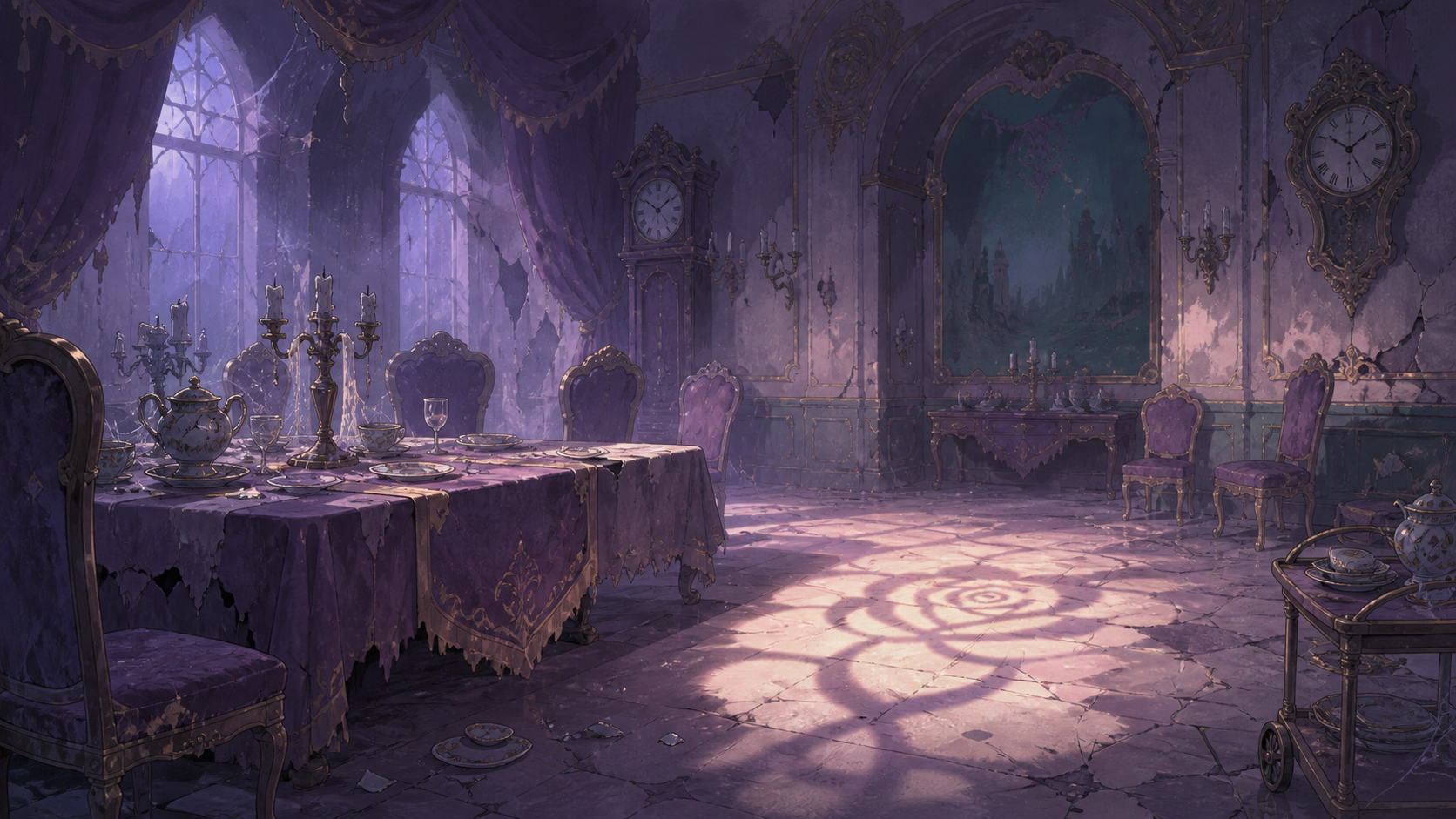
RaeRae Rants · Beauty and the Beast · Everybody at Work Did Not Answer That Door
The Enchantress Cursed the Wrong People
Teach the prince a lesson if you must. Why is Chip spending childhood as a cup while the adults call this justice?
I have questions for the magical justice system
The prologue tells us a prince turns away an old woman seeking shelter because he judges her appearance. She reveals herself as an enchantress, transforms him into a beast, curses the castle, and gives him until the final rose petal to learn love. The lesson sounds tidy until the camera introduces a household full of people whose bodies were also transformed. Suddenly one man’s moral education has a workforce attached to it.
Lumiere did not close the door. Mrs. Potts did not insult the visitor. Cogsworth did not decide beauty was the measure of human worth. Chip is a child. Yet every one of them loses a human body, a future, contact with the outside world, and the ability to leave. If the enchantress is the story’s instrument of justice, her justice distributes pain according to proximity to power rather than responsibility.
A test designed to be failed
The enchantress arrives disguised as someone the prince is socially trained to disregard. That makes the test morally clear: hospitality should not depend on beauty, wealth, or status. It also makes the encounter a trap in the narrative sense. She knows who he is, possesses overwhelming power, and chooses a form intended to reveal prejudice. The prince’s failure is real even if the situation is constructed.
The problem begins when exposure becomes punishment without proportion. A lesson could confront him with the consequence of his values, remove his title, require service, or force him to experience dependence. Instead, the curse changes bodies and links restoration to romantic love. The method reproduces the same appearance-based logic it condemns while dragging uninvolved people into the sentence.
The servants are treated like extensions of the estate
Cursing the household assumes workers belong to the prince so completely that punishing his property includes punishing them. The castle, servants, furniture, and social world are bundled into one domain. That is aristocratic logic disguised as magic. Their separate moral agency disappears because the prince’s home is imagined as an extension of his person.
The transformed bodies make the assumption literal. A maître d’ becomes a candelabra, a housekeeper becomes a teapot, and a majordomo becomes a clock. People are reduced to the tools associated with their labor. The curse does not only imprison them. It declares that their identities are functions performed for the household. The enchantress punishes class hierarchy by making its dehumanizing logic physically real, then leaves the workers trapped inside it.
Chip destroys every defense of proportionality
No explanation can make Chip responsible for the prince’s refusal. He is young enough that his cursed body becomes a permanent childhood image. Whether he was present at the door or asleep in another room does not matter. The magic reaches him because he belongs to the household. His mother must then keep him safe as fragile ceramic while hoping the employer who caused the punishment develops emotionally before time runs out.
The child turns an abstract fairy-tale curse into collective punishment nobody should romanticize. If the enchantress wanted the prince to learn compassion, making an innocent child collateral damage is a strange demonstration. Chip’s suffering creates urgency, but it also exposes that the story’s moral authority has committed harm more sweeping than the initial offense.
What exactly did Mrs. Potts do
Mrs. Potts appears to have spent her life feeding people, managing domestic work, raising children, and providing the emotional judgment the castle’s ruler lacks. Her cursed form transforms that care into anatomy. She becomes the vessel from which others receive warmth. The punishment turns a skilled woman into the household function everyone already expected her to perform.
This is not incidental symbolism. The curse selects forms based on labor roles, which means it recognizes servants only through usefulness. Mrs. Potts must continue nurturing the prince whose action endangered her child. Her path back to humanity depends on helping him become worthy. The enchantress effectively assigns the harmed worker responsibility for rehabilitating the person who caused the harm.
Lumiere loses ownership of his own flame
Lumiere’s body becomes hospitality. His arms hold fire, his face melts into wax, and his social charm becomes a permanent service device. He can no longer separate work from self. Even romance with Fifi or Plumette occurs between bodies redesigned as household equipment. The curse invades intimacy as thoroughly as employment.
His optimism should not be mistaken for consent. People adapt to conditions they cannot leave. Lumiere creates joy, rebellion, and connection within the punishment, but skillful survival does not validate the sentence. The fact that he can turn a banquet into liberation says something admirable about him and nothing flattering about the magic that made liberation necessary.
Cogsworth becomes the deadline
Cogsworth is transformed into a clock inside a curse governed by time. He does not merely watch the rose fall. His body constantly measures the condition threatening everyone. Anxiety becomes mechanical sound, public movement, and professional function. The worker already responsible for schedules is forced to embody the deadline created by somebody else’s moral failure.
That design is clever enough to distract from its cruelty. Fairy tales often make punishment aesthetically satisfying, and audiences can confuse thematic precision with justice. Cogsworth’s body is the perfect symbol. It is also a body he did not choose. Symbolic elegance does not give the enchantress moral permission to use a person as metaphor.
Fifi, Plumette, and the body as job description
The feather-duster transformation is often played for flirtation. A maid becomes an object designed to clean, decorated to remain feminine and visually appealing. Her labor, gender, and cursed anatomy collapse into one image. The joke depends on instant recognition, but the recognition reveals how narrowly the household understands her role.
Later adaptations can rename her, expand her personality, or alter the design, yet the central problem remains. The enchantress chooses bodies that mirror service. Workers are not transformed randomly. They become what the aristocratic household uses them to do. If the curse is teaching the prince to see inner worth, it begins by erasing the inner lives of everyone employed around him.
The rose makes their bodies hostages
The enchanted rose measures time until the prince must love and be loved. Every falling petal threatens permanent objecthood for the servants. Their bodies are therefore held hostage to a relationship they cannot control. They can advise, stage dinners, feed Belle, improve the atmosphere, and coach the Beast, but they cannot ethically produce another person’s love on demand.
This structure creates an impossible moral conflict. Respecting Belle’s autonomy may doom their families. Pressuring her may help restore them. The enchantress has designed a test in which innocent people benefit from manipulating a young woman’s feelings. Even when the servants behave compassionately, the curse makes that compassion carry self-interest they did not choose.
Why romantic love is the required cure
The wording centers love as proof of transformation, but the story operationalizes that requirement through romance. The prince does not break the curse by feeding strangers, compensating workers, surrendering power, or learning sustained public responsibility. He must love and receive love before the deadline. The moral test becomes dependent on another person granting emotional access.
That design risks treating Belle as a certification system for male growth. If she loves him, the lesson is complete. If she does not, every servant remains cursed. Her feelings become infrastructure for magical justice. The film ultimately protects her agency through release and voluntary return, but the enchantress built conditions that place enormous collective pressure on the answer.
Appearance is punished with appearance
The prince rejects the visitor because he cannot see beauty beneath an unattractive form. The enchantress responds by giving him an appearance designed to inspire fear and disgust. The symmetry is narratively satisfying. It also reinforces the idea that an undesirable body is punishment. The lesson against judging appearance uses altered appearance as its central threat.
The story tries to complicate this by making the Beast lovable before he becomes conventionally handsome again. Still, restoration is presented as reward. Human beauty, mobility, and status return when the moral test is passed. The servants also receive human bodies as liberation. The narrative knows bodies are not moral evidence, yet its magical system continues treating form as a visible grade.
The 1991 prologue hides the workforce
Stained-glass narration condenses the curse into myth. The prince’s cruelty, the enchantress’s revelation, the rose, and the transformed castle appear in a sequence so visually controlled that there is little room to ask who was standing in the kitchen. By the time the servants arrive as comic personalities, the audience has accepted their condition as part of the fairy-tale package.
That structure is brilliant storytelling and convenient moral framing. The prologue tells us whose action matters before showing the people who bear consequences. Once Mrs. Potts and Chip become emotionally real, the original explanation should feel less sufficient. The movie rarely returns to judge the enchantress because its narrative authority was established before the victims received voices.
The 2017 version makes the problem more visible
The live-action film expands the enchantress’s presence and shows how the curse affects villagers’ memories and separated relationships. The household’s human connections become clearer, which deepens the damage. Spouses and community members lose years together without understanding why. A magical punishment aimed at one castle reaches beyond its walls into ordinary lives.
The adaptation also suggests the servants may share blame for failing to intervene in the prince’s upbringing or cruelty. That explanation attempts to distribute responsibility, but it risks converting employment into parental obligation. Servants under aristocratic authority cannot be assumed to possess the power to reform the child who will own their livelihood. Failure to stop a ruler is not equivalent to the ruler’s freedom to act.
Could the staff have intervened
Maybe some adults enabled the prince. Institutions often survive because people normalize cruelty, protect reputation, and obey harmful commands. Cogsworth’s rule enforcement and the household’s later matchmaking show how fear can become complicity. A serious reading should not romanticize every servant as morally perfect simply because they lack formal power.
Complicity still requires proportion and evidence. The curse does not distinguish between the senior administrator, the cook, a child, and workers whose influence may have been negligible. It does not offer individual paths to repair. Everyone receives the same dependency on the prince’s success. Collective punishment treats proximity as guilt because evaluating actual responsibility would require seeing servants as separate people.
The enchantress never checks the workplace
After casting the curse, the enchantress appears to leave. She does not monitor whether workers are safe, whether the Beast’s rage worsens, or whether the deadline creates coercive pressure. The spell is set and forgotten until conditions are met. Magical power functions like policy written by someone who never has to live under implementation.
If justice creates predictable harm for innocent people, intent is not enough. The enchantress may intend to teach compassion. The actual system traps families, incentivizes manipulation, and places vulnerable workers under the same ruler in a more dangerous form. A powerful person should be judged by consequences too. Fairy-tale authority does not deserve an exemption simply because it arrives with beautiful light.
Belle enters a punishment she did not create
Belle is not cursed by the enchantress, but she becomes the missing mechanism of the cure. Nobody gives her informed consent at the beginning. She does not know the rose’s terms, the household’s deadline, or the extent to which every servant’s hope depends on her feelings. She enters to save Maurice and is immediately surrounded by people interpreting her presence as possibility.
The concealment makes emotional sense because the truth would be overwhelming. It is also ethically significant. Belle is asked to navigate captivity, a volatile prince, and an invested household without knowing the full stakes. The enchantress’s test reaches another innocent person by turning her autonomy into the final variable of a curse designed years earlier.
The servants create justice inside an unjust spell
What saves the story morally is not the enchantress’s design. It is the way servants make better choices within it. Mrs. Potts feeds Belle despite the Beast’s command. Lumiere welcomes Maurice. Cogsworth eventually risks disobedience. The household learns to direct labor toward care rather than merely authority. They produce pockets of justice the spell itself did not guarantee.
This distinction matters because breaking the curse can look like proof that the punishment worked. The ending does not validate every method used to reach it. People survived, resisted, loved, and changed under unjust conditions. Their success belongs to them. It does not retroactively make the person who imposed those conditions wise.
What a proportionate lesson might have looked like
The enchantress could have removed the prince’s title and required him to live without automatic service. She could have compelled him to offer shelter, placed the rose deadline on his own body alone, or made restoration depend on acts of hospitality performed without reward. The servants could have retained human bodies and the freedom to leave. The moral lesson did not require their imprisonment.
A better spell would separate accountability from access to romance. The prince could demonstrate change through choices affecting strangers, workers, and people who owe him nothing. Love might still grow later, but it would not function as a test Belle has to pass for everyone else. Justice should create responsibility for the wrongdoer, not incentives for surrounding people to manage his redemption.
Power is not the same as moral authority
The enchantress possesses enough power to transform bodies, alter memory, seal a castle, and define the terms of restoration. The story presents that power with visual authority, encouraging viewers to treat her judgment as correct because it is effective. But capacity answers what she can do, not whether she should do it. Magic does not remove ethical scrutiny.
This is the rant underneath the rant. Institutions and powerful people often design punishment for symbolic impact while ignoring the workers, families, and children who absorb it. The curse is memorable because it makes every detail thematic. It is unjust for the same reason: human lives are arranged as teaching materials for somebody else’s lesson.
The final transformation does not refund the years
When the curse breaks, bodies return, memories reconnect, and the castle celebrates. Restoration is moving because the loss was real. It does not return the years spent as objects, erase fear, or guarantee that work will now be freely chosen. Chip gets a human body back, but whatever childhood time passed under the curse cannot simply be poured into the cup again.
Happy endings often treat reversal as repair. A spell undone is not the same as harm accounted for. The prince should owe the household more than gratitude. He owes recognition, autonomy, compensation, safety, and the right to leave. If transformation only restores the old hierarchy with a kinder ruler, the workers have regained bodies without receiving justice.
The enchantress cursed the wrong people
The prince needed consequences. The servants needed protection from his consequences. Chip needed a childhood. Belle needed information and an unlocked door. Instead, the enchantress created a beautiful system in which innocent bodies became leverage, labor roles became anatomy, and romantic love became the deadline for collective release.
I can love the rose, the stained glass, the clock, the candelabra, the teapot, and the transformation while still saying the magic was wrong. Fairy tales are sturdy enough for questions. In fact, the best ones keep generating questions after the lesson appears settled. The prince learns to see the person beneath the surface. The audience should do the same for every worker the prologue turned into scenery.
A clever symbol can still be an unjust sentence
Part of the curse’s appeal is how perfectly every form fits. The clock worries about time. The candelabra creates warmth and spectacle. The teapot mothers and feeds. The wardrobe performs style. The visual intelligence makes the transformations feel inevitable, as if narrative appropriateness were evidence of fairness. It is not. A punishment can be beautifully designed and morally grotesque.
That distinction matters whenever storytelling turns suffering into satisfying symbolism. Audiences are trained to admire the match between flaw, job, and consequence. The servants did not choose to become metaphors. Their bodies are used to explain themes to us. Remembering the person beneath the symbol is exactly the lesson the prince is supposed to learn, which makes forgetting the workers beneath their designs especially ironic.
Restoration should require worker consent too
The ending assumes every servant wants to resume the human role held before the curse. Human form is obviously preferable to involuntary objecthood, but restoration of a body should not automatically restore employment terms, rank, or residence. Years of danger may have changed what Lumiere, Cogsworth, Mrs. Potts, Plumette, and the others want from the castle. Freedom includes the ability to leave a kinder employer.
A prince who truly learned to see inner worth would ask rather than assume. Do they want to remain? What do they need? How should labor, family time, wages, housing, and authority change? The enchantress’s spell ends when romance succeeds, but justice would continue through those questions. Otherwise the magic returns people to the arrangement that made them collateral damage in the first place.
The village pays for magic it never chose
The expanded live-action continuity makes clear that the curse reaches spouses, families, and community memory. People outside the castle lose relationships without understanding the absence. Their grief is altered by magic, not resolved. The enchantress protects the secrecy of the lesson by rewriting innocent lives, turning an entire region into scenery for one prince’s test.
That broader effect removes any remaining claim that the spell is narrowly targeted. Magical justice becomes social engineering. If power can edit memory to make punishment function smoothly, the absence of protest proves nothing. People cannot consent to conditions they have been made unable to remember. The silence surrounding the castle is another result of force, not evidence that the sentence was accepted.
The curse punishes workers for a prince’s failure
The opening asks viewers to accept that an entire household becomes furniture because one young ruler refuses shelter to a stranger. The prince’s cruelty deserves consequence. The servants’ bodies become collateral.
That choice reveals a familiar moral shortcut: punish the institution by transforming the people with the least power inside it. A cook, child, maid, footman, and clockmaker receive decades of bodily danger while the person responsible remains the only one whose emotional growth can release them.
The test itself was designed as a trap
The enchantress disguises herself, requests entry, and reveals power only after rejection. Hospitality matters, especially when wealth confronts apparent need. Yet a moral test becomes suspect when the examiner controls every fact and imposes catastrophic consequences on people who never knew an examination was occurring.
The rose adds a deadline but no guidance. The prince must learn love while isolated inside the evidence of his punishment. The servants must coach the person whose failure altered their bodies. The curse demands emotional development through conditions likely to produce shame, fear, and control.
Chip makes the injustice impossible to ignore
Chip is a child throughout the enchanted years. Whatever the timeline does with aging, his experience is shaped by a punishment attached to somebody else’s decision before he could hold meaningful authority.
The film uses his cuteness to make the household warm. It rarely lets that warmth become accusation. Mrs. Potts must comfort her son, support the Beast, host Belle, and hope the romance succeeds because the enchantress created a system where care labor substitutes for justice.
Restoration does not repay the lost years
The finale returns human bodies and allows celebration, but reversal is not the same as repair. The household has endured isolation, fear of becoming permanent objects, and dependence on the Beast’s romantic success.
A deeper ending would let the servants respond differently. Some may forgive. Some may leave. Some may love the prince and still refuse to serve him. Human form should restore choice, not automatically restore the employment structure that preceded the curse.
My final receipt on the enchantress
The enchantress identifies real cruelty and answers it with collective punishment. The story calls the result a lesson because the prince eventually changes. The people turned into household objects are asked to treat his improvement as compensation.
Mercy would have targeted authority, protected the workers, and created a path to accountability that did not require a stranger’s love. The curse produces a beautiful fairy tale. It remains terrible justice.
A better curse would have separated accountability from dependence
The enchantress could have limited the transformation to the prince, removed his title, required restitution, or allowed the servants to leave while he learned to live without obedience. Instead, she binds everybody’s future to his ability to receive love. That design makes the harmed workers responsible for producing the emotional conditions of their own release. They coach his manners, manage his anger, welcome Belle, create romantic opportunities, and protect hope from the despair their punishment caused.
Even the deadline is experienced unequally. The Beast fears permanent monstrosity, but he retains mobility, authority, private rooms, and control of the castle. The servants fear losing the remainder of their human form while continuing to work for him. Their bodies become household functions: a mother pours tea, a child becomes a cup, a maître d becomes a candlestick, and a tightly wound administrator becomes a clock. The magic turns labor roles into anatomy.
That visual idea is brilliant and morally ugly in exactly the way the best fairy-tale arguments can be. It literalizes how service can consume identity while asking the servants to remain charming enough that viewers do not stay angry. I am staying angry. The happy transformation is moving, but justice would require more than restoring skin at the moment the prince completes his lesson. It would require wages, choices, apologies, and the freedom to decide whether this household still deserves them.
The curse treats love as a performance metric
The prince must love and be loved before the final petal falls, turning intimacy into a timed outcome with an entire household watching. That pressure makes every interaction ethically unstable. Belle cannot know that the servants’ futures depend on her feelings, while the servants cannot offer neutral advice because failure may erase their remaining humanity. Love becomes the assignment nobody is allowed to describe. A just lesson would create room for accountability without making another person’s affection the grade. The Beast needs to learn generosity, restraint, listening, and repair whether Belle chooses him or not. The servants need release that does not depend on successfully producing romance. By tying transformation to mutual love, the enchantress confuses moral growth with romantic reward. The story ultimately escapes that trap only because the Beast releases Belle before knowing she will return. His best act occurs when he stops trying to pass the test.
The enchantress never returns to assess what the curse did to the people she transformed. That absence lets the ending treat restored appearances as a complete moral accounting. It is not. Mrs. Potts has spent years fearing for Chip, Lumiere has watched friends become less human, Cogsworth has managed a household trapped outside ordinary time, and Belle entered the castle without knowing their survival had been attached to her emotions. A responsible resolution would let those people narrate the cost in their own words. The prince’s reform matters, but it cannot speak for everyone injured along the way. Magic created the punishment instantly. Repair would take longer because bodies can be restored before trust, memory, labor, and power have actually changed.
Keep going
Return to the Beauty and the Beast hub for full reviews, character profiles, rants, lore, and guides.