
The Dress Destruction
The rules changed because Cinderella succeeded. The tearing was class enforcement with beads.
Lady Tremaine says yes because she knows how to manufacture failure
The royal invitation applies to every eligible maiden, so openly forbidding Cinderella would expose the household’s cruelty. Lady Tremaine offers conditional permission instead. Cinderella may attend after completing her chores and finding something suitable to wear. The terms sound neutral because the sabotage remains unstated. Abuse becomes harder to challenge when power presents an impossible demand as a fair opportunity.
The workload is designed to consume the deadline
Lady Tremaine and her daughters produce tasks faster than Cinderella can finish them. Every request is individually ordinary. Together they create confinement through time. This is why overwork belongs in the analysis of control. A locked door is not required when another person owns every minute before an opportunity closes. Cinderella’s labor keeps the household functioning while being used to prove she supposedly lacks readiness for public life.
Cinderella chooses her mother’s dress, not a fantasy gown
The dress connects her to a family life that existed before Lady Tremaine reorganized the home around hierarchy. Wearing it would bring memory into the ballroom. The garment is outdated, but Cinderella sees possibility because emotional value matters beside fashion. Her first route to the ball depends on inheritance, repair, and community craft rather than supernatural transformation.
The mice notice the impossible schedule and organize
Jaq, Gus, and the birds do not wait for Cinderella to beg. They assess the problem, divide labor, locate materials, and work collectively. Their intervention proves Cinderella’s relationships have practical force. She has spent years protecting smaller creatures, and care returns as solidarity when formal power blocks her. The first miracle is mutual aid, not magic.
The materials come from castoffs Anastasia and Drizella rejected
The mice recover a sash and beads the stepsisters discarded. Objects treated as worthless become enough to create beauty when labor and imagination reconnect them. Upcycling also exposes abundance inside the household. The sisters possess so much that they forget what they threw away, then claim ownership when it becomes desirable on Cinderella. Scarcity is manufactured for one person while waste remains available to everyone above her.
The dress contains many hands and one person’s hope
Cinderella did not sew the final version herself because coerced labor occupied her time. That does not make the dress less hers. Authorship can be collective. The animals build from her plan, her mother’s garment, recovered materials, and knowledge of what the evening means to her. The finished dress is a visible record of relationship. Destroying it attacks more than fabric.
Cinderella enters the staircase believing the rules worked
She completed the assigned work, found appropriate clothing, and appears at the promised time. Her happiness is not naïve. It is based on Lady Tremaine’s stated agreement. The scene creates dread because viewers know conditional abusers preserve power by changing the meaning of compliance after it occurs. Cinderella’s success forces the sabotage to become physical.
Lady Tremaine never touches the dress
She recognizes the sash and beads, speaks in a tone that directs attention, and lets Anastasia and Drizella perform the violence. Delegated cruelty protects her self-image. She can pretend the daughters merely reclaimed property while knowing exactly what the attack will do. Power often works through suggestion because followers have learned which harm will receive approval.
The stepsisters call discarded objects stolen once Cinderella looks beautiful
Ownership suddenly matters when the items create value on someone they consider inferior. Their accusation is legally thin and emotionally useful. They do not want the sash or beads back as materials. They want to remove evidence that Cinderella can enter the same social field. The attack is class enforcement disguised as property recovery.
Jealousy is not the whole explanation
Anastasia and Drizella react to beauty, but the deeper threat is equality. Cinderella standing beside them in a formal dress contradicts the household story that she naturally belongs below. Destroying the garment restores visible hierarchy before the carriage leaves. Jealousy describes emotion. It does not fully describe the system that teaches them whose humiliation is permitted.
The violence is intimate and public
Hands pull at fabric, beads, sash, sleeves, and skirt while Cinderella is surrounded by the family that should have protected her. The attack targets the body through clothing without needing to strike skin directly. It leaves her exposed, shocked, and unable to follow. Lady Tremaine watches until the work is complete, then calmly departs.
The animation makes fabric feel like injury
Tearing cloth stretches the moment because each rip removes another piece of hope and another sign of communal labor. Cinderella’s body recoils while the dress comes apart around her. The scene allows a family audience to recognize assaultive cruelty without graphic violence. Material damage becomes emotionally legible as violation.
Anastasia and Drizella are responsible even under their mother’s influence
Lady Tremaine trained the hierarchy and cues the attack, but the daughters choose to pull, accuse, and continue after Cinderella’s distress is obvious. Understanding how cruelty is learned does not erase accountability. The later redemption of Anastasia in sequels works only if the franchise remembers what she must repair.
Cinderella does not fight back because the power imbalance is real
She is outnumbered, economically dependent, socially isolated, and facing the person who controls her home. Physical resistance could escalate danger without preserving the dress. Freezing is not agreement or weakness. It is a common response when violence arrives through people whose retaliation will continue after the immediate scene. The movie shows shock more accurately than critics who demand a perfect defensive performance.
The Grand Duke and palace never see the exclusion happening
The royal proclamation creates nominal access but provides no enforcement for women whose guardians can obstruct them at home. Universal invitations are not universally usable. Transportation, clothing, time, safety, and household authority decide who can appear. The ball’s fairness exists only at the level of paper.
The destroyed dress exposes the limits of following every rule
Cinderella worked, repaired, waited, and complied with the exact condition. The household punished success because the condition was never meant to create access. This is the moment when endurance stops producing a path forward. Her coping system collapses because evidence finally proves the game cannot be won through obedience. That realization is devastating and clarifying.
Her tears are not a failure of character
Cinderella leaves the house, reaches the garden, and admits she cannot believe anymore. The breakdown follows prolonged control and a coordinated destruction of hope. Stories often praise resilient women until resilience requires rest, grief, or help. Then the same audience calls them weak. The scene gives Cinderella permission to reach a limit.
The Fairy Godmother arrives after community labor has already mattered
Magic does not erase what the mice and birds built. It responds after their solution is violently destroyed by greater power. The second dress is not proof mutual aid was inadequate. It is additional support arriving when the scale of harm exceeds what the first network can repair before the deadline. People can need community and extraordinary intervention without either becoming meaningless.
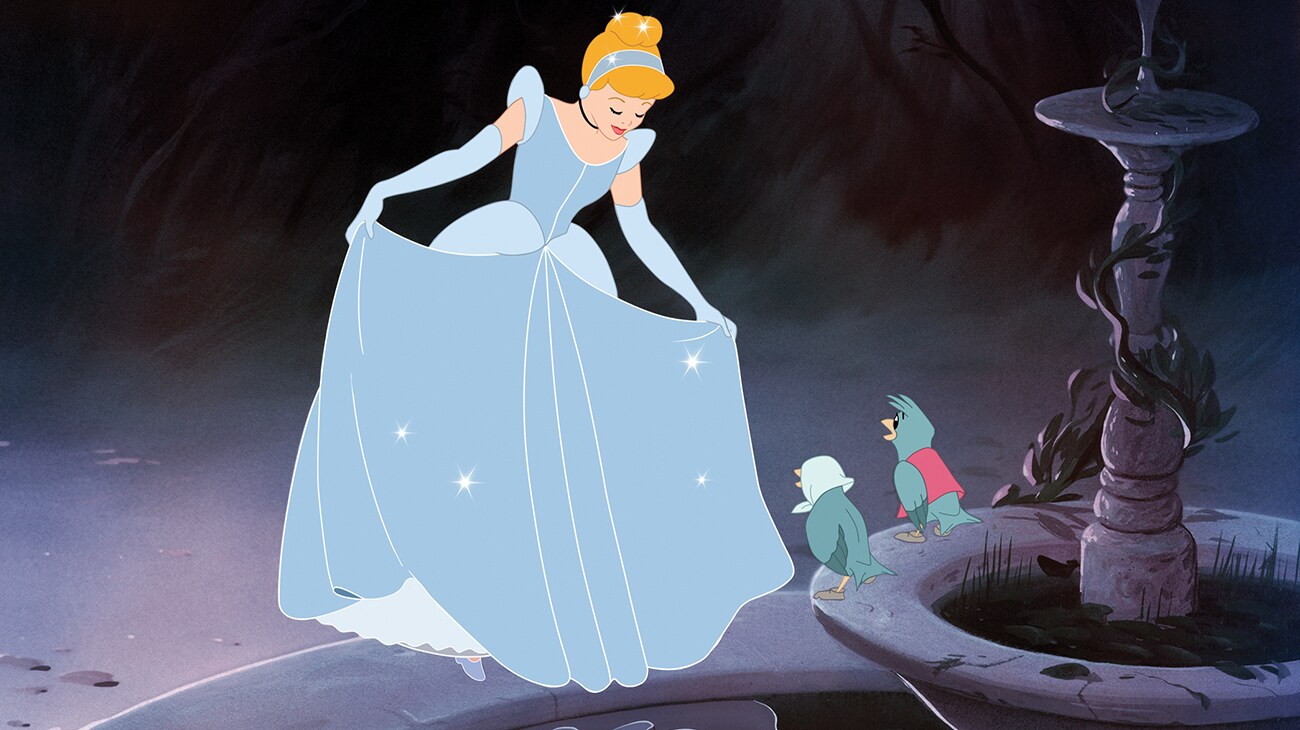
The magical gown should not replace the emotional value of the first dress
The blue transformation became the franchise icon, while the handmade pink dress is often remembered mainly for being torn. The first garment contains Cinderella’s mother, animal friends, recovered materials, and work performed in solidarity. The magical gown creates spectacle. The handmade dress carries history.
Lady Tremaine destroys access because she cannot prove Cinderella lacks worth
She never attempts a fair comparison. Her strategy is keeping Cinderella from being seen. This reveals insecurity beneath control. A hierarchy that requires invisibility cannot trust its own claim of superiority. The ball becomes dangerous because public recognition might create witnesses beyond the house.
The scene understands clothing as social permission
A dress does not create Cinderella’s dignity, but the court requires a visual code before it will admit her. Clothing becomes the passport to a public institution. The household controls that passport through money, labor, and violence. Fashion here is neither superficial nor inherently liberating. It is part of how class decides who becomes visible.
The prince remains irrelevant to the emotional center of the scene
Cinderella wants to attend the ball before she knows romance will happen. The destruction hurts because it closes freedom, public participation, memory, and a promised evening. Reducing the moment to losing a chance at a man shrinks what the dress represents. She wants one night outside the household’s definition of her.
The mice cannot confront Lady Tremaine directly, so they work through openings
Small allies use vents, pockets, stairs, thread, and teamwork. Their methods reflect a world where direct power is unavailable. Resistance under domination often looks indirect because survival requires avoiding the authority one opposes. The film turns those tactics into comedy and suspense without making them trivial.
The destruction is why the later slipper needs to survive
Lady Tremaine learns that clothing and objects can be used to block evidence. She later locks Cinderella away and breaks the official slipper. Cinderella’s possession of the second slipper defeats the repeated strategy. The household cannot destroy every record. The ending answers the dress scene through material proof.
A remake can add dialogue and still miss the structural clarity
Later Cinderella versions may give the heroine speeches, backstory, or explicit slogans about courage. The 1950 scene communicates control through workload, conditions, delegation, property claims, and a staircase. Its restraint is not absence of politics. The mechanics of abuse are visible to anyone willing to watch what happens between the songs.
The scene is upsetting because joy lasted long enough to become believable
Cinderella sees the finished dress, thanks her friends, and runs toward a promised evening. The film lets possibility feel real before tearing it apart. Cruelty becomes more than deprivation. It becomes the deliberate destruction of a future already held for one minute. That timing is why the scene still hurts after viewers know magic is waiting outside.
The staircase turns social rank into physical position
Lady Tremaine and her daughters begin above Cinderella and descend toward the carriage. Cinderella runs down from her tower space to join them, briefly collapsing the house’s vertical hierarchy. The attack stops her at the threshold where private labor might become public presence. Architecture helps tell the story before anyone explains power.
The sisters destroy what their own rejected taste helped create
Anastasia and Drizella discarded the materials because they lacked value within their immediate plans. When Cinderella’s friends recombine them beautifully, the sisters recognize possibility only as theft. Their reaction shows how privilege can waste resources and still resent reuse by someone below. Ownership becomes a weapon against transformation.
Cinderella’s gratitude makes the attack more painful
She looks at the finished dress and understands that her friends used their limited time and bodies to help. Her joy includes being known well enough for others to act. The tearing therefore damages a gift relationship, not just an outfit. The stepsisters cannot destroy the care that made it, but they can prevent that care from crossing the palace threshold in its original form.
Lady Tremaine exits before Cinderella can recover language
The household moves immediately toward the carriage, leaving no space for appeal, negotiation, or witness. Speed is part of the control. Cinderella is expected to process shock alone while the opportunity literally drives away. Abusers often treat the harmed person’s inability to respond instantly as proof no legitimate objection exists.
The first dress would have made Cinderella visibly connected to her mother
Wearing the inherited garment into public life could have restored continuity between the daughter she was and the adult future Lady Tremaine tried to monopolize. Destroying it attacks memory and lineage as well as access. The magical gown later gives Cinderella a new image, but the loss of the maternal object remains.
The scene distinguishes rescue from recognition
The mice recognize Cinderella’s need and build with her history. The Fairy Godmother later rescues the immediate plan through magic. Both forms of help matter, but they are not identical. Recognition knows why the first dress matters. Rescue solves the deadline. A complete support system needs people who understand the person and resources capable of changing the condition.
The scene makes witnesses out of children
Young viewers understand that the promise was broken, the workload was unfair, and the tearing was deliberate even before they possess adult vocabulary for abuse. That clarity matters. The film teaches recognition through action rather than requiring a character to name the system. Later nostalgia should not sand the cruelty down into harmless sibling drama.
RaeRae’s final reaction
This is the scene that ends every lazy argument about Cinderella doing nothing. She works through an impossible list, claims the exact promise Lady Tremaine made, and arrives in a dress built by the community she protected. The rules did not fail accidentally. They changed because she succeeded. Lady Tremaine does not need to rip one bead herself. She points. Anastasia and Drizella perform the violence. Then everybody calls it jealousy because “class enforcement through delegated abuse” does not fit neatly on a princess lunchbox. The Fairy Godmother’s gown is gorgeous, but I will always mourn the first dress harder. That one held her mother, her friends, recovered scraps, and proof that care can build an exit. They tore the fabric because they could not risk Cinderella being seen. The magic did not create her worth. It made the household’s sabotage temporarily unable to hide it.