Chungha
the dancer who turned one project-group year into a solo career and then apparently turned a group chat into an actual reunion. This page follows the complete career, not only the nine months when eleven agencies temporarily shared custody.

Profile
| Stage name | Chungha |
|---|---|
| Born | February 9, 1996 |
| From | South Korea; raised partly in Dallas, Texas |
| I.O.I role | Vocalist and dancer |
| Produce 101 rank | 4 |
| Solo debut | 2017 |
| Current status | Active solo artist and 2026 I.O.I reunion participant |
Early life and Produce 101
CHUNGHA entered Produce 101 as an MNH Entertainment trainee after years of dance training. She finished fourth. The show initially introduced her as a strong dancer; her freestyle skill, choreography instincts and stable vocals made that label too small before the season ended.
I.O.I career
May 2016 · Debut
I.O.I debuted with “Dream Girls” and Chrysalis. CHUNGHA entered an eleven-member lineup that had immediate national recognition and almost no time to develop privately.
August 2016 · Split schedules
October 2016 · Full-group peak
January 2017 · Planned ending
“Downpour” and the final concert closed the original contract. The ending was administrative, public and emotionally real. CHUNGHA returned to a separate agency path with the I.O.I name still attached to every future introduction.
Career after 2017
She debuted solo in 2017 and built one of the strongest post-I.O.I music careers through songs including “Roller Coaster,” “Gotta Go,” “Snapping” and “Stay Tonight.” Her catalog moved through bright pop, house, Latin touches and performance-heavy dance music while she became a standard reference point for female solo choreography.
Skills and stage identity
Precision is the obvious word, but musicality is better. CHUNGHA does not merely hit counts. She changes weight, texture and intention inside the count, then keeps enough breath for a live vocal.
What to listen for
On an eleven-member recording, raw line count can be misleading. Listen for how CHUNGHA changes the texture: weight, brightness, rhythmic bite, vocal lift or the emotional temperature around the next member.
What to watch
2026 reunion
Member accounts and fan reporting credit her with contacting the women individually to see whether the tenth-anniversary reunion was possible. That makes her part performer, part project manager and part menace to impossible calendars.
Read the connected review: “Suddenly” : song meaning, MV, credits, member moments and reunion tea.
Fandom file
She is polished onstage and almost aggressively earnest off it. The gap between glamorous soloist and woman apologizing to furniture after bumping into it remains excellent fandom material.
Original-group shorthand
Post-I.O.I identity
CHUNGHA should not be introduced as if life paused after the farewell concert. The I.O.I origin explains the audience; the later work explains the artist.
The RaeRae take
CHUNGHA matters because the dancer who turned one project-group year into a solo career and then apparently turned a group chat into an actual reunion. That is more useful than a bias score, a zodiac sign pretending to be analysis, or twenty facts copied from the same fan profile.
The solo career did not begin at “Gotta Go”
Chungha debuted solo in 2017 after I.O.I completed its project term. Her first mini album, Hands on Me, established that the dancer from Produce 101 could carry a full recording and promotion cycle alone. “Roller Coaster” in 2018 widened that audience with bright synth-pop and a performance that balanced precision with ease. “Gotta Go” followed in early 2019 and became the song most likely to be used as shorthand for her career, but the catalog around it matters just as much.
“Snapping,” “Stay Tonight,” “Play,” “Dream of You,” “Bicycle” and “Killing Me” moved through house, Latin-pop, R&B and heavier dance production. The common thread is not one genre. It is Chungha’s ability to make choreography read clearly without allowing the vocal line to disappear behind it. Her years of dance training are visible in isolation, transitions and control of the camera, not only in difficult steps.
Querencia, the long rollout and the cost of scale
The first studio album Querencia arrived in 2021 after an unusually long series of prerelease singles. Its four-part structure treated home and refuge as ideas that could hold multiple sounds. The ambition gave Chungha room to test English-language material and international collaborations, but it also demonstrated how a large rollout can exhaust both artist and audience when schedules keep shifting.
Her later departure from MNH Entertainment in 2023 closed the agency relationship that had managed her from trainee years through solo stardom. The pause that followed should not be written as disappearance. Chungha spoke about burnout and considered studying abroad before deciding to continue music. Signing with More Vision in October 2023 began a different chapter with a new official platform and a rebuilt set of social channels.
More Vision: “EENIE MEENIE,” Alivio and the current file
“EENIE MEENIE,” featuring Hongjoong of ATEEZ, returned Chungha to official releases in March 2024. The song used a low, repetitive bass line and a more relaxed attack than the sparkling dance-pop most associated with her. The accompanying “I’m Ready” performance film became its own fan favorite because it placed dance ability at the center without pretending a performance video is secondary evidence.
The 2025 EP Alivio continued the More Vision chapter with “STRESS” and material built around relief, pressure and the emotional work of letting go. Her official website remains operated through More Vision, so the current agency field should follow that first-party record rather than speculation created by gaps between promotions.
Official Socials
YouTube tracking history
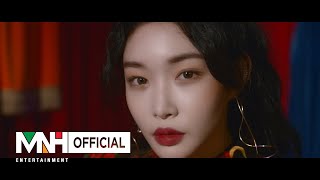
Selected defining Chungha solo videos. Daily gains and total views update through CVM Sekai’s YouTube tracking history.



Sources
What Chungha brought back to I.O.I
Chungha returned to LOOP with a solo career sturdy enough to swallow the room, then made the correct choice: she did not. The satisfying part is watching a dancer famous for command re-enter an ensemble and listen. Her control is still obvious in the attack of a turn and the way she places a shoulder accent, but the performance stays in conversation with eight other women.
That makes the reunion useful context for her solo catalog. “Roller Coaster,” “Gotta Go,” Querencia and Alivio prove scale and authorship; I.O.I proves adaptability. One does not downgrade the other. If anything, the contrast shows why she survived the industry’s habit of turning female soloists into one-song visual concepts.
Replay her work for dynamics, not just difficulty. Chungha can make a chorus feel larger by delaying force until the last possible count. When she spends that power sparingly, the stage looks expensive even before production does anything helpful.
RaeRae Reacts
Gimme A Minute: Jay Park and CHUNG HA Turned Flirtation Into a Timing Drill — exact playlist upload UUjLMDHlnGg.
Dance was never separate from the vocal story
Chungha is often divided into two compliments: technically strong dancer, dependable live vocalist. Her solo career works because those skills negotiate with each other. She does not treat choreography as decoration performed while a track plays. Movement changes the pressure, breath and attitude of a phrase, while the vocal tells the body which accents matter enough to keep.
Watch her torso rather than only the limbs. She can isolate a sharp detail while keeping the center stable, then release into a larger line without losing the beat’s internal subdivisions. That control gives the singing room. A performer who throws equal force into every count may look busy and sound breathless; Chungha chooses where the body spends energy so the entire performance can peak together.
Why the solo transition worked
I.O.I proved that Chungha could command attention inside eleven personalities, but a solo debut asks a different question: can one person generate contrast for an entire song? “Why Don’t You Know” answered with clarity rather than excess. The arrangement, choreography and summer color gave her room to establish a recognizable center without pretending the first single had to contain every future version of the artist.
Later releases sharpened the identity through rhythm and control. “Roller Coaster” made tension feel elegant; “Gotta Go” turned restraint into seduction; “Snapping” allowed harder edges without abandoning precision. The continuity is not one genre. It is the sense that Chungha understands exactly where the song’s balance point sits and can move around it without losing authority.
“Gotta Go” became a blessing and a trap
A signature hit gives an artist cultural shorthand, then dares every future release to reproduce the moment. “Gotta Go” crystallized Chungha’s mature performance image so completely that adjacent work was often judged by how closely it recreated that control. The correct lesson was not “make this song again.” It was that detailed choreography, a memorable tonal world and an artist with absolute command can make subtlety feel enormous.
Her catalog becomes more interesting when it resists the trap. Brighter songs, heavier club production and emotionally exposed material all test different parts of the voice and body. Not every experiment needs to replace the signature. A career can keep its landmark while building roads that do not circle it forever.
Querencia and the cost of proving range
Querencia was ambitious in scale, genre and rollout. It showed how many rooms Chungha could enter, but it also demonstrated the difficulty of asking one album cycle to carry a complete artistic thesis while external conditions keep changing. Range is exciting; it can also scatter attention if audiences are asked to process too many doors before they understand the house.
The album deserves listening beyond its singles because the sequencing reveals an artist testing languages, rhythms and emotional temperatures. It also deserves honest context about the strain surrounding an extended promotional period. “More content” is not automatically more care. Sometimes a concentrated campaign protects both the record and the person performing it better than a schedule built to prove inexhaustibility.
Agency change and rebuilding the pace
Chungha’s move into a new company chapter mattered because the public could hear and see a recalibration after an intense early solo run. Agency language often promises a fresh start, but the evidence arrives through music, credits, scheduling and how the artist describes her own participation. A profile should record the contract change, then let releases prove what actually changed.
“EENIE MEENIE” and the work around Alivio show a performer willing to re-enter pop without acting as though the previous chapter never happened. The voice carries more grain and the performance can tolerate more looseness. Control remains, but it is no longer always presented as immaculate distance. That shift gives the artist somewhere human to stand inside the technique.
Collaboration should reveal chemistry, not just reach
A featured artist can be added to a song as marketing arithmetic, or the collaboration can create a conversation neither performer could have alone. When Chungha works with another singer or rapper, listen for whether the arrangement changes around them. Does she answer the guest’s rhythm, alter her tone or allow a rougher exchange to interrupt her polished center? Those interactions matter more than counting two famous names on one thumbnail.
The React tracker keeps each exact official upload separate because an MV, performance video and dance practice reveal different evidence. The music video builds the concept; a performance cut exposes spacing and camera dependence; a practice version shows the choreography’s mechanics. Chungha is precisely the kind of artist for whom those distinctions pay off.
Returning to I.O.I without shrinking the soloist
The 2026 reunion does not require Chungha to become her 2016 self. She returns as one of the clearest solo success stories produced by the project, but the group frame removes the need to demonstrate that success. In “Suddenly,” she can contribute experience rather than dominate the proof. That generosity is more convincing than assigning the established soloist every climax.
Her presence also changes how the old footage reads. Produce 101 showed potential under competition; I.O.I showed adaptation under a deadline; the solo catalog showed sustained authorship and physical command. LOOP places all three histories in the same shot. The achievement is not that the famous soloist came back to help. It is that a member returned to the specific chemistry that existed before the individual brand became enormous.
My Chungha replay map
Start with Produce 101 and I.O.I’s “Whatta Man,” then move through “Why Don’t You Know,” “Roller Coaster,” “Gotta Go,” “Snapping” and Querencia. Add “EENIE MEENIE,” a current live stage and “Suddenly.” For at least one song, watch the MV, performance video and dance practice in that order. The point is to hear how production, camera and body collaborate—not to decide which version contains the one true Chungha.
How this Chungha archive is organized
Chungha’s page separates the compressed I.O.I year from the much larger solo catalog because the two bodies of work answer different questions. The group record shows how she adapted inside eleven voices and competing agency schedules. The individual tracker follows releases credited to CHUNG HA, including distinct music videos, performance films and collaborations. A dance practice is not a duplicate when the review examines choreography that the edited MV cannot show.
Evidence is weighted toward official channels, label materials, album credits and complete performance footage. That matters for an artist whose reputation is routinely reduced to short dance breaks or isolated live notes. The useful archive preserves the setup, physical load and arrangement around the moment. View totals stay attached to their exact uploads, while writing, composition and featured-artist credits remain textual facts rather than numbers borrowed from another version of the song.
LOOP is documented as a nine-member 2026 promotion inside an eleven-member group history. Chungha participated; Mina and Jieqiong did not because of prior schedules. U&I names the original group fandom, not every audience she acquired as a soloist. That distinction lets reunion material connect back to I.O.I without shrinking a decade of independent work into “what happened after the project group.”