
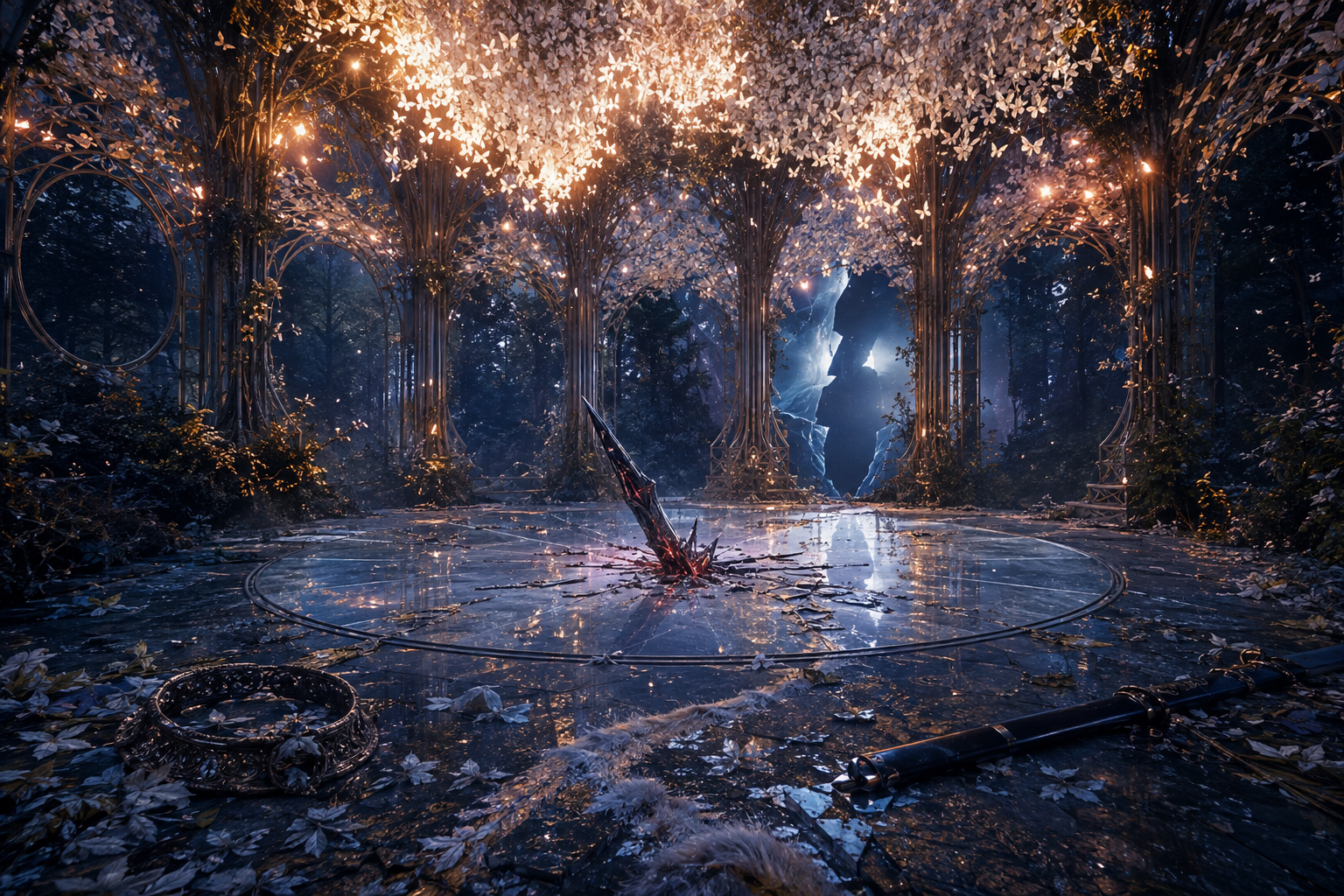
The Butterfly Roof Becomes a Rain of Fire
Amerasu gathers her people to name the wound they have been nursing for centuries. The instant she says she understands Ineluki’s design, the hidden sanctuary is breached through the very system meant to carry knowledge.
The scene begins as an intervention
Amerasu summons every resident of Jao é-Tinukai’i and chooses Westerling because much of her evidence came from Simon. That choice matters. The mortal guest is not decorative proof of cosmopolitan grace; he has the right to hear what his experience helped reveal.
She tells the Zida’ya that they carried Unbeing away from the Garden inside themselves. Their tragedy is not merely that mortality exists. It is that they have made death an intimate companion, polished old wounds until extinction begins to resemble beauty, and called withdrawal dignity.
Under the living roof, the sanctuary finally looks capable of examining itself.
Then Amerasu reaches the sentence the enemy cannot permit
She separates Ineluki’s living fire from the hatred now sustaining him. His claim begins in real injustice, but he sees the present only through grievance and would erase the world he says he is correcting.
She identifies Utuk’ku, explains the Norn Queen’s fear of Unbeing, and begins to say that she understands the enemy’s design.
That is when the conversation stops being historical reflection and becomes a target.
The door for knowledge opens both ways
The Mist-Lamp is one of the Witnesses: related to scales, pools, Speakfire, the singing Shard, and other structures touching the Road of Dreams. It makes communication across impossible distances real.
Utuk’ku speaks through it first. Then a fiery Red Hand presence, devouring light around itself, forces passage through the Lamp. The network has not merely been overheard. It has become an invasion route.
The hidden city’s greatest advantage—preserved knowledge and connection—turns into the geometry of the breach. No wall had to fall before the danger entered the room.
This is not one dramatic monster crashing a meeting
The Red Hand ignites the living butterfly roof. The Stormspike hound pack attacks at the same time. One hound carries Jingizu, the heart of Sorrow, proving the assault is also a retrieval operation. Ingen Jegger moves through the chaos toward Amerasu with Utuk’ku’s command.
Each layer answers a separate need: silence the explanation, reclaim the sword, create enough violence to overwhelm the defenders, and make the sanctuary’s beauty burn over the people who trusted it.
Jiriki later names the shape correctly. The timing is too exact to be accident. The enemy spends enormous force because Amerasu’s unfinished sentence threatened the larger plan.
The image is cruel because the roof was alive
A stone ceiling burning would be destruction. The butterfly roof turns destruction into betrayal of atmosphere. The city has used living beauty as architecture, evidence that withdrawal preserved something the mortal world could not.
Now luminous wings fall as fire.
The scene does not prove beauty was false. It proves beauty was never a defense strategy. Jao é-Tinukai’i can remain wondrous and still be reachable, penetrable, and politically accountable for what its isolation allowed to continue elsewhere.
Simon kills a hound—and then cannot stop
Simon fights with what is available and kills one of the white hounds using a rock. After Ingen stabs Amerasu, Jiriki runs him through and Sithi arrows finish the attack.
Simon keeps smashing the dying man’s face until others pull him away.
The excess matters. Grief, imprisonment, humiliation, Morgenes, Haestan, dragon terror, and helplessness do not excuse the act into heroism. The text leaves him ashamed because rage has crossed from resistance into repetition.
Inside a chapter about hatred surviving by feeding itself, Simon briefly becomes another mouth.
Amerasu’s death ends neutrality
Her last wish frees Simon. Likimeya and Shima’onari begin war councils. The Zida’ya can no longer narrate the conflict as a distant mortal catastrophe or preserve withdrawal as an ethically complete response.
The attack takes Amerasu’s explanation but supplies other evidence. Utuk’ku fears what she knows. The Red Hand can move through Witness infrastructure. Sorrow is required elsewhere. The hounds and Ingen were coordinated. Ineluki’s final design depends on convergence and silencing.
The missing sentence becomes an organizing absence for the rest of the series.
Why this moment keeps pulling
Stone of Farewell spends the entire book making sanctuary conditional. This is the image that closes the argument.
The roof is beautiful. It burns. The Witness connects minds. It admits an enemy. The hidden city preserves life. It cannot preserve innocence. Amerasu finally names the moral cost of retreat, and the world outside answers by entering violently.
Then the chapter leaves Simon not with a clean warrior transformation, but with shame, a dead elder’s charge, and a road back toward ordinary friendship.
On the record
This React is grounded in the complete owner-accessed Kindle reading of Stone of Farewell, through page 589. Its primary scene is Chapter 28, pages 549–569, reconciled with the owned-edition reference layer and later Five Houses evidence.