
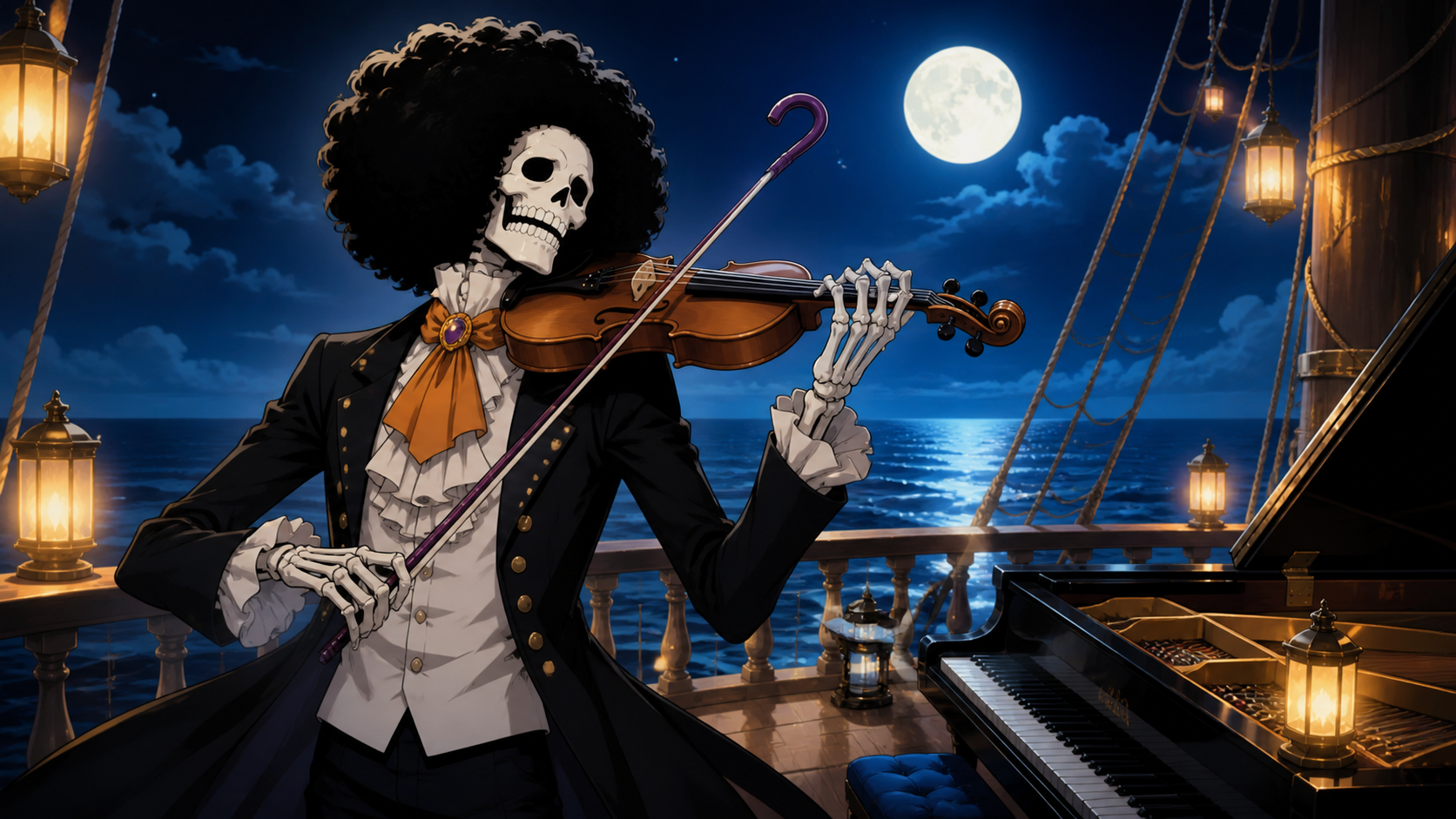
Brook: One Piece Character Profile
Quick profile
Brook is the Straw Hat musician, a swordsman from the West Blue, and the surviving member of the Rumbar Pirates. The official ONE PIECE.com profile lists him as 90 years old, 277 centimeters tall, born April 3, and carrying a 383 million berry bounty. His Revive-Revive Fruit returns his soul after death, but a long search leaves only a skeleton body to inhabit.
The Rumbar Pirates make music into a promise
Brook serves first as a convoy guard before joining the Rumbar Pirates under Yorki. Their crew treats music as daily infrastructure. Songs build rhythm for work, hold morale together, and make strangers feel welcome. Laboon, a young island whale, follows that sound until the Grand Line becomes too dangerous for a child.
The crew leaves Laboon at Reverse Mountain with a promise to circle the world and return. That promise defines Brook more deeply than any bounty. When illness forces Yorki and part of the crew to leave the Grand Line, Brook becomes captain. Later enemies poison the remaining pirates beyond Chopper-style medical rescue.
Binks’ Sake records people the world would lose
The Rumbar Pirates spend their final minutes performing Binks’ Sake into a Tone Dial. Voices disappear from the arrangement one by one until Brook finishes alone. The recording is not merely sentimental evidence. The song preserves a collective performance for Laboon and refuses the clean erasure of an entire crew.
Brook carries the Dial for fifty years because delivery matters. Memory is not a private feeling here. Memory has a recipient, a route, and unfinished work. Returning to Laboon means letting the whale hear both the joy and the loss rather than offering a softened version of what happened.
Fifty years alone on the Florian Triangle
Brook’s soul takes too long to locate his body after death. By the time he returns, only a skeleton remains. Gecko Moria later steals Brook’s shadow, preventing him from entering sunlight. He drifts alone through fog on the ruined ship with the bodies of his friends and no safe way to leave.
His comedy often arrives before the story lets loneliness speak. Decades without ordinary conversation make Brook eager for contact and terrified of another disappearance. Joining the Straw Hats does not erase that isolation. New relationships give him a life sturdy enough to carry the history without being reduced to the history.
Thriller Bark restores more than a shadow
Brook initially refuses Luffy’s invitation because Moria’s power makes travel in daylight impossible. Ryuma’s zombie body holds Brook’s stolen shadow, and Zoro ultimately wins the duel that returns the shadow to its owner. The crew also protects Brook from another cycle of solitary survival.
Luffy’s invitation matters because the captain wanted a musician long before meeting Brook. The role is not charity for a tragic survivor. Brook supplies a skill the crew values, accepts responsibility as a Straw Hat, and gains a credible route back to Laboon.
The skeleton body is funny and politically complicated
Skull jokes turn an impossible body into material Brook controls. He names the missing eyes, skin, stomach, and organs before other people can define him only through horror. The humor creates agency without pretending death was painless.
His repeated requests to see women’s underwear remain boundary violations framed as a running gag. Loneliness can explain Brook’s hunger for intimacy, but trauma does not create permission. The strongest Brook scenes let courtesy, care, and consent carry more weight than a joke that asks women to absorb his discomfort.
Swordsmanship, music, and the cold of the underworld
Brook uses a shikomizue, a blade concealed inside a cane, with fast fencing techniques built around precision. Music can lull enemies to sleep, produce illusions, coordinate movement, and strengthen morale. These are not decorative additions to a swordsman template. Performance changes the conditions of a fight.
Training develops his Revive-Revive Fruit beyond a second life. Brook can separate his soul from his body for scouting, pass through barriers, affect spiritual beings, and channel the chill associated with the underworld through his sword. His body can be broken and reassembled, but damage still creates risk and requires help.
Soul King turns celebrity into an escape route
During the two-year separation, Brook lands among the Longarm Tribe and becomes a professional touring musician known as Soul King. Fame expands his musical control and gives him access to audiences far beyond a pirate crew. His managers expect ownership of the profitable persona.
Brook uses the final concert to announce his allegiance to Luffy and return to the Straw Hats. The scene reframes celebrity as labor he can leave. An audience may love Soul King, but public affection does not cancel Brook’s promise, crew membership, or right to choose where his work goes next.
Whole Cake Island proves quiet competence
Brook infiltrates Big Mom’s territory, copies the Road Poneglyph, protects the copy, and directly confronts an Emperor whose Soul-Soul Fruit dominates ordinary spirits. His own relationship with death gives him unusual resistance and lets his music affect the homies.
He also breaks Mother Carmel’s portrait at the exact moment the alliance needs Big Mom destabilized. None of these jobs depends on being the strongest fighter present. Brook listens, identifies the objective, and completes work while louder crises pull attention elsewhere.
Music aboard the Thousand Sunny
A musician does more than provide a party after victory. Brook marks meals, mourning, reunions, boredom, and the stretches of sea where no enemy appears. The crew lives together for long periods in a moving home. Shared music helps ten people with incompatible histories develop rituals that belong to everyone.
His relationships carry different registers. Luffy offers uncomplicated welcome. Zoro recognizes disciplined sword work. Robin meets macabre humor without panic. Franky shares the experience of living in a body that refuses ordinary categories. Chopper can respond as both doctor and delighted audience. These connections keep Brook from becoming only the crew’s sad backstory.
Japanese performance by Chō
Chō gives Brook theatrical timing, formal courtesy, musical buoyancy, and aching restraint. The voice can stretch a skull pun into vaudeville, then narrow into the controlled delivery of a captain honoring dead crewmates. That range prevents the jokes and grief from feeling like separate characters.
Song performance is central rather than supplemental. Brook must sound like somebody whose musicianship could hold a ship together, build a worldwide career, and carry a last recording across half a century. Chō makes joy disciplined enough to survive sorrow.
RaeRae’s verdict
Brook is not proof that grief ends. He is proof that loyalty to the dead does not require joining them. He carries the song forward, accepts new friends without replacing old ones, and treats reunion as a responsibility rather than a fantasy.
The best Brook material understands that comedy can be survival without becoming immunity from criticism. Let the skeleton puns stay. Let the music stay loud. Let the underwear gag retire. His real charm has always been the combination of impeccable nerve, deep courtesy, strange anatomy, and a musician’s refusal to let silence receive the final word.
Fifty years alone cannot be solved by one welcome party
Brook’s loneliness lasts longer than several crewmates have been alive. The Rumbar Pirates die around him, his revived soul returns too late, and the ship becomes a moving grave where music preserves voices nobody else can hear. That history should affect more than the first Thriller Bark tears. Isolation changes how a person handles silence, touch, memory, conflict, and the fear that every new relationship will disappear.
The Straw Hats give Brook company, but company is not a reset button. His relentless jokes can be read as performance developed in a place where nobody remained to answer. He asks to see underwear, laughs at his own skeleton, and fills dead air before dead air can become the old ship again. The harassment still violates boundaries. Trauma can explain the compulsion without turning women into treatment for the compulsion.
I want more scenes where Brook gets to be quiet without the quiet becoming horror. Music with the crew, tea beside Robin, a watch shift under stars, or an ordinary disagreement can show that solitude no longer equals abandonment. Recovery is not forgetting the Rumbar Pirates. Recovery is learning that memory can live beside new noise.
Music carries testimony farther than a sword
Binks’ Sake is joyful, ridiculous, and devastating because the final performance becomes a record of people dying one by one. The Tone Dial preserves sound when bodies cannot continue. Brook carries that recording toward Laboon, but the promise is larger than one reunion. The song refuses the erasure of an entire crew.
His Soul King career extends that power. Celebrity gives Brook access, money, crowds, and a public identity the World Government does not fully control. Whole Cake Island proves he can use performance as cover while conducting precise intelligence work. He copies a Road Poneglyph, confronts Big Mom, and protects the mission without needing the story to announce that the musician became essential.
My Brook verdict depends on holding the comedy accountable without losing the grief. He is not lovable because death made every violation harmless. He is lovable because he keeps creating beauty after unspeakable isolation and can still choose to become more considerate inside a crew that offers another chance at ordinary life.
The reunion with Laboon cannot return the years they lost
Laboon waits at Reverse Mountain because the Rumbar Pirates promised to return. Brook survives because returning gives loneliness a direction. The promise is tender, but the eventual reunion should not be treated as though loyalty froze both lives safely in place. Laboon has Crocus, scars, routines, and decades of experience. Brook has died, wandered as a soul, endured the Florian Triangle, joined another crew, and become a global musician.
Keeping a promise after that much change means meeting again as the people they became, not restoring the afternoon when the promise was made. Brook must bring the Tone Dial and tell the truth about every friend who cannot arrive. Laboon must be allowed to respond as more than a reward waiting at the edge of the map.
I expect tears, music, and at least one joke timed so badly that the grief becomes breathable. More than anything, I want the reunion to honor continuity without pretending grief is unchanged love stored in a box. Brook’s journey matters because he carried memory forward while making new commitments. Returning to Laboon should confirm that new love never betrayed the old crew.
That future reunion also gives the crew a reason to complete the route rather than simply reach a treasure. Pirate King mythology can turn the voyage into one man’s achievement. Laboon reminds everybody that circumnavigation carries obligations waiting behind them. Brook is not sailing only toward the final island. He is sailing back to a friend. The route becomes a circle of accountability, which is a much better shape for freedom than a straight line toward glory. Even the final celebration should leave room for the whale who kept listening at the beginning of the world.
Brook’s body also complicates the usual One Piece promise that eating, sleeping, and medical care restore a fighter. He has no ordinary organs, yet cold, exhaustion, salt, spiritual damage, and fractured bones still create limits. Chopper has to learn a patient whose anatomy breaks familiar assumptions. Brook has to explain sensations that sound impossible to everybody else. Their collaboration could be one of the crew’s richest examples of disability-informed care: the patient remains the authority on lived experience, the doctor brings trained observation, and neither pretends an unusual body is a punchline before being a body that deserves accurate treatment.
His age should matter beyond jokes about bones. Brook remembers a political and musical world that predates nearly every current alliance. Songs, customs, and names survive in him even when official archives forget them. Robin reads stone history; Brook carries lived history in melody. Their knowledge belongs together.
Official sources and routes
ONE PIECE.com: Brook official character profile
ONE PIECE.com: current anime staff and Japanese cast
Watch One Piece on Crunchyroll
Browse One Piece character profiles