
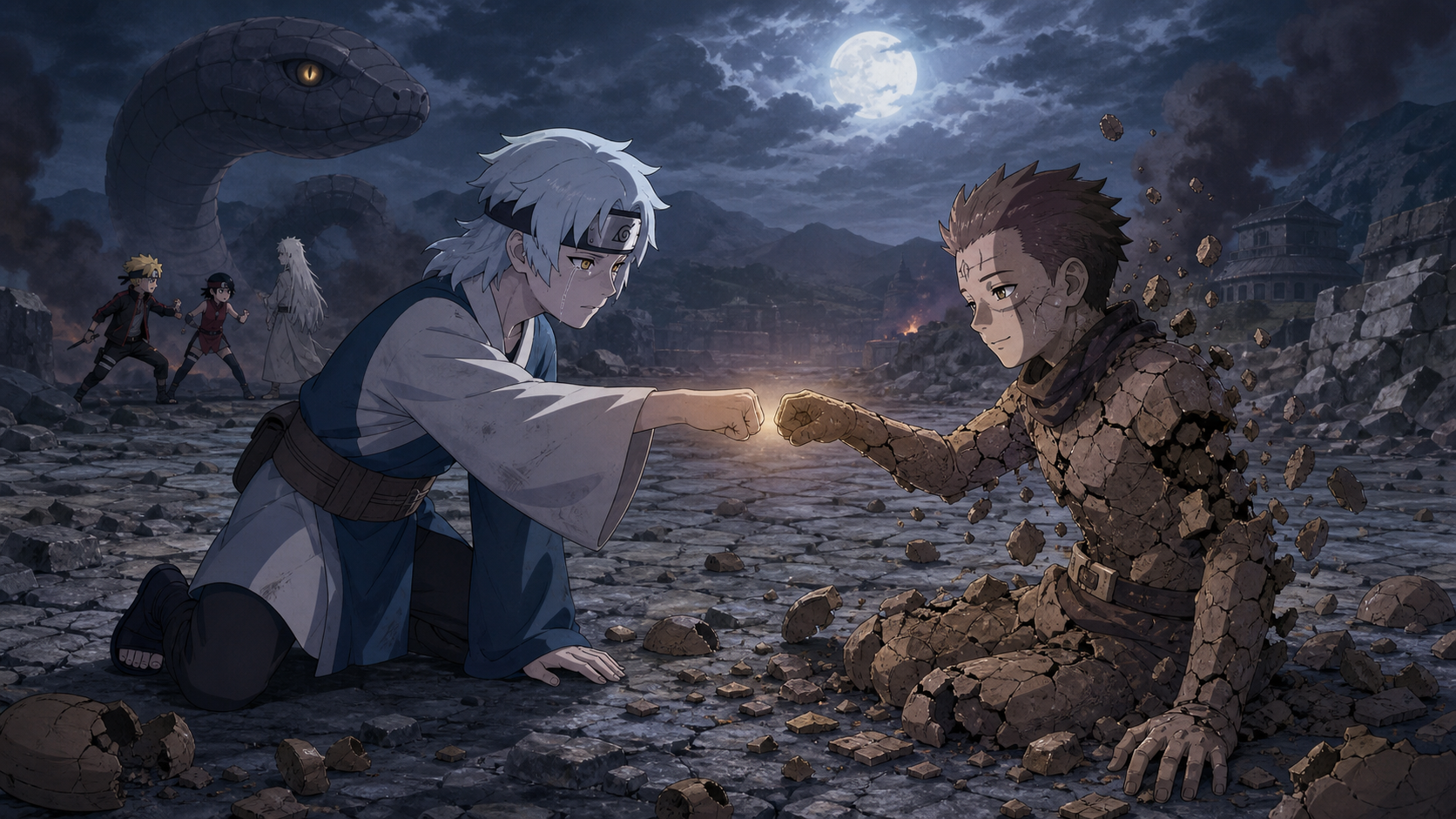
Mitsuki and Sekiei
Sekiei needs Mitsuki's betrayal to mean their friendship was false. An unfinished fist bump leaves both truths together: the mission was deception, and the care was real.
Series: Boruto: Naruto Next Generations
Episode: 90 · Mitsuki and Sekiei
Arc: Mitsuki Disappearance Arc
Release: 2019-01-20
Previous: Episode 89 · A Piercing Heart
Directory: All 293 Boruto episodes
Bottom line
Boruto Episode 90 makes Mitsuki defend two friendships that cannot survive in the same shape. Boruto and Sarada finally know he was working against Kū, but Sekiei experiences the reveal as a personal betrayal. He believed Mitsuki listened, cared, and might help the Fabrications live. Mitsuki did care. That truth makes the fight worse, not easier. Sekiei attacks with a body already cracking apart, pushes Mitsuki to fight by threatening Boruto, and spends his remaining life trying to force one clear answer from a friend who will not give him the hatred he expects. Their unfinished fist bump becomes the episode's real wound. Elsewhere, Kirara traps Boruto and Sarada until Boruto summons Garaga, the enormous snake who once rejected human trust. Garaga chooses to answer and helps break Kirara's control, another relationship proving that loyalty can exist without ownership. By the end, Kū has stolen a human heart and recovered, Kirara and Sekiei are gone, and Team 7 faces the final consequence of Ōnoki's experiment. The episode refuses the easy version where Mitsuki's secret plan makes every hurt disappear. He saved Iwagakure and still broke Sekiei's trust. He cared about Sekiei and still had to stop him. Sometimes a choice can be necessary and heartbreaking at the same time.
Kū runs because Mitsuki's strike worked
Mitsuki's attack damages Kū badly enough to force a retreat. The artificial leader who celebrated receiving a heart now scrambles toward medical help while the disguised snakes expose the deception behind him.
Boruto and Sarada want to pursue immediately, but the battlefield splits. Kirara blocks their path. Sekiei blocks Mitsuki's. The teammates who just reunited must separate again before any conversation can happen.
Sekiei sees betrayal before strategy
Sekiei watched Mitsuki hand Kū the false heart and strike from behind. He does not see a successful infiltration. He sees the person he trusted reveal that their time together contained a hidden purpose.
That reaction is fair. Mitsuki protected a larger group, but Sekiei's friendship was not imaginary. Sekiei shared questions, fear, and hope with him. Discovering that Mitsuki planned against the Fabrications makes every intimate conversation feel contaminated by doubt.
Mitsuki does not want this fight
Mitsuki tries to stop Sekiei without escalating. He avoids lethal attacks and speaks with the same quiet directness he used during their earlier conversations.
Restraint is not enough for Sekiei because he is not only trying to win. He wants Mitsuki to acknowledge the rupture. Every calm dodge can look like another refusal to treat his feelings as real.
Explosive Clay turns grief into range
Sekiei attacks with Explosive Clay, filling space Mitsuki might otherwise use to disengage. The technique gives his anger a physical shape: small creations launched outward, each carrying destruction inside.
His body is already deteriorating, so every attack spends time he does not have. Sekiei knows the cost and keeps throwing. The fight becomes a countdown powered by emotion rather than tactics.
Threatening Boruto forces Mitsuki's answer
Sekiei understands that Mitsuki will continue holding back unless somebody he loves becomes the target. He threatens to kill Boruto. The provocation works.
This is not proof that Boruto matters and Sekiei does not. The threat forces Mitsuki to protect one friend from another. Sekiei turns the hierarchy he fears into a weapon, then suffers when Mitsuki responds exactly as predicted.
Mitsuki's body knows how to end the fight
Once Mitsuki fights seriously, the difference in control becomes clear. He was created, trained, and repeatedly tested by Orochimaru. Sekiei was rushed into existence with a failing frame and a narrow military purpose.
Both are artificial beings, but their conditions are not equal. Mitsuki received enough stability and experience to form a life beyond the laboratory. Sekiei received a deadline.
Sekiei wanted a future with friends
Sekiei's questions were never only about becoming human. He wanted to know whether a heart would let him remain with Kū, Kakō, Kokuyō, Kirara, and Mitsuki. Strength mattered because survival mattered.
Kakō and Kokuyō are already dead. Kū has betrayed Ōnoki. Kirara is fighting elsewhere. The imagined future collapses while Sekiei's body follows. Mitsuki becomes the last person close enough to receive all that grief.
Mitsuki admits the friendship was real
Mitsuki tells Sekiei that he always considered him a friend. The statement comes too late to save the fight, but not too late to matter.
Mitsuki's mission required deception. His affection did not. Both existed together. Sekiei does not have to forgive the deception before dying, and Mitsuki does not have to deny the mission to validate the bond.
The unfinished fist bump says more than a speech
Mitsuki and Sekiei reach toward the fist bump associated with their friendship. Sekiei dies before the gesture can fully settle into completion.
The almost-contact hurts because the distance is tiny. They understand each other one moment too late, with only air left between intention and touch. The image refuses a clean reconciliation while preserving tenderness.
Mitsuki's face carries grief without performance
Mitsuki does not collapse into a loud display. His stillness makes the loss feel heavier. The character has spent the arc being asked whether he has a will, heart, or emotional center. Sekiei's death does not need theatrical proof.
Quiet grief is still grief. The absence beside him becomes enough.
Kirara thinks control has already won
Boruto and Sarada face Kirara after escaping one round of her genjutsu. She remains confident because controlling bodies allows her to turn teamwork against itself.
Her mistake is assuming every relationship depends on direct command. Boruto has another bond available, one Kirara cannot see inside the room.
Boruto summons Garaga
Boruto calls Garaga, the enormous one-eyed snake he met in Ryūchi Cave. Their earlier conflict centered on betrayal. Garaga distrusted humans because a former summoner abandoned him, and Boruto promised to prove Mitsuki's bond was not another version of that wound.
The summoning pays off the arc rather than functioning as a random larger attack. Garaga answers during the moment Boruto is trying to reach the friend he refused to abandon.
Garaga chooses to help
A summoning contract creates a route, not automatic affection. Garaga's decision to answer matters because he is famously unwilling to be treated like obedient equipment.
Kirara's worldview depends on turning people into dolls. Garaga is the worst possible counterargument: huge, irritable, independent, and helpful only on terms that preserve his own will.
Sarada and Boruto fight beside a difficult ally
Boruto and Sarada coordinate around Garaga's scale and power instead of commanding every movement. The alliance is messy, but messiness is more alive than Kirara's perfect puppet arrangement.
Teamwork does not require identical motives. Boruto wants Mitsuki. Sarada wants the village freed and her teammate safe. Garaga wants to settle his own relationship with trust. Their actions overlap enough to stop Kirara.
Kirara dies without understanding connection
Kirara's defeat ends the threat of her genjutsu, but the larger tragedy remains. She developed a will and used that freedom to remove choice from others.
Like Kakō and Kokuyō, she dies during the first short stretch of life where personal preferences became visible. Ōnoki created beings capable of becoming people and placed them inside a crisis before they could become much else.
Kū finds the heart he was promised
Kū escapes and obtains a real human heart. His body recovers. The success is horrifying because the transplant proves the doctor's theory worked.
Technical success does not redeem the method. Kū survives through the exact sacrifice Ōnoki claimed the project would prevent. The new heartbeat becomes evidence of murder, not humanity.
A transplanted organ cannot answer Sekiei's question
Sekiei dies without receiving a heart. Kū lives after taking one. Their outcomes make Mitsuki's earlier statement concrete. The organ restores physical function but does not decide character.
Sekiei, without a biological heart, protects friends and seeks connection. Kū, with a human heart, prepares more violence. Anatomy is not the moral verdict.
Boruto's faith was right and incomplete
Boruto believed Mitsuki had a reason to leave and refused to label him a traitor. Episode 90 vindicates that faith. Mitsuki sabotaged the factory, deceived Kū, and protected the village.
Faith did not give Boruto full knowledge. Mitsuki formed a genuine friendship with Sekiei, made independent choices, and accepted risks Boruto never approved. Believing in somebody is not the same as understanding every part of them.
Sarada's questions were also right
Sarada kept asking what evidence supported Boruto's certainty. Her caution never meant she cared less. She understood that loyalty without attention can become another way of ignoring a friend's choices.
Team 7 needs both instincts. Boruto keeps the relationship open. Sarada keeps reality visible. Mitsuki needs space to choose without losing people willing to challenge those choices.
Mitsuki learned from both sides
The Fabrications showed Mitsuki a version of created life defined by short bodies, assigned purpose, and desperate questions. Boruto showed him a version of friendship that refuses easy abandonment. Orochimaru gave him freedom while remaining fascinated by what he would choose.
Mitsuki's double game belongs to the person emerging between those influences. He no longer acts only because Boruto is his sun. He decides what must be protected and accepts the loneliness of acting before anyone understands.
Team 7 returns to the same battlefield
After Sekiei and Kirara fall, Mitsuki rejoins Boruto and Sarada. The team faces Kū, newly stabilized through a stolen heart.
The reunion has no time for a detailed apology. Their shared direction becomes enough for the moment. Emotional repair can come after survival, but the need for later repair should not be forgotten.
Sekiei deserved more than one borrowed purpose
Ōnoki and the doctor built Sekiei to supervise Akuta and serve a project. When curiosity appeared, nobody paused the operation to let him discover a life beyond that assignment. He learned friendship while traveling toward a crisis and learned grief while his body failed. Even his hope for a transplant remained tied to becoming useful for the same group.
Mitsuki briefly showed him another possibility. A created person could choose a friend, ask embarrassing questions, enjoy a conversation, and care about someone outside the creator's instructions. That glimpse made Mitsuki's betrayal feel larger because Sekiei attached a possible future to the bond. The tragedy belongs to the system that gave him days where he needed years. Blaming Sekiei for reacting badly would miss the adults who manufactured desperation and called the result protection.
Boruto will have to hear the story he missed
Boruto reaches Mitsuki after the fight, but he did not stand beside him for Sekiei's final moments. He saw an opponent keeping Mitsuki from the team. Mitsuki lost a friend whose relationship Boruto barely knew.
That gap matters for whatever Team 7 becomes after the mission. Boruto cannot make the reunion complete by saying faith won. Mitsuki needs room to explain why Sekiei mattered, including the parts of the relationship that existed while Boruto felt abandoned. Friendship has to tolerate stories formed outside the friendship. Otherwise Boruto's loyalty becomes another demand that Mitsuki orbit only him.
Sarada may understand that boundary first. She spent the arc insisting that Mitsuki's will could lead somewhere Boruto did not expect. The team can welcome him home while accepting that home is not the only place where his inner life happened.
Sekiei experiences strategy as personal abandonment
Mitsuki strikes Kū to protect Boruto and stop the plan. Sekiei sees the action through a relationship built on Mitsuki appearing to choose the Fabrications.
The misunderstanding is not stupidity. Mitsuki never gave Sekiei the information required to read the betrayal as strategy. Every private conversation, shared question, and promised future now looks like evidence collected under false pretenses.
Mitsuki had reasons to hide his purpose. Those reasons do not remove the emotional reality of what Sekiei experiences when the truth arrives through violence.
Mitsuki does not want the fight and cannot refuse the consequences
Mitsuki knows Sekiei's body is failing, understands the desperation behind the attack, and values the friendship they formed. None of that allows him to let Sekiei threaten Boruto or continue protecting Kū.
Compassion does not always produce a peaceful option. Mitsuki tries to speak, restrain, and delay, but the battlefield keeps narrowing until his body knows exactly how to end the danger.
The tragedy comes from competence. Mitsuki can survive because he is strong enough to harm someone he wishes he could save.
Explosive Clay gives Sekiei distance from the body already betraying him
Sekiei's technique lets him attack through created objects while his own movements become less reliable. The range is tactical and emotionally appropriate for a person afraid that closeness will expose weakness.
He can fill the space with noise, force Mitsuki to respond, and postpone the conversation underneath the explosions. Every detonation says that the relationship must be fought before the body runs out of time.
The spectacle never hides the physical collapse. Sekiei is spending a life measured in hours to demand an answer he should have received before the battle.
Threatening Boruto forces Mitsuki to reveal the hierarchy of his choices
Sekiei understands that Boruto matters to Mitsuki and uses that bond to make neutrality impossible. Mitsuki can no longer protect the mission through ambiguity.
Choosing Boruto does not prove Sekiei meant nothing. Mitsuki chooses to stop immediate harm while grieving the person causing the harm.
The episode resists the childish equation where one protected friend invalidates every other attachment. Mitsuki's loyalties conflict because both relationships are real.
The killing strike reveals how much Orochimaru built into Mitsuki
Mitsuki's body moves with precision when the emotional self hesitates. Orochimaru created a child capable of ending threats efficiently, and that capability remains available during the most painful relationship Mitsuki has formed outside Konoha.
The skill saves Boruto. The same skill leaves Mitsuki holding the result of a decision no laboratory can process for him.
Power gives him an answer to danger. Power gives him no answer for what to do with grief after the danger stops.
Sekiei wanted friendship before he understood how little time remained
The Fabrications were promised purpose, service, and replacement bodies. Sekiei found something less organized and more human in Mitsuki: conversation, curiosity, irritation, and the possibility of being remembered by choice.
That desire does not absolve his participation in the takeover. The desire explains why betrayal hurts more than physical failure.
Sekiei wanted a future large enough to contain friendship. Ōnoki's project gave him a body too unstable to reach that future.
The unfinished fist bump protects the relationship from a false clean ending
A completed gesture could turn the death into reconciliation packaged for the audience. The missed contact preserves everything neither boy managed to resolve.
Mitsuki admits the friendship. Sekiei does not receive enough time to decide what that admission changes. Forgiveness, anger, relief, and doubt remain suspended between their hands.
The scene hurts because death interrupts rather than completes the conversation. Loss rarely waits for emotional symmetry.
Mitsuki's grief is quiet because grief does not owe the room a performance
Mitsuki does not collapse into a speech large enough to make Sekiei's death legible to everybody nearby. His face, stillness, and delayed movement carry the shock.
Quiet grief can be mistaken for limited feeling, especially around a character already treated as emotionally artificial. The episode refuses that reading by letting the camera remain with him.
Mitsuki's expression matters because nobody else fully understands what relationship just ended.
Garaga helps because Boruto allowed distrust to remain part of the contract
Garaga never becomes a cheerful mascot. The snake remembers betrayal, challenges Boruto's certainty, and keeps his own judgment.
Choosing to answer the summon means more because Boruto did not force emotional obedience. Their difficult alliance survives disagreement long enough to become trust.
Garaga's arrival offers a counterpoint to Sekiei. One bond forms after acknowledged suspicion. The other collapses under truths withheld until battle.
Kirara mistakes controlled movement for owned identity
Kirara can manipulate bodies and interpret obedience as proof that connection is unnecessary. The control works mechanically and fails as an understanding of people.
Boruto, Sarada, and Garaga coordinate because each actor retains judgment. Kirara's puppets move cleanly because judgment has been removed.
Her defeat comes from relationships that contain friction, not from perfect submission. Connection is slower than control and more adaptable when the plan breaks.
Kū's transplant cannot manufacture the heart Sekiei developed
Kū receives a human organ and treats the functioning body as evidence that he has crossed into the future promised to him. Sekiei dies with no transplant and leaves behind affection, regret, loyalty, and grief.
The contrast is not that biology means nothing. The organ sustains life. The organ does not dictate what the living person values.
Kū steals the mechanism associated with a heart. Sekiei built the relationships people mean when they say someone had one.
That distinction also protects Mitsuki from the same reduction. Orochimaru engineered organs, chakra pathways, and abilities, but no creator can install the meaning Mitsuki formed through Team 7, Sekiei, or the choices that placed those relationships in conflict. A body can be designed. A lived identity accumulates beyond the design.
Quick reaction
Episode 90 is the Mitsuki arc's emotional center because Sekiei was not a fake friend placed beside a secret hero. He was a real friend aligned with a harmful plan, and Mitsuki was a real friend secretly working to destroy that plan. Their bond cannot cancel the conflict. The conflict cannot make the bond false. That is why the unfinished fist bump hurts more than a polished goodbye. Garaga answering Boruto offers the opposite movement: an old betrayal does not prevent a difficult new trust from forming. Kū's stolen heart closes the argument with brutal clarity. A human organ can keep a body moving while the person chooses cruelty. Sekiei's failing body could hold affection without one. Mitsuki survives between those truths, carrying a grief nobody else in Team 7 fully witnessed.
Sources and lawful viewing
Official episode reference: Naruto Official episode guide
Licensed episode route: Crunchyroll licensed series page