
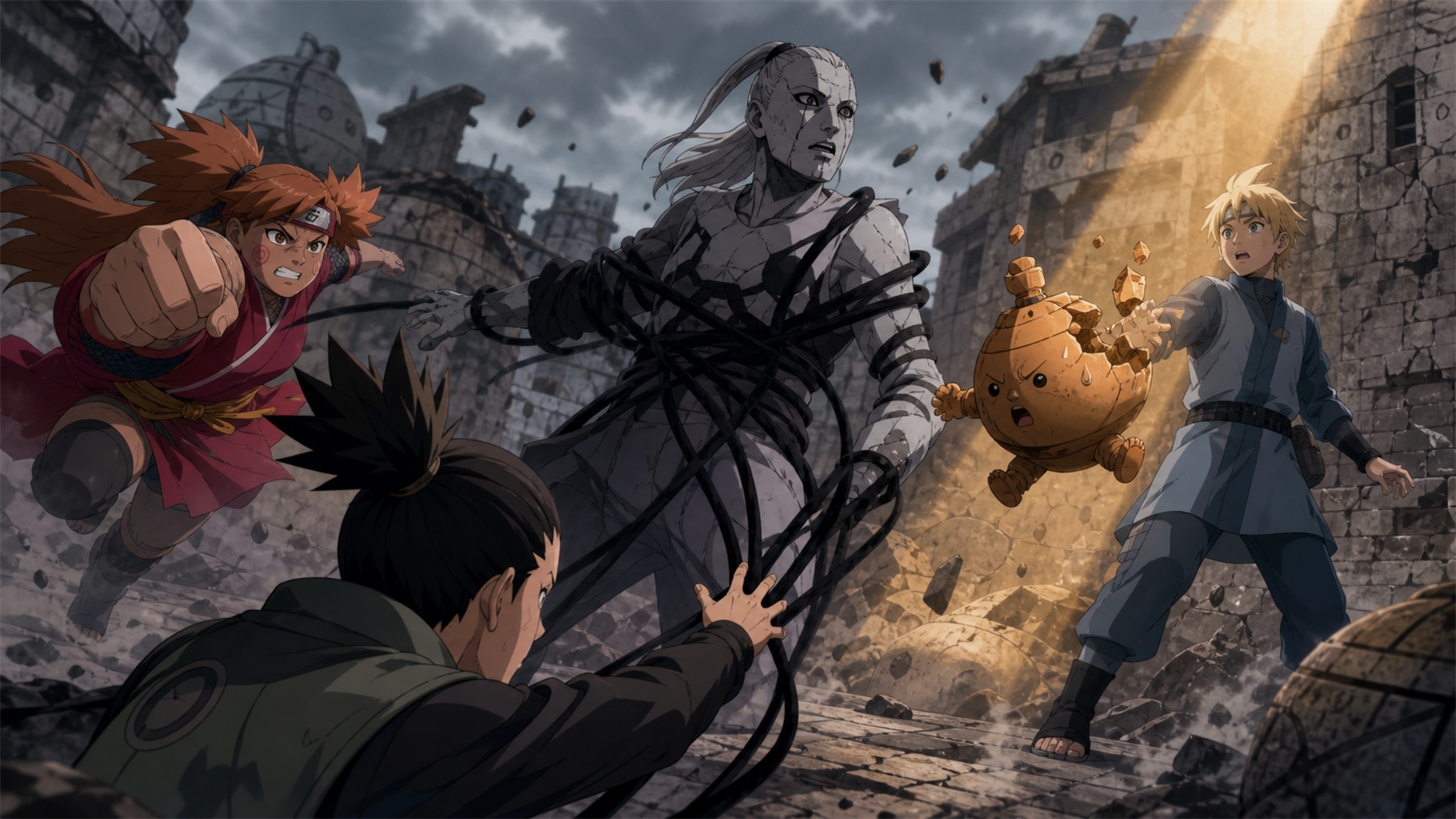
Clash: Kokuyou!
Kokuyou claims he has no heart. Team 10's shared strategy and Akkun's final choice prove that biology was never the only place a heart could live.
Series: Boruto: Naruto Next Generations
Episode: 88 · Clash: Kokuyou!
Arc: Mitsuki Disappearance Arc
Release: 2019-01-06
Previous: Episode 87 · The Sensation of Living
Directory: All 293 Boruto episodes
Bottom line
Boruto Episode 88 breaks Ōnoki's fantasy in public. He returns to Iwagakure expecting Kū to explain a temporary complication and finds empty streets, imprisoned villagers, roaming Akuta, and five human beings prepared for heart transplants. Kū is no longer asking permission. The artificial son Ōnoki created to protect his plan has taken the plan away from him. While the former Tsuchikage confronts that failure, Team 10 faces Kokuyō and proves the very idea his creators denied: strength is not only the power held inside one body. Shikadai's trap, Inojin's Mind Body Switch, Chōchō's physical force, and Akkun's tiny act of protection become one shared answer. Kokuyō insists that he has no heart. Inojin entering his mind proves otherwise. Akkun dies after saying Inojin's name, and Inojin tries to pretend the loss does not hurt while tears make the truth obvious. The episode places artificial lives on both sides of its argument. Kū uses threatened life to justify harvesting humans. Akkun spends his life protecting one human friend. The presence of a heart never guaranteed kindness. Choice reveals what somebody does with one.
Iwagakure no longer looks like Ōnoki's village
Ōnoki escorts the captured Konoha genin and Akatsuchi back into the village believing that he can still control the situation. The streets correct him before Kū says a word. Battle damage covers familiar places. Villagers have disappeared. Akuta patrol openly. A secret experiment has become an occupation.
The silence is important. Ōnoki wanted to protect the village's future, but the actual village has been removed from view so his project can operate without resistance. Any plan that requires the people to vanish before peace becomes visible has already failed.
Kirara tells Ōnoki to ask Kū
Ōnoki demands an explanation from Kirara and receives a casual redirection. Ask Kū. That small exchange shows the hierarchy has changed. The Fabrications no longer treat their creator as the final authority. Kirara follows the leader who controls the present operation.
Ōnoki built a chain of command and assumed gratitude would keep him at the top. Personhood does not work that way. Once the Fabrications developed preferences, fear, and loyalty, they could decide whose orders served them. Kū offers survival. Ōnoki suddenly offers restraint.
Kū calls occupation an adjustment
Kū insists the plan is proceeding, only under changed conditions. The euphemism is almost impressive. Captured citizens, forced confinement, armed patrols, and stolen government become operational adjustments because admitting the word takeover would destroy the claim that everybody still serves Kozuchi's peaceful will.
This is how a bad plan protects itself from evidence. Every contradiction becomes proof that more control is required. Villagers resist, so villagers must be contained. The Fabrications deteriorate, so human hearts must be taken. Ōnoki objects, so Ōnoki must be removed from authority.
Five hearts end Ōnoki's excuse
Kū reveals that five human beings have been secured as heart sources. Ōnoki finally denounces the action as the opposite of his intention. He wanted artificial soldiers to prevent young shinobi from dying. Kū intends to kill living people so the artificial soldiers can survive.
The contradiction was present from the beginning. Created bodies with limited stability were never an escape from sacrifice. The project only delayed the question of who would pay. Once the Fabrications feared death, the hidden cost became human inventory.
Kū shows the body that is running out of time
Kū's deterioration keeps the confrontation from becoming morally simple. His body is cracking. He and the other Fabrications are dying because Ōnoki and the doctor created them before solving the foundation of their survival. Their demand for help is not fake.
Kū uses a real injustice to authorize another one. He was created with consciousness and a death sentence. The prisoners did not create him. Their hearts cannot become compensation. Responsibility belongs to the adults who started the experiment, not the nearest bodies capable of being harvested.
Ōnoki gives an order after losing power
Ōnoki orders Kū to release everybody. The command sounds like a Tsuchikage speaking, but the office no longer answers him. Kū questions whether Ōnoki truly supports the plan if he would allow the Fabrications to die.
That accusation finds the weakest point in Ōnoki's thinking. He wanted to imagine the Fabrications as tools when sacrifice felt distant and as lives when their success reflected his compassion. Kū forces him to confront both meanings at once. They are lives. That truth does not grant them ownership of other lives.
Kū knocks down the father he outgrew
When persuasion fails, Kū strikes Ōnoki unconscious. The other Fabrications hesitate, which matters. They recognize a boundary even when they do not stop him. Kū explains the violence by claiming Ōnoki is temporarily confused.
The language mirrors every controlling leader who removes dissent while insisting the dissenter will eventually understand. Kū has inherited more than Ōnoki's plan. He has inherited the habit of deciding another person's will for them.
Shikadai turns one explosion into an exit
As Akuta prepare to attack the genin, an explosive-tag kunai fills the area with smoke. Shikadai appears, frees the group, and pushes them toward escape while many Akuta remain occupied guarding captured citizens.
His timing is not luck. He has already studied patrols, routes, and the village's new priorities. Shikadai keeps surviving because he treats every system as something with a pattern. Even occupation creates habits. Habits create openings.
Team 10 stays while Boruto and Sarada move
Kokuyō blocks the escape route. Shikadai makes the necessary split: Boruto and Sarada must continue toward Mitsuki while Team 10 holds Kokuyō. The choice gives each group a clear job without pretending either job is safe.
Boruto has spent the arc insisting that reaching Mitsuki matters. Shikadai now protects that mission with his own body. Friendship here is not a speech about trust. Friendship is choosing the dangerous assignment that gives somebody else a chance to finish theirs.
Kokuyō has strength without range
Kokuyō is brutally fast and powerful, but Shikadai identifies a usable limitation. He lacks ninjutsu and therefore lacks dependable long-range pressure. The team cannot overpower him directly, so they must control distance, light, and timing.
This is the Team 10 inheritance at its best. Nara restraint, Yamanaka possession, and Akimichi force were built to combine. Their techniques become stronger because another person is ready to act inside the opening.
Shikadai hides the light before needing the shadow
Shikadai anticipates that Kokuyō will destroy nearby light sources to break Shadow Possession. He has Inojin prepare a hidden source for the moment after Kokuyō believes the trap is gone.
That planning is delicious because Kokuyō reads the obvious tactic correctly and still loses the exchange. Shikadai does not expect an opponent to remain ignorant. He expects the opponent to learn and builds the next layer around that learning.
Chōchō makes the opening count
Shadow restraint means nothing if nobody can convert the pause into damage. Chōchō does. She lands the physical hit Shikadai cannot deliver while maintaining control.
Her role also answers Kokuyō's obsession with isolated strength. Chōchō is powerful, but power arrives at the correct second because Shikadai and Inojin help create that second. Team 10 never asks one body to contain every solution.
Kokuyō learns their strategy
The first combination does not end the fight. Kokuyō understands the pattern, breaks pressure, and adapts. Inojin recognizes that repeating the same move will fail.
Shikadai responds with the option nobody knows will work: Mind Body Switch. Artificial anatomy, unfamiliar consciousness, and Kokuyō's force make the technique uncertain. The team uses the available chance because waiting for certainty would hand Kokuyō control.
Inojin enters the mind Kokuyō denies
Inojin's Mind Body Switch reaches Kokuyō. The possession does not hold for long, but success proves a crucial fact. Kokuyō contains a mind that the Yamanaka technique can enter.
Kokuyō has been told that lacking a biological heart means lacking the inner quality humans call heart. Inojin's presence inside him makes that division harder to defend. A person was there to reach, even if the body came from a laboratory.
Akkun wakes and chooses Inojin
Akkun remembers Inojin being taken and leaves the cave to find him. Nobody gives that order. No grand plan assigns the mission. The little Akuta moves because the relationship matters.
That choice carries more proof of personhood than all of Ōnoki's speeches. Akkun has preference, memory, worry, and loyalty. He does not need a human-shaped body or a dramatic vocabulary before those qualities count.
One tiny body changes the decisive second
Kokuyō forces Inojin out and moves to attack him. Akkun jumps into the line of danger, obstructing Kokuyō's vision long enough for Team 10 to try again. Kokuyō destroys Akkun's mask, but the interruption gives Chōchō the opening for a heavy strike.
Akkun cannot overpower Kokuyō. The contribution matters because protection is not measured only by size. A second of blocked sight can save a friend. Team 10's entire victory is built from people lending one another seconds.
Strength of heart is not a power level
Kokuyō cannot understand why humans endanger themselves for others. Shikadai explains that people make up for physical limits through another kind of strength, the strength of heart.
The phrase could become sentimental nonsense in a weaker fight. Episode 88 earns the line through mechanics. Shikadai risks becoming bait. Inojin enters an unknown mind. Chōchō trusts their timing. Akkun places a fragile body between Kokuyō and Inojin. Heart is visible as coordinated risk.
Kokuyō dies considering the possibility
Kokuyō denies possessing a heart because his body lacks the organ. Shikadai points toward the Mind Body Switch. Inojin could enter because there was a mind to enter. Kokuyō dies thinking about that contradiction.
His ending differs from Kakō's exhilaration but carries the same indictment. Another Fabrication discovers a personal truth at the exact moment the unstable body can no longer hold him. Ōnoki created consciousness without giving consciousness enough time.
Akkun says Inojin's name
Akkun manages to say Inojin's name before dying. The word destroys every attempt to classify him as disposable clay. Naming was the beginning of their bond, and the name returned at the end belongs to the person Akkun chose.
Inojin cries while trying to downplay the loss. That defense is painfully believable. Admitting how much Akkun mattered would make the grief feel even larger. Tears refuse the performance. A friend died.
Kirara turns Boruto and Sarada into dolls
While Team 10 fights for one another's agency, Kirara attacks Boruto and Sarada through genjutsu. Sarada activates the Sharingan knowing the threat, but Kirara still paralyzes them and prepares to play with them as obedient dolls.
The contrast is sharp. Akkun becomes more alive through a freely chosen bond. Kirara treats living people as toys once their choices are removed. Artificial origin is not the moral dividing line. Respect for another person's will is.
Konohamaru finds the factory and Mitsuki
Konohamaru reaches the Akuta production site, and Mitsuki finds him. Their meeting places an adult ally inside the physical center of the project just as the transplant preparations begin.
Mitsuki now stands between several definitions of created life. Orochimaru calls him a child and experiment. Boruto calls him a friend. Kū sees him as the key to stability. Konohamaru's response will matter because rescue must protect Mitsuki without pretending his choices never mattered.
Kū renames occupation because language is part of control
Calling the takeover an adjustment lets Kū describe violence as administration. Residents lose freedom, leaders lose authority, and artificial soldiers fill the streets, but the softer word asks everyone to treat the result as temporary maintenance.
The euphemism protects the person giving orders. If no occupation exists, no occupier must answer for the occupied.
Boruto has spent the arc watching people rename coercion as protection. Kū's vocabulary makes the pattern official.
Five stolen hearts destroy Ōnoki's claim that nobody would pay
Ōnoki designed the Fabrications because he wanted artificial soldiers to absorb risk instead of young shinobi. Kū answers by demanding human organs to extend artificial lives.
The project never removed sacrifice. The project moved sacrifice away from the creator's sight until the bodies became unavoidable.
Five hearts turn an abstract flaw into five people whose futures were treated as replacement parts. Ōnoki's intention cannot survive that evidence unchanged.
Kū outgrows obedience because personhood was always the uncontrolled variable
Ōnoki wanted created defenders capable of judgment on a battlefield and obedient enough never to challenge the purpose assigned to them. Those goals contradict each other.
Judgment produces interpretation. Interpretation produces disagreement. Kū learns to value his own survival, resents expiration, and decides the creator's limits should no longer bind him.
Knocking Ōnoki down is cruel. The act is also proof that the project produced a will rather than equipment.
Shikadai uses the explosion as information before using shadow as restraint
The blast changes visibility, positions, and the enemy's expectations. Shikadai recognizes an exit route inside the disruption rather than treating the explosion as pure damage.
His tactical strength comes from reading what a battlefield becomes after the plan fails. The shadow technique matters because he first creates conditions where the shadow can matter.
Leadership appears through sequence: move allies, hide intent, test the opponent, then commit the clan ability at the moment with the highest value.
Team 10 stays because splitting the group is not abandonment
Boruto and Sarada need to move toward Mitsuki and the center of the crisis. Shikadai, Inojin, and Chōchō remain against Kokuyō so pursuit remains possible.
The split works because roles are clear and the teams trust one another to carry separate risks. Nobody treats the most visible objective as the only meaningful fight.
Holding Kokuyō is rescue infrastructure. Team 10 creates the time other people need.
Chōchō turns one opening into shared momentum
Chōchō's strength matters because she acts when Shikadai creates the chance. Raw power without timing would teach Kokuyō another pattern and waste energy against a body built to absorb punishment.
Her contribution also prevents strategy from becoming Shikadai's solo performance. He can identify the opening, but Chōchō supplies the force that makes the opening consequential.
Team 10 succeeds when planning and power remain in conversation.
Inojin enters a mind Kokuyō insists does not count
Kokuyō treats inner life as irrelevant beside physical strength and assigned purpose. Inojin's technique reaches the consciousness behind that claim.
The encounter confirms that Kokuyō has perception, memory, judgment, and enough interior resistance to contest the intrusion. Denying the mind does not make the mind absent.
Inojin's clan technique becomes philosophical evidence through direct contact. Someone is home inside the artificial body.
Akkun chooses Inojin without an order or survival advantage
Akkun's return provides no tactical benefit to the tiny creature. Moving toward Inojin increases danger and eventually costs the life the bond had only begun to shape.
That sacrifice cannot be explained through original programming alone. Akkun recognizes a person, remembers care, and decides the relationship matters in the decisive second.
Choice makes the act loving. The artificial body does not reduce the choice.
Inojin's name becomes Akkun's final piece of language
Akkun learned a name, formed attachment, and used language to identify the person who changed a short life. Saying Inojin's name at the end gives the bond a direction no creator assigned.
The word does not need a surrounding speech. Limited language concentrates the meaning rather than shrinking the feeling.
Inojin hears proof that recognition traveled both ways.
Kokuyō's final question arrives too late and still matters
Kokuyō spends the fight measuring strength through combat output. Akkun's choice introduces a form of strength that cannot be ranked through durability or force.
He dies considering that possibility rather than converting instantly into a gentle person. The incomplete realization respects the character more than a sudden moral reversal would.
Personhood includes the capacity to encounter an idea too late and leave the question unfinished.
Kirara's puppets reveal the moral opposite of Akkun
Akkun becomes more fully himself through a freely chosen relationship. Kirara empties Boruto and Sarada's movement of choice while preserving the appearance of living bodies.
The contrast separates creation from violation. Artificial beings can choose. Human beings can be reduced to tools.
Moral worth depends on how will is respected, not which body was born and which body was built.
Akkun's death should change how the survivors describe the Akuta
Before Akkun, the small creatures function as enemy units, obstacles, and evidence of a manufacturing system. Inojin's bond creates a record that cannot fit inside the word weapon.
Survivors should carry that knowledge into the aftermath. Destroying a production site may be necessary, but people must distinguish active threats from created beings capable of choice, attachment, fear, or refusal.
Akkun cannot benefit from that revised understanding. Future created lives might, which gives grief a practical demand beyond remembrance.
Ōnoki's project failed because protection without consent became replacement
Ōnoki wanted to protect young shinobi from battlefield death. The project moved toward bodies designed to fight, expire, and be replaced without social grief.
That logic depends on declaring the created defenders less worthy of choice and mourning. Akkun makes the declaration impossible. Inojin grieves because a relationship formed, not because a biological checklist was completed.
Protection becomes exploitation when one class of life is expected to absorb danger so another class can remain innocent of the cost.
Team 10 leaves the battle with a victory nobody can celebrate cleanly
Kokuyō falls, Boruto and Sarada move forward, and the tactical objective succeeds. Inojin still holds the loss of a friend whose death made the opening possible.
Shikadai and Chōchō need to recognize that grief without demanding immediate composure for the next mission step. Operational success and personal devastation can occupy the same result.
The episode earns pain by refusing to let the scoreboard define what Team 10 carries away.
Quick reaction
Episode 88 hurts because Akkun proves the argument through love and dies before anybody with authority can learn from him. Ōnoki wanted artificial beings without troublesome wills. Kū developed a will strong enough to seize a village. Kokuyō developed a mind strong enough for Inojin to enter. Akkun developed affection strong enough to place a tiny body in front of a fatal attack. None of them remained tools. Their choices are not equally kind, but kindness was never the requirement for personhood. Team 10 wins because three inherited techniques become one shared strategy and a fourth unexpected friend gives them the final second. Inojin's tears are not a side note after the action. They are the evidence. Akkun belonged in his life, and losing him leaves a real absence.
Sources and lawful viewing
Official episode reference: Naruto Official episode guide
Licensed episode route: Crunchyroll licensed series page