
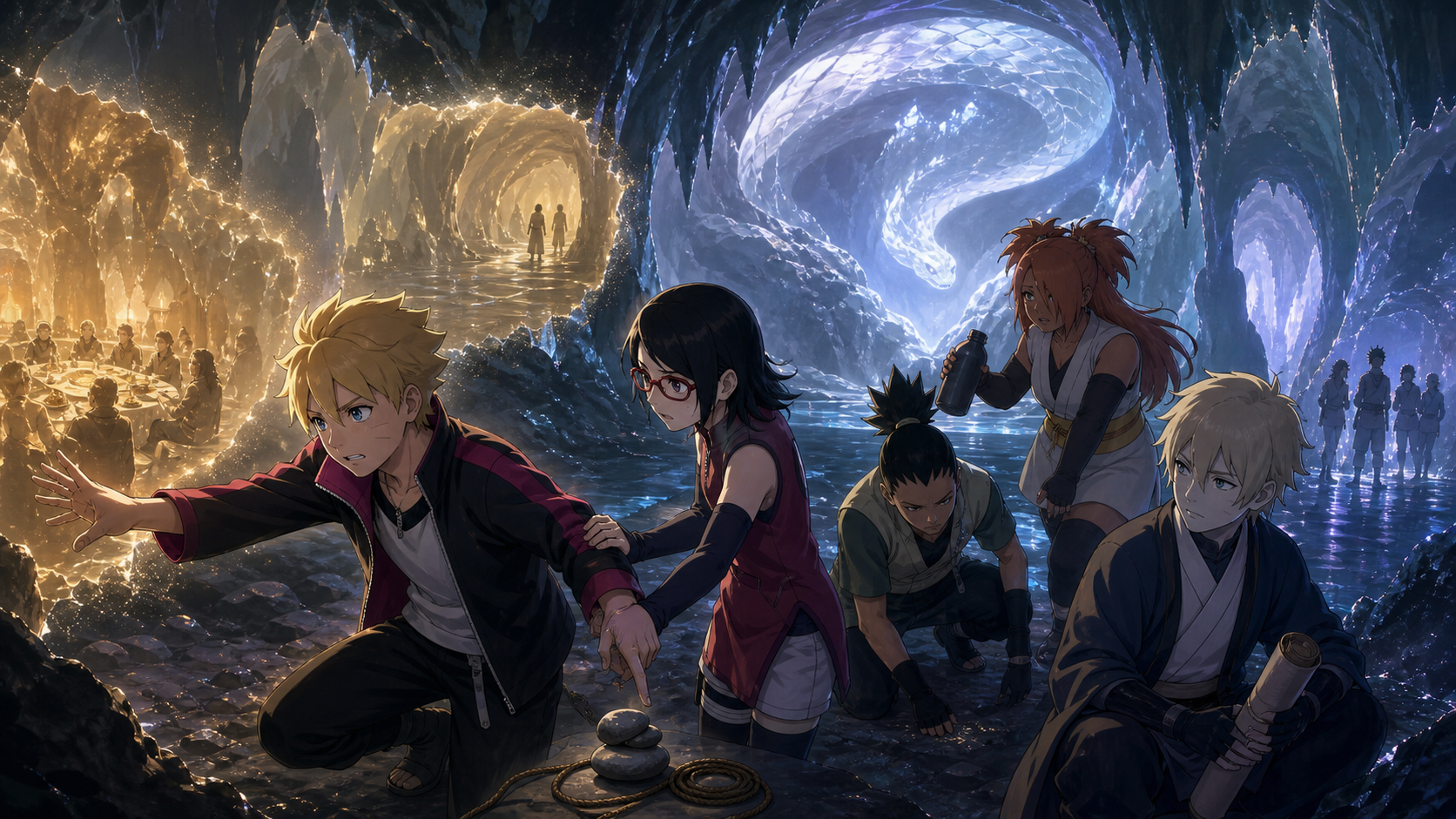
The Trials of Ryūchi Cave
Ryūchi Cave tests Boruto with a false feast, a stone puzzle, and visions built from his friends’ real criticism before the White Snake Sage names one final price.
Series: Boruto: Naruto Next Generations
Episode: 75 · The Trials of Ryūchi Cave
Arc: Mitsuki Disappearance Arc
Release: 2018-09-20
Previous: Episode 74 · The Enemy, Ino-Shika-Chō!
Directory: All 293 Boruto episodes
Bottom line
Boruto Episode 75 takes a hungry, exhausted group of genin, drops a luxury dinner in front of them, and waits to see who notices the hostess knows Mitsuki’s name. Ryūchi Cave does not announce itself with a sign. The cave appears when Boruto, Sarada, Shikadai, Inojin, and Chōchō have nearly run out of energy, then greets them with comfort designed to lower every guard they have left.
Boruto catches the lie because Tagorihime mentions Mitsuki before anyone in the group has introduced the reason for their visit. The palace dissolves, the food disappears, and the welcoming woman reveals the snake beneath the performance. That is only the first trial. Boruto then faces Ichikishimahime’s stone puzzle and Tagitsuhime’s attack on his heart before the White Snake Sage finally agrees to see him.
The episode works best as a creepy fairy tale. The three snake women are beautiful, playful, hungry, and completely comfortable with the possibility that children may become dinner. Boruto’s loyalty carries him through, but his friends’ accusations during the final illusion land because every word contains some truth. He has endangered everyone. He has ignored their objections. He is still the reason they have come this far. Passing the trial does not prove the criticism wrong. Boruto passes because he refuses to let guilt replace his purpose.
Episode file
- Series: Boruto: Naruto Next Generations
- Episode: 75
- Title: “The Trials of Ryūchi Cave”
- Arc: Mitsuki’s Disappearance Arc
- Japanese airdate: September 20, 2018
- Previous episode: “The Enemy, Ino-Shika-Chō!”
- Next episode: “Incurring Wrath”
The official episode guide keeps the premise simple: Boruto and the others find Ryūchi Cave, then must survive several trials before meeting the White Snake Sage. The actual episode is a test of appetite, problem solving, and resolve wrapped inside one deeply suspicious hospitality package.
The road makes everybody easy prey
The group wanders without a reliable map or clear description of Ryūchi Cave. Hunger and fatigue turn every step into an argument. Chōchō and Inojin complain because their bodies are asking reasonable questions that Boruto’s urgency keeps ignoring. Shikadai knows the mission has passed the point where determination can substitute for supplies.
Then the cave appears. The timing matters. A palace, warm welcome, beautiful host, and full table would be tempting under normal conditions. After days of searching, the offer feels like rescue. Ryūchi Cave does not attack their strength first. The cave waits until relief becomes the strongest desire in the room.
Boruto remains suspicious because Mitsuki occupies every part of his attention. That obsession protects him here. The same tunnel vision that creates trouble in ordinary life keeps him from accepting comfort before receiving an answer.
Tagorihime serves dinner with one fatal mistake
Tagorihime welcomes the group and encourages them to eat. Chōchō and Inojin are ready to respect local cuisine with their whole hearts. Sarada and Shikadai lower their guard enough to consider the offer. Boruto listens.
Tagorihime mentions Mitsuki. Nobody told her his name.
That tiny mistake breaks the illusion more effectively than a flashy jutsu. Boruto has spent the entire arc being accused of moving through emotion instead of evidence, and here he catches the decisive piece of evidence before everybody else. He does not sense evil chakra or activate a special eye. He remembers the conversation.
Tagorihime’s face twists into a snake, the palace falls away, and she complains that the children did not eat enough for her to consume their chakra. Ma’am. The customer service survey will be brutal.
The first trial is hunger, not purity
The dinner illusion does not prove that anyone who reached for food lacks loyalty. Hungry children wanted food. That is not a character failure. The trial measures whether the group can notice manipulation while their bodies are depleted, which gives the cave a serious home-field advantage.
Boruto succeeds because Tagorihime reveals information she should not know. Without that mistake, the entire group might have eaten. His victory depends on attention and luck as much as moral resolve. The episode wisely avoids treating Chōchō’s appetite as the reason the trap nearly works. Everybody is tired. Everybody wants the search to become easier for one night.
The unseen voice in the fog reminds Tagorihime that the group did not fail and sends them onward. Ryūchi Cave has rules, but the people taking the test do not receive those rules in advance. That mystery creates atmosphere and also makes every success feel precarious.
The fog splits the group
Once the false welcome disappears, the genin move deeper into fog thick enough to separate them. The teamwork that carried them through earlier danger becomes harder to use. Boruto follows a figure and enters a chamber alone. A door seals behind him.
Isolation changes the test. During the dinner illusion, Boruto could compare what he heard with what his friends remembered. Inside the chamber, nobody can confirm what is real or help him read the instructions. Ryūchi Cave wants individual answers, even though the search for Mitsuki has been powered by a group.
The split also puts Boruto back in the position he keeps choosing: the person who believes he has to solve the central problem himself. His friends came because they refused to let him do that. The cave keeps arranging situations where his solo instinct becomes unavoidable.
Ichikishimahime gives Boruto a puzzle with teeth
Ichikishimahime appears and disappears around the chamber, congratulating Boruto while explaining the rules. A large stone surface has grooves that must be filled using pieces scattered around the room. Complete the wall and the door opens. Fail long enough and she gets to drink his weakened chakra.
Her preference for faint chakra makes the trial extra nasty. She does not want Boruto at full strength. She wants the effort to drain him first. The puzzle is both lock and seasoning.
Boruto starts fitting pieces carefully. Most grooves accept a stone, but the final space has no obvious match. He grows frustrated because every minute spent arranging rocks is another minute Mitsuki moves farther away. Ichikishimahime asks whether he came seeking the White Snake Sage’s power. Boruto answers that he only wants his friend.
Breaking the stone is the most Boruto answer possible
Boruto accidentally breaks one of the pieces, then realizes the mistake created a new shape. Instead of searching forever for a perfect piece, he breaks other stones and builds the form the last groove needs. The solution is impatient, practical, and completely in character.
Some viewers will call that cheating. Ryūchi Cave never said the stones had to remain whole. Boruto solves the problem by questioning an assumption the room encouraged him to make. He does not possess Shikadai’s love of elegant strategy, but he can recognize when the presented rules are narrower than the actual rules.
The scene also echoes his reason for entering the cave. Konoha has handed him a fixed picture of Mitsuki as a deserter. Boruto keeps breaking that picture apart because the available pieces do not fit what he knows about his friend.
Tagitsuhime tests the part Boruto cannot punch
After the puzzle, Tagitsuhime bites Boruto and sends him into visions shaped around his friends. Sarada, Shikadai, Inojin, and Chōchō accuse him of being selfish, reckless, and willing to risk everyone for a decision he made alone. The attack targets guilt rather than fear.
Those accusations hurt because they are not invented from nothing. Boruto did leave the village without permission. Sarada chose to follow, and Team 10 joined later, but Boruto’s urgency set the road. He has repeatedly treated delay as betrayal and caution as an obstacle. His friends have paid for his certainty.
The trial asks whether that guilt will make him abandon Mitsuki. Boruto refuses. He does not produce a perfect defense. He holds onto the belief that Mitsuki deserves to be reached before everybody else decides his story.
Resolve does not erase the criticism
Boruto passes Tagitsuhime’s trial, but passing should not be read as proof that every accusation was false. His friends do have reasons to challenge him. Loyalty can coexist with accountability. Boruto’s emotional truth is that leaving Mitsuki alone feels impossible. The group’s practical truth is that Boruto has led them into a cave where snake women openly discuss eating their chakra.
The episode becomes richer when both truths remain visible. Boruto is not a saint completing a holy quest. He is a frightened friend whose best quality and worst habit come from the same refusal to let go.
Tagitsuhime calls his heart worthy because his purpose survives doubt. She does not declare his choices wise. That distinction saves the sequence from becoming a lecture where stubbornness automatically equals virtue.
The others survive their own trials offscreen
Boruto finds his friends unconscious but unharmed after Tagitsuhime releases him. The episode focuses almost entirely on his tests, leaving the others’ experiences vague. We know the cave separated them and subjected them to danger, but their individual trials remain mostly outside the frame.
That choice keeps pacing tight and preserves Boruto as the lead. The missed opportunity is obvious. What would Ryūchi Cave offer Sarada, who wants to become Hokage and fears losing another teammate? What guilt would Shikadai face after choosing to continue? What would tempt Chōchō beyond the easy food joke? Inojin’s private fears rarely receive this much narrative space.
The group waking without lasting harm also softens the danger. Tagorihime claimed she would eat them if they failed. The episode wants the threat to feel real without showing exactly how close anybody came.
The White Snake Sage is not impressed by friendship
The group finally reaches the White Snake Sage and explains that Orochimaru sent them. Her reaction to Orochimaru’s name carries history. He once came seeking power and changed through experiences Ryūchi Cave remembers. Boruto has walked into one of the places connected to Orochimaru’s transformation without asking for any of the power on offer.
The Sage explains that the trials are designed for people seeking senjutsu. Boruto repeats that he wants information from Mitsuki’s snake. She has little interest in helping simply because his motive is heartfelt.
That response suits Ryūchi Cave. Naruto earned help from Mount Myōboku through relationships and training. The White Snake Sage runs a colder institution. Access is transactional, danger is expected, and sympathy does not replace payment.
Boruto rejects the power everyone assumes he wants
The idea of training under the White Snake Sage carries enormous weight for Naruto fans. Orochimaru and Kabuto pursued snake power. Mitsuki possesses Sage Transformation. Boruto has arrived at the source and could ask what strength might be available.
He does not care. Mitsuki is missing. Power that delays the search has no value to him.
That refusal reveals a key difference between Boruto and many people who enter legendary training grounds. He is ambitious, but his ambition is not organized around collecting every technique. He wants enough strength to protect his choices and his people. In this moment, information matters more than becoming impressive.
The choice also stops the episode from turning into an abrupt training arc. Boruto did not come to Ryūchi Cave to copy Naruto’s Sage Mode journey with snakes instead of toads. He came because Orochimaru pointed toward a message only the Sage might read.
The final bargain is almost comically unfair
The White Snake Sage eventually agrees to examine Mitsuki’s snake on one condition: Boruto must bring her Garaga’s reverse scale. Garaga lives deeper in the cave, has lost an eye, and is infamous even among the snakes for his violent temper.
After three trials, the reward is another trial with a target who can physically crush the entire group. Ryūchi Cave believes customer loyalty means surviving long enough to receive the next impossible assignment.
The bargain sets up Episodes 76 and 77 while revealing the Sage’s view of Boruto. She sees determination and wonders how far that determination can be pushed. Her attendants assume the children will die. Boruto hears only the possibility of an answer.
Ryūchi Cave and Mount Myōboku feel worlds apart
Both sacred places teach senjutsu and house powerful summons, but their cultures could not feel more different. Mount Myōboku is strange, demanding, and occasionally dangerous, yet Naruto forms warm relationships there. Ryūchi Cave welcomes visitors through deception, drains chakra, and treats failure as permission to eat somebody.
The contrast suits the animals and the shinobi histories connected to them. Toad contracts become part of Naruto and Jiraiya’s lineage. Snake contracts carry Orochimaru, Sasuke, Kabuto, betrayal, experimentation, and ambition. Aoda later complicates the picture, but Episode 75 leans fully into the unsettling reputation.
Boruto’s presence creates another contrast. He enters the snake stronghold through love for a friend created by Orochimaru. The cave may expect hunger for power. Boruto brings a different appetite.
What changed for me on replay
The first watch belongs to the snake-face reveals and the question of whether anybody will get eaten. On replay, Tagitsuhime’s accusations become the strongest material. Boruto’s friends have already expressed versions of those concerns while awake. The cave is not creating guilt from nothing. The cave is using the arguments Boruto keeps outrunning.
Tagorihime’s mistake also stands out as a fair clue. Boruto does not pass because the script grants him supernatural resistance to illusion. He listens closely enough to catch information she could only know by reading the group or receiving instructions from the Sage.
The White Snake Sage’s lack of interest feels sharper too. Boruto believes reaching her should matter because the journey was difficult. She never promised difficulty would buy compassion. Ryūchi Cave respects survival, not effort.
What works
The horror-fantasy atmosphere gives the Mitsuki search a distinct visual identity. Tagorihime, Ichikishimahime, and Tagitsuhime have different methods and personalities, making the trials feel like encounters rather than repeated traps. Boruto solves each challenge through attention, improvisation, and emotional resolve instead of overpowering anyone.
The episode also understands Boruto’s contradiction. His loyalty is inspiring. His recklessness is exhausting. The final heart trial puts both on screen without forcing viewers to choose a single interpretation.
Boruto refusing Sage training is an excellent character beat. The legendary offer cannot distract him from the person who brought him there.
What does not work
The rest of the group deserves visible trials. Sarada and Team 10 have chosen the same dangerous road, and their private fears could deepen the arc. Leaving them unconscious turns their experience into proof that Boruto passed rather than character development of their own.
The rules also remain slippery. Failure may mean death, chakra consumption, unconsciousness, or simple rejection depending on what the scene needs. Mystery supports the atmosphere, but clearer consequences would make the danger easier to trust.
Finally, the episode risks celebrating stubbornness without enough recovery. These children are hungry and exhausted before the first trial. They finish several psychological attacks and immediately accept a mission against Garaga. Somebody needed water, food, and at least one sensible nap.
The cave understands Boruto better than most adults do
Ryūchi Cave builds every trial around the fastest route into Boruto’s decision-making. Hunger offers relief. The stone puzzle offers a wall. The heart trial offers shame. None of those pressures asks whether Boruto possesses enough power. Each one asks whether somebody can redirect his attention long enough to make him abandon Mitsuki.
That distinction matters because adults across the village keep treating the mission as a discipline problem. Boruto disobeyed an order, pulled friends into danger, and crossed a national border without permission. Every charge holds. The cave does not care about Konoha’s rules, though. These snakes hunt the emotional weakness beneath the violation. Tagorihime assumes hunger will make the group careless. Ichikishimahime assumes frustration will make Boruto accept an impossible premise. Tagitsuhime assumes guilt will make him confuse accountability with surrender.
Boruto survives because those are three different problems. He can admit hunger without trusting the host. He can fail to understand the stone while still questioning the rules. He can hear every accusation from his friends without deciding Mitsuki deserves abandonment. The episode never turns him into a calm strategist. Thank goodness. Boruto stays loud, impatient, and far too willing to throw his body at a supernatural obstacle. Growth arrives through sharper loyalty, not a sudden personality transplant.
Sarada also deserves more credit than the trial structure gives her. She keeps the group focused whenever Boruto starts running on instinct alone. Shikadai reads danger with the exhausted expression of somebody who knew this trip would become ridiculous three disasters ago. Chōchō and Inojin keep moving after hunger has stripped away most of their patience. Their presence prevents the episode from becoming a solo hero test disguised as teamwork.
The White Snake Sage sees the same contradiction everybody else sees. Boruto came seeking help, refused Sage Transformation, and still expected cooperation. Her answer is not kindness. She gives him another dangerous task because Ryūchi Cave respects resolve only after resolve pays an entrance fee. Fetching Garaga’s reverse scale turns the reward into a new threat, which feels perfectly consistent with a place where dinner can smile back.
That ending also keeps the episode honest. Boruto has not earned wisdom, mastery, or forgiveness. He has earned directions to the next problem. The cave confirms his loyalty while refusing to certify every choice that loyalty produced. For a series that sometimes lets determination clean up consequences too quickly, that restraint lands.
Final take
“The Trials of Ryūchi Cave” is a strange, stylish detour that earns its place by revealing Boruto rather than revealing Mitsuki. The cave offers food, confusion, power, and guilt. Boruto keeps choosing the missing friend at the center of every test.
My verdict: a strong supernatural episode with three memorable snake women, one clever dinner clue, one deeply Boruto puzzle solution, and a final bargain designed by somebody who has never heard of reasonable working conditions. The trial of his heart lands because his friends’ criticism is true enough to hurt.
Boruto reaches the White Snake Sage and receives no easy answer. He gains the right to face Garaga, which is Ryūchi Cave’s version of congratulations. The group wanted information. First, they have to survive the snake everybody else in the cave would rather avoid.
Sources and lawful viewing
Official episode reference: Naruto Official episode guide
Licensed episode route: Crunchyroll licensed series page