
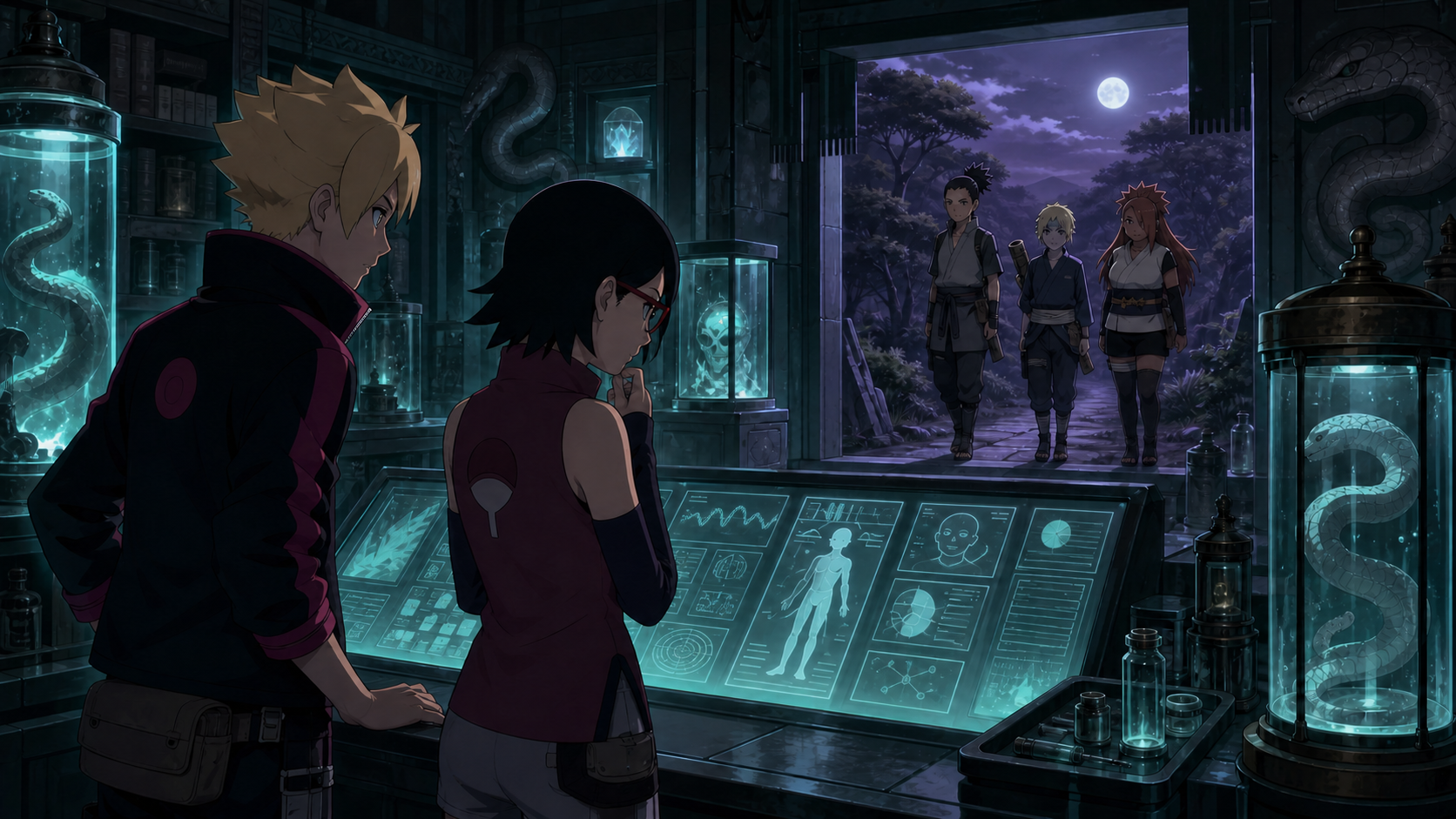
The Other Side of the Moon
Boruto enters Orochimaru’s laboratory looking for Mitsuki and finds clone tanks, a lethal safeguard, and the question he keeps avoiding: what if leaving was Mitsuki’s choice?
Series: Boruto: Naruto Next Generations
Episode: 73 · The Other Side of the Moon
Arc: Mitsuki Disappearance Arc
Release: 2018-09-13
Previous: Episode 72 · Mitsuki’s Will
Directory: All 293 Boruto episodes
Bottom line
Boruto Episode 73 asks a painfully simple question: how can Boruto call Mitsuki his friend when he knows almost nothing about him? Boruto and Sarada leave Konoha, sneak past Yamato’s guards, and enter Orochimaru’s laboratory looking for an answer to Mitsuki’s snake message. Boruto finds tanks containing other Mitsuki bodies instead. Welcome to the worst possible version of meeting your friend’s parent.
Orochimaru explains that Mitsuki is an experiment, one of several bodies, and protected by a curse that can destroy him if the secrets behind his creation are exposed. Orochimaru delivers this information with the calm of somebody discussing equipment maintenance. Boruto is horrified because he came asking whether Mitsuki is safe, while Orochimaru appears more concerned about keeping research secure.
The episode does not let Boruto hide inside outrage. Orochimaru asks what Boruto will do if leaving Konoha was Mitsuki’s own choice. Sarada and Boruto have to admit that their friendship was real but shallow in crucial places. They knew Mitsuki as a loyal teammate. They rarely asked what he wanted when Team 7 was not providing the answer. Orochimaru then points them toward the White Snake Sage at Ryūchi Cave, Team 10 closes in, and the search moves from “prove Mitsuki innocent” toward “learn who Mitsuki is.”
Episode file
- Series: Boruto: Naruto Next Generations
- Episode: 73
- Title: “The Other Side of the Moon”
- Arc: Mitsuki’s Disappearance Arc
- Japanese airdate: September 13, 2018
- Previous episode: “Mitsuki’s Will”
- Next episode: “The Enemy, Ino-Shika-Chō!”
The official episode guide follows two tracks: Team 10 receives orders to retrieve Boruto and Sarada, while the pair seeks Orochimaru’s help interpreting Mitsuki’s message. The title points toward the hidden part of Mitsuki that his friends never learned to see.
Boruto and Sarada are officially on the run
Leaving the village has transformed concern into disobedience. Boruto and Sarada know search teams will be looking for them. Sarada warns that Orochimaru’s laboratory is guarded by jōnin and that getting caught will end the investigation before they learn anything useful.
Boruto keeps moving because every official answer has left Mitsuki farther away. Sarada follows because she shares the need for truth and knows Boruto will attempt the break-in alone otherwise. Their choices are reckless, but the story does not reduce Sarada to a babysitter. She wants to understand Mitsuki too.
The mission already reveals their different strengths. Boruto supplies momentum. Sarada understands security, disguise, and the consequences of being seen. Team 7 is missing one member, yet the habits of the team remain inside how the other two operate.
Team 10 receives the retrieval order
Moegi arrives to collect Shikadai, Chōchō, and Inojin. Their assignment is to bring Boruto and Sarada back to Konoha. The choice of team is personal and tactical. These are friends who know the fugitives’ habits, and Ino-Shika-Chō can track, restrain, and retrieve without approaching the mission like a hunt.
Shikadai immediately understands that the situation has become serious. Boruto running toward danger fits the usual pattern. Sarada leaving with him means the evidence may be stronger than the village realizes. That thought will matter when Team 10 finally catches them.
For now, official orders and friendship point in the same direction: find Boruto and Sarada before somebody else does.
Sarada uses Mitsuki’s face as a distraction
The laboratory’s guards make a direct approach impossible, so Sarada transforms into Mitsuki and draws them away. The disguise is practical and emotionally loaded. Mitsuki’s appearance is the key that opens the route toward information about Mitsuki.
Yamato and the surveillance team have spent years watching Orochimaru. Seeing Mitsuki near the perimeter during an active security crisis demands attention, which gives Boruto time to slip inside. Sarada accepts the more visible role because Boruto carries the snake message and needs to reach Orochimaru.
The plan works long enough to separate them, then Sarada is trapped inside a barrier. She has gambled on speed and disguise against adults assigned specifically to prevent unauthorized movement around this laboratory. The guards were never going to stay fooled forever.
Boruto meets the other Mitsukis first
Inside the lab, Boruto finds a tank containing another Mitsuki body. The image destroys the comforting idea that Mitsuki’s origin is one strange family secret. Boruto’s friend appears repeatable. Orochimaru’s laboratory holds physical evidence that the person Boruto knows began as part of an experimental series.
Suigetsu catches Boruto before the shock can settle, and Orochimaru finally introduces himself. Boruto came prepared to dislike the legendary criminal who created Mitsuki. The tank gives that dislike somewhere immediate to land.
Seeing another body does not make Mitsuki replaceable, of course. The horror comes from Orochimaru’s environment suggesting exactly that. Boruto knows Mitsuki through shared jokes, missions, meals, and trust. A matching face cannot reproduce those choices.
Orochimaru says “experiment” where Boruto says “friend”
Orochimaru explains that the Mitsukis are his experiments. His language remains clinical because creation, memory, bodies, and repeated trials belong to ordinary work inside this lab. Boruto hears the same words as a denial of Mitsuki’s personhood.
The clash exposes why Boruto needed to come. Konoha knows Mitsuki’s origin and allowed him to join Team 7 under strict secrecy. Boruto received none of the context needed to understand how that origin might shape Mitsuki’s fear, privacy, or sense of choice. Orochimaru has context and speaks from the perspective Boruto trusts least.
The episode does not ask viewers to choose one vocabulary. Mitsuki was created through an experiment. Mitsuki is also a person. Orochimaru’s failure is not knowing the first fact. His failure is treating the second fact like an interesting result rather than the center of the discussion.
The curse makes Orochimaru’s priorities plain
Orochimaru reveals that Mitsuki carries a safeguard capable of destroying him if the secrets of his body are exposed. The measure protects Orochimaru’s research by making Mitsuki pay the price. Boruto reacts exactly as he should: what kind of parent places a self-destruct mechanism inside a child?
Orochimaru frames the curse as security. The world remembers his experiments, enemies would value Mitsuki’s biology, and sensitive knowledge could create enormous danger. None of that makes the arrangement less horrifying. Mitsuki’s body becomes the lock around somebody else’s intellectual property.
The reveal also raises the stakes of the disappearance. If Mitsuki reaches people capable of uncovering his design, the danger may come from inside him as well as from the strangers guiding him away.
Karin rescues Sarada with another Mitsuki disguise
Sarada remains trapped until Karin intervenes, directs her toward Boruto, and transforms into Mitsuki to pull the guards away. The sequence gives Sarada and Karin a short reunion without reopening the entire question of Sarada’s parentage. Karin helps because the larger laboratory household has clearly decided Boruto and Sarada should reach Orochimaru.
Yamato sees Mitsuki again and follows. Between Sarada’s first transformation and Karin’s second, the surveillance team is chasing a face that belongs to neither person they see. That confusion fits an episode about how little anyone understands the real Mitsuki beneath the image.
Karin’s involvement also confirms that Orochimaru’s people are controlling access more than the guards realize. The laboratory remains under observation, but the observed subjects know the tunnels, transformations, and timing better than the watchers.
The snake gives Orochimaru almost nothing
Boruto hands over the small snake and repeats the message: this was Mitsuki’s will. Orochimaru examines the snake but reports no additional spoken message. Boruto expected the laboratory to translate one phrase into a complete explanation. Instead, he receives the same uncertainty in a colder room.
That disappointment forces the episode away from plot mechanics and toward character. Boruto cannot solve Mitsuki by decoding a hidden recording. He has to consider that “my will” may mean exactly what the words say.
Orochimaru knows how to press that wound. He asks whether Boruto will still trust Mitsuki if leaving Konoha was a deliberate choice.
Orochimaru asks the question Boruto keeps avoiding
Boruto wants Mitsuki’s departure to be coercion, a secret mission, or a misunderstanding. Any of those answers would preserve the version of Team 7 he wants back. Orochimaru asks him to imagine that Mitsuki chose the road.
That possibility does not mean Mitsuki stopped caring about his friends. Choice can be influenced, incomplete, dangerous, and still chosen. Mitsuki may believe the strangers possess answers Konoha and Orochimaru have withheld. He may need to test whether his will exists outside the orbit built for him.
Boruto insists that he still trusts Mitsuki. The statement matters because trust no longer means “Mitsuki would never leave.” Trust begins shifting toward “Mitsuki has a reason, and I need to hear him before deciding what that reason means.”
Boruto and Sarada admit how little they asked
Away from Orochimaru’s direct pressure, Boruto and Sarada discuss their friendship with Mitsuki. They shared daily life without asking many questions about his past or what he wanted for himself. Mitsuki was calm, dependable, and always available. His silence made their lack of curiosity easy to miss.
Boruto feels the failure personally because Mitsuki built so much of his identity around Boruto as his sun. Boruto accepted the devotion without fully asking what being the moon cost Mitsuki. Sarada recognizes the same blind spot from a different angle. Team 7 functioned well, and function looked like closeness.
The honesty makes their friendship more believable, not less. Many people know a friend’s favorite meal, battle habits, and jokes before learning the private questions that keep that person awake. The problem is not incomplete knowledge. The problem is believing closeness means no further questions are needed.
The moon metaphor belongs to Mitsuki
Orochimaru and Log discuss Mitsuki in terms of the moon and the sun. Boruto is the sun whose light gives Mitsuki direction. Mitsuki is the moon, reflecting light while trying to understand whether he can shine through a will of his own.
The title’s “other side” points toward everything Boruto and Sarada could not see from their position. A moon always has a side turned away from one observer. That hidden surface is not automatically dark, false, or hostile. The viewer simply stands somewhere that cannot see the whole sphere.
Boruto has treated the visible side of Mitsuki as the complete person because that side loved him. The disappearance forces him to respect the unseen side without assuming hidden means dangerous.
Ryūchi Cave becomes the next impossible address
Orochimaru tells Boruto and Sarada that the White Snake Sage at Ryūchi Cave may be able to read the snake’s own thoughts. The Sage offers a route beyond the spoken message, though Orochimaru cannot or will not provide a convenient map.
The suggestion sends the children toward one of the legendary homes of senjutsu. Orochimaru knows the danger. He also knows Boruto’s answer will be yes before the warning finishes. Pointing him there may help Mitsuki, test Boruto, satisfy Orochimaru’s curiosity, or all three.
Suigetsu and Karin have already helped the pair avoid Yamato’s team. Orochimaru denies everything afterward with the confidence of somebody who has survived much larger lies.
Yamato knows exactly how slippery Orochimaru remains
Yamato returns to question Orochimaru about Karin’s interference and whether Boruto and Sarada entered the facility. Orochimaru denies sending Karin and denies the children were present. The exchange is almost funny because nobody in the room believes innocence has suddenly become Orochimaru’s hobby.
Yamato’s surveillance reflects the uneasy arrangement Konoha maintains with its former enemy. Orochimaru has knowledge the village uses, freedom within limits, and enough secret routes to make those limits feel theoretical. Episode 73 shows the arrangement failing in miniature. Two genin enter the lab, receive help, and leave with a new destination while the official guards chase transformations.
Orochimaru may be helping Mitsuki pursue independence. He is also enjoying control over who knows what. Both can be true.
Team 10 closes the road
Boruto and Sarada leave with the Ryūchi Cave lead and encounter Team 10. The next argument arrives before they can process the laboratory. Shikadai, Chōchō, Inojin, and Moegi represent the village order they have been avoiding.
The placement is perfect. Boruto has just insisted that Mitsuki’s choice deserves trust. Now Boruto and Sarada must defend their own unauthorized choice to friends ordered to stop them. Everyone believes care justifies the direction they are taking.
Episode 74 will turn that disagreement into a tactical fight. Episode 73 ends with the emotional positions already clear.
What changed for me on replay
The first watch makes the clone tank and self-destruct curse the loudest revelations. On replay, Orochimaru’s question about Mitsuki choosing to leave becomes the core. Boruto spends the entire episode demanding information that will restore his preferred answer. Orochimaru gives him a possibility that requires a different kind of trust.
Karin and Sarada’s mirrored Mitsuki disguises also gain meaning. Multiple people wear Mitsuki’s face while the real Mitsuki remains absent. The laboratory can reproduce his body and outsiders can copy his appearance, but nobody present can state what he wants.
Yamato’s failed surveillance feels less comic too. Konoha believes Orochimaru is contained. The ease with which his household moves Boruto and Sarada through the facility shows how much the arrangement depends on Orochimaru choosing cooperation.
What works
The episode turns exposition into a character confrontation. Orochimaru’s clone tank, clinical language, and curse reveal are not random lore. Each detail changes how Boruto understands Mitsuki. Boruto’s disgust is justified, and Orochimaru still asks the question Boruto most needs to hear.
Sarada receives meaningful work through the disguise, barrier escape, and reflection on Team 7. Karin and Suigetsu make the laboratory feel like a functioning household of suspiciously competent enablers. Yamato’s presence keeps Orochimaru’s history inside the scene without repeating that entire history.
Most importantly, “The Other Side of the Moon” allows friendship to be real and incomplete. Boruto did care about Mitsuki. He also failed to ask who Mitsuki was beyond the care he provided.
What does not work
The self-destruct curse is enormous and receives surprisingly little immediate follow-through. Boruto reacts, but the story moves quickly toward the snake message and Ryūchi Cave. A revelation that Mitsuki can be destroyed to protect research deserves more than one horrified exchange.
The security around Orochimaru’s lab also looks embarrassingly easy to manipulate. Sarada, Karin, and Suigetsu keep Yamato’s team moving through decoys while Boruto reaches the central subject of surveillance. The sequence is fun, though Konoha’s containment plan needs an audit.
Sarada’s prior knowledge of the lab and Mitsuki could receive more direct discussion. Boruto asks whether she knew, but the emotional weight stays primarily with him. Mitsuki was her teammate too.
Boruto finally meets the limits of calling somebody a friend
Boruto enters Orochimaru’s laboratory expecting evidence that Mitsuki remains the boy Boruto already understands. Every room answers with proof that Boruto never did the work required for that confidence. The bodies in the tanks look like Mitsuki. Orochimaru describes a creation process Boruto never knew existed. A curse can destroy the very heart carrying Mitsuki’s memories. Friendship has been real, but Boruto’s knowledge has stayed embarrassingly thin.
Orochimaru does not need to raise his voice. His calm makes the confrontation worse. He asks what Boruto knows about Mitsuki’s thoughts, past, fears, and choices. Boruto has plenty of memories with Mitsuki and almost no answers about Mitsuki. The distinction cuts straight through every dramatic promise Boruto has made since the disappearance.
That does not make Boruto a fake friend. Children often build friendships through shared days before anybody knows how to ask the deeper questions. Mitsuki also designed his life around concealment. He offered loyalty, competence, and strange little observations while keeping Orochimaru, the laboratory, and his own origin outside the conversation. Boruto could not learn facts Mitsuki refused to share. He could have noticed the silence, though.
Sarada understands that problem from another direction. Her family history taught her how much damage grows inside an unanswered question. She knows Orochimaru’s laboratory, knows Karin, and knows enough about Mitsuki to help Boruto reach the truth. Yet she also carries gaps. Team 7 worked beside somebody whose identity remained partly classified even within their friendship.
Orochimaru’s use of the word “experiment” keeps the episode from softening him into an eccentric parent. He wants Mitsuki to develop a will, but that desire exists beside replacement bodies and a lethal safeguard. Care and control occupy the same room. Orochimaru may want Mitsuki to choose freely while still reserving the power to erase what Mitsuki knows. That contradiction should make Boruto furious.
The moon metaphor gains force here because Boruto has enjoyed being Mitsuki’s sun without asking what the light costs. Mitsuki chose Boruto as a point of direction. Boruto accepted that devotion as part of their normal friendship. Now Orochimaru forces him to consider whether Mitsuki’s path has ever belonged to Mitsuki, or whether every adult and friend around him keeps assigning a purpose.
Ryūchi Cave offers no comforting shortcut. Recovering the snake’s thoughts may reveal where Mitsuki went, but knowledge cannot decide how Boruto should respond. If Mitsuki left by choice, rescue could become another form of refusal to listen. If coercion shaped the choice, Boruto must separate Mitsuki’s will from the pressure surrounding him. Either answer demands more maturity than “my friend would never do that.”
That is why the episode works. Boruto leaves with stronger resolve and weaker certainty. The mission becomes less about dragging Mitsuki home and more about earning the right to hear him. For once, stubborn loyalty has to learn how to ask a question before announcing the answer.
Final take
“The Other Side of the Moon” is the episode where Boruto’s rescue mission becomes a friendship reckoning. He discovers that Mitsuki has other bodies, a lethal safeguard, a creator who calls him an experiment, and a private will Boruto never learned to ask about.
My verdict: unsettling, necessary, and much stronger when Orochimaru is allowed to be helpful without becoming safe. Boruto’s anger gives the episode heat. Orochimaru’s question gives the episode depth. Sarada, Karin, Suigetsu, Yamato, and Team 10 keep the investigation moving around that confrontation.
Boruto leaves the laboratory still trusting Mitsuki, but the meaning of trust has changed. He cannot prove friendship by insisting Mitsuki would never leave. He has to reach Ryūchi Cave, recover the snake’s thoughts, and prepare for an answer that belongs to Mitsuki rather than Team 7.
Sources and lawful viewing
Official episode reference: Naruto Official episode guide
Licensed episode route: Crunchyroll licensed series page