
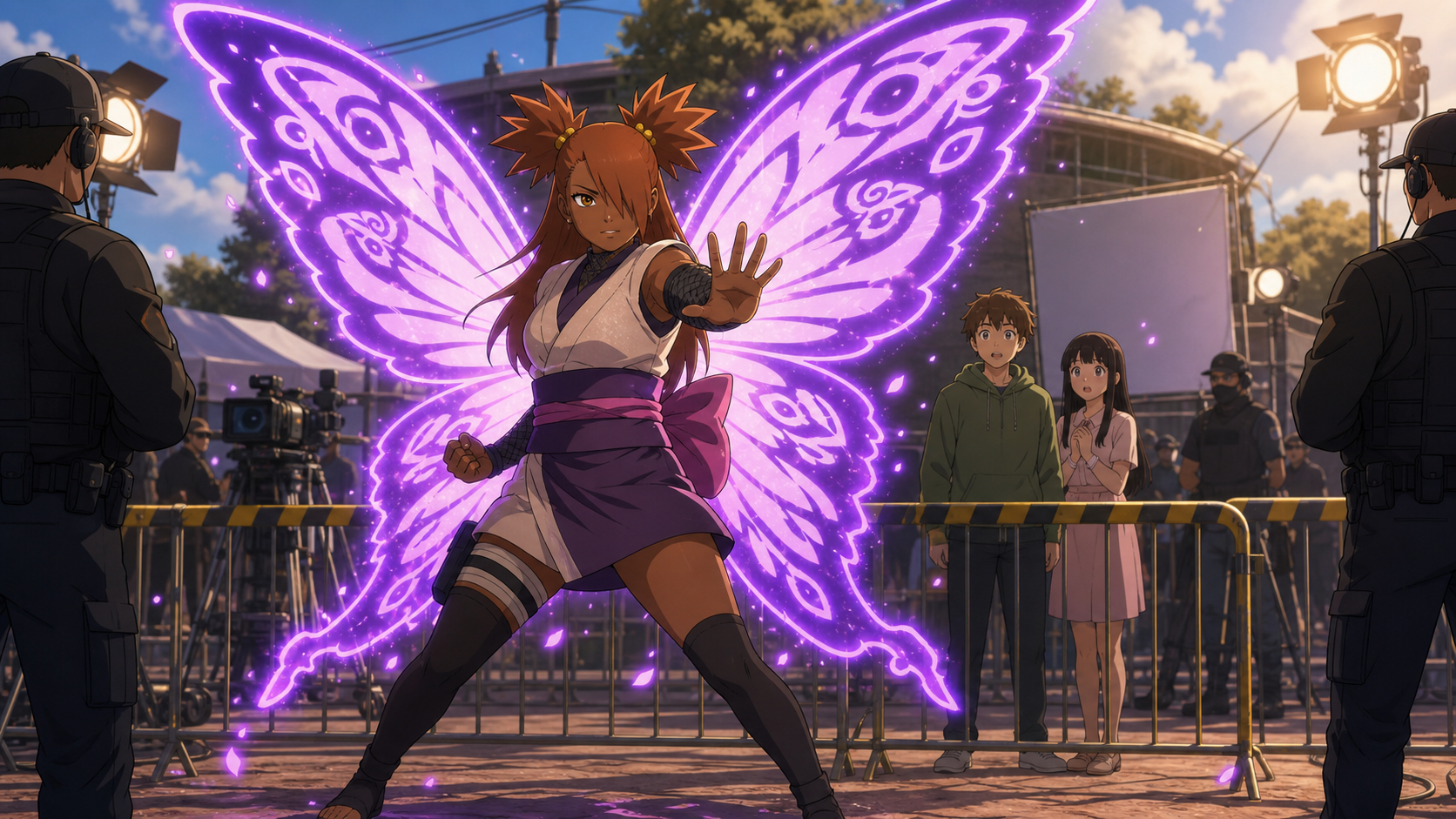
Super Cho-Cho Butterfly Mode!
Chōchō’s clan technique is power, not a diet commercial. Tomaru’s delayed attention says more about his shallow gaze than her worth.
Series: Boruto: Naruto Next Generations
Episode: 67 · Super Cho-Cho Butterfly Mode!
Arc: Chōchō Arc
Release: 2018-08-02
Previous: Episode 66 · My Story…!!
Directory: All 293 Boruto episodes
Bottom line
Boruto Episode 67 gives Chōchō a celebrity crush, a joint protection mission, and one of the most frustrating uses of an Akimichi technique in the entire franchise. “Super Cho-Cho Butterfly Mode!” puts Teams 7 and 10 on a film set after actors Tomaru and Ashina receive death threats. Chōchō arrives in Butterfly Mode, Tomaru notices her because she is thin, and the episode immediately starts treating his attention like proof that the transformation made her more desirable.
No. Butterfly Mode is not a diet commercial. Chōchō was funny, powerful, fashionable, hungry, and completely visible before Tomaru learned how to look in her direction. His sudden interest exposes his limits. The episode almost understands that point, but then makes Chōchō weaken her own attack because she is afraid he will see her usual body. The masked attacker escapes, an actress is injured, and the joke lands on the girl whose confidence used to be one of her best qualities.
Quick reaction
There is a fun mission buried inside this mess. Two genin teams protecting dramatic television stars should be chaos. Ashina bosses Team 7 around. Chōchō pretends not to care about Tomaru while doing absolutely everything he asks. Boruto cannot recognize his own friend after her transformation. A gas-mask shinobi crashes through the wall like the world's angriest continuity note.
Chōchō carries the comedy because she commits to every feeling at full volume. The writing lets her down by confusing romantic insecurity with character growth. A crush can shake her confidence. That is human. Making thinness the reason the crush exists is lazy.
Chōchō wants a handsome boyfriend
The episode opens with Chōchō talking about romance and appearance. She likes food, knows she comes from the Akimichi clan, and also wants a handsome boyfriend. None of those desires cancel the others.
That foundation could support a smart story. Chōchō has always refused to behave like a fat girl must apologize before wanting beauty, fashion, or romance. She looks at herself and sees the main character. Letting a crush complicate that confidence could reveal something tender without erasing what makes her special.
Instead, the episode reaches for the simplest possible switch: Chōchō becomes thin, so a handsome man finally notices her. The story starts losing her before the mission even begins.
Boruto does not recognize her
Teams 7 and 10 gather for their assignment, and Boruto sees a beautiful girl he does not recognize. Shikadai and Inojin know Chōchō has used an Akimichi technique. Boruto needs the explanation.
His confusion is played for comedy, but the scene establishes the episode's entire visual argument. Thin Chōchō is presented as a reveal. The camera and characters treat her like a new arrival rather than the same friend using a familiar clan ability.
Sarada's reaction matters more. She recognizes Chōchō and starts asking why the transformation is being maintained. Sarada sees continuity where Boruto sees novelty. That difference becomes the heart of their conflict across the arc.
Naruto assigns a joint protection mission
Actors Tomaru and Ashina have received death threats connected to their popular television drama. Naruto assigns Team 10 to protect Tomaru and Team 7 to protect Ashina. Konohamaru and Moegi provide the adult command.
The setup is excellent fandom material. Shinobi who regularly deal with bandits and rogue ninja now have to navigate trailers, shooting schedules, assistants, props, and actors who expect service. Celebrity security requires patience that none of these children packed.
The death threat also gives the comedy a hard boundary. Somebody may genuinely intend to kill the clients. Every distraction has consequences, even when Tomaru smiles like the lighting department owes him money.
Tomaru turns Chōchō into his personal assistant
On set, Chōchō tends to Tomaru while pretending she is not impressed. She brings what he requests, hovers near him, and performs indifference with all the subtlety of a fireworks display.
Tomaru enjoys the attention. He is charming enough to keep her interested and self-absorbed enough to accept service without wondering why a bodyguard is doing assistant work. The mission line starts blurring immediately.
Chōchō's behavior is funny because we know her. She wants Tomaru to notice how little she cares while arranging her entire orbit around him. The problem is that Tomaru notices the transformed body first and the person only when she is useful.
Ashina makes Team 7 work for every paycheck
Ashina handles her protection detail differently. She orders Team 7 around and treats the genin like staff. Boruto, Sarada, and Mitsuki get the less glamorous side of celebrity duty while Chōchō floats through her own romance fantasy.
The contrast begins building Ashina's resentment. Tomaru receives admiration. Ashina receives protection and production pressure, but her authority is already shrinking behind the scenes. Her demands look spoiled now and more desperate once Episode 69 exposes her plan.
Sarada watches both sides of the set. She sees Ashina's difficult behavior, Tomaru's flirtation, and Chōchō losing focus. Future Hokage eyes are collecting receipts.
Chōchō pretends Butterfly Mode is effortless
Sarada questions why Chōchō keeps maintaining the technique. Chōchō acts as though the transformation is casual, natural, and completely unrelated to Tomaru. Nobody believes her.
Butterfly Mode consumes stored calories and converts that energy into chakra. The change in appearance comes with the technique. Chōchō treats the physical cost like background noise because admitting effort would mean admitting Tomaru's gaze matters.
That is the first real crack in her confidence. She usually owns every appetite and every choice. Now she is hiding the work required to remain in a form somebody else praised.
Tomaru hands her a prop ring
Tomaru asks Chōchō to hold a ring used in the production. Chōchō immediately leaps from “guarding an actor” to “possibly planning our wedding.” Her imagination wastes no time.
The ring becomes a recurring symbol because Tomaru uses romance as performance. He knows how to make an ordinary gesture feel intimate. Chōchō supplies the meaning because she wants the fantasy.
Her reaction is delightfully dramatic. Plenty of us have built an entire relationship out of one compliment and a shared glance. The problem is not that she dreams. The problem is that Tomaru has given her almost nothing real to dream about.
Sarada sees the warning sign
Sarada questions Chōchō's behavior around Tomaru. She knows her friend is pretending, sees the technique being maintained for appearance, and recognizes that a client is pulling focus away from the mission.
Sarada is correct and terrible at making correctness sound like care. Her concern comes out as criticism. Chōchō hears a challenge and doubles down.
Their conflict feels believable because neither girl is fake. Sarada protects through directness. Chōchō protects vulnerability with swagger. One wants evidence. The other wants the dream to survive long enough to become evidence.
The gas-mask shinobi crashes the set
The attacker does not sneak through a window. He smashes through a wall wearing a gas mask and clothing associated with Amegakure. Subtlety has left the studio.
Boruto attacks first, but the target turns out to be a shadow clone. The clone drops a smoke device, giving the real attacker cover. Inojin strikes, the masked shinobi counters, and Shikadai finally catches him with Shadow Possession.
For a moment, the joint team has the threat contained. Boruto brings pressure. Inojin forces movement. Shikadai shuts the escape route. Chōchō should finish the sequence.
Chōchō returns to full size for the hit
Chōchō releases the maintained transformation and prepares to attack with her usual strength. That should be the payoff. The Akimichi body Tomaru has not seen is exactly the body needed to stop the person threatening him.
Then Chōchō looks toward Tomaru.
She panics at the idea that he will see her. She forces herself thin again and throws a weaker strike. The attacker escapes. An actress is injured during the chaos.
That moment is supposed to show how deeply the crush has affected her. The cost is not abstract. Chōchō compromises the mission and somebody gets hurt.
Tomaru's gaze becomes a tactical weakness
The masked attacker never defeats Chōchō's power. Tomaru's imagined judgment does. Chōchō edits herself in the middle of combat because being seen feels more dangerous than losing the target.
That is painful character territory. A girl known for occupying space suddenly believes safety depends on becoming smaller. The episode could treat the moment with real weight.
Instead, the arc keeps leaning toward romantic comedy. The mission failure should force immediate honesty about why Chōchō weakened her own punch. Nobody needs to shame her, but somebody needs to name what happened.
The injured actress becomes a production problem
After the attack, the producer worries that filming will be delayed because an actress was hurt. Not whether she is okay. Not how the attacker breached the set. The schedule.
That reaction quietly tells us what kind of workplace surrounds Ashina and Tomaru. People are interchangeable as long as the episode gets finished. Chōchō will become the replacement in Episode 68, and the production will barely pause before placing her in costume.
The producer's priorities also support Ashina's later anger. She works in a system that values faces, momentum, and publicity over people. Her eventual scheme remains wrong, but the industry around her is not innocent.
Butterfly Mode deserved clan history
Chōji's Butterfly Mode in Naruto came with enormous stakes. The Akimichi pills pushed his body toward death. The butterfly wings represented stored energy released at terrible cost and a boy choosing to protect his friends.
Chōchō accessing the technique differently could show generational progress. Maybe better training allows safer activation. Maybe her natural control is exceptional. Maybe Chōji taught her how to reach the power without repeating his trauma.
Episode 67 explains almost none of that. The technique becomes a visual shortcut to thinness. A legacy ability carrying decades of fandom memory deserves more than “now the actor thinks she is hot.”
Chōchō's confidence was never fake
Some viewers read this arc as proof that Chōchō's self-love was always a mask. I do not. Confidence can be real and still get bruised. Nobody graduates from insecurity forever.
Chōchō believes she is beautiful. She also notices which bodies receive praise. Tomaru's attention gives that pressure a face. When the person she wants responds only to Butterfly Mode, old cultural messages become personal.
Her confidence does not disappear because she struggles. The finale matters precisely because she rebuilds from a genuine wound rather than revealing that every earlier declaration was a lie.
Tomaru is a crush, not a love interest
Tomaru is handsome and practiced at charm. That is the full résumé so far. He does not ask what Chōchō likes, how her technique works, or why she became a shinobi. He gives her tasks and a prop ring.
The show presents him as a romantic possibility because Chōchō believes he is one. The audience should keep the distinction clear. A crush is made from projection. A relationship requires knowledge.
Tomaru becomes interesting only as a mirror for conditional attention. As an actual match for Chōchō, he has the emotional depth of the studio wall the attacker just destroyed.
Team 10 almost works beautifully together
During the attack, Inojin and Shikadai create the opening Chōchō needs. Their teamwork reflects the Ino-Shika-Chō tradition: pressure, restraint, and finishing power.
Chōchō's hesitation breaks the chain. That failure stings because Team 10 had the attacker. Shikadai cannot maintain every shadow forever. Inojin cannot cover every angle. Their formation depends on trust that the final strike will arrive.
Episode 67 could use that team consequence more directly. Chōchō is not only risking a client relationship. She is disrupting a formation carried through generations.
Boruto and Sarada are supporting witnesses
Boruto mostly handles the visible threat. Sarada mostly watches Chōchō. Neither one owns this story, which is appropriate. Chōchō rarely gets a full arc centered on her choices.
Boruto's failure to recognize her sets the visual premise. Sarada's refusal to pretend nothing has changed provides the emotional pressure. Their roles show two kinds of seeing: Boruto notices appearance, while Sarada notices behavior.
Mitsuki remains quieter, collecting human mysteries for the potato-chip lecture he will deliver two episodes later.
The episode confuses a body change with a personality change
Thin Chōchō speaks more softly around Tomaru, performs indifference, and worries about maintaining an image. Those behaviors are not produced by Butterfly Mode. They are choices driven by the response she receives.
That distinction matters. The technique changes her body. Tomaru's attention changes her behavior. Blaming the form would miss the social pressure attached to the form.
Chōchō remains Chōchō beneath every pose. The tragedy is watching her decide that the loud, hungry, fully visible version might cost her the fantasy.
Comedy works when Chōchō controls the joke
Her instant wedding plans are funny. Her fake indifference is funny. Boruto staring at a teammate he cannot identify is funny because Boruto is often oblivious.
The humor stops working when the audience is asked to laugh at the possibility that Tomaru might see her usual body. Chōchō should never become the horror reveal in her own episode.
The difference is simple. Laugh with her enormous personality. Do not make her body the punishment waiting at the end of the gag.
Replay notes
Watch Tomaru's requests. Chōchō interprets ordinary client behavior as intimacy because each request gives her another reason to stay close. Tomaru never has to promise anything.
Watch Sarada whenever Chōchō pretends. Her concern begins before the attack because she knows how differently her friend usually carries herself.
Watch the fight choreography. Team 10 genuinely has the attacker contained until Chōchō sees Tomaru. The mission failure is built into the formation, not added afterward through dialogue.
Finally, watch the producer after the injury. His first concern points directly toward the workplace resentment that will drive the arc's final reveal.
What worked
The celebrity-protection setup is fun. Teams 7 and 10 create a crowded ensemble without stealing Chōchō's spotlight. Shikadai and Inojin contribute cleanly during the fight, while Boruto's clone encounter gives the masked attacker enough credibility to continue.
Chōchō remains funny and specific even when the writing around her fails. Sarada's concern feels earned. The ring plants the romantic fantasy, and the injured actress plants the next episode's casting problem.
The final tactical failure also gives the arc a real consequence. Chōchō's insecurity changes the outcome, which means the story has somewhere meaningful to go.
What did not work
The episode reduces Butterfly Mode to thinness and romantic access. That choice disrespects Akimichi history and turns Tomaru's shallow gaze into the engine of Chōchō's story.
The age and client boundary is uncomfortable. Tomaru behaves like a grown celebrity flirting with a young guard, while the show treats the attention as harmless wish fulfillment. Nobody in command notices how quickly Chōchō becomes his assistant.
Most of all, the episode fails to give Chōchō's hesitation enough emotional weight. A teammate gets hurt after she weakens her attack. That should land harder than the producer worrying about the schedule.
Butterfly Mode is an inheritance, not a makeover
The Akimichi technique carries generations of meaning. Stored calories become chakra. Chakra becomes wings, strength, speed, and enormous physical cost. Chōji once used the clan’s pills knowing the final stage could kill him. Chōchō inherits a safer path, but the power still connects her body to family history.
Episode 67 mostly treats that history like a beauty reveal. Chōchō becomes thinner, Tomaru notices her, and the production frames his attention as proof that the transformation uncovered something desirable. That approach flattens a powerful jutsu into a makeover montage.
Chōchō never lacked beauty or confidence. Her ordinary confidence is one of her best qualities because she refuses the shame other people expect her to carry. She likes food, fashion, romance, and herself. The crush should create new vulnerability without rewriting that foundation.
Tomaru’s gaze becomes dangerous when Chōchō weakens her attack to protect the version of herself he finds attractive. She knows how to fight. She knows a full-strength strike could stop the masked shinobi. She also knows the technique will return her body to its usual form, so hesitation enters where training should take over.
That failure deserves compassion and accountability. Chōchō is a young girl receiving sudden approval from a celebrity she likes. Of course the attention matters. Yet a teammate gets hurt because she lets the approval influence combat. The lesson cannot stop at “believe in yourself.” Chōchō needs to confront how quickly a stranger’s preference gained authority over her judgment.
Sarada sees the danger because her friendship with Chōchō predates the film set. She knows the loud, hungry, fashionable girl who never required Butterfly Mode to command a room. Her skepticism is not jealousy or prudishness. Sarada watches a friend edit herself around somebody who has shown no interest in learning the original.
Tomaru remains a crush rather than a love interest. He likes service, praise, and a transformed silhouette. He hands Chōchō a prop ring without building intimacy, then accepts her attention as part of the production atmosphere. Chōchō fills every empty space with a romantic story because the fantasy is more complete than the man.
The masked attack exposes the cost of that fantasy, but the episode still has room to recover. Chōchō lands the hit only after returning to full size. Her body does not interrupt her power. Her attempt to hide does. That difference should anchor everything that follows.
RaeRae verdict
“Super Cho-Cho Butterfly Mode!” gives Chōchō the center of the episode and then asks her to become smaller once she gets there. I love her dramatic crush. I love Team 10's attack sequence. I love Sarada watching the nonsense with the exhausted stare of somebody already filling out the incident report.
I hate what the story does with Butterfly Mode. Chōchō's clan technique is power, inheritance, and stored chakra. Tomaru seeing a thinner silhouette does not unlock her beauty. He simply reveals how little he saw before.
The final miss is the honest core of the episode. Chōchō has enough strength to stop the attacker, but fear of Tomaru's judgment changes her hand. That wound deserves the full three-episode conversation. She does not need punishment for wanting him. She needs to remember that anybody who requires her to hide has already failed the audition.
Sources and lawful viewing
Official episode reference: Naruto Official episode guide
Licensed episode route: Crunchyroll licensed series page