
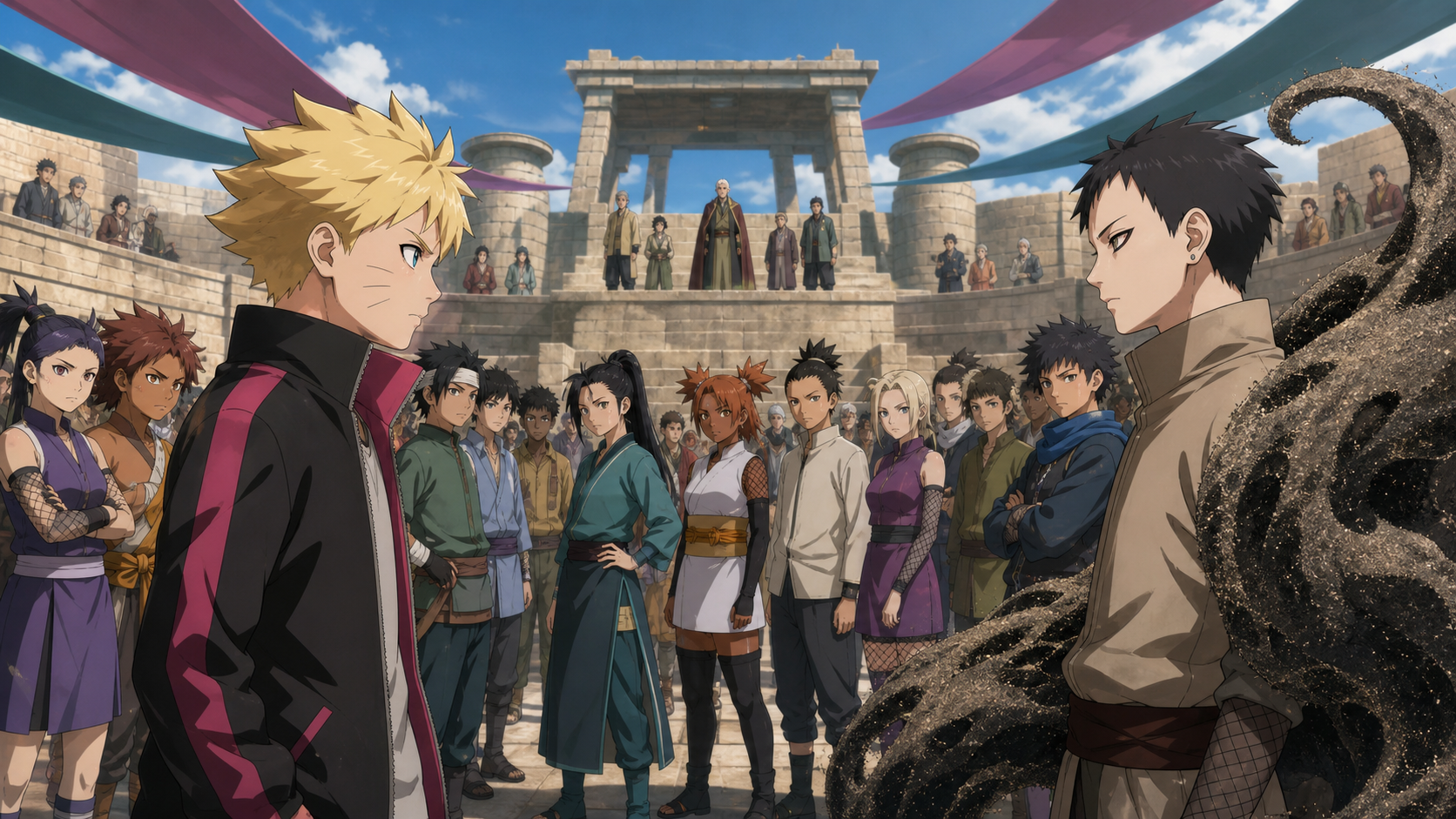
Rivals, Gather!!
The five villages gather, Shinki controls what his team reveals, and Sai’s false-choice ink trap tests whether apparent failure stops the next decision.
Series: Boruto: Naruto Next Generations
Episode: 56 · Rivals, Gather!!
Arc: Versus Momoshiki Arc
Release: 2018-05-03
Previous: Episode 55 · The Scientific Ninja Tool!
Directory: All 293 Boruto episodes
Bottom line
Boruto Episode 56 brings the rival villages into Konoha, lets everybody stare at everybody else over burgers and bad attitudes, then opens the Chūnin Exams with one of Shikamaru and Sai’s mean little tricks. The first stage looks like a true-or-false question about a fifth volume that does not exist. Both answers drop the candidates into ink pits. The people who keep fighting after believing they chose wrong are the ones who pass.
That test is simple, maybe too simple, but the emotional idea lands. Chūnin leadership is not about always knowing the hidden answer. A future squad leader has to act after a plan collapses and shame arrives first.
Shinki is the episode’s strongest new presence. Yurui talks. Boruto talks back. Shinki barely needs to raise his voice to make both boys look noisy. Gaara’s adopted son enters the exam already measuring what everyone reveals, including the techniques his own team should keep hidden.
Shikamaru welcomes a different generation
Shikamaru opens the first Chūnin Exams gathering competitors from the Five Great Nations under the Allied Shinobi system. The ceremony carries history whether the children feel that history or not.
Their parents’ generation met foreign shinobi through war, invasion, assassination, and one exam that Orochimaru turned into an attack on Konoha. These genin arrive by train, eat in the same restaurants, and compete under a shared administration.
That change deserves celebration. Peace does not make the children soft. Peace gives them a chance to learn one another’s names before somebody orders them to become enemies.
The old danger has not disappeared, of course. The adults already know an Ōtsutsuki threat is moving closer. The banners look stable while the sky above them is not.
Every village arrives with an argument
The visiting teams are not just bodies needed to fill a bracket. Their clothes, techniques, manners, and group dynamics announce different village cultures before the exam starts.
The Hidden Cloud sends Yurui, Toroi, and Tarui. Yurui’s bubblegum swagger reaches the room first. The Hidden Mist sends the Senka triplets, a coordinated unit whose similarity becomes part of their tactical identity. The Hidden Sand sends Yodo, Araya, and Shinki, with Shinki carrying the most immediate threat.
Konoha brings a much larger social web. Team 7, Team 10, Team 5, Team 15, and the other familiar genin enter with friendships that can become rivalries the instant a ranking appears.
Thunder Burger is where the exam really starts
Before the official first stage, the candidates size one another up at Thunder Burger. I love this setting because the rivalry begins somewhere ordinary. Nobody needs a forest full of giant snakes to start acting foolish. Give teenagers food, village pride, and one stranger with a disrespectful tone.
Yurui needles Boruto, and Boruto responds exactly as expected. Neither boy wants to look weak in front of teammates or future opponents. The exchange threatens to become a preview match without rules.
Then Shinki steps in.
He does not calm the room through warmth. He shuts the posturing down because pointless exposure is bad strategy.
Shinki knows that information has value
Shinki warns his teammates against revealing their techniques before the exam. That choice immediately distinguishes him from Boruto.
Boruto wants to be seen. Shinki wants to control what others are allowed to see.
Both instincts grow from family history. Boruto is chasing Naruto’s attention and public recognition. Shinki is Gaara’s adopted son, trained by somebody whose childhood power made him a target, a weapon, and a political symbol. Shinki treats visibility as a resource rather than a reward.
His composure can feel arrogant, but the strategy is sound. Every unnecessary demonstration gives a future opponent free preparation.
Gaara’s son changes the temperature
The reveal that Shinki is Gaara’s adopted son matters beyond famous-parent trivia. Gaara understands what happens when adults define a child through dangerous power. His relationship with Shinki suggests an attempt to create a different home around another unusually gifted boy.
Shinki does not resemble young Gaara emotionally. He has discipline, teammates, and enough security to stop a fight without needing to terrorize the room. The Iron Sand connection will become clearer later, but his presence already carries the Sand’s history.
Boruto sees a rival. Older viewers see proof that Gaara built a family after growing up without one.
Yes, that gets me every time.
The first clock starts before the explanation ends
Sai announces that the first test is a true-or-false quiz at Exam Venue B, twenty kilometers away. The candidates have one hour to reach the site.
The trick is that the clock is already running.
This opening filters teams before the written question ever appears. Candidates who stand around complaining lose time. Teams have to hear the operational detail hidden inside the announcement and move.
That feels like Shikamaru’s design. The obvious task is “answer a question.” The actual first demand is “notice that the mission has already begun.”
The run to Venue B exposes priorities
Traveling twenty kilometers within the time limit asks for stamina, speed, and team management. The fastest candidate cannot simply abandon two teammates and call the result leadership.
Some teams push through obstacles with visible techniques. Shinki’s group takes care not to reveal more than necessary. Konoha’s teams draw on relationships formed through missions and training.
The anime moves quickly through this material, and I wish the journey lasted longer. A multi-village race offers so many chances for temporary alliances, sabotage, bad navigation, and somebody discovering that their loudest teammate did not pack water.
Even compressed, the stage shows that the exam is gathering information before anyone reaches a desk.
Sai offers one ridiculous question
At Venue B, Sai asks whether a fifth volume exists in a familiar shinobi strategy book series. Candidates must stand on the true or false side.
The question feels almost insultingly trivial after the race. That mismatch is the warning.
Teams debate whether they remember the book, whether the title continued, and whether another village might know more. The choice tests confidence as much as knowledge. Nobody wants to reveal that they have no idea after arriving at a promotion exam.
The correct factual answer is neither side. There is no fifth volume.
Both answers are wrong on purpose
Once the teams commit, the floors collapse under both groups. Everybody falls toward pits filled with ink.
Sai tells them that choosing incorrectly means failure. For one sharp second, the candidates believe the exam is over.
The real test begins inside that feeling.
Teams that stop struggling and accept the ink fail. Teams that use their abilities to avoid the ink pass. The exam measures whether apparent failure ends their decision-making.
I like the principle. I also think Shikamaru enjoys designing tests that let him watch an entire room become annoyed at the same time.
Sarada sees the rule beneath the question
Sarada responds to the fall instead of wasting time arguing about the nonexistent answer. The Sharingan helps her read the changing environment, but Team 7 still has to act together.
The important insight is not literary trivia. The important insight is that a shinobi mission can reveal new conditions after the plan has already failed.
Sarada’s Hokage ambition fits this kind of problem better than a simple score. Leadership requires recovering from wrong information without freezing, blaming the nearest teammate, or pretending the fall never happened.
Mitsuki treats surprise like weather
Mitsuki’s calm is useful in an exam built around panic. He does not need the adults to be fair before he can observe what the trap demands.
That composure can make him look emotionally detached, but Team 7 benefits from somebody who does not add more noise when the floor disappears. Mitsuki adjusts, supports the group, and keeps watching Boruto.
The episode has not yet reached the point where his hidden Sage Transformation becomes a direct tournament problem. Shinki’s warning and Mitsuki’s quiet competence begin establishing that another level exists under the surface.
Boruto passes without using the gauntlet
Katasuke’s observer reports that Boruto has not used the Kote yet. The line matters because Boruto clears the first stage through Team 7’s own response.
He does not need the device.
Katasuke’s reaction is not relief that the child can succeed honestly. The scientist wants the tool used on a larger stage. That motive turns Boruto’s future temptation into part of somebody else’s demonstration plan.
An adult has looked at a child’s success and thought, essentially, “not useful enough for my product.”
That is nasty work.
Katasuke is waiting for spectacle
The Kote can store techniques and release them without the user’s normal chakra training. As research, the invention has enormous possibilities. As a hidden exam device, the invention corrupts every measurement around the wearer.
Katasuke wants an audience large enough to notice. Boruto wants an audience of one.
Those desires meet around Naruto’s gaze. The researcher gains a public demonstration. Boruto gains the illusion of certain approval. Opponents, teammates, and exam officials supply the stage without being told.
The manipulation works because Katasuke never has to say “cheat.” He gives Boruto the means, praises the result, and waits for fear to finish the argument.
Yurui and Boruto are louder versions of the same insecurity
Yurui’s arrogance at Thunder Burger makes him easy to dismiss, but the posturing serves a recognizable purpose. He wants foreign rivals to believe the Cloud team has already won.
Boruto talks back because he cannot tolerate somebody else controlling the room’s opinion of him.
Both boys are performing confidence before the exam measures anything. Shinki’s intervention reveals how much energy they spend protecting an image.
The difference will become important in the tournament. Yurui brings a bizarre technique that genuinely belongs to him. Boruto brings genuine talent plus a hidden machine that promises a cleaner image than talent can guarantee.
The ink pit is a good test with thin consequences
The first stage has a solid central idea, but the episode resolves the fall quickly. We do not spend enough time with candidates who fail, panic, save teammates, or decide whether to keep trying.
The original Naruto written exam stretched tension through surveillance, information gathering, cheating technique, and the famous final question. Boruto’s version is faster and friendlier to the arc’s pace, but the emotional footprint is smaller.
I do not need a copy of Ibiki’s test. I do want the new generation’s exam to reveal as much character as the old one did.
Peace changes the exam without removing pressure
Nobody entering this round expects Konoha to invade their village tomorrow. That is progress. The competition still turns children into representatives of national strength.
Yurui’s behavior reflects on the Cloud. Shinki’s control reflects on the Sand. Boruto’s performance will be read through the fact that he is the Hokage’s son. Sarada carries both Uchiha history and a stated ambition to lead Konoha.
Peace reduces the cost of failure, but reputation keeps pressing on every result. The adults need to remember that these are candidates, not miniature foreign-policy reports.
First watch: Shinki stole the episode
On my first watch, Shinki became the person I kept tracking. He says little, stops Yurui and Boruto without showing his technique, and watches the exam as though he already knows most people are wasting information.
The restraint is compelling because Boruto is living at the opposite volume. Boruto needs Naruto to notice. Shinki appears almost allergic to unnecessary notice.
I wanted to know what Gaara taught him, what Gaara failed to teach him, and why Yodo and Araya accept his authority so quickly.
Second watch: the Kote report is the ugliest scene
The ink trap gets the set piece, but Katasuke’s observer reporting that Boruto has not used the tool yet is the detail that bothers me most on replay.
Boruto has just passed honestly. A responsible adult would celebrate that proof and remove the prohibited device before the next round. Katasuke treats the honest pass as a delay in his own agenda.
That line changes how I read every later activation. Boruto makes the choice, but somebody older has prepared the stage, supplied the secret, and decided the child’s ordinary ability is not marketable enough.
Third watch: the false question is about shame
The factual trick is easy once the nonexistent fifth volume is revealed. The emotional trick is harder.
Can a candidate continue after publicly choosing the wrong side? Can a team act while embarrassment is still arriving? Can somebody save a teammate without first demanding to know who picked the answer?
Those are leadership questions. A Chūnin cannot require certainty before taking responsibility.
The ink pit works best when viewed as a shame trap rather than a trivia trap.
What the episode gets right
Episode 56 introduces a large rival field without making every arrival feel identical. Thunder Burger gives the tension a social setting. Shinki makes an immediate impression through restraint. Sai’s early clock rewards attention. The false-choice pit tests recovery rather than memorization.
The episode also confirms that Boruto can pass without the Kote. That evidence is essential. His later cheating is not the act of a helpless child with no legitimate path forward.
Katasuke waiting for a larger stage provides the adult pressure the story needs, even if the episode does not condemn him loudly enough yet.
Where the episode falls short
The race and ink-pit responses are too compressed. Many teams appear only long enough to establish costumes before the narrative moves on.
Shinki’s teammates need more independent personality. Yodo and Araya should not exist solely as satellites around Gaara’s son. The Cloud team receives louder introductions, but Tarui and Toroi remain thin.
The first-stage design also passes a large number of candidates without much distinction between quick reflexes and genuine team leadership. A longer aftermath could show what the proctors actually recorded.
Sai tests what happens after certainty collapses
The written question offers two answers and punishes both. Candidates who choose true hear that true is wrong. Candidates who choose false hear the same verdict. Sai does not test trivia. He tests whether apparent failure controls the next decision.
The ink pit begins when teams believe the exam has already ended. Panic becomes the real obstacle. A candidate who accepts shame as final stops looking for teammates, surfaces, or another route. A candidate who questions the announcement can still act.
Sarada reads the structure quickly. The problem never provided enough information for a fair factual answer, which means the answer cannot be the actual measurement. Her reasoning does not prevent the fall, but reasoning keeps Team 7 from treating the fall as proof that nothing remains possible.
Mitsuki responds with familiar calm. Surprise rarely controls him because Orochimaru built his childhood from tests, hidden premises, and manipulated choices. That history makes him useful during the exam and raises an uncomfortable question about why a child finds deceptive pressure so normal.
Boruto passes through his own ability. He moves, protects his team, and adapts while the gauntlet stays hidden. The episode establishes that he never needed prohibited technology to reach the tournament. His fear concerns recognition, not qualification.
Katasuke sees the honest result and remains dissatisfied because honest success does not advertise the product. The scientist needs a dramatic technique under maximum attention. Boruto’s development becomes secondary to the demonstration Katasuke wants the arena to witness.
That adult pressure changes how the later cheating should be judged. Boruto makes every final choice and understands the ban. Katasuke still studies a child’s insecurity, supplies the device, encourages secrecy, and waits for the most valuable public stage. Accountability has room for more than one name.
Shinki enters as the rival Boruto cannot charm
Yurui mirrors Boruto’s loud confidence. Both boys perform certainty for friends and strangers. The insults are noisy because each wants the room to decide the result before the match begins.
Shinki has no interest in that performance. He watches, gathers information, and treats every visible technique as future leverage. His calm does not make him emotionless. Confidence comes from control rather than applause.
Gaara’s presence adds another layer. Shinki is the Kazekage’s son, yet he does not appear desperate to force Gaara’s eyes toward him. Gaara attends, observes, and trusts his child’s preparation. Boruto notices the relationship without understanding why the contrast hurts.
The five-village gathering proves that peace changed the Chūnin Exams. Children from former enemy nations trade insults over burgers rather than meeting first on a battlefield. Rivalry survives, but rivalry now operates inside rules designed to create shared experience instead of casualties.
Shinki still carries the severity of an older model. He views weakness as something opponents exploit and expects the tournament to confirm hierarchy. Boruto wants the exam to confirm personal worth. Sarada wants advancement toward leadership. Mitsuki wants participation beside Boruto. Every candidate enters the same bracket carrying a different definition of what winning means.
Episode 56 works because the first test refuses to validate any definition immediately. Everybody falls. Passing begins with refusing to let the announced failure become the only fact that matters.
That lesson will become painfully relevant for Boruto. The exam gives him proof that failure can be questioned, survived, and followed by another choice. The gauntlet offers a faster lie: make sure failure never becomes visible enough to survive.
RaeRae verdict
Boruto Episode 56 is a lively doorway into the Chūnin Exams. The five villages gather. Burgers become diplomatic hazards. Shinki walks into the story looking like he has already read everyone’s weaknesses. Sai asks a question with no correct side, drops the children into ink, and passes the ones who refuse to let apparent failure make the next decision.
Boruto passes honestly.
Please hold onto that fact. He reaches the next stage through Team 7’s real ability while the forbidden gauntlet stays under his sleeve. Katasuke sees that honest success and waits for a bigger audience anyway.
The episode’s best rivalry is not Boruto versus Yurui or even Boruto versus Shinki. The real fight has already started between Boruto’s imperfect, legitimate skill and the polished shortcut somebody keeps telling him will look better.
Sources and lawful viewing
Official episode reference: Naruto Official episode guide
Licensed episode route: Crunchyroll licensed series page