
Sasuke’s Shadow
Team 7 finds White Zetsu beneath an abandoned mine, Boruto breaks formation, and Sasuke’s black flames point toward the next Ōtsutsuki war.
Series: Boruto: Naruto Next Generations
Episode: 52 · Sasuke’s Shadow
Arc: Versus Momoshiki Arc
Release: 2018-04-04
Previous: Episode 51 · Boruto’s Birthday
Directory: All 293 Boruto episodes
Bottom line
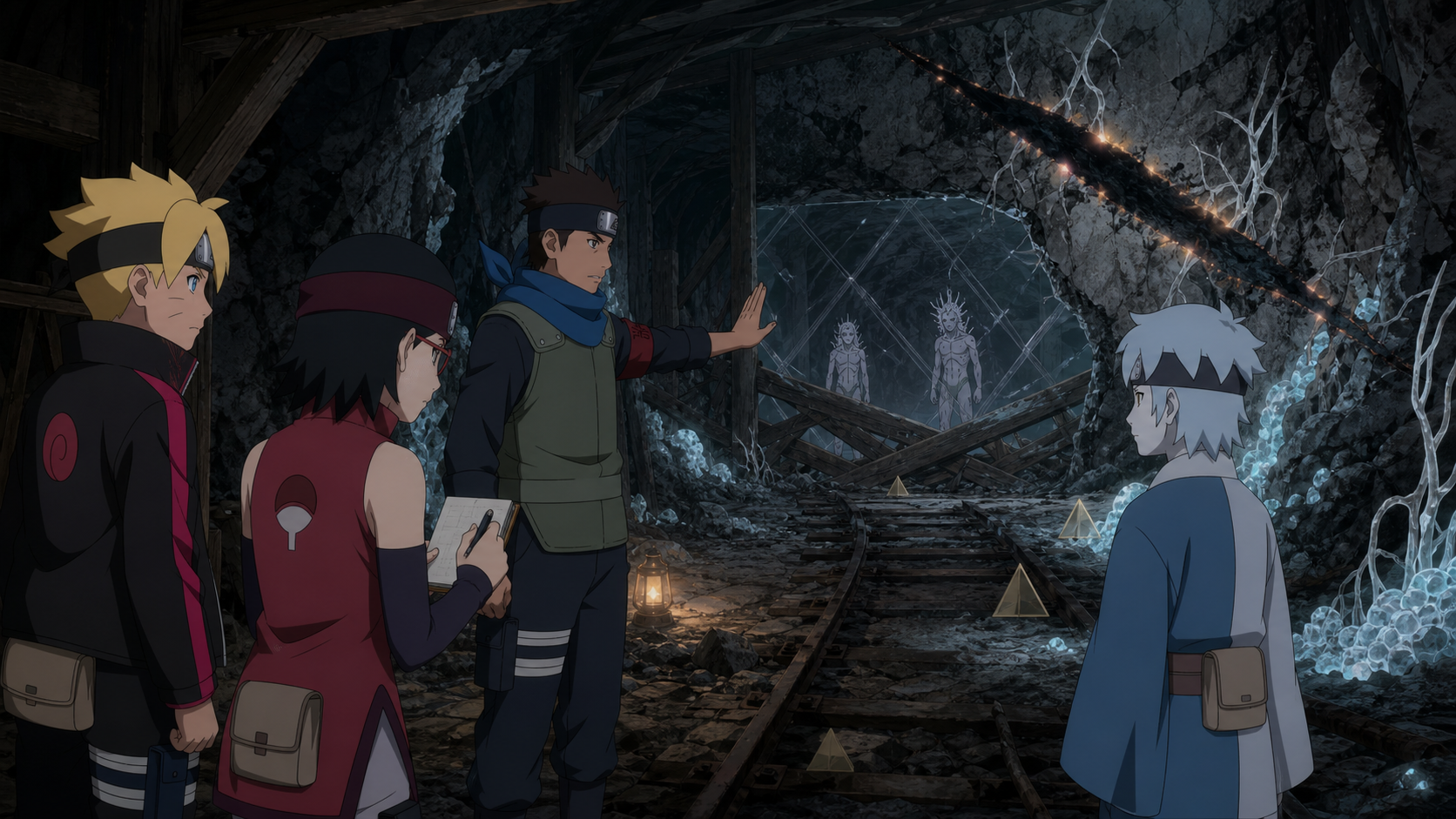
“Sasuke’s Shadow” finally drags Boruto close enough to the old war that he cannot treat Naruto and Sasuke as famous names attached to other people’s stories. Team 7 walks into an abandoned mine expecting the ugly end of a train-robbery mission and finds a White Zetsu throwing three chakra natures at them. Konohamaru knows what that body means. Sarada understands that retreat could leave a larger danger buried. Mitsuki recognizes the cultivation chamber because Orochimaru taught him about the subject. Boruto sees another opening to prove himself and nearly gets crushed for ignoring the plan. Every member arrives with a different relationship to the previous generation, and the mine forces those relationships into the same room.
I like this episode far more than I remembered because the title plays fair. Sasuke never joins Team 7’s fight, yet his choices cover every wall. The dead White Zetsu, the Amaterasu flames, Konohamaru’s explanation, Sarada’s quiet attention, and Boruto’s sudden fascination all make Sasuke present without giving him a heroic entrance. Then the final scene moves into Kaguya’s ice dimension and reveals Momoshiki and Kinshiki waiting for him. The episode starts as leftover cleanup from the Fourth Shinobi World War and ends with the next Ōtsutsuki threat already watching.
The mine changes the mission immediately
Team 7 entered the abandoned mine because the train robbers had used the area as a hideout. The dead thieves already told us something had gone terribly wrong, but a large pale creature with bladed arms changes the assignment from criminal pursuit to survival. Konohamaru’s shock matters because he recognizes White Zetsu before the children understand what they are seeing. His generation has a name, a war, and thousands of bodies attached to that face.
The kids only have the evidence in front of them. A creature attacks, shifts between Lightning, Fire, and Wind Release, and moves with enough strength to break Konohamaru’s kunai. Boruto uses the flash and noise device Katasuke gave him to create a brief opening. That little tool is not a miracle weapon. Boruto reaches for whatever he has because Team 7 has not yet found a clean answer, which makes the beat feel practical instead of flashy.
White Zetsu should not still be alive
Konohamaru believed the White Zetsu army had been destroyed after the war. That belief is why the encounter feels worse than a random monster attack. The shinobi world built peace while assuming one of Kaguya’s biological weapons had been erased. One surviving body means the old count was wrong. A cultivation site means the problem was buried rather than finished.
Boruto has heard war stories, but hearing that Kaguya created White Zetsu and seeing one lunge at his face are not the same education. Naruto’s generation remembers infiltration, mass replacement, and bodies altered into weapons. Team 7 sees one enemy in a tunnel. Konohamaru has to explain that the tunnel connects to a history much larger than their mission rank.
Konohamaru sounds like a veteran here
Konohamaru often gets trapped between being the responsible adult and being the teacher a new Team 7 can outgrow. Episode 52 gives him material that belongs to him. He fought in the war. He knows why Kaguya’s name changes the danger level. His first instinct after finding the cultivation room is to send the genin back while he continues alone, and that choice comes from memory rather than cowardice.
The episode also lets him listen. Sarada argues that splitting up would leave Konohamaru more vulnerable and reduce the team’s ability to cover one another. She does not whine about being treated like a child. She makes a tactical case based on the enemy they have already faced. Konohamaru accepts the argument and takes responsibility for a team plan. That exchange feels like actual training because authority and judgment move in both directions.
Sarada makes the strongest case
Sarada has no interest in walking away simply because the situation became frightening. She also does not rush forward without a reason. Team 7 now knows that at least one White Zetsu remains active, and Konohamaru going deeper alone would not make the danger smaller. Her answer is cooperation. Stay together, study the attack, and use each person’s strengths.
Her Sharingan becomes the center of the rematch because Sarada can read the White Zetsu’s attack pattern. That function matters more than a spectacular solo move. Sarada turns observation into a plan that Boruto, Mitsuki, and Konohamaru can use. She wants to become Hokage, and this is the kind of leadership that makes the ambition believable long before she has the power to carry the title.
Mitsuki knows more than he says
Mitsuki finds the dead blossom in the cultivation chamber and explains that the structure once supplied chakra for producing White Zetsu. The flower can no longer incubate more bodies because the chakra source has died. Then Mitsuki casually says his parent taught him about the subject, which is one of those lines that lands differently when everybody knows Orochimaru is the parent in question.
Of course Orochimaru had a lesson ready on White Zetsu cultivation. That sentence may be the least surprising surprise in the entire mine. Mitsuki’s knowledge helps the team understand that they are not standing in front of an active factory, but the explanation also reminds us that Mitsuki’s childhood education came from a person who studies bodies, vessels, and forbidden systems for breakfast. Team 7 benefits from that knowledge while Konohamaru wisely avoids opening the much larger conversation underground.
The rematch gives everybody a job
Once Team 7 locates the surviving White Zetsu again, the fight becomes a clean demonstration of coordination. Sarada reads the pattern. Mitsuki, Boruto, and Konohamaru answer the elemental attacks. Boruto’s shadow clones draw attention when the enemy switches to physical force. Konohamaru holds the finishing power in reserve while the genin create the opening.
The sequence works because nobody suddenly becomes strong enough to erase the threat alone. Team 7 has information from the first encounter, and they use that information better the second time. The fight feels like a lesson learned under pressure, which is exactly what an early Team 7 mission should deliver.
Boruto ruins the plan for one bad second
Then Boruto sees a chance and lunges beyond the strategy. The White Zetsu pins him before he can turn that impulse into a victory. Mitsuki has to pull the creature away, and Konohamaru ends the fight with Rasengan. Boruto does contribute, but his desire to own the finishing moment nearly turns good teamwork into a rescue.
That mistake matters because Boruto is about to become obsessed with Sasuke. He wants strength that looks independent, rare, and undeniable. Episode 52 shows the flaw before giving him the new idol. Boruto can follow a plan. Boruto can also abandon one the moment personal glory appears within reach. Sasuke’s power will fascinate him, but discipline is the lesson he needs first.
Mitsuki saves Boruto without making a speech
Mitsuki reacts as soon as Boruto gets trapped. No lecture. No demand for gratitude. He removes the immediate danger so Konohamaru can finish the fight. The rescue fits the way Mitsuki has attached himself to Boruto from the beginning, but the episode does not stop to explain that bond again.
I appreciate the restraint. Mitsuki’s loyalty becomes visible through movement, and Boruto’s mistake remains visible too. The scene does not pretend friendship erased the bad decision. Teamwork covered the consequence, which is useful, but Boruto still created the consequence.
Konohamaru earns the Rasengan finish
Konohamaru’s Rasengan destroys the surviving White Zetsu after the team creates the opening. The attack carries obvious Naruto lineage, yet the finish belongs to Konohamaru’s role as captain. He does not stand back so the genin can collect a dramatic victory against a war weapon they barely understand.
The result also keeps the power scale honest. Team 7 can engage, learn, and contribute. Konohamaru remains the experienced shinobi responsible for bringing everybody home. Boruto sometimes struggles with adult authority because Naruto’s job has poisoned the emotional meaning of responsibility for him. Watching Konohamaru use authority well gives the series a necessary counterexample.
The cocoon chamber is the real horror
The dead White Zetsu cocoons disturb me more than the fight. One hostile body can become an action problem. Rows of decomposed bodies reveal an entire production system. Kaguya did not create a single guardian by accident. She prepared an army because she feared another threat from her own clan.
The chamber also makes the war feel physically unfinished. Peaceful Konoha has trains, birthday errands, scientific tools, and children excited about the Chunin Exams. Beneath that modern world sits a room full of bodies grown for a war that most of Team 7 only knows through adults. Boruto loves telling us that his era is different. The mine answers that history does not vanish because children grew up after the funeral.
Sasuke arrived first
Deeper in the ruins, Team 7 finds White Zetsu bodies burning in black flames. Amaterasu identifies Sasuke without requiring his face. The visual is perfect for the title because Sasuke exists as aftermath. He has already found the danger, fought through the site, and moved toward whatever evidence waited beyond Team 7’s reach.
Sarada learns something about her father through the work he left behind. Sasuke’s absences hurt his family, and no secret mission cancels that hurt. The episode still gives his distance a concrete purpose. He is not wandering because the story needs him to look mysterious. Sasuke is tracing Kaguya’s history and searching for the threat she expected to arrive.
Konohamaru finally names Sasuke’s mission
Konohamaru tells the genin that Sasuke has been investigating Kaguya and the Ōtsutsuki clan in secret. Sasuke works outside the village because the enemy may exist beyond ordinary borders and because public knowledge could create panic or interference. The explanation gives Team 7 a glimpse of the hidden labor behind Konoha’s calm surface.
The secrecy also changes Sasuke’s reputation in Boruto’s eyes. Before this point, Sasuke was Sarada’s absent father and one of the legendary men attached to Naruto’s generation. Now Boruto hears that Sasuke operates alone, investigates enemies nobody else can reach, and possesses strength that rivals Naruto. You can almost hear the new obsession click into place.
Boruto wants the shadow instead of the office
Naruto represents meetings, missed birthdays, public duty, and a Hokage desk that keeps swallowing family time. Sasuke represents movement, secrecy, combat, and power without the visible paperwork. Boruto has not yet learned that Sasuke’s path carries loneliness, guilt, and family damage of its own. He only sees the version of adulthood that looks free.
That contrast explains why Sasuke becomes appealing so quickly. Boruto does not merely want a stronger teacher. He wants an answer to Naruto. If the Hokage stands in the light and disappoints his son, the mysterious shinobi in the shadows can look like the cooler truth. Episode 52 lets us understand the attraction before Episode 54 brings Boruto and Sasuke face to face.
Sarada hears a different story
For Boruto, Sasuke’s mission sounds exciting. For Sarada, the same information belongs to her family. She has spent years asking where her father is, what kind of man he became, and whether his bond with her is real despite the distance. Black flames in a mine prove that Sasuke has protected the village, but they cannot sit at the dinner table with her.
The episode does not give Sarada a large emotional monologue, which is the right choice. Her presence already carries the contradiction. She can be proud that Sasuke is doing work only he can do and still deserve more than clues left in dangerous ruins. Both feelings fit inside the same daughter.
Orochimaru and Sasuke haunt Team 7 differently
Mitsuki knows about the cultivation mechanism because of Orochimaru. Sarada sees Sasuke’s Amaterasu. Boruto becomes curious about Sasuke’s strength. Konohamaru stands among three children whose parents or chosen adults are tied to some of the darkest chapters in shinobi history, and all three children are trying to build identities that do not simply repeat those histories.
That family texture gives the mine more weight than a nostalgia cameo. White Zetsu connects Orochimaru’s research, Sasuke’s investigation, the Fourth War, Kaguya, and the next Ōtsutsuki arrival. Team 7 is not borrowing old lore for twenty minutes. They are inheriting a problem their parents could not completely bury.
Naruto’s arrival comes after the danger
After Team 7 reports back, Naruto sends a Shadow Clone with other shinobi to secure the area. The response makes operational sense, but the timing fits Boruto’s larger frustration. Naruto appears after Konohamaru and the children have already fought, investigated, and found Sasuke’s trail. The Hokage can mobilize the village, yet Boruto experiences another version of his father through a clone.
Episode 53 will make the Shadow Clone wound painfully personal at Himawari’s birthday. Here the clone belongs to public duty and cleanup. Placing these episodes together makes Boruto’s resentment messier. Naruto’s technique genuinely lets him answer more emergencies, and the same technique can make his family feel replaceable when he uses a copy where his presence was promised.
The title belongs to more than Amaterasu
Sasuke’s shadow covers the mine because his work preceded Team 7. The title also describes the influence moving toward Boruto. Sasuke does not need to meet him yet. Knowledge of his mission is enough to alter what Boruto wants from strength and adulthood.
Sasuke also lives in Naruto’s political shadow by choice. Naruto holds the office while Sasuke handles threats beyond ordinary village reach. That arrangement protects Konoha, but Episode 52 refuses to make the hidden half completely invisible. Team 7 finds the evidence, and Boruto starts looking toward the person who left the flames.
Momoshiki and Kinshiki change the scale
The final move into Kaguya’s ice dimension confirms that Sasuke’s investigation has reached the right enemy. Momoshiki and Kinshiki notice the visitor before Sasuke gets a comfortable look at them. The series has spent dozens of episodes establishing Boruto’s everyday world, new technology, school friendships, and smaller missions. Now the threat behind Kaguya’s army steps into view.
This ending works because the White Zetsu chamber prepared the question. Why did Kaguya need an army? Momoshiki and Kinshiki answer without a lecture. Kaguya feared members of her clan who would come after her, and Sasuke has walked into their territory while following that fear to its source.
The episode quietly begins the Chunin Exams crisis
The Versus Momoshiki Arc does not begin with a stadium exploding. The danger enters through research, ruins, and evidence left by people who understand more than Boruto. That slower entry gives the coming attack a history. Momoshiki is not a villain dropped onto the Chunin Exams because the movie plot needs spectacle. His arrival grows from Kaguya’s choices, Sasuke’s investigation, and the world that survived the previous war.
Meanwhile, Boruto is worried about strength, recognition, and Naruto’s failures at home. Those concerns are real even when a cosmic threat exists. The arc becomes stronger because the family wound and the Ōtsutsuki threat approach the same event from different directions.
The production sells the underground unease
The mine uses darkness without turning the action unreadable. White Zetsu’s pale body stands against the stone, elemental attacks briefly reshape the space, and Amaterasu’s black fire creates a visual signature nobody in the franchise can mistake. The cocoon chamber slows the episode after the fight and lets scale replace speed.
I also like how Sasuke’s presence is handled through environmental evidence before the dimensional reveal. Showing his face too early would flatten the mystery. The flames let Team 7 understand that somebody powerful passed through, then Konohamaru supplies the name and purpose. By the time Sasuke appears, the audience already knows what his path means to the children behind him.
My favorite beat is Sarada refusing to split the team
The Amaterasu reveal is cooler. Momoshiki’s appearance is bigger. Sarada’s argument is still my favorite moment because she behaves like the future leader she says she wants to become. Konohamaru plans to protect the genin by carrying the danger alone. Sarada notices that the choice could make everybody less safe and says so.
She does not win through family privilege or a sudden power-up. Sarada reads the situation, explains the weakness in the plan, and gets her captain to reconsider. Naruto has spent years teaching us that becoming Hokage begins when people acknowledge someone. Sarada earns a small piece of that acknowledgment in a mine where her father’s shadow is already waiting.
The part that still frustrates me
Boruto breaking formation is completely believable, but the episode moves past the mistake quickly once Mitsuki rescues him. I wanted one sharper look between Boruto and Sarada, or a brief correction from Konohamaru after the fight. He almost turns a workable strategy into a fatal accident because he wants the decisive hit.
The coming arc will punish Boruto’s hunger for shortcut power much harder, so the missing lecture is not a continuity failure. Still, this episode had the perfect evidence in hand. Team 7 won when Boruto followed Sarada’s analysis and Konohamaru’s structure. Boruto got pinned when he decided the plan mattered less than his moment.
RaeRae’s verdict
“Sasuke’s Shadow” is a strong bridge episode because the old generation’s history does real work instead of arriving as fan-service wallpaper. White Zetsu turns the mine into an unmarked grave and a warning. Konohamaru brings war memory. Sarada brings tactical judgment. Mitsuki brings unsettling knowledge and immediate loyalty. Boruto brings courage, useful improvisation, and the exact impatience that will make Sasuke and the Scientific Ninja Tool dangerous answers to his insecurity.
Most of all, Sasuke feels present before he appears. His black flames tell Sarada where her father has been, tell Boruto what kind of shinobi exists outside Naruto’s office, and tell the audience that Kaguya’s unfinished story is moving again. When Momoshiki and Kinshiki look toward their visitor in the ice dimension, the Chunin Exams stop feeling like the biggest event on the horizon. Team 7 entered a mine looking for the remains of one mission. They came out standing at the entrance to the next war.
Sources and lawful viewing
Official episode reference: Naruto Official episode guide
Licensed episode route: Crunchyroll licensed series page