
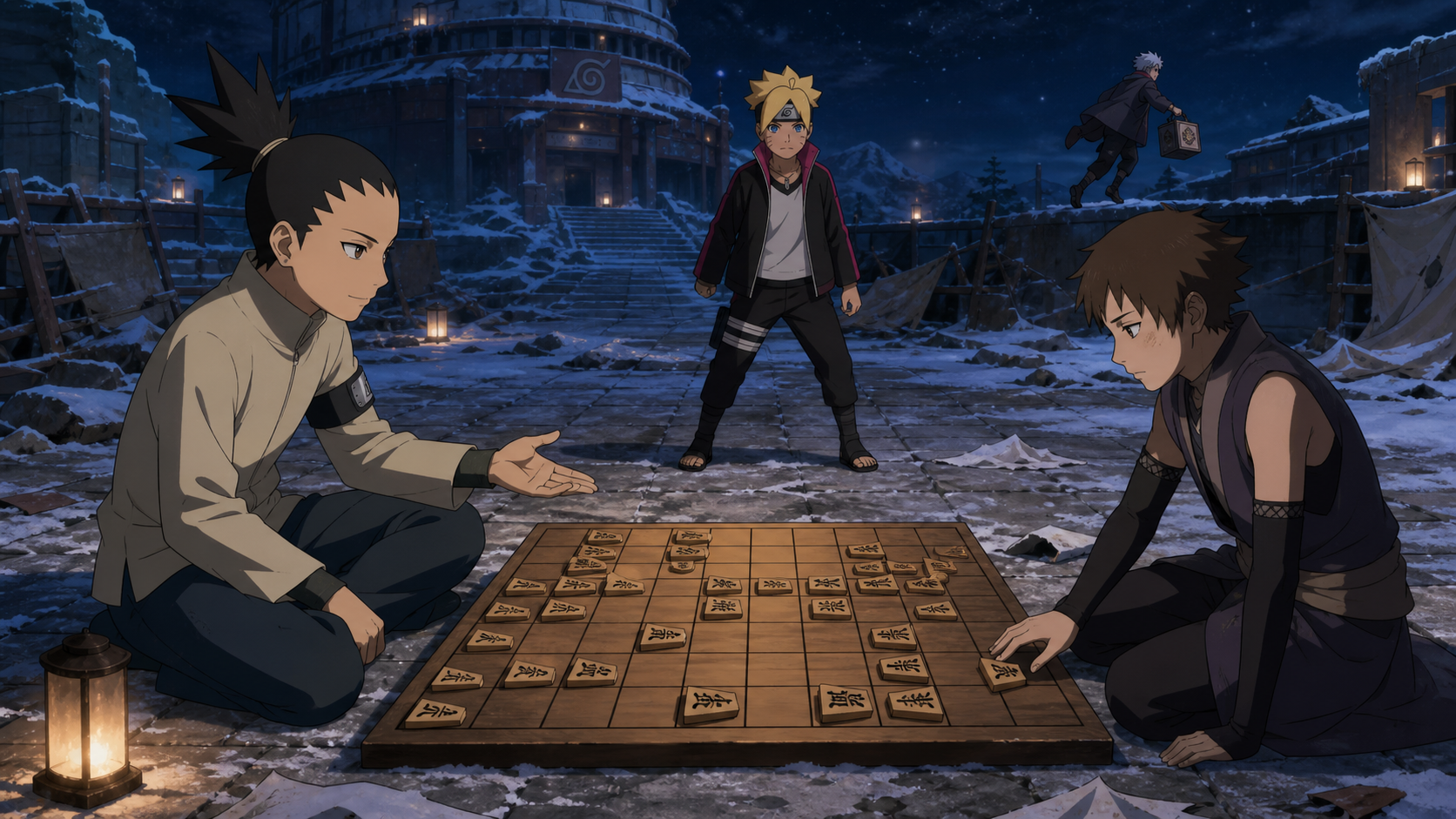
The Figure I Want to Be
Gekkō turns Ryōgi’s grief into a weapon, Shikadai refuses to discard his friend, and Boruto helps return one stolen choice before Naruto ends the escape.
Series: Boruto: Naruto Next Generations
Episode: 47 · The Figure I Want to Be
Arc: Byakuya Gang Arc
Release: 2018-02-28
Previous: Episode 46 · Go! The Crest of Night Strategy
Directory: All 293 Boruto episodes
Bottom line
“The Figure I Want to Be” works because Shikadai never saves Ryōgi with a perfect speech. He notices the lie in front of him, refuses to let Gekkō define his friend as a disposable pawn, and keeps reaching Ryōgi while the boy’s memories are being rewritten in real time. Boruto supplies force, clones, and absolute refusal to quit. Shikadai supplies the plan and the personal connection. Together they break through Ryōgi’s ice and Gekkō’s genjutsu long enough for the truth to return: Gekkō did not rescue Ryōgi from the men who killed his parents. Gekkō killed them and built a loyal child from the wreckage.
The finale is not flawless. Naruto catches Gekkō so easily that the larger chase ends with an orange streak and one very embarrassed criminal. I still prefer that ending to pretending two genin should defeat every adult threat alone. The emotional fight belonged to Shikadai and Ryōgi. The arrest belonged to the Hokage. Ryōgi ends the episode in a cell, not magically welcomed home because friendship broke the spell. That consequence matters. Shikadai helped him recover a choice. Nobody pretends one recovered choice erased the Byakuya Gang’s thefts, manipulation, or the people hurt along the way.
The train keeps the finale moving
Boruto and Shikadai catch Gekkō and Ryōgi aboard the escaping train. The setting gives every decision urgency because the stolen scroll, the gang leader, and Ryōgi are moving toward the border while the boys fight through connected cars.
There is no safe room for a long debate. Gekkō can split the train, abandon followers, and use the narrow passages to control who reaches him. Shikadai has to think several cars ahead while Boruto keeps creating openings through pure stubborn momentum.
Gekkō notices the shōgi pieces
The pieces Shikadai gave Ryōgi represent a friendship Gekkō did not authorize. Gekkō sees them and immediately understands the threat. He throws the pieces out of the train and orders Ryōgi to prove his loyalty by finishing Shikadai.
That gesture tells us everything about Gekkō’s version of family. Loyalty means eliminating any relationship that gives Ryōgi another way to understand himself. A real guardian would not fear a child making a friend. Gekkō fears every bond he cannot control.
Ryōgi insists the friendship meant nothing
Ryōgi says the shōgi pieces carry no meaning. The denial sounds rehearsed because he is trying to make Gekkō’s command and his own feelings occupy the same body without colliding.
Shikadai knows their games mattered. He also knows he cannot win by demanding that Ryōgi confess friendship on command. He keeps watching the gaps between Ryōgi’s words and actions, which is where the truth has survived.
Gekkō hides control inside concern
Under the excuse of checking Ryōgi’s wound, Gekkō activates the technique controlling him. The movement looks almost caring. That disguise is the point. Gekkō trained Ryōgi to associate obedience with rescue, protection, and family.
The cursed seal and genjutsu make the abuse visible, but the emotional mechanism existed before chakra entered the conversation. Gekkō saved the role of “father” for himself, then edited Ryōgi’s memory until gratitude became a cage.
Mirrored ice turns sight against Boruto
Ryōgi’s ice reflects Gekkō’s image and catches Boruto in genjutsu. Boruto begins seeing Shikadai as an enemy and attacks the person trying to help him.
The trick is effective because Boruto trusts direct perception. He believes the person in front of him is the problem and responds immediately. Genjutsu weaponizes one of his strongest instincts by changing what “in front of him” means.
Shikadai has been embarrassed by Mirai for a reason
Shikadai recognizes the genjutsu and breaks Boruto free. He credits experience gained from Mirai using similar techniques on him. Somewhere, Mirai should receive a thank-you note for every training session Shikadai probably called troublesome.
The detail gives his competence a history. Shikadai does not identify the illusion because Nara intelligence magically solves every problem. He has been caught before, learned what the trap feels like, and uses that memory when Boruto cannot trust his own eyes.
Gekkō kills his own follower
At the front of the train, Gekkō kills one of the Byakuya Gang members. The murder destroys whatever remains of his noble-thief performance. His followers are tools, and a tool that slows his escape loses all value.
The moment also tells us what awaits Ryōgi if obedience stops being useful. Gekkō calls him family because the word produces loyalty. Ryōgi’s survival has always depended on serving the role assigned to him.
Shikadai identifies the real board
Shikadai tells Boruto that Ryōgi is under genjutsu and warns him about reflective surfaces. He stops treating the conflict as a friend making inexplicable choices and recognizes the controller shaping those choices.
That recognition does not erase Ryōgi’s participation. The recognition changes the tactic. Beating him unconscious would stop one opponent. Breaking Gekkō’s hold could return the person capable of choosing what happens next.
Boruto and Shikadai break the ice
The boys smash through Ryōgi’s barrier and move farther along the train. Their partnership is one of the finale’s best choices because neither can handle every job.
Boruto brings clones, Wind Release, and the willingness to attack a wall until the wall regrets existing. Shikadai reads the sequence and keeps the rescue connected to Ryōgi rather than reducing him to another obstacle between Boruto and Gekkō.
Splitting the pursuit is risky and necessary
Boruto goes after Gekkō while Shikadai stays with Ryōgi. The choice gives each boy the fight only he can carry. Boruto can stop the stolen scroll from leaving. Shikadai is the person Ryōgi might still hear through the genjutsu.
The split also trusts Shikadai’s judgment. Boruto does not take over the personal confrontation because he is the protagonist. He protects the larger mission and leaves the friend to his friend.
Boruto stops the train separation
Gekkō tries to disconnect his car and escape with the stolen technology. Boruto reaches him before the separation succeeds.
The chase gives Boruto a straightforward target, but Gekkō remains an adult manipulator with more experience than the boys. Boruto can delay him and ruin the clean exit. The episode does not need Boruto to become stronger than every person on the train.
Shikadai pins Ryōgi and keeps talking
Shikadai catches Ryōgi with Shadow Possession and tries to reach him. The restraint is both physical and emotional. He stops the immediate attack without pretending control can replace persuasion.
The scene echoes their shōgi games because Shikadai understands position. He cannot erase every move that brought Ryōgi there. He can hold the board long enough for another move to become possible.
The cursed seal turns grief into a weapon
Gekkō’s control spreads across Ryōgi’s body and makes him see Shikadai as the person who killed his parents. The genjutsu does not invent a random fear. The technique takes the deepest wound in Ryōgi’s life and attaches Shikadai’s face to the crime.
That cruelty matters more than the power increase. Gekkō has preserved Ryōgi’s grief because grief keeps the boy useful. Healing would weaken the story that only Gekkō stands between him and another loss.
Shikadai cannot talk through the whole attack
Ryōgi’s ice and cursed power overwhelm ordinary conversation. Shikadai needs Boruto’s help to create physical contact strong enough to interrupt the genjutsu.
I like that limit. Friendship is important, but the series does not make sincerity a substitute for tactics. Shikadai knows whom he needs to reach. Boruto helps him survive long enough to reach that person.
Boruto turns Shikadai into the projectile
Boruto and his shadow clones use Wind Release to launch Shikadai through Ryōgi’s attack. The plan is ridiculous, dangerous, and exactly suited to these two.
Shikadai normally controls space from a distance. Here he puts his own body on the line because physical contact may break the illusion. Boruto supplies the force while trusting Shikadai to handle the landing and the truth waiting on the other side.
Contact returns the buried memory
When Shikadai reaches Ryōgi, the genjutsu breaks and the original memory returns. Gekkō killed Ryōgi’s parents. The man who built himself into the role of rescuer created the tragedy that made rescue possible.
The revelation is devastating because Ryōgi’s loyalty was not based on one lie around the edges. His entire family identity rested on the killer standing where a protector should have been.
Ryōgi was never only a pawn
The title’s shōgi language has followed him through the arc. Ryōgi accepted being a piece because a pawn receives direction and does not have to question the player who claims to understand the board.
Shikadai’s friendship showed him another possibility. Their games allowed choice, risk, loss, and conversation without punishment. Gekkō threw away the pieces because those ordinary afternoons threatened the obedience built through violence.
Shikadai chooses the kind of strategist he wants to be
Shikadai could treat Ryōgi as an enemy piece to remove. Instead, he studies the control around him and takes the harder route. He protects the mission while refusing to discard the person.
That choice separates him from the lazy-genius stereotype. Shikadai does not avoid effort when somebody matters. He complains, calculates, and then commits harder than most people who announced heroism before the fight began.
Boruto supports a story that is not about him
Boruto gives Shikadai the space and force needed to reach Ryōgi. He does not demand the final emotional speech or turn Ryōgi’s recovery into proof that Boruto was right about everything.
That restraint is growth. Boruto can be loud, impulsive, and desperate to matter. Here he recognizes that Shikadai holds the relationship and works as the teammate rather than stealing the center.
Naruto ends Gekkō’s escape
For a few moments, the boys believe Gekkō got away. Naruto crosses the distance and stops him before the plan can succeed.
The ease is almost comic after the elaborate train battle. Naruto is the Hokage and one of the strongest shinobi alive. Gekkō built a political scheme, manipulated a child, used genjutsu, and stole scientific research. Then the adult responsible for national security catches him. Correct.
The stolen scroll returns to Katasuke
Boruto returns the scientific-ninja-tool scroll to Katasuke. The recovery closes the immediate mission and links the Byakuya Gang arc to technology that will become much more personal for Boruto during the Chunin Exams.
Katasuke’s work has now attracted theft and public conflict. Boruto sees the research as something worth protecting before he later uses a related tool to fake his own power. That contradiction is coming, and the story has already placed the temptation in his hands.
Ryōgi ends in a cell
Ryōgi sits in custody and considers the life he chose, the life Gekkō manufactured, and the person he may become next. The episode does not skip from revelation to celebration.
I respect that boundary. He was manipulated and abused. He also participated in theft, attacks, and a campaign that placed civilians in danger. Understanding why he acted changes how we judge him. Understanding does not remove every consequence.
Shikadai cannot complete Ryōgi’s future
Shikadai gave him a route back to the truth. Ryōgi still has to live after the truth. Friendship can visit, challenge, and remind him that another self exists. Friendship cannot make every decision that follows.
The unfinished ending fits the title. Ryōgi does not announce one clean figure he wants to become. For the first time, the answer may belong to him rather than Gekkō.
My favorite beat is Gekkō throwing away the pieces
The memory reveal carries more drama, but Gekkō discarding the shōgi pieces is the detail that makes his fear visible. Two small objects threaten a man with genjutsu, stolen technology, and a moving train.
The pieces prove Ryōgi formed a bond outside the gang. Gekkō understands that independent affection can lead to independent judgment. He has to destroy the evidence because his authority cannot survive a child realizing family may feel different from obedience.
The part that frustrates me
Gekkō’s defeat arrives so quickly that the arc’s political manipulation receives less closure than Ryōgi’s personal story. Konoha stops the riots and retrieves the scroll, but the public anger the gang exploited deserves more than one villain being caught.
Gekkō manufactured unrest. He did not invent every economic anxiety or resentment inside the village. The finale handles the manipulator and leaves the conditions that made manipulation effective largely untouched.
Gekkō calls Ryōgi family while treating him like disposable equipment
Gekkō’s control works because he attaches obedience to survival. Ryōgi loses his parents, wakes inside grief, and receives a new story where Gekkō rescued him. Every later order can masquerade as repayment to the only family supposedly left.
The cursed seal strengthens that structure. Memory, emotion, and physical response become tools Gekkō can activate. Ryōgi may believe he chooses loyalty, but the available choices have been edited by somebody controlling what loss means.
Throwing away the shōgi pieces reveals the truth. Gekkō enjoyed strategy only while other people served as pieces. Once the board stops producing advantage, he destroys the follower who failed and abandons Ryōgi to cover his escape. Family was branding around ownership.
Shikadai refuses the same pattern. He wants Ryōgi to stop, remember, and face the truth, but he does not claim that friendship gives him authority over Ryōgi’s future. His goal is to return enough memory and freedom for Ryōgi to make a choice outside Gekkō’s script.
That difference matters during the final fight. Words alone cannot break a cursed seal built through trauma and repeated control. Shikadai keeps talking because the conversation preserves Ryōgi’s personhood even when every attack treats him like a weapon.
Boruto supports without taking over. He breaks the ice, creates movement, and launches Shikadai into the contact needed to reach the buried memory. The emotional center remains between Shikadai and Ryōgi. Boruto’s best role is helping a friend complete a connection rather than making every rescue proof of his own importance.
The returned memory does not erase Ryōgi’s crimes. He participated in theft, violence, and a plan that endangered civilians. Manipulation changes the context around responsibility without making the harm imaginary. A cell at the end feels harsh and honest because freedom from Gekkō is only the beginning of repair.
Shikadai chooses strategy without becoming another manipulator
Shikadai has inherited a mind capable of turning people into positions. Shadow Possession controls bodies. Shōgi trains him to sacrifice pieces for an objective. Village leadership will eventually ask him to make decisions where somebody pays a cost.
Gekkō represents the ugliest endpoint of that skill. Every relationship becomes leverage. Every grievance becomes recruitment material. Every follower becomes expendable once usefulness ends. Intelligence exists only to concentrate power around the person planning the board.
Shikadai wants another model. He studies movement, predicts danger, and creates openings while remaining accountable to the people inside the plan. Launching himself through Boruto’s help carries risk he shares rather than assigns from safety.
Mirai’s earlier training prepared him for mirrored ice because she taught him that sight can be manipulated. Shikadai does not win through natural genius alone. He carries lessons from an older cousin who repeatedly humbled him, a father who understands strategy under pressure, and teammates who trust his calls.
The figure he wants to become therefore cannot be defined by being the smartest person in the room. He wants to be somebody whose intelligence protects choice rather than replacing choice. Ryōgi becomes the test because rescuing him would be easy to confuse with deciding for him.
Shikadai pins Ryōgi and keeps offering facts. Your memory was changed. Gekkō used you. Our friendship happened. The statements create a road back without pretending the road has only one acceptable destination.
When contact restores the murder memory, Ryōgi finally sees how Gekkō built the rescue story from the crime Gekkō committed. The revelation destroys coerced loyalty, but Shikadai does not celebrate like a player capturing the king. His friend has just recovered the worst moment of his life.
That restraint completes the arc. Strategy wins, yet the person being rescued never becomes a trophy. Shikadai changes the board by refusing Gekkō’s definition of what pieces are for.
Catching Gekkō cannot repair every grievance he exploited
Naruto stops the escaping adult and closes the immediate threat. The scroll returns. The riots end. Konoha can identify a villain, recover stolen property, and restore order.
The anger Gekkō manipulated deserves separate attention. Citizens believed powerful people received advantages, technology displaced work, and ordinary frustration had no useful route toward change. Genjutsu amplified those feelings, but believable manipulation needs material already present.
Konoha cannot answer the crisis by announcing that every protester was controlled. Some people were. Other people may have entered the crowd because a manufactured message attached itself to real anxiety. Security and social repair require different responses.
The Scientific Ninja Tool also returns to Katasuke without much discussion of why the technology became such a tempting symbol. Gekkō wanted the scroll because concentrated power can be sold as liberation while remaining controlled by whoever owns access.
The next arc will place a version of that device directly in Boruto’s hands. Episode 47 therefore leaves a useful warning. Technology does not create selfishness, insecurity, or inequality. People decide which wounds the technology will exploit and who receives credit for the result.
Ryōgi’s cell cannot hold every unfinished question. Shikadai gives one child a restored memory. Naruto catches one manipulator. Konoha still has to learn why the village provided Gekkō with so many fears ready for recruitment.
RaeRae’s verdict
“The Figure I Want to Be” gives Shikadai the finale he earned. His bond with Ryōgi began over shōgi, so the last fight becomes a battle over who gets to make the next move. Gekkō throws away the pieces, rewrites faces inside grief, and orders Ryōgi to prove loyalty through violence. Shikadai refuses to answer manipulation with another demand for ownership.
Boruto helps him break the ice, survive the cursed attack, and reach Ryōgi through physical contact. The recovered memory destroys Gekkō’s claim to family. Naruto handles the escaping adult, Katasuke gets the scroll back, and Ryōgi faces consequences after the genjutsu falls. Nobody receives a perfect ending. Shikadai simply returns one stolen choice to his friend, and sometimes one honest move is enough to change the whole board.
Sources and lawful viewing
Official episode reference: Naruto Official episode guide
Licensed episode route: Crunchyroll licensed series page