
Memories from the Day of Snow
A stolen lamp confirms Shikadai’s fear, while Ryōgi remembers the snowy night Gekkō took control of his grief, his family story, and the future he thought he chose.
Series: Boruto: Naruto Next Generations
Episode: 45 · Memories from the Day of Snow
Arc: Byakuya Gang Arc
Release: 2018-02-14
Previous: Episode 44 · Shikadai’s Doubts
Directory: All 293 Boruto episodes
Bottom line
Boruto Episode 45 turns a stolen lamp into the saddest piece of evidence in the Byakuya Gang arc. Shikadai already knows Ryōgi has been lying. Ryōgi knows Shikadai is clever enough to catch him. They still sit down for one more shōgi game because neither boy wants the friendship to end before somebody says the truth aloud. Around them, Gekkō keeps feeding anger toward Kaminarimon Company while Ryōgi remembers the snowy night when his parents died and Gekkō appeared as his rescuer. On a first watch, that memory explains Ryōgi’s loyalty. After Episode 47 reveals what Gekkō did, every comforting word becomes unbearable. He did not simply give an orphan a home. He took control of the crime, the funeral, the story, and the child left behind. Shikadai cannot know all of that yet. He only knows Ryōgi recognized Katasuke’s laboratory too easily and carries an item from the gang’s stolen-goods list. Winning the game earns him one question. “Are you part of the Byakuya Gang?” There is no clever move left after that.
The protest gives Ryōgi somewhere to hide from himself
People gather against Kaminarimon Company over wealth and alleged exploitation, and the Byakuya Gang enjoys watching the unrest grow. Ryōgi asks Gekkō whether their plan is truly about justice. That question tells on him. A person who feels secure in the mission does not need reassurance at the exact moment the scheme begins working. Ryōgi wants Gekkō to make the world simple again: the company is greedy, the gang helps ordinary people, and every lie serves a righteous purpose. Shikadai has made that simplicity harder to maintain. Friendship gave Ryōgi a life outside the gang, even if only for a few games at a quiet table.
Gekkō answers doubt with the same old story
Gekkō does not need to threaten Ryōgi openly. He returns to the language that shaped the boy’s entire life. They are honorable thieves. They take from people who have too much. Their cause is just. Gekkō presents loyalty as proof that Ryōgi still understands his father and the family he supposedly inherited. The manipulation works because every claim is attached to grief. Questioning the gang would mean questioning the man who says he saved Ryōgi, the father Gekkō claims once served beside, and the only home Ryōgi remembers after the snow. No wonder the boy keeps asking for confirmation instead of walking away.
Shikadai’s silence is louder than Boruto’s concern
Boruto and the others go to see the protest, but Shikadai acts detached when they ask what he thinks. Nobody believes that performance. Shikadai can complain about trouble all day, yet genuine indifference looks different on him. He is quiet because every public clue keeps pointing toward the friend who stopped showing up. Saying that fear aloud would make Ryōgi a suspect. Keeping the fear private preserves the last version of their friendship for a little longer. I felt that hesitation because Shikadai is usually most comfortable when a problem can be arranged into pieces. Ryōgi has become the piece he does not want to move.
Snow begins as a memory Ryōgi cannot escape
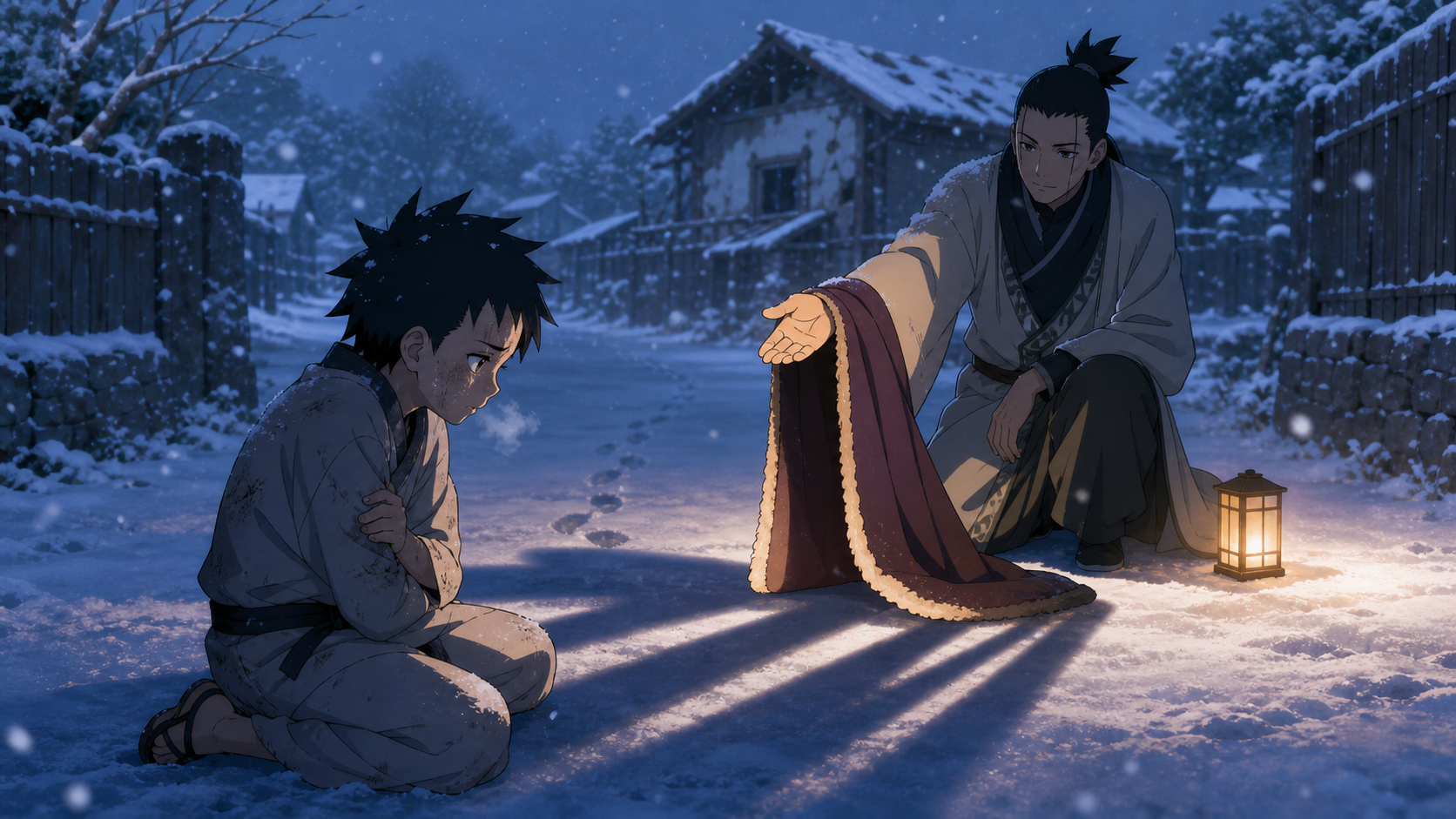
Ryōgi’s past arrives in cold blue silence. His father returns from a mission already dying, and his mother rushes to help. The attacker follows the wounded man home and kills her in front of their child. Ryōgi is not given time to understand one loss before another lands. The scene feels abrupt because childhood catastrophe is abrupt. A home becomes a murder site. Parents become bodies. The person who should answer every frightened question disappears. Snow outside makes the world look still while Ryōgi’s entire life is being ripped apart indoors.
His Ice Release wakes up through terror
When the killer turns toward Ryōgi, the boy’s Ice Release erupts. He protects himself on instinct and collapses. That power could have been framed as a triumphant bloodline awakening, but the episode keeps the moment ugly and frightened. Ryōgi does not celebrate. He has no parent left to tell him what happened or help him understand the ability. His first major use of ice becomes tied to the night he loses everybody. Later, Gekkō will train that power and claim authority over what the memory means. The technique belongs to Ryōgi, but Gekkō makes himself the interpreter.
Gekkō is waiting when Ryōgi wakes
Ryōgi opens his eyes and finds Gekkō beside him. The man says he killed the attacker and handled the funeral. Think about how much control sits inside those two statements. Gekkō becomes rescuer, witness, avenger, and keeper of the dead before Ryōgi can ask another adult what happened. He decides which facts the child receives and which farewells are already over. Ryōgi cannot see his parents again, cannot hear another account, and cannot compare Gekkō’s version with anything outside the room. By the time the boy is awake enough to choose, Gekkō has chosen the shape of reality for him.
The funeral being over breaks my heart
Gekkō tells Ryōgi that his parents’ funeral has already happened. The sentence moves quickly, but the cruelty deserves attention. Ryōgi loses even the ritual of saying goodbye. No final look, no community gathered around stories, no chance to see who mourned with him. Gekkō removes the witnesses who might connect Ryōgi to a life beyond the gang. The boy wakes after the world has closed around a finished narrative: his parents are gone, their killer is dead, and Gekkō is the only person left. That is not rescue followed by bad influence. That is isolation built before Ryōgi can stand.
Gekkō borrows Ryōgi’s father to recruit the son
Gekkō claims Ryōgi’s father secretly worked with the Byakuya Gang in addition to his shinobi duties. The story gives Ryōgi a way to keep loving his father while stepping directly into Gekkō’s control. Joining the gang does not feel like abandoning his parents. Gekkō frames membership as inheritance. Ryōgi can imagine that every theft continues his father’s unfinished work. On a first watch, the claim sounds suspicious. After the later reveal, the lie becomes monstrous. Gekkō murders Ryōgi’s parents and then uses the father’s name as a recruitment letter.
Training becomes affection with conditions attached
Gekkō teaches Ryōgi, praises his Ice Release, and gives him a role among the gang. The boy receives food, shelter, technique, and belonging from the same source. That mixture explains why Ryōgi defends him so fiercely. Gekkō has arranged every need so gratitude points toward obedience. Ryōgi does not experience the gang as a random criminal organization. He experiences the group as proof that somebody wanted him after the worst night of his life. Shikadai threatens that structure without trying. A friendship based on games and conversation shows Ryōgi that care can exist without debt, orders, or a heroic rescue story.
Shikadai notices the Katasuke mistake
Ryōgi once spoke about Katasuke’s laboratory with familiarity that did not fit his claim of being new to Konoha. Shikadai stores that detail instead of confronting him immediately. That patience is both strategic and personal. He wants more than a technically correct accusation. He wants Ryōgi to give him another explanation. The laboratory clue suggests somebody has been surveying the village, and the Byakuya Gang has every reason to study a site full of ninjutsu research. Shikadai’s brain has already reached the answer, but his heart keeps looking for an alternate route.
The stolen lamp makes denial impossible
Ryōgi brings out a lamp when evening falls over their shōgi game. Shikadai recognizes the object from a list of goods stolen by the Byakuya Gang. I love how ordinary the evidence looks. No villain mask drops onto the table. No dramatic scroll reveals a secret identity. A lamp meant to make their game warmer exposes the theft. Ryōgi uses stolen property to light the friendship he is hiding from his gang, and Shikadai sees both truths at once. The object is incriminating, but the choice to bring the lamp also shows how badly Ryōgi wanted this meeting to continue after dark.
One more shōgi game becomes a goodbye
They play as if routine can hold the world together. Shikadai watches the board, Ryōgi watches Shikadai, and every move carries more weight than either boy admits. Their friendship began because shōgi allowed silence without awkwardness. Now the same game gives them somewhere to put all the words they are avoiding. Shikadai does not knock the pieces aside or demand answers at once. He lets the match finish. That choice feels tender. Whatever happens after the question, he wants their last honest shared language to remain complete.
Shikadai wins the right to ask one question
When Shikadai wins, he asks Ryōgi to answer a single question. The structure matters because their friendship has always respected rules. Shikadai is not interrogating a captured enemy. He uses the terms of their game to create one narrow opening where Ryōgi can tell the truth. Then he asks whether Ryōgi belongs to the Byakuya Gang. No speech, no accusation padded with moral superiority. Shikadai names the fear plainly. His restraint makes the moment hurt more. He is giving Ryōgi the easiest possible path toward honesty, and Ryōgi still cannot take that path.
Ryōgi tries to laugh away the first clue
Ryōgi initially brushes off Shikadai’s suspicion. The reaction is defensive before anger takes over. He needs Shikadai to accept a weak explanation because the alternative forces both identities into the same room. He cannot be Gekkō’s loyal family member and Shikadai’s honest friend under the gang’s current plan. The episode has allowed him to keep those lives separate until the lamp connects them. Ryōgi’s panic is not only fear of capture. He is watching the one relationship he chose for himself collide with the relationship chosen for him in childhood.
Shikadai lays out the evidence without cruelty
Shikadai explains the laboratory inconsistency and the stolen lamp. He does not call Ryōgi stupid. He does not mock the honorable-thief story. He shows how the pieces fit and waits for his friend to respond. That calm is probably harder for Ryōgi than anger would have been. An angry accusation could be dismissed as hostility from an enemy shinobi. Shikadai’s disappointment comes from somebody who paid attention to him, remembered his words, and wanted their meetings to be real. Gekkō has taught Ryōgi how to resist enemies. Nobody taught him how to face a friend who sees the lie and stays gentle.
Ice becomes Ryōgi’s exit when words fail
Ryōgi reacts with anger and uses Ice Release to escape. The power born on the night of his parents’ murder now protects Gekkō’s version of that night. That connection is brutal. Ryōgi freezes the space between himself and Shikadai because distance feels safer than answering. He can run back to the gang and call the confrontation betrayal. He cannot erase the fact that Shikadai was right. The escape ends the conversation physically, but the question follows him into Episode 46. Every order from Gekkō now competes with Shikadai asking for one honest answer.
The episode understands that affection does not cancel suspicion
Shikadai cares about Ryōgi and investigates him anyway. Those actions are not opposites. Caring makes the unexplained details matter more. Shikadai does not protect the friendship by pretending the Byakuya Gang is harmless. He protects the truth of their bond by refusing to let lies define the final move. I appreciate that maturity. Fandom stories sometimes treat trust as never asking difficult questions. Episode 45 understands that real trust can require a question whose answer may break your heart.
Ryōgi’s loyalty makes sense without becoming right
Gekkō appears in Ryōgi’s memory as the man who saved him, avenged his parents, buried them, taught him, and gave him family. Of course Ryōgi feels loyal. The later truth does not make the boy foolish. The lie was built when he was terrified, grieving, and alone. Understanding that history does not make the gang’s actions noble. Ryōgi still helps steal, manipulate, and endanger people. The episode holds sympathy and responsibility together by showing the cage without pretending the cage moves his body for him.
Kaminarimon’s workers become pieces in Gekkō’s family story
While Ryōgi remembers being recruited, current workers protest outside Denki’s father’s company. Gekkō turns both private grief and public frustration into fuel. He tells Ryōgi that the gang is family, tells civilians that theft is justice, and positions himself as the person who knows what everybody’s pain means. That pattern matters more than any single slogan. Gekkō does not create solidarity. He centralizes interpretation. Every hurt becomes evidence that people should follow him, and every doubt becomes proof that the doubter has forgotten the cause.
Shikamaru and Sai know the unrest has another purpose
Sai and Shikamaru brief Naruto on the growing tension and consider what the Byakuya Gang wants from the chaos. Their concern gives the episode a wider frame without stealing the children’s story. The adults understand that the protest may be serving a second operation, but Shikadai has the personal clue that will make the decoy legible. I like seeing the generations work different parts of the same problem. Shikamaru reads political movement. Sai reads criminal behavior. Their sons and classmates notice the human details buried inside both.
On replay, Gekkō is present inside every missing fact
Episode 47 changes this flashback completely. Gekkō is not the rescuer who later became controlling. He is the killer who edited himself into the role of rescuer. The unseen funeral, the dead attacker, the secret story about Ryōgi’s father, and the immediate offer of training all protect the same lie. Watching Episode 45 again feels like watching somebody manufacture a childhood in real time. Ryōgi’s memory is emotionally true because his fear and gratitude are real. The facts inside that memory belong to Gekkō.
The lamp says more about Ryōgi than the mask
The gang’s masks make members interchangeable. The lamp does the opposite. Ryōgi chooses to bring stolen evidence into a private meeting because he wants enough light to keep playing with Shikadai. That choice is reckless, sweet, and sad. Somewhere underneath Gekkō’s training, Ryōgi values this friendship enough to loosen his guard. Shikadai notices because Shikadai notices everything, but I do not read the lamp only as a mistake. I read the lamp as the part of Ryōgi already reaching toward another life before he knows how to ask for one.
What changed on every replay
My first watch focused on whether Shikadai would confront Ryōgi. The stolen lamp felt like a neat detective clue, and the final Ice Release escape carried the emotional punch. After learning the truth about Gekkō, the funeral became the detail I could not stop thinking about. He removes Ryōgi’s chance to see his parents, controls every witness, and hands the child a finished story. Another replay made the shōgi game hurt most. Ryōgi could have stayed away. Shikadai could have reported the suspicion without meeting him. Both boys choose one more game because the friendship is real even when honesty is not.
Gekkō turns rescue into a debt Ryōgi can never finish paying
Ryōgi wakes after terror, newly awakened Ice Release, and the murder of his parents. Gekkō controls the first explanation, the first shelter, and the first path forward. A grieving child receives no independent witness capable of challenging the story.
The missed funeral makes the control complete. Ryōgi cannot see the bodies, hear relatives remember his parents, or ask why events unfolded. Gekkō closes mourning before Ryōgi wakes, then offers training as the only remaining connection to the father Ryōgi lost.
Every later act of care carries conditions. Food, shelter, instruction, and praise arrive when Ryōgi obeys. Doubt receives another reminder that Gekkō saved him. Gratitude becomes a chain because no amount of service can equal a life supposedly rescued.
Shikadai’s friendship creates a relationship outside that accounting. A shōgi game requires neither payment nor public loyalty. Ryōgi can lose, laugh, argue, and return without proving usefulness. That ordinary freedom makes the friendship dangerous to Gekkō’s structure.
The stolen lamp reveals how badly Ryōgi wants both lives. He wears the gang’s mask and carries evidence into a private game. Operational discipline would demand leaving the lamp behind. Friendship asks for enough light to see the board.
Shikadai notices the mismatch without turning the conversation into an interrogation. He presents evidence, asks a direct question, and gives Ryōgi room to answer. Suspicion does not erase affection. Affection does not require Shikadai to pretend the evidence means nothing.
Ryōgi escapes through Ice Release because words would force him to choose between the person who defines survival and the friend offering another reality. The technique first awakened during trauma. Gekkō later shaped the power into service. Using ice to flee repeats the pattern: fear creates distance before choice can become clear.
The episode refuses an instant rescue because manipulation this deep cannot collapse after one correct accusation. Shikadai places doubt inside the story Gekkō built. Ryōgi carries that doubt back to the gang, where every new order will have to compete with the memory of one honest question across a shōgi board.
That question survives the escape.
RaeRae’s final reaction
Episode 45 is quiet, cruel, and much better than the phrase “villain backstory” suggests. Ryōgi is not asking us to excuse him. The episode is showing why Gekkō’s approval feels like survival and why Shikadai’s question feels more dangerous than a police chase. I wanted Ryōgi to answer. I wanted Shikadai to reach across that board. I also knew the story had not earned an easy rescue yet. The stolen lamp, the snowy memory, and the unfinished goodbye give this arc an emotional spine strong enough to carry the protest plot into its climax. Gekkō built Ryōgi’s whole identity around a lie. Shikadai does not break that lie tonight, but he places the first honest piece on the board.
Sources and lawful viewing
Official episode reference: Naruto Official episode guide
Licensed episode route: Crunchyroll licensed series page