
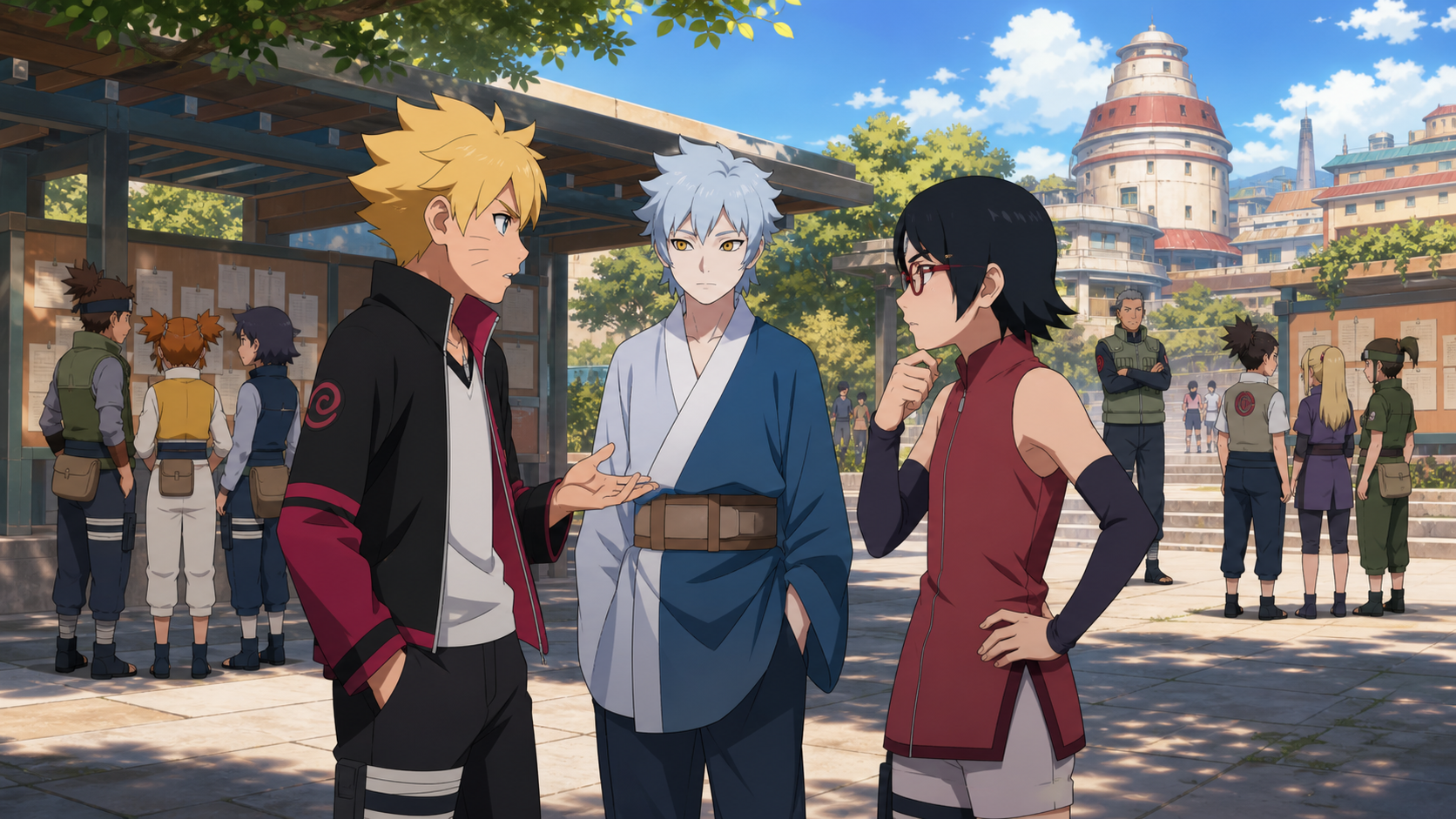
Formation of the Three-Man Squad?
Boruto and Sarada appeal to escape Team 3, Mirai makes their solo habits fail, Mitsuki holds the bridge together, and Sarada chooses the legacy of Team 7.
Series: Boruto: Naruto Next Generations
Episode: 38 · Formation of the Three-Man Squad?
Arc: Genin Mission Arc
Release: 2017-12-20
Previous: Episode 37 · A Shinobi’s Resolve!
Directory: All 293 Boruto episodes
Bottom line
Boruto Episode 38 starts with Boruto and Sarada trying to escape the same team and ends with Sarada asking Naruto to give that team the most loaded number in Konoha. The new genin are sorted by ability and compatibility. Shikadai, Inojin, and Chōchō inherit Ino-Shika-Chō. Boruto expects to stand beside Shikadai and instead receives Sarada and Mitsuki under Konohamaru as Team 3. Sarada wants a transfer. Boruto agrees for completely different reasons. Their direct appeal to the Hokage becomes a bridge fight against Mirai, who reads both of them, taunts both of them, and drops both of them into a trap while Mitsuki uses his body to keep the broken crossing from collapsing. Konohamaru finally tells Boruto and Sarada to stop treating the other person’s strengths like an inconvenience. They combine shadow clones, Sharingan, and one gloriously improvised plan to knock Mirai off the bridge. By the time Naruto hears the appeal, Sarada no longer wants out. She wants the name Team 7. That is legacy earned through one afternoon of being forced to look at each other properly.
Graduation becomes real when the names are grouped
The forehead protectors made everyone genin, but the squad list determines who will share missions, danger, and daily irritation. Classmates who spent years moving as one social group are divided into three-person cells with adult leaders. The room feels different as names are announced because childhood friendship no longer guarantees professional partnership. Every reaction tells us what each student assumed the future would look like before the Academy made the decision public.
Boruto expected Shikadai because comfort looks like compatibility
Boruto wants Shikadai on his team. The expectation makes sense. Shikadai understands his moods, slows his worst impulses, and rarely turns every disagreement into a competition. Boruto imagines missions as an extension of friendship, so the person he already trusts seems like the obvious teammate. The Academy is balancing abilities and traditions across the whole class, not building around Boruto’s comfort. His disappointment is less about Sarada at first than losing the future he casually assumed.
Ino-Shika-Chō arrives with generations already attached
Shikadai joins Inojin and Chōchō in the newest Ino-Shika-Chō formation. Their parents fought together, their clans built techniques around one another, and Konoha treats continuation almost like a public institution. The trio is familiar enough that Boruto cannot really argue with the logic. I still love that the next generation brings completely different personalities into the formation. Tradition gives them a structure. Chōchō will make sure nobody mistakes structure for predictability.
Team 3 looks absurdly powerful and emotionally combustible
Boruto, Sarada, and Mitsuki are assigned to Konohamaru. On paper, this is a ridiculous amount of talent: Naruto’s son, Sasuke and Sakura’s daughter, and Orochimaru’s synthetic child. In practice, Boruto and Sarada can turn breathing in the same direction into an argument. Mitsuki calmly enjoys the weather while the other two reject the assignment. The Academy sees complementary skill. Boruto and Sarada see the person most likely to challenge every instinct they have.
Sarada asks for a transfer before pretending politeness
Sarada immediately says she wants another team. I respect the directness even when the delivery is sharp. She is serious about becoming Hokage and does not want Boruto’s impulsiveness damaging her mission record. Sarada thinks a team should support the future she has chosen, and Boruto looks like chaos with whisker marks. Her mistake is assuming that compatibility means similarity. Konohamaru will spend the episode proving that somebody who sees the world differently can cover the opening you cannot.
Boruto agrees because being rejected activates him instantly
Boruto was disappointed about Shikadai, but Sarada’s rejection gives him a new reason to protest. If she does not want him, he certainly does not want her. Their shared appeal begins as mutual annoyance rather than cooperation, which is extremely them. Even when they want the same administrative outcome, they compete over whose reasons are more valid. Mitsuki follows with the serenity of somebody watching an experiment he already finds entertaining.
Konohamaru gives them the most ridiculous appeals process
The only way to overturn the assignment is to deliver a direct petition to the Hokage. That rule sounds designed by someone who assumes reaching Naruto will test whether the complainants can function together. Boruto has family access in theory, but Hokage Naruto is moving through official duties and guarded routes. Sarada treats the appeal seriously. Boruto treats proximity to his father as both advantage and grievance. The chase begins before either asks why Konohamaru looks so unsurprised.
Naruto is busy testing jōnin because peace still needs readiness
Elsewhere, Naruto trains Konoha’s jōnin to resist his power and looks disappointed by their performance. The scene reminds us that team assignments sit inside a larger village defense system. Naruto cannot personally carry every mission forever, no matter how easily he overwhelms the adults around him. Boruto is trying to reach Dad. Sarada is trying to reach the Hokage. Both roles occupy the same person, and neither child has much patience for the schedule separating them.
Sarada reveals the Sharingan while rushing toward her future
During the pursuit, Sarada uses the Sharingan in front of Boruto. The reveal gives him a clearer look at the strength she has been building quietly. Boruto knows Sarada is skilled, but seeing those eyes changes the scale of what she brings to a team. Sarada’s power is not decorative Uchiha inheritance. She uses the Sharingan to read movement, anticipate attacks, and support the exact tactical role that will defeat Mirai.
Mitsuki finds Naruto because of course Mitsuki finds Naruto
Mitsuki identifies the Hokage’s location while Boruto and Sarada burn energy arguing their way forward. His competence is almost comic because he never needs to make a production of being useful. Mitsuki wants to remain beside Boruto, so he helps the appeal even though success might separate the team. That contradiction reveals how he approaches choice at this point. Boruto’s desire sets the direction, and Mitsuki supports the movement. Episode 39 will ask whether that support is truly his own will.
Mirai guards the bridge with Sarutobi authority
Mirai stands between the genin and Naruto. As Asuma’s daughter, the Third Hokage’s granddaughter, and a capable chūnin, she carries her own layered legacy into the confrontation. She is not a random checkpoint. Konohamaru’s cousin guards the path to the Hokage while evaluating the children assigned to Konohamaru. The family symmetry is delicious, especially because Mirai has no intention of making the test gentle.
The trap breaks the bridge and removes Mitsuki from the fight
Boruto and Sarada trigger Mirai’s setup, the bridge ropes snap, and Mitsuki stretches his arms to hold the crossing together. The image makes the team problem literal. Mitsuki is physically keeping the path from falling while Boruto and Sarada have to move without relying on him to solve their conflict. His role saves everybody and takes him out of direct combat. The calm teammate cannot mediate forever. The loud two must finally cooperate.
Mirai reads Boruto’s impatience before he finishes moving
Boruto attacks with the confidence that usually carries him through Academy fights. Mirai has more experience and knows how to invite the move she wants. She blocks, redirects, and taunts him into pushing harder. Boruto’s creativity remains dangerous, but Mirai recognizes the emotional rhythm behind his choices. He wants to prove the team assignment is wrong. Every failed solo attack gives her more proof that the assignment might be exactly right.
Mirai knows how to make Sarada’s pride work against her
Sarada approaches with more analysis, but Mirai needles her confidence and isolates her from Boruto’s timing. Sarada wants to show that she does not need the teammate she is petitioning to leave. Mirai turns that desire into predictability. Strength without coordination becomes a sequence of separate attempts. The chūnin does not need to overpower their combined potential because they refuse to combine anything.
Konohamaru tells them the truth they are too annoyed to hear
Konohamaru points out that Boruto and Sarada keep focusing on each other’s flaws while ignoring complementary strengths. Boruto improvises, creates openings, and refuses to stay down. Sarada observes, reads patterns, and commits to precise action. Neither skill set is complete alone. Konohamaru does not ask them to like every personality trait. He asks them to recognize what the other person can do when a mission stops caring about their preference.
Boruto’s clones become tools instead of an audience
Once Boruto accepts Sarada’s read of the field, his shadow clones stop being a solo performance and become moving pieces inside a shared plan. He can attack from several directions, create noise, and force Mirai to choose a response. Sarada watches that response through the Sharingan. Boruto supplies unpredictability while trusting Sarada to identify the useful opening. That shift is teamwork, not because they become polite, but because each allows the other’s strength to shape the move.
Sarada uses Boruto’s chaos with surgical timing
Sarada does not need Boruto to become orderly. She needs to understand the pattern inside his disorder. Her Sharingan lets her follow the clone movement and Mirai’s reactions until the right moment appears. The plan works because Sarada stops treating Boruto’s style as a flaw to remove. She turns his relentless pressure into tactical cover. That lesson will define some of Team 7’s best fights later.
Knocking Mirai off the bridge is both victory and comedy
Boruto and Sarada finally combine their approaches well enough to send Mirai over the side. The triumph lasts just long enough for the episode to remind us that Mitsuki is still holding the bridge and Mirai is now dangling in a situation the adults probably predicted. Their solution is effective, a little excessive, and unmistakably Team 7. They reach Naruto because the test made them act like the squad they planned to dissolve.
Mitsuki’s bridge work deserves more than a footnote
The episode’s flashiest teamwork belongs to Boruto and Sarada, but neither reaches Naruto if Mitsuki lets go. His body carries the weight of the damaged crossing while they fight. That quiet support resembles his place in the early team: he stabilizes conflict without demanding recognition. Episode 39 complicates that role by revealing how much of Mitsuki’s identity has been built around finding a sun. Team 7 eventually needs him as a full person, not permanent connective tissue.
Sarada reaches Naruto and changes the appeal
After fighting so hard for a transfer, Sarada no longer asks to leave. The bridge proved that Boruto’s differences can strengthen her rather than derail her. She does not pretend they suddenly stopped irritating each other. She chooses the team with better information. That distinction matters. Sarada’s changed mind is not surrender to an imposed decision. The experience gave her ownership of the commitment.
The request for Team 7 turns inheritance into ambition
Sarada asks Naruto to rename Team 3 as Team 7, honoring the squad formed by Naruto, Sasuke, and Sakura. Boruto likes the idea of surpassing the old team. Mitsuki accepts the shared direction. The number carries triumph, betrayal, reunion, and the entire emotional spine of the original series. Giving that name to these children creates a promise bigger than marketing nostalgia. They inherit unfinished expectations as well as famous techniques.
Naruto approves because the children choose the burden
Naruto grants the name. He knows better than anybody that the original Team 7 was never a simple model of harmony. Calling a squad Team 7 does not guarantee friendship or greatness. The new trio has just demonstrated the important first step: conflict can become coordination when people stop using difference as proof that connection is impossible. Naruto approves the number because they ask after earning a glimpse of what the number requires.
Mirai is left tied up because victories need one embarrassing receipt
Back at the bridge, Mirai remains restrained with nobody rushing to help. The ending gives her the comic consequence every too-confident examiner deserves. She tested the genin, pushed them toward teamwork, and got caught in the result. Mirai will be fine. Her dignity may need a separate recovery mission. I appreciate any episode willing to close a legacy-heavy team formation with one competent adult hanging around like an unpaid invoice.
Team 7 begins through argument, not instant destiny
The episode could have announced the famous combination and relied on audience nostalgia. Instead, Boruto and Sarada reject the placement, fight separately, fail separately, and then choose the name after discovering how their abilities fit. Mitsuki’s support keeps the route open. Konohamaru’s coaching gives them language for what happened. The team feels less like destiny because the children had to do something with the assignment.
The team assignments expose what each child thinks a team should provide
Boruto hears a team assignment and imagines friendship. Shikadai has been beside him through academy nonsense, family frustration, and the kind of quiet conversations Boruto rarely manages with anybody else. Wanting Shikadai makes emotional sense. Boruto wants one person who already knows when he is showing off, when he is actually angry, and when the bragging covers a fear he cannot name. The problem is that a shinobi team cannot exist only to make Boruto comfortable. A three-person cell needs different tools, different instincts, and enough friction to stop one loud personality from setting every direction.
Sarada approaches the assignment from the opposite side and still reaches the wrong conclusion. She treats compatibility as a professional calculation, but her first calculation is shaped by irritation. Boruto looks careless to her. His refusal to respect rules feels incompatible with her ambition to become Hokage. She sees Mitsuki as strange, unreadable, and too willing to follow Boruto. Her objections sound practical until Mirai forces Sarada to work without the perfect conditions she believes a serious shinobi deserves. Sarada does not need teammates who behave like Sarada. She needs teammates whose abilities give her better choices under pressure.
Mitsuki barely protests because Mitsuki already has the placement he wants. That calm acceptance makes him look easygoing, but his motive is the least professionally detached of the three. He wants proximity to Boruto. Episode 38 quietly places three different needs inside one team: Boruto wants familiarity, Sarada wants control, and Mitsuki wants personal meaning. None of those desires is shameful. None can become the governing principle of a combat unit either. Konohamaru's first real job is teaching them how to turn private motives into shared responsibility.
Konohamaru has to become a teacher before he can enjoy the Team 7 nostalgia
Konohamaru grew up chasing Naruto, declaring his own Hokage dream, and treating the old Team 7 as legendary proof that impossible children could become extraordinary shinobi. He could easily romanticize this assignment. Instead, the episode gives him the less glamorous adult role. He has to stand beside three talented children while they complain about a decision he understands better than they do. He cannot demand instant loyalty or wave the famous number in their faces. The name only matters after the children learn why they belong together.
His bridge-side lesson works because he does not pretend Boruto and Sarada suddenly like each other. Konohamaru identifies a usable fact: each child has noticed the other's strengths even while complaining. Boruto knows Sarada can track movement and choose a clean opening. Sarada knows Boruto can flood a battlefield with pressure, feints, and unexpected angles. Their irritation has made them pay attention. Konohamaru turns that attention away from personal judgment and toward tactical trust.
That distinction matters for his own growth too. Young Konohamaru wanted adults to recognize his potential. Jōnin Konohamaru must recognize potential without letting talent excuse bad teamwork. He gives Boruto and Sarada room to fail, then offers the exact correction they need. The scene is not flashy leadership. The scene is patient leadership, which may be harder for a former academy menace who once solved problems with the Sexy Technique and raw nerve.
Mirai gives the new generation a fair fight without giving them an easy one
Mirai could overpower fresh genin through experience alone, but she chooses a smarter test. She attacks their habits. Boruto moves first because waiting feels like surrender. Sarada takes the bait because being underestimated offends her. Mitsuki observes, supports, and becomes the structural answer before either teammate notices the bridge needs saving. Mirai does not need a speech about their weaknesses. She makes the weaknesses expensive.
The fight also gives Mirai overdue space as a Sarutobi in her own right. Asuma's daughter and Kurenai's daughter carries a family history full of skilled shinobi, grief, and expectations she did not choose. The episode lets her stand between Konohamaru's students and Naruto without reducing her to somebody's child. Her genjutsu, close-range control, and psychological reads establish professional authority. When the genin finally beat her, the victory lands because Mirai has been competent from the first exchange.
Leaving her tied up works as comedy because the episode never makes her foolish. Boruto and Sarada need cooperation, timing, and Mitsuki's support to create one successful opening. Mirai loses the test she designed after the students finally answer the lesson. That outcome feels like a teacher getting the result she wanted and an older cousin receiving a little disrespect as payment. Both readings fit the Sarutobi family beautifully.
Choosing Team 7 is not the same as inheriting Team 7
Sarada's request carries enormous franchise weight, but Episode 38 does not hand the new trio the old team's achievements. A number cannot transfer Kakashi's guidance, Sakura's discipline, Sasuke's trauma, or Naruto's refusal to abandon people. The number carries memories and expectations. Boruto, Sarada, and Mitsuki still have to decide what their version means.
Their starting point already differs. Naruto's Team 7 formed around loneliness that each member hid in a different way. Boruto's Team 7 forms inside a peaceful village where famous parents, clan histories, and public expectations crowd the room. Boruto is not ignored; he fears being seen only as the Hokage's son. Sarada is not chasing Sasuke's approval in the same way Sakura chased Sasuke's attention; Sarada wants a public office built around service while questioning the family history surrounding her. Mitsuki enters with a manufactured body, a dangerous parent, and a private decision to use Boruto as his sun. The inheritance is complicated before their first proper mission.
Sarada's choice therefore feels braver than a nostalgic callback. She asked to leave because she believed the assignment blocked her path. After the bridge, she asks for a name associated with the hardest possible version of that path. She accepts Boruto's disruption, Mitsuki's mystery, and Konohamaru's leadership as part of the work. Naruto approves because he recognizes a choice made after conflict, not a child borrowing a famous label for attention.
What changed on every replay
My first watch waited for the Team 7 name. On replay, Mitsuki holding the broken bridge became the image that defined the episode. He supports the path while Boruto and Sarada discover why they need each other. Another pass made Mirai more fun because her taunting is precise enough to expose both children’s pride without turning the fight cruel. The final detail I kept returning to was Sarada changing the petition herself. She does not merely withdraw the complaint. She replaces the requested escape with a larger commitment.
RaeRae’s final reaction
Episode 38 is a legacy episode with enough personality to avoid becoming a museum tour. Boruto wanted Shikadai, Sarada wanted anybody but Boruto, Mitsuki wanted whatever kept him near his sun, and Konohamaru somehow had to turn that mess into a mission-ready cell. Mirai snapping the bridge was dramatic, but Mitsuki holding the entire route together while the other two learned teamwork was almost too perfect. I laughed when they left her tied up, cheered when Sarada asked for Team 7, and immediately remembered how much emotional damage that number has historically attracted. These kids have no idea what they just volunteered to inherit. I am seated anyway.
Sources and lawful viewing
Official episode reference: Naruto Official episode guide
Licensed episode route: Crunchyroll licensed series page