
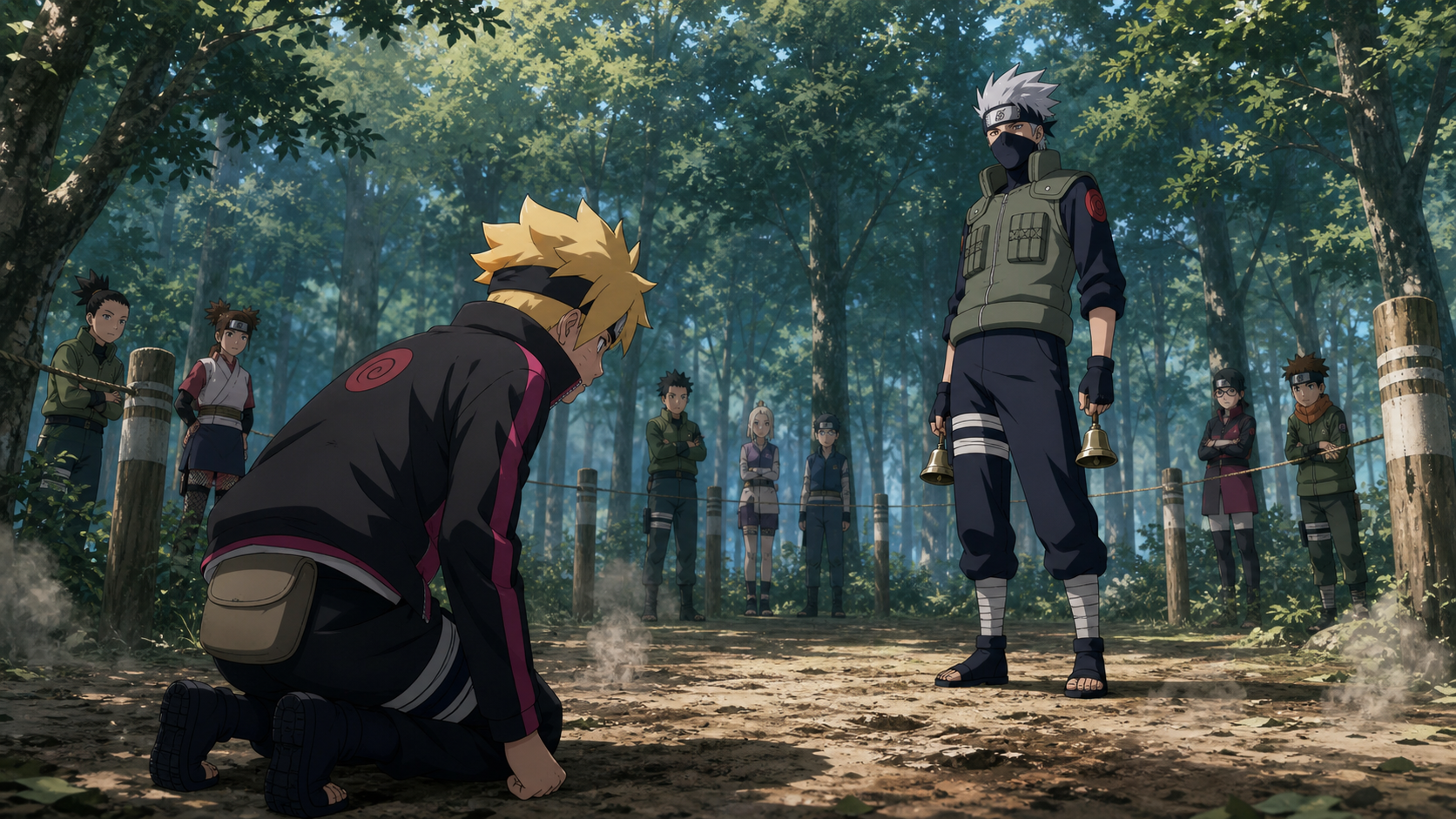
The Graduation Exam Begins!
One bell turns the class into rivals, the instructors punish every scattered plan, and Boruto’s chūnin-level skill carries him straight into Kakashi’s real test.
Series: Boruto: Naruto Next Generations
Episode: 36 · The Graduation Exam Begins!
Arc: Academy Graduation Arc
Release: 2017-12-06
Previous: Episode 35 · The Parent-Teacher Conference!!
Directory: All 293 Boruto episodes
Bottom line
Boruto Episode 36 gives us a graduation exam built like a trap and a Kakashi performance so cold that I almost forgot how delighted this man gets when students finally surprise him. The written test rewards information gathering. The practical test hands every student a white bandanna, puts targets on Shino, Anko, and Konohamaru, then adds one bell to Kakashi’s waist and lets panic do the rest. One bell. An entire class. Kakashi does not need to tell them to turn graduation into a race because scarcity delivers the message for him.
Boruto hears that message louder than anybody. He rushes ahead, bypasses battles he considers a waste of time, reaches Kakashi first, and proves that his combat instincts are already absurdly good. Kakashi privately judges his ability around chūnin level. Then he pins Boruto down and says the boy lacks the decisive quality required to become a shinobi. The episode is not arguing that Boruto has no talent. The episode is taking his talent seriously enough to ask whom that talent serves.
The written exam starts with a theft
Denki and Iwabee celebrate because they stole the exam questions from the teachers’ lounge. Boruto immediately calls the move cheating, which is hilarious coming from a child whose entire spiritual practice involves finding the side door nobody else noticed. Sarada catches the real test before he does. Shino told the class to check the questions and develop a strategy beforehand. The theft was not a failure of character. The theft was the assignment.
That opening establishes the exam’s favorite trick. Instructions mean more than their surface wording. Shinobi are expected to gather intelligence, read context, and recognize when success depends on interpreting the situation rather than obediently filling in boxes. Denki and Iwabee look reckless for a beat, then turn out to be the students who listened most carefully.
Boruto’s perfect score feeds the wrong confidence
Shino grades the written papers, and Boruto earns a perfect score. Kakashi notices. He also notices how comfortable Boruto looks inside that success. Boruto is not sweating graduation because every stage keeps confirming the story he already believes about himself. He is talented, quick, and naturally suited for whatever comes next.
A perfect score should be good news. For Boruto, the score becomes one more cushion between confidence and self-examination. Kakashi sees a student who can clear the obvious standard without confronting the habits that will become dangerous when another person’s life depends on his choices.
Kakashi arrives carrying one bell and old trauma
Shino, Anko, and Konohamaru explain the practical exam in the forest. Each student receives a white bandanna. Lose the bandanna and fail. Destroy the target on a teacher and that teacher can no longer interfere. The arrangement already gives the class multiple tactical problems before Kakashi strolls in as proctor.
Then the one bell appears. Longtime Naruto fans know exactly what Kakashi is doing. The original Team 7 learned that the apparent competition was designed to expose whether they would abandon one another. Kakashi has brought the lesson back for a generation raised in peace, only now the test covers a whole classroom rather than three children and a lunch box.
One bell turns classmates into rivals before anyone moves
Kakashi implies that only the student who takes his bell will graduate. Nobody has time to calmly compare interpretations. The pressure hits first. Several students rush forward because the rules have made cooperation feel like a threat to personal survival.
That scarcity is the real opening attack. Kakashi knows the class has friendships, but friendship feels different when success appears limited to one person. The exam asks whether their bonds can survive a structure that rewards selfishness.
Boruto attacks before the signal settles
Boruto launches kunai at Kakashi almost immediately. Kakashi’s body becomes wood, and the substitution announces the distance between academy confidence and veteran experience. Boruto is fast enough to initiate. Kakashi is far enough ahead to let the attack hit a version of the battlefield that no longer exists.
Kakashi remarks on Boruto’s resemblance to Naruto, but the comparison has teeth. Young Naruto also charged toward Kakashi with more confidence than information. Boruto inherited the instinct to force a moment. He has not yet learned when the moment requires other people.
The class scatters into exactly the mistake Kakashi wants
Once the exam begins, students split into different approaches. Some pursue Kakashi directly. Others hang back so classmates can become distractions. Shikadai plants a tracker on Kakashi, only for Shino’s insect to remove the device.
Every decision makes sense in isolation. Together, the decisions reveal a class with no shared plan. Intelligence exists everywhere, but intelligence has not become coordination. Kakashi does not need to defeat one team because the students have not truly formed one.
Shino removes Shikadai’s clever little advantage
Shikadai getting a tracker onto Kakashi is genuinely smart. The move shows forethought and understands that finding the target may matter more than charging blindly. Shino quietly removing the tracker with an insect is even better because the teachers are evaluating every layer of the students’ planning.
Information can be planted, lost, corrupted, or noticed by an opponent. Shikadai’s idea is not useless because Shino counters the move. The exchange shows why a single clever action cannot substitute for backup plans and communication.
Anko turns the forest into a maze
Anko uses genjutsu to send several student groups around in circles. She does not need a spectacular battle when confusion can waste their limited time. The forest becomes less a location than a test of perception.
Anko’s presence also gives the episode delicious teacher-chaos energy. She understands that frightened students reveal patterns quickly. Who notices the repetition? Who trusts another classmate’s senses? Who keeps running because admitting confusion feels worse than losing time?
Ino-Shika-Chō meets a teacher who enjoys the assignment
Shikadai, Inojin, and Chōchō face Anko and her snakes. Their inherited formation gives them a language for cooperation, but family history does not hand them an automatic win. Anko pressures the trio while students previously caught in her genjutsu manage to return.
That return matters. The class is already beginning to solve problems after being separated. They have not reached the unified answer Kakashi wants, but they are not helpless background bodies waiting for Boruto to finish the episode.
Konohamaru clears students with uncomfortable efficiency
Konohamaru knocks out Renga, Tsuru, Hako, Namida, and Wasabi. The speed of those losses reminds us that academy competence is not field equality. These teachers know how to isolate a mistake and end an exchange before students can recover.
I appreciate that the episode lets the instructors feel dangerous. A graduation exam loses tension if every adult suddenly forgets how to fight. The students need enough pressure to expose their habits, and Konohamaru supplies pressure without stealing Kakashi’s role as the final wall.
Sarada reads the exam better than Boruto
Boruto does not want to waste time fighting Konohamaru. Sarada lets him continue toward Kakashi because she believes neutralizing the teachers serves a larger purpose. She sees structure where Boruto sees delay.
Sarada’s decision is not passive permission. She chooses a necessary battlefield and trusts her own ability to handle that responsibility. Boruto takes the route with the most visible prize. Sarada takes the route that makes everybody else’s path more possible.
Sumire and Sarada become a fantastic temporary pair
Sarada and Sumire combine the Sharingan and Nue against Konohamaru. Their abilities come from radically different experiences, yet the partnership works because both girls understand observation, control, and timing.
This pairing is one of the episode’s best reminders that team assignments have not happened yet. The academy class can still create unexpected combinations before formal squads narrow their daily lives. Sarada’s precision and Sumire’s quiet force look natural together, and I would happily watch much more of that partnership.
Mitsuki chooses Shino so Boruto can continue
Shino blocks Boruto and Mitsuki. Mitsuki stays behind to handle their teacher while Boruto keeps searching for Kakashi. On the surface, Mitsuki is enabling Boruto’s solo run. Yet the choice also shows that Boruto is not actually advancing alone. Somebody keeps absorbing the obstacles he dismisses.
Mitsuki rarely complains about that role. His loyalty feels effortless, which makes the imbalance easy for Boruto to miss. The episode wants us to notice the labor supporting Boruto’s big entrance even when Boruto does not.
Mitsuki defeating Shino is not a casual achievement
Mitsuki prepares to use more of his power against Shino and ultimately defeats him. Shino tells him to go ahead. The scene gives Mitsuki a clean demonstration of competence without making the victory feel loud.
Shino is a skilled adult shinobi with one of Konoha’s most difficult fighting styles. Getting past him confirms that Mitsuki belongs among the class standouts. The quiet child is carrying far more power than his classmates fully understand, and he still chooses to spend that power opening Boruto’s route.
Boruto hunts Kakashi from above
Boruto searches from a giant tree and uses a shadow clone as bait. This is where his instincts become exciting. He is not simply throwing bodies toward Kakashi. He probes, watches, and tries to manufacture a readable response.
The forest suits Boruto because vertical movement lets him create angles faster than most opponents can track. Against a normal examiner, his speed and improvisation might be enough. Against Kakashi, every clever approach becomes another piece of information the veteran can study.
Shadow clones make Boruto look ready
Boruto’s shadow clones pressure Kakashi and fill the field with possibilities. The technique is inherited, but Boruto uses the copies with his own sharper, more technical rhythm. He treats clones as moving pieces in a trap rather than an endless supply of bodies.
Kakashi recognizes the ability. That recognition matters because his later judgment cannot be dismissed as simple dislike. He sees how good Boruto already is. The criticism becomes harsher precisely because the skill level raises the stakes of whatever Boruto lacks.
The Boruto Stream is a genuinely nasty surprise
Boruto uses the Boruto Stream while approaching from underground, turning movement and concealment into one layered attack. The plan has personality. Boruto loves creating a visible threat, then delivering the real danger from an angle the opponent dismissed.
Kakashi substitutes away, but forcing that response still counts as evidence of Boruto’s combat intelligence. The kid is not bluffing his way through graduation. He can build an attack sequence under pressure and make a former Hokage react.
Kakashi privately gives Boruto chūnin-level credit
Kakashi considers Boruto a cut above the rest and judges his skills around chūnin level. That assessment is enormous. Boruto is taking a graduation exam for entry-level shinobi status, and the proctor sees ability beyond the rank he is trying to earn.
The episode refuses the easy story where arrogance hides mediocrity. Boruto’s arrogance sits beside real excellence. That combination is more dangerous and more interesting because success keeps rewarding the habits Kakashi wants to challenge.
Skill is not the missing piece
Kakashi says Boruto lacks one decisive trait. Episode 37 will name the lesson more fully, but Episode 36 lets the absence sit between them. Boruto can attack, adapt, and surprise. He cannot yet explain what becoming a shinobi means beyond being good enough to win.
That gap is not about bravery. Boruto has plenty. The missing quality is resolve tied to responsibility, the willingness to hold a purpose when cleverness stops being fun and somebody else starts paying for his choices.
Kakashi uses genjutsu to take control
Kakashi gets behind Boruto through genjutsu and pins him down. The reversal is brutal because Boruto has spent the fight feeling closer and closer to the bell. Kakashi reveals that the apparent momentum belonged to the examiner all along.
Veteran skill looks different from academy brilliance. Boruto creates impressive moments. Kakashi controls the conditions surrounding those moments. The pin turns that difference into a physical fact Boruto cannot joke away.
Reaching Kakashi first becomes Boruto’s indictment
Boruto reaches Kakashi before the rest of the class, which should sound like victory under the one-bell rules. Instead, arriving first exposes him. He left every supporting fight behind and accepted every sacrifice that cleared his route.
Nobody forced Mitsuki to stay with Shino or Sarada to face Konohamaru, but Boruto never stopped to ask what their choices meant. He treats their help as the landscape of his success. Kakashi sees a future teammate who may race ahead while assuming everyone else will manage the cost.
The bell hangs there like a lie
Kakashi’s bell remains visible enough to keep Boruto focused on possession. That is why the old test still works. A tangible prize can make a complicated mission feel simple. Grab the object. Beat the opponent. Become the winner.
Shinobi work rarely stays that clean. The mission objective matters, but so do the people, the information, the route home, and the consequences hidden beyond the assignment. The bell is not meaningless. The bell is incomplete.
Kakashi’s cruelty has a purpose and still hurts
Kakashi tells Boruto that he is unsuitable to become a shinobi. The line is colder than a technical correction because Kakashi wants to crack the certainty protecting Boruto from the lesson. He succeeds. Boruto cannot shrug off a verdict from somebody who just proved how thoroughly he was read.
I understand why Kakashi goes hard. I also understand why that sentence lands like a blade. Boruto has been wondering whether graduation will separate him from his friends. Kakashi turns the fear inward and suggests Boruto himself may be the reason he does not belong beside them.
This is Kakashi repeating history with a larger class
Kakashi once watched Naruto, Sasuke, and Sakura chase bells while distrusting one another. He now watches Boruto’s entire class scatter under the same false scarcity. The faces change, but the temptation remains familiar.
The difference is scale. This generation has friendships across many combinations, and the exam must pull those relationships into one decision. Kakashi is not looking for a single trio to share lunch. He is waiting for a classroom to decide that one bell cannot define whose future matters.
The cliffhanger works because Boruto really was excellent
Episode 36 ends with Boruto pinned and emotionally dismantled. The cliffhanger would feel cheap if he had simply fought badly. Instead, he did almost everything a flashy action hero is supposed to do. He tracked Kakashi, used clones intelligently, layered the Boruto Stream, and forced responses from a legendary opponent.
Then Kakashi says none of that answers the exam. The frustration is the point. Boruto cannot solve this problem by becoming more impressive because impressive was never the missing quality.
RaeRae’s take
Kakashi came to this graduation exam dressed like the final boss of childhood confidence, and I need everyone to respect how personally he committed to ruining Boruto’s morning. One bell for a whole class is wicked work. Watching Boruto sprint toward that obvious trap while Sarada and Mitsuki quietly clear his road made me want to reach through the screen and turn his head around.
Still, Boruto is so much fun to watch when his brain catches fire. The tree positioning, the clone bait, the underground approach, and the Boruto Stream all show why adults keep worrying about him and admiring him in the same breath. He is already good enough to be dangerous. Episode 36 asks whether he can become dependable. That question is much better than pretending he needs another power boost.
Peace changed the exam without making the profession harmless
The graduation test shows how much Konoha has changed since Naruto's childhood. Nobody sends twelve-year-olds into a forest where enemy villages may kill them for a scroll. The instructors control the field, the written portion rewards observation instead of memorized trivia, and the practical targets are adults who know the students. That safer structure is real progress. The village can test judgment without pretending trauma is the only honest teacher.
Safer does not mean soft. A shinobi still needs to interpret incomplete instructions, recognize manipulation, protect teammates, manage fear, and act under physical pressure. Kakashi builds those demands into an exam where the greatest danger comes from the students misunderstanding success. One bell makes individual victory appear possible while making collective victory seem mathematically absurd. The setup asks whether children raised during peace will preserve community when an institution offers scarcity as an excuse for selfishness.
That question belongs in Boruto more than another lecture about the new generation having easy lives. These children did not choose the peace their parents built. They should benefit from peace. Their responsibility is learning what peace requires from them now. Teamwork, restraint, information sharing, and the ability to value a weaker classmate are not lesser shinobi skills. Those habits are how a village stops repeating the wars that shaped Kakashi.
Boruto's talent becomes a problem only when talent narrows his vision
Kakashi's private chūnin-level assessment matters because the episode refuses a cheap humiliation. Boruto does not fail to reach the bell because his techniques are childish. His clones create pressure from multiple angles. His movement through the trees shows excellent spatial awareness. The Boruto Stream turns wind and cooperation with a clone into explosive acceleration. He adapts fast enough to make one of the most experienced shinobi alive pay attention.
Every successful choice also carries the flaw Kakashi wants to expose. Boruto uses clones as extensions of himself, not as partners with separate judgment. He bypasses classmates because their battles appear unrelated to his objective. He treats reaching Kakashi first as proof that his priorities were correct. The same confidence that produces creative combat prevents him from asking whether the exam's obvious route is the real route.
Kakashi attacks that blind spot with brutal precision. Calling Boruto unfit after praising his ability would sound contradictory if the standard were raw power. The standard is trust. A shinobi with Boruto's speed and influence can pull people into danger before anybody has time to challenge the plan. Dependability requires him to look backward, count who followed, and notice who never reached the clearing.
The supporting students keep the episode from becoming another private prodigy test
Mitsuki choosing Shino, Sarada working with Sumire, and Ino-Shika-Chō confronting Anko prevent the practical exam from shrinking around Boruto. Each encounter reveals a different kind of readiness. Sarada and Sumire coordinate without needing identical personalities. Shikadai reads patterns while Chōchō and Inojin give his plans force. Mitsuki accepts a difficult opponent so somebody else can advance.
Those choices are the early answer to Kakashi's hidden question, even before the class understands the question. Boruto races toward the apparent prize while his classmates build small examples of cooperation across the field. Episode 37 will turn those examples into one united plan. Episode 36 earns that resolution by showing the pieces separately and allowing Boruto to miss what the audience can already see.
Sources and lawful viewing
“The Graduation Exam Begins!” is Boruto: Naruto Next Generations Episode 36 and part of the Academy Graduation arc. The class clears a written intelligence-gathering test before facing Shino, Anko, Konohamaru, and Sixth Hokage Kakashi in the practical exam.
Official episode reference: Naruto Official episode guide
Licensed episode route: Crunchyroll licensed series page