
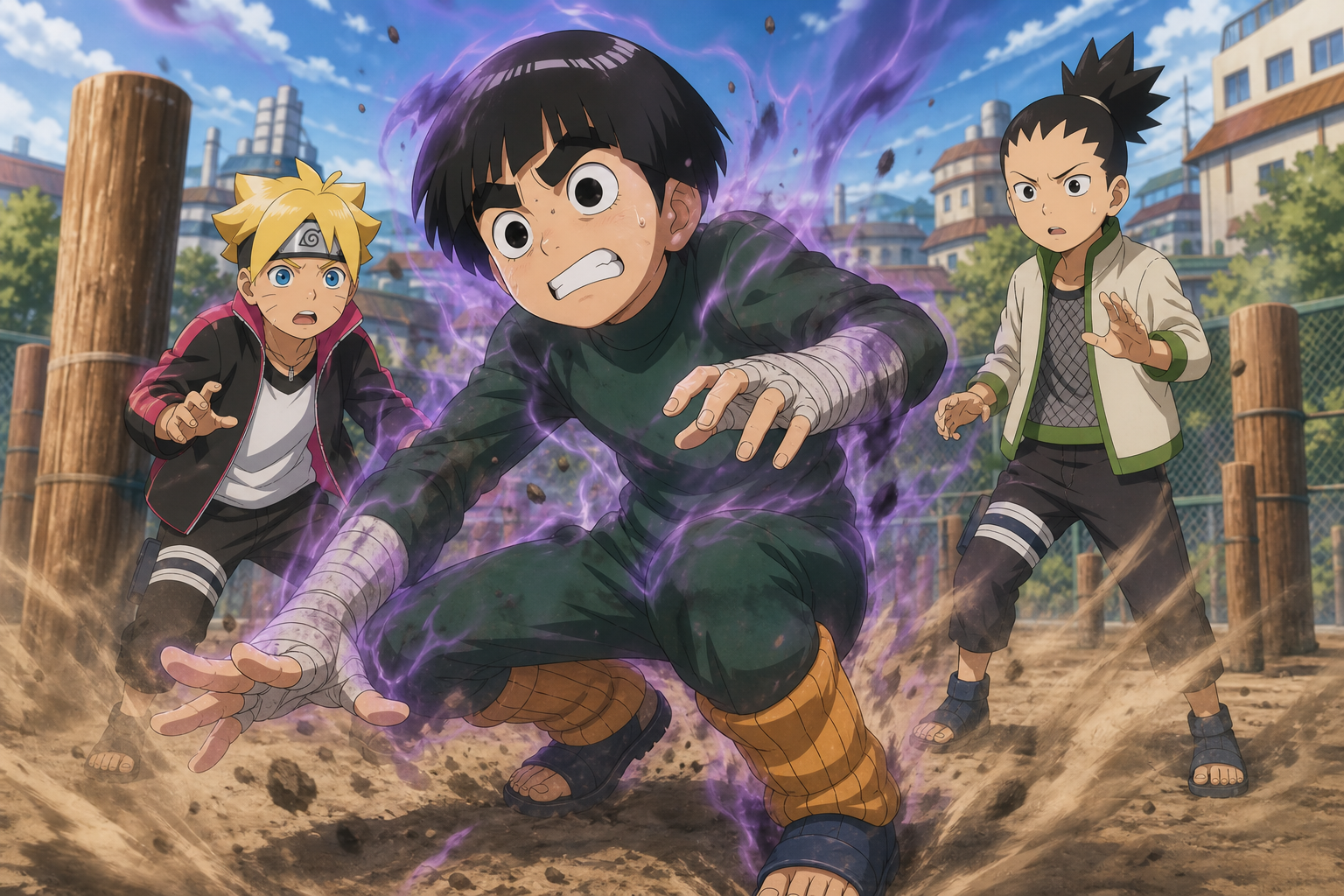
Metal Lee Goes Wild!
Metal has every taijutsu skill until somebody watches, then the Ghost gives his fear enough power to attack the classmate who noticed.
Series: Boruto: Naruto Next Generations
Episode: 3 · Metal Lee Goes Wild!
Arc: Academy Entrance
Release: 2017-04-19
Previous: Episode 2 · The Hokage's Son!
Directory: All 293 Boruto episodes
Shino starts with a shuriken lesson nobody respects
Shino begins teaching the class how to throw shuriken. Most students barely listen. Their quiet instructor has not learned how to hold a room full of children who respond to spectacle faster than explanation.
Sumire struggles with the technique. Inojin and Shikadai breeze through because their parents already made them practice at home. Then Metal Lee steps up and shows exactly how much work he has put into his body.
His first throws are clean. His form is controlled. Metal is talented enough to make the exercise look easy until he notices classmates watching.
The moment attention lands on him, everything changes.
Metal's body knows the form until the audience arrives
Metal practices constantly. His taijutsu, balance, and throwing motion come from the same relentless effort that defines Rock Lee. Nothing about his preparation is weak.
Then Inojin and Shikadai look his way. Metal becomes self-conscious, tightens up, and starts making mistakes. The skill has not vanished. His awareness of every watching eye crowds out the rhythm he built in private.
Shikadai notices the pattern immediately. His observation is accurate. His delivery has all the warmth of a weather report.
Metal hears that classmates can see the exact weakness he works hardest to hide. One careless comment becomes louder than every successful throw.
Boruto finds a weapon he was not supposed to use
Boruto discovers a Fūma shuriken in a locker and decides the beginner exercise needs more danger. He throws the oversized weapon toward the target.
Metal believes he can deflect the blade. Under ordinary training conditions, he probably can. The class watches. His nerves hit. His foot catches on the spinning weapon, and the shuriken drags him through the practice area.
Shikadai asks where Boruto found equipment they were not approved to use. The answer is Iwabee's locker.
Boruto's defense is basically that the weapon existed and curiosity happened. Shino is not moved.
Everybody connected to the stunt receives “voluntary” work.
Punishment means repairing Naruto's face
Shino assigns Boruto, Shikadai, Inojin, and Metal to help repair the Hokage Rock, specifically the damage Boruto caused when the train crashed into Naruto's carved face.
The punishment is wonderfully personal. Boruto does not merely clean a classroom. He has to stand on his father's monument and restore the exact public image he damaged during his entrance-ceremony rebellion.
Shikadai and Inojin are dragged into another Boruto consequence. Metal wants to prove he can complete the work. The cliff face puts every movement on display, which is the worst possible environment for his nerves.
One simple repair becomes another performance.
Metal falls behind while everyone else takes a break
The boys work across Naruto's stone face. When they pause, Metal's section remains unfinished. He sees the missing patch, sees the others noticing, and feels the pressure rise.
He rushes.
The carving slips and damages Naruto's face again. Boruto has watched his own vandalism turn into a class punishment, yet Metal experiences the new damage as a personal catastrophe. One mistake has made the entire assignment worse in front of the exact classmates whose judgment he fears.
Shikadai comments on Metal's nervousness again. He is not trying to wound him. That does not make the words land softly.
Metal leaves carrying shame, anger, and the beginning of a dark shadow nobody notices.
Shikadai realizes the comment went too far
The next day, Shikadai decides to apologize. That choice deserves credit because admitting a careless sentence hurt somebody is rarely convenient, especially for a boy who treats emotional complications as troublesome.
Boruto and Inojin go with him. They expect an awkward conversation and a return to class.
Boruto's right eye activates. He sees the same warped darkness around Metal that surrounded Denki before the train incident.
The apology arrives one moment too late to prevent the Ghost from taking hold. Metal attacks Shikadai with all the taijutsu skill that disappeared under ordinary attention.
Now every eye is on him, and the dark chakra has converted fear into force.
Possessed Metal is frighteningly good
Metal's anxiety never meant he lacked power. Under the shadow, hesitation disappears and his training floods into the fight. He moves faster, strikes harder, and overwhelms the classmates who assumed nervous mistakes defined him.
The tragedy is obvious. Metal finally performs without freezing because something predatory has taken away the part of him that worries about consequences.
Shikadai becomes the target because his words sit closest to the wound. Boruto gets caught in the middle and recognizes that beating Metal down will not explain what changed.
Episode 3 gives Metal a showcase and makes the showcase hurt. We wanted to see Rock Lee's son fight. The Ghost gives us that fight by stealing his control.
Shikadai's shadow catches the wrong problem
Shikadai uses Shadow Imitation to restrain Metal. The technique can stop his body, but the possessed boy begins forcing his way free.
Shikadai urges Boruto to knock him out. In practical terms, the request makes sense. Metal is dangerous, the shadow bind is failing, and Boruto has an opening.
Boruto hesitates because he can see the darkness wrapped around their classmate. The attacker and the person inside the attack are not the same problem.
That distinction does not produce a perfect plan. The boys are Academy students improvising against a phenomenon adults have not identified. They need Metal unconscious before somebody gets seriously hurt.
Metal solves that part himself by accident.
Metal breaks free and knocks himself out
Metal pushes through Shikadai's hold, loses control of his movement, and strikes himself unconscious. The dark shadow leaves as he falls.
The ending is less glamorous than a finishing jutsu. That makes the scene feel right. Boruto does not claim credit for defeating him. Shikadai does not pretend restraint fixed everything. Metal's rampage ends in one painful collision after his body finally outruns the chakra controlling him.
Boruto watches the darkness disperse. Denki was not an isolated incident. Something is selecting people, inflaming their worst emotional moment, and leaving when the violence ends.
He still cannot explain why only his eye sees the shadow.
Shikadai gives the apology he came to give
When Metal wakes, Shikadai apologizes for the comment from the previous day. He does not blame the fight on Metal's personality or hide behind the possession.
Metal accepts. The four boys head back toward class.
The apology cannot erase the dark chakra, but the apology matters because Metal's original hurt was real before the Ghost arrived. Shikadai now understands that noticing a weakness does not give him permission to turn the weakness into a joke.
Their friendship does not become instantly sentimental. Shikadai remains dry. Metal remains nervous. The difference is that one boy has learned to look again after his first clever conclusion.
Boruto asks Hinata about the Byakugan
At home, Boruto asks his mother about the Byakugan. His right eye keeps revealing things nobody else can see, and the Hyūga bloodline offers the most obvious explanation.
Hinata knows her clan's dōjutsu. Boruto is not showing the familiar signs, but his question begins a family thread that will grow through Episodes 8 and 9.
He does not tell her the full story yet. Boruto wants a name for the power without exposing how uncertain and frightened the sightings make him.
If the eye is a Byakugan, then the mystery becomes inheritance. If the eye is something else, Boruto has no map.
Naruto comes home too tired for the question
Naruto arrives exhausted and goes straight to bed. Boruto has just survived another strange chakra incident and started asking about his eye. His father is physically home and unavailable.
The scene is small, but the pattern matters. Naruto loves his family. Hokage work keeps consuming the attention Boruto wants most. Every unexplained event becomes one more experience the son handles with classmates before the father hears a complete version.
Boruto's secrecy is not only pride. He has learned that catching Naruto at the right moment feels like another mission.
The Ghost keeps moving while the Hokage sleeps from protecting everybody else.
Video games become exposure training, Academy style
The next day, Boruto, Shikadai, and Inojin invite Metal to play video games. Their theory is that relaxed time together might help him become less nervous around people.
This is not a professional strategy. This is three boys deciding friendship and a controller can solve stage fright.
The instinct is sweet. Metal needs classmates who see him outside a public test. The execution goes exactly as expected. He becomes anxious and breaks Boruto's game.
Boruto is horrified. Shikadai probably considers the result predictable. Metal has now survived possession but may not survive the price of replacement hardware.
The comedy lets the episode end with connection rather than shame.
Inojin notices more than the episode says aloud
Inojin moves between Boruto's impulsiveness and Shikadai's analysis. He has trained at home, understands the social tension, and joins the apology visit without needing the crisis centered on him.
His presence helps Metal's story feel like a class friendship rather than a two-boy moral lesson. These children are starting to form small circles that will become formal teams later.
Inojin also inherits two family techniques and the expectations attached to them. He can understand how parental training creates ease in class while somebody else struggles under observation.
The episode does not give him a speech. Sometimes showing up beside friends is enough.
Rock Lee's legacy is visible without Rock Lee appearing
Metal carries his father's brows, haircut, training ethic, and taijutsu. Rock Lee does not need a scene for the inheritance to shape every reaction.
Viewers remember a boy who could not use ninjutsu or genjutsu and trained until effort became his superpower. Metal has inherited that discipline along with a different obstacle. His body can perform. His nerves interfere when an audience turns movement into judgment.
That difference keeps Metal from becoming a smaller Rock Lee. He is not repeating his father's exact struggle. He is finding his own way to make training available when people watch.
The game-console disaster suggests the journey will remain messy.
The Ghost chooses a wound, not a weak person
Denki and Metal are very different. Denki feared his father's control over his future. Metal fears public failure. Both carry emotions the shadow can intensify.
Episode 3 makes the pattern clearer without explaining the culprit. The Ghost does not create skill, rage, or pain from nothing. The Ghost takes something already present and pushes until the person becomes useful for chaos.
Metal is not chosen because he is weak. His chakra, training, and emotional strain make him a powerful vessel. Once restraint disappears, the attacker gains access to everything Metal built through years of work.
That is why Boruto's eye matters. He can see the moment somebody's pain stops belonging only to them.
Shino remains the most ignored adult in the room
Shino gives instructions, catches the Fūma-shuriken violation, assigns repair work, and continues trying to teach. His students respond more strongly to one another than to him.
That distance is funny in Episode 3. By Episode 6, the Ghost will use Shino's frustration against the class.
The Academy arc builds its victim chain through people standing near one another but missing the private wound. Shino misses Metal's possession. The class misses Shino's growing humiliation. Boruto sees the chakra but does not yet know how to share the warning with adults.
Every near miss gives the Ghost another opening.
Metal's fight teaches Boruto what the eye sees
Boruto saw darkness around Denki before the train crash, but one incident could still be confusion. Seeing the same distortion around Metal creates a repeatable pattern.
The eye activates around emotional escalation. The shadow changes behavior. The influence leaves after the victim loses consciousness.
Boruto does not have a name for the power or the entity. He has enough evidence to keep watching.
That investigative instinct begins here, underneath the comedy of Fūma shuriken, monument repair, and broken games. The Ghost arc grows because Boruto pays attention after the fight ends.
Metal's anxiety does not cancel his training
Metal performs beautifully until attention lands on him. The problem is not a lack of technique or discipline. His body knows the movements. Public scrutiny interrupts the connection between preparation and execution, then embarrassment makes the next attempt harder.
That cycle is why the opening practice hurts. Classmates see one mistake and react to the spectacle. Metal experiences the mistake as confirmation that everybody will watch him fail. The Fūma shuriken accident piles physical comedy onto a fear already running at full volume.
The Ghost exploits the pressure by removing hesitation rather than adding skill. Possessed Metal becomes terrifying because all the strength, speed, and repetition were already his. Dark chakra strips away the restraint that normally keeps a trained student from treating a classmate like an enemy.
Recovery therefore cannot mean teaching Metal to fight. He needs space to perform badly without believing one mistake has exposed his entire worth.
Shikadai learns that a casual remark can land like a verdict
Shikadai does not intend to wound Metal. He reads the situation quickly, makes a comment, and moves on because the remark feels minor from his side. Metal carries the words into punishment duty where every mistake already feels public.
The apology matters because Shikadai does not defend his intention as though intention erases impact. He returns, names the harm, and tries to repair the friendship. The Ghost interrupts before Metal can respond freely, but Shikadai's choice still establishes the standard.
His intelligence often allows him to see emotional patterns before other classmates. Episode 3 reminds him that observation without care can become another form of distance. Knowing why someone struggles does not grant permission to turn the struggle into a joke.
During the attack, Shikadai protects himself without treating Metal as an enemy who deserves punishment. The restraint of his shadow technique creates time for the possession to break rather than escalating the fight for pride.
Lee's legacy appears through work, not a copy of his personality
Metal inherits taijutsu discipline and physical ability from Rock Lee, but he does not inherit Lee's comfort with public intensity. Lee could announce a challenge, cry, train, and declare another challenge before the room recovered. Metal feels every eye as added weight.
That difference keeps him from becoming a smaller version of his father. The same training culture produces another child with his own emotional problem. Metal respects effort deeply and still cannot effort his way out of anxiety on command.
The episode also avoids making anxiety proof that he lacks the Lee family's courage. Returning to class, facing Shikadai after humiliation, and later attempting games with the group all require courage. None of those choices look like a dramatic gate-opening moment.
Fandom sometimes treats inherited techniques as the whole character file. Metal's first focus episode argues that legacy includes expectations, comparison, and the need to discover a personal relationship with skills everybody already associates with a famous parent.
The broken game is a better ending than instant confidence
Boruto, Shikadai, and Inojin bring Metal into a low-stakes activity because they recognize that constant performance keeps feeding the problem. Nobody asks him to prove taijutsu ability. The boys try to create a room where losing should be harmless.
Metal still breaks the console. The joke works, but the failure also protects the episode from a false cure. One apology and one friendly invitation cannot erase a nervous system trained to expect humiliation.
The group does not exile him after the accident. Boruto may mourn the hardware, yet Metal remains part of the gathering. That response gives him evidence stronger than a speech: a mistake can damage something without ending the relationship.
The Academy arc keeps building friendship through messy repetition. These children will irritate, embarrass, rescue, and disappoint one another many times. Trust grows when they return after the broken object rather than pretending nobody will break anything again.
Inojin's presence matters too. The invitation is not framed as Boruto performing a one-person rescue mission for the anxious boy. Several classmates make room, which lowers the pressure on Metal to reward one hero with instant improvement. He can participate badly and remain included.
That is a far more useful response than telling Metal to calm down. Anxiety already makes him monitor every movement. Another instruction to control himself would add a new performance to fail. Games redirect attention toward shared play, even when the first attempt ends with shattered plastic and everybody staring.
The console will need replacing. The friendship does not. Boruto learns that helping somebody may cost him something tangible and still fail to produce a neat emotional ending. Welcome to caring about people, kid. The receipt is terrible and the result is worth trying again.
RaeRae's reaction
Metal catching his foot on the Fūma shuriken and getting dragged across the practice area is the kind of physical comedy that hurts more because we just watched him perform perfectly before people noticed. The boy has the skill. His nerves choose the worst possible second to announce themselves.
Shikadai's apology works because he does not become a completely different child. He realizes the comment cut deeper than intended, shows up, and says so. Then Metal attacks him under dark chakra, because timing in this Academy is never kind.
The video-game ending is my favorite. Boruto, Shikadai, and Inojin decide friendship will cure performance anxiety. Metal breaks the console. Healing is not linear, and Boruto's electronics pay the price.
Bottom line
Boruto Episode 3 follows Metal Lee from a strong shuriken student to the Ghost's second Academy victim. Watching classmates wrecks his form, Boruto's unauthorized Fūma shuriken drags him through practice, and punishment on Naruto's Hokage Rock turns one carving mistake into public humiliation.
When Shikadai returns to apologize, the dark chakra pushes Metal into a frightening taijutsu attack. Shikadai restrains him, Metal accidentally knocks himself out, and Boruto watches the shadow leave. Shikadai apologizes, Boruto asks Hinata about the Byakugan, Naruto arrives home exhausted, and one broken video game becomes the boys' first clumsy attempt to help Metal feel comfortable around them.
Sources and lawful viewing
Official episode reference: Naruto Official episode guide
Licensed episode route: Crunchyroll licensed series page