
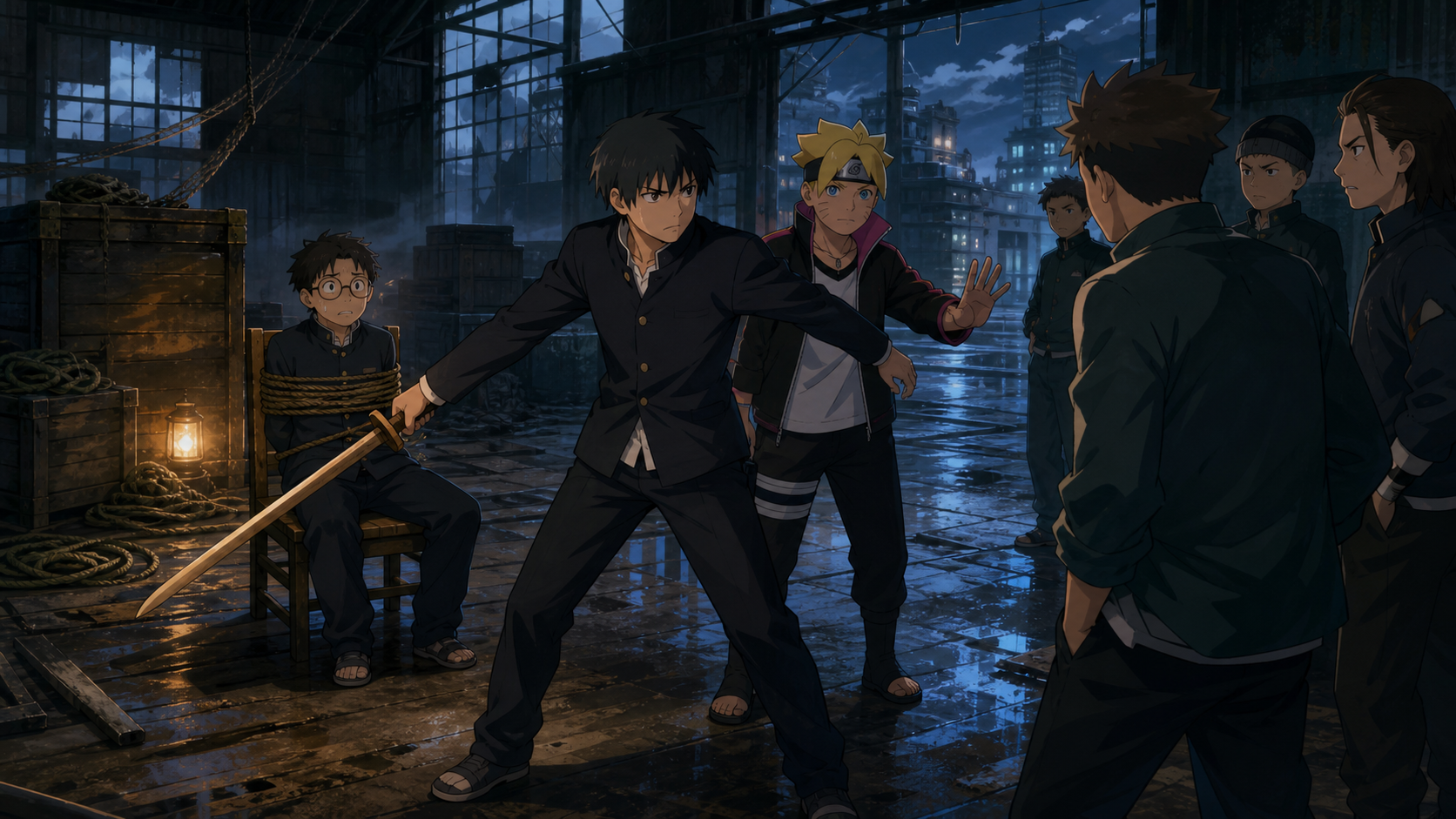
A Shinobi Bout of Friendship
Hachiya kidnaps Denki and turns Kagura’s Academy history into a public weapon, while Boruto refuses to let Yagura’s blood or one violent collapse own his friend’s future.
Series: Boruto: Naruto Next Generations
Episode: 27 · A Shinobi Bout of Friendship
Arc: School Trip Arc
Release: 2017-10-04
Previous: Episode 26 · The Mizukage’s Successor
Directory: All 293 Boruto episodes
Bottom line
Boruto Episode 27 begins with Denki kidnapped because Hachiya has decided the school trip needs a hostage situation. Denki is the easiest student to isolate, the easiest friend to use as bait, and the worst person to underestimate if Hachiya thinks fear makes somebody disposable. Boruto, Iwabee, and Kagura follow the message into a fight designed to humiliate Konoha’s visitors and drag Kagura’s buried Academy history into public view.
The rescue becomes Kagura’s episode long before he draws a blade. Hachiya knows the name Karatachi, knows Kagura is Yagura’s grandson, and knows exactly what happened when Kagura lost control at the Academy. He throws every secret into the room because shame is easier to weaponize when witnesses are present. Kagura nearly killed classmates. He wounded Shizuma. Other students learned to fear him. Kagura has spent years treating that day like a prophecy.
Boruto does not offer a perfect speech. He offers something more useful for this story: stubborn refusal. He has fought Kagura with wooden swords, watched Kagura stop his own strike, played cards beside him, and seen the boy choose care repeatedly. One violent collapse is part of Kagura’s history. Boruto refuses to let Hachiya turn one history into the only future available. The episode calls the fight a shinobi bout of friendship because Boruto’s real challenge is not defeating Hachiya. Boruto has to stand close enough for Kagura to believe that trust can survive the truth.
Denki disappears from a field trip that was already getting messy
The class has barely adjusted to modern Kiri, old grudges, and Iwabee trying to fight local boys in public. Then Denki vanishes. A message tells Boruto where to go if he wants his classmate back.
Nothing says educational travel like an unscheduled hostage retrieval before roll call.
Hachiya chooses the classmate everyone will chase
Hachiya targets Denki because Denki lacks the loud combat reputation surrounding Boruto and Iwabee. The choice is cowardly, but strategically clear. Kidnap the student least likely to overpower the gang, then wait for stronger friends to walk into prepared ground.
Denki becomes bait because Hachiya understands the Konoha group well enough to know nobody will leave him behind.
Kagura recognizes Hachiya’s style
Kagura identifies Tsurushi Hachiya as the likely person behind the message. Hachiya is a former Academy classmate who resents the modern direction of Kirigakure and dislikes the visiting Leaf students.
Kagura’s knowledge should make the route easier. Instead, every step toward Hachiya also moves Kagura toward the secret he has been hiding from Boruto.
Boruto was never going to wait politely
Boruto receives a threat involving a friend and immediately treats the location as an appointment. This child inherited Naruto’s ability to hear “trap” and translate the word into “directions.”
The recklessness remains real, but so does the loyalty. Denki does not have to be the strongest or closest friend in the class to receive Boruto’s full response.
Iwabee comes because Denki is his person
Iwabee and Denki began the series on opposite sides of an Academy argument. Since then, each boy has filled the exact gap in the other. Denki helps Iwabee with study. Iwabee helps Denki trust his body and nerve.
Hachiya picked Denki as the easy hostage and accidentally invited the boy most likely to put a wall through the rescue site.
The warehouse is built for intimidation
Hachiya’s gang controls the space, controls Denki, and expects the visitors to react on cue. Numbers, darkness, and local familiarity all favor Kiri’s attackers.
The setup looks larger than the gang truly is. Hachiya wants Boruto to feel surrounded before the first strike, because intimidation saves energy when the target agrees to perform fear.
Denki remains Denki under pressure
Denki is frightened because kidnapping is frightening. The episode does not need to pretend otherwise. Courage has never required Denki to stop looking like a normal child dropped into ninja nonsense.
His friends come because his fear matters, not because he has to earn rescue by acting unbothered.
Hachiya wants a spectacle more than a victory
If Hachiya only wanted Boruto hurt, he had quieter options. The message, hostage, gang, and public revelations create a stage. He wants the Leaf visitors humiliated and Kagura exposed beside them.
Shizuma’s influence already appears in the structure. Violence is never enough. Violence must tell a story about Kiri becoming hard again.
Kagura steps into the fight he fears
Kagura joins the rescue even though combat can awaken the part of himself he distrusts most. Avoiding every blade would protect his clean record, but Denki would remain tied up while Kagura protected an image of harmlessness.
He chooses the endangered person over the comfort of staying outside the fight. That choice says more about Kagura than Hachiya’s speech ever will.
Hachiya knows Kagura’s family name can clear a room
Hachiya reveals that Kagura is Yagura Karatachi’s grandson. The Fourth Mizukage’s rule is inseparable from the Bloody Mist era, and the family connection lands like an accusation.
Kagura has been waiting for Boruto to hear the name and step backward. Hachiya says the truth because he expects ancestry to finish the isolation.
Yagura’s blood is not a personality test
Kagura resembles his grandfather in bloodline, not in destiny. The episode places that basic truth against years of local fear. People saw Karatachi and expected cruelty before Kagura made a choice.
Kagura eventually began expecting the same cruelty from himself. That is the deeper damage. Hachiya does not merely expose a family secret. He confirms the nightmare Kagura already rehearses alone.
The Academy incident was genuinely terrible
Kagura lost control during his Academy years and attacked fellow students. He injured classmates and left a scar on Shizuma. The scene was not a rumor invented by enemies.
Boruto’s friendship works because the episode does not need the past erased. Kagura did something frightening. A frightening act still cannot write every choice afterward.
Hachiya turns confession into a weapon
Hachiya reveals Kagura’s history to break trust between Kagura and the Konoha students. The goal is not honesty. The goal is maximum shame at the exact moment Kagura needs steady hands.
Truth can still be used dishonestly. Hachiya selects the facts, controls the timing, and leaves no space for Kagura to explain what he has done since.
Kagura begins believing the worst version again
Kagura’s fear rises because Hachiya’s story matches his private belief. A descendant of Yagura lost control and hurt people. To Kagura, that sequence feels less like one event and more like blood announcing itself.
The fight becomes dangerous when Kagura stops trusting his ability to stop.
Boruto has evidence from the wooden-sword bout
Boruto already fought Kagura in Episode 26. Kagura’s technique overwhelmed him, but Kagura pulled the finishing strike. That moment showed control under pressure before Boruto knew why control mattered so much.
Hachiya offers an old disaster as proof. Boruto has a recent choice as counterevidence.
Friendship means Boruto does not flinch on schedule
Hachiya expects Yagura’s name and the Academy attack to change Boruto’s face. Boruto refuses the cue. He has met Kagura, argued with Kagura, played with Kagura, and been knocked around by Kagura.
The boy in front of him remains larger than the secret behind him. Boruto’s refusal denies Hachiya the isolation he came to manufacture.
Iwabee understands being judged by the worst file
Iwabee has spent years labeled a repeat student, troublemaker, and failed ninja prospect. He knows how quickly other people turn one record into a permanent identity.
Kagura’s history is far more serious, but Iwabee recognizes the shape of the judgment. Present choices still matter after a bad record exists.
The gang learns that Konoha students coordinate
Boruto and Iwabee do not fight like isolated heroes. Their classmates’ different skills give the rescue options beyond charging the nearest opponent.
Hachiya built the trap around predictable loyalty. He forgot loyalty can also produce teamwork, improvisation, and several children refusing to panic in the same direction.
Kagura’s blade starts feeling too familiar
As the fight intensifies, Kagura approaches the state he fears. Movement becomes sharper, aggression becomes easier, and the old Academy memory presses against the present.
The tension is not whether Kagura has talent. Everybody knows he does. The tension is whether talent and bloodlust have become permanently fused in his mind.
Hachiya keeps provoking the exact wound
Hachiya wants Kagura to lose control because another violent episode would prove every accusation. He does not care who gets cut as long as Kagura becomes useful evidence for Bloody Mist nostalgia.
That cruelty separates concern from exploitation. Someone worried about Kagura’s history would reduce pressure. Hachiya adds pressure and waits for blood.
Boruto stays inside Kagura’s reach
Boruto takes the frightening position: close enough to be hurt, loud enough to be heard, and stubborn enough not to leave. He trusts Kagura while understanding that the danger is real.
The gesture matters because Kagura expects fear to empty the room. Boruto remains where the old story says nobody should remain.
The Shinobi Bout card becomes a promise
Their shared card game and wooden-sword match give Boruto a language beyond grand declarations. The “Shinobi Bout” idea is playful, competitive, and tied to a version of combat where both boys chose the terms.
Hachiya frames violence as proof of monstrosity. Boruto reframes the bout as something friends can survive together.
Kagura stops himself
Kagura does not become harmless. He becomes responsible for the next motion. The difference is everything. Control does not arrive because Boruto declares him good. Control arrives because Kagura chooses not to repeat the Academy attack.
One stopped blade cannot erase the classmates who were hurt. One stopped blade can still prove that repetition is not destiny.
Hachiya’s gang retreats
Once the trap loses emotional control over Kagura and tactical control over the Konoha students, Hachiya’s group pulls back. Their grand local superiority looks much smaller while retreating from Academy visitors.
The withdrawal also preserves Hachiya for Shizuma’s larger plan. Episode 27 resolves the kidnapping without pretending the political threat has disappeared.
Boruto frees Denki
The rescue finally returns to the person tied up at the center. Boruto reaches Denki and releases him.
Denki does not become a prize proving Boruto won. He becomes a classmate returned to the group that noticed his absence and came.
Kagura expects friendship to end after the truth
The immediate danger passes, but Kagura still waits for Boruto’s judgment. Hachiya’s retreat cannot remove Yagura’s name or the Academy memory from the conversation.
Kagura has survived the fight. Believing he can survive being known is harder.
Boruto refuses to confuse history with fate
Boruto understands inherited judgment because everyone sees Naruto when they look at him. The comparison is not equal, since Naruto’s name grants Boruto privilege while Yagura’s name gives Kagura suspicion. The shared pressure still helps Boruto reject the idea that ancestry owns the future.
Kagura’s grandfather does not get to choose who Kagura protects today.
Friendship does not require a polished Kagura
Boruto does not wait for Kagura to become emotionally tidy, historically uncomplicated, or safe from every future mistake. Fandom friendship would be painfully boring if characters had to complete a moral application first.
He trusts the boy who showed up for Denki while afraid of himself. That is enough reason to stay for the next choice.
Shizuma now knows exactly where to press
The rescue gives Kagura confidence, but the exposed history also reveals how vulnerable he remains to anyone offering acceptance. Shizuma has already positioned himself as the person who never rejected Kagura after the Academy attack.
Episode 27 ends a kidnapping and opens the door for a much more personal abduction in Episode 28.
Denki's kidnapping works because Hachiya mistakes gentleness for isolation
Hachiya chooses Denki because Denki appears least likely to fight back and most likely to make Boruto panic. The decision exposes how bullies read social groups. Denki's technical intelligence, loyalty, and growing courage disappear behind the visible fact that he is not the strongest fighter in the class. Hachiya assumes physical vulnerability means social disposability.
Iwabee's response destroys that assumption. Denki is not an interchangeable classmate to him. Their friendship began through conflict, grew through mutual respect, and changed how both boys understood the Academy. Iwabee brings force, but the emotional point arrives before the first punch: Hachiya selected somebody whose absence would mobilize people immediately.
Denki also remains himself while captured. He does not transform into a hidden taijutsu genius or deliver a heroic escape that would make his friends unnecessary. He observes, endures, and trusts that the relationships he built have consequences. The episode respects his courage without pretending every valuable shinobi must solve danger through combat.
Hachiya weaponizes confession because shame needs an audience
Hachiya does not reveal Kagura's Academy history to protect anybody. He stages the reveal during a hostage confrontation because public humiliation can destabilize Kagura faster than a blade. The facts are real. Kagura lost control, injured classmates, and scarred Shizuma. Hachiya arranges those facts to force one conclusion: violence is Kagura's true identity, and friendship exists only until other people learn the record.
That method relies on Boruto and Iwabee responding on cue. They are supposed to flinch, retreat, or look at Kagura with the same fear Kagura already carries. Their rejection would confirm every warning Shizuma has planted. Hachiya wants Kagura emotionally separated before the next recruitment attempt begins.
Boruto refuses the performance. He does not argue that the Academy incident never happened. He compares the story with choices he personally witnessed. Kagura could have hurt him during their wooden-sword bout and stopped. Kagura entered the warehouse to help Denki. Present evidence does not erase past harm, but present evidence proves the past is not the only available pattern.
Iwabee understands what a permanent worst-day label can do to a child
Iwabee spent years treated as the Academy failure whose anger and repeated grades explained everything. Adults and classmates could look at one file and decide they understood his entire future. Denki helped him see that failure was a condition he could change rather than a complete identity.
That history gives Iwabee a quiet connection to Kagura. The scale differs, because Kagura seriously injured people and carries the name of a feared Mizukage. The emotional mechanism remains familiar. Shame tells both boys that the worst recorded event deserves more authority than every choice made afterward.
Iwabee's participation in the rescue therefore means more than extra muscle. He stands beside somebody being reduced to a file and refuses the reduction. Denki once did something similar for him. The friendship network keeps passing forward the lesson that a person needs accountability, support, and room to act differently.
The Shinobi Bout card gives Kagura a memory stronger than reassurance
Boruto's card matters because Kagura cannot dismiss the wooden-sword bout as polite encouragement. He remembers the physical moment when control began slipping and he stopped. The card connects friendship to a specific act of restraint. Boruto is not trusting an imagined harmless Kagura. He is trusting the boy who experienced the dangerous impulse and made a choice inside the danger.
That distinction gives the promise backbone. Kagura fears that another loss of control is inevitable. Boruto offers evidence that control can return through attention, relationship, and a decision made before the blade finishes moving. The card cannot guarantee future safety. The card can remind Kagura that fatalism already failed once.
Hachiya keeps provoking because the observed restraint threatens his story. He needs Kagura to repeat the Academy incident so everybody will reinterpret the friendship as temporary foolishness. Kagura's stopped blade denies him the spectacle and creates a second piece of evidence against inherited destiny.
Stopping does not solve Kagura's trauma, but stopping changes the next choice
The episode avoids declaring Kagura healed after one successful restraint. He remains frightened by his body, ashamed of the injured classmates, and vulnerable to Shizuma's promise of unconditional acceptance. Boruto's loyalty creates space. Therapy, time, accountability, training, and trustworthy mentorship would still have work to do if Kiri used those exact terms.
What changes is the balance of memory. Before the warehouse, Kagura's fear could point to the Academy attack as final proof. After the warehouse, fear has to contend with the moment he stopped, the friend who stayed close, and the hostage who went home alive. The new memory does not delete the old one. The new memory prevents the old one from speaking alone.
Shizuma recognizes that danger immediately. Kagura is beginning to imagine a self beyond violence, so Shizuma must intensify the guilt, offer a more exclusive belonging, and attach acceptance to the Bloody Mist project. Episode 27 resolves Hachiya's trap while showing why the larger manipulation has become urgent.
The classmates' presence also prevents Boruto from becoming Kagura's only emotional lifeline. Iwabee witnesses the restraint. Denki survives because several people coordinate. Kagura's better choice enters a shared record rather than remaining a private promise between two boys. That wider witness matters when manipulation later tries to isolate him.
Kagura may still believe Boruto's loyalty is exceptional and therefore fragile. A group memory offers another possibility: ordinary peers can see dangerous history, demand better action, and remain present after the crisis. The episode does not fully build that community for him, but the warehouse gives him a first glimpse.
Boruto Episode 27 lets Kagura contradict his own prophecy
“A Shinobi Bout of Friendship” could have reduced Kagura to a secret bloodline reveal. Instead, the episode lets that reveal collide with present action. Kagura is Yagura’s grandson. Kagura hurt classmates. Kagura scarred Shizuma. Kagura also walks into Hachiya’s trap to rescue Denki, fights beside Boruto, and stops before the feared history repeats.
Boruto’s role is beautifully simple. He refuses to let Hachiya control the meaning of Kagura’s past. He does not need a courtroom defense or a perfect theory of inherited violence. He knows the boy who spared him in their bout and came when Denki disappeared. Boruto trusts observed choices more than a villain’s dramatic reveal.
Denki goes home. Hachiya retreats. Kagura remains frightened, but fear no longer has uncontested evidence. Somewhere between the hostage rope, the gang fight, and Boruto’s refusal to flinch, Kagura creates a memory that belongs beside the Academy disaster. Shizuma will try to bury that memory under shame next. Episode 27 makes sure the audience knows the better evidence exists.
Sources and lawful viewing
Official episode reference: Naruto Official episode guide
Licensed episode route: Crunchyroll licensed series page