
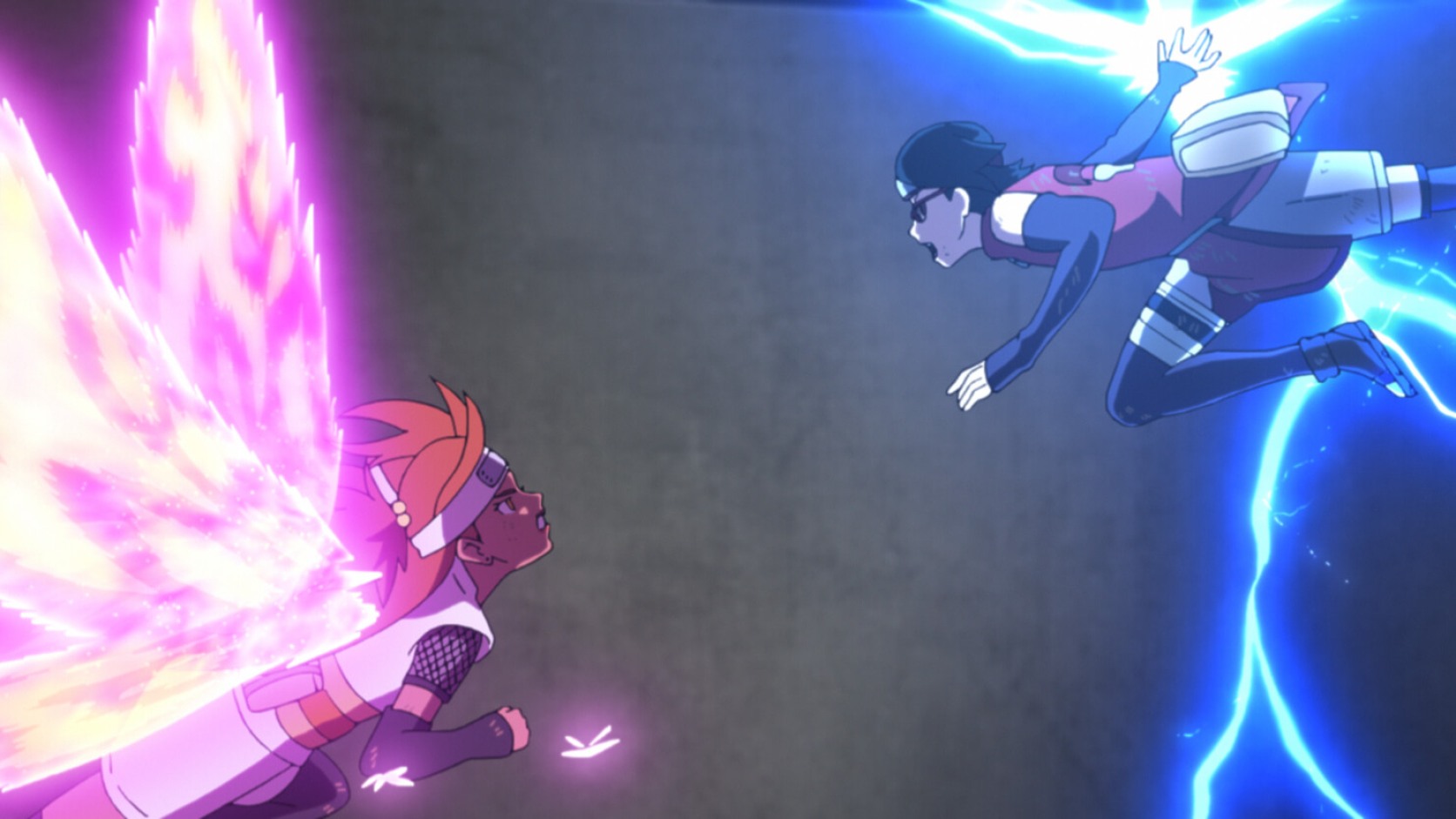
Showdown Between Best Friends
Sarada and Cho-Cho promise a serious match, proving that friendship can hold ambition, disappointment, and full effort without turning either girl into somebody else’s stepping-stone.
Series: Boruto: Naruto Next Generations
Episode: 225 · Showdown Between Best Friends
Arc: Chunin Re-Examination
Release: November 21, 2021
Previous: Episode 224 · The Legend of the Monster Cat
Directory: All 293 Boruto episodes
Bottom line
Boruto Episode 225 lets Sarada and Cho-Cho promise each other a serious fight, then trusts their friendship to survive ambition. That matters. Too many stories treat affection between girls as fragile the moment both want the same thing. Sarada and Cho-Cho refuse that bargain. Neither asks the other to shrink, apologize for trying, or turn the Chunin Exam into a friendship ceremony.
Their match works because respect raises the standard. Sarada knows Cho-Cho deserves her full attention. Cho-Cho knows Sarada's dream of becoming Hokage does not grant a free victory. The result hurts one friend and advances the other, but disappointment does not have to become betrayal.
The episode at a glance
- Series: Boruto: Naruto Next Generations
- Episode: 225
- Title: Showdown Between Best Friends
- Arc: Chunin Re-Examination
- Original release: November 21, 2021
- RaeRae rating: Four and a half bowls of ramen out of five
- Core question: Can friendship make competition more honest without asking either girl to surrender ambition?
The promise protects both girls
Sarada and Cho-Cho agree to give everything. The promise removes one of the ugliest doubts available in a friendship match: did somebody hold back out of pity?
Taking the fight seriously says, “I believe you can handle my effort.” That is respect, not cruelty. Neither girl must wonder whether the outcome was arranged to protect feelings.
The promise also creates responsibility. Full effort does not mean reckless force. Both remain accountable for control, safety, and recognizing when the match should stop.
Friendship is not automatic softness
Girls are often expected to preserve harmony by making desire less visible. Cho-Cho and Sarada reject that demand. They want promotion, recognition, and proof of growth.
Ambition does not make either girl a bad friend. Hiding ambition would not make the relationship healthier. Honest friendship can contain competing goals when nobody treats the other person's success as theft.
The match becomes intimate because each knows the other's habits. That knowledge creates tactical advantage and emotional risk at the same time.
Sarada's Hokage dream raises the stakes
Sarada does not want promotion only for status. Chunin leadership appears connected to the future she has chosen. Every evaluation can therefore feel like evidence about whether the Hokage dream is realistic.
That pressure needs limits. One match cannot validate or cancel a life direction. A future Hokage will need years of missions, relationships, mistakes, study, and public trust.
Sarada should pursue the win without treating defeat as a prophecy. Ambition becomes sustainable when a setback can teach rather than destroy identity.
Cho-Cho refuses to become a supporting character
Cho-Cho knows Sarada's dream and still claims her own right to win. Good. Friendship does not require becoming background scenery in somebody else's destiny.
She brings Akimichi techniques, confidence, humor, and tactical awareness that belong to her story. The episode lets her compete as a complete person rather than a test designed only to reveal Sarada's growth.
That distinction matters beyond the bracket. Cho-Cho's future deserves investment whether or not her goal comes with a famous title.
Knowing somebody creates tactical intimacy
Best friends remember patterns strangers miss: how the other reacts under pressure, which movement signals commitment, and where confidence becomes stubbornness.
Using that knowledge in a sanctioned match is not betrayal. Both consented to competition under shared rules. The ethical boundary would be exploiting private pain unrelated to the contest.
Their closeness makes adaptation essential. A familiar technique may be anticipated before execution, so each girl has to become less predictable without abandoning her strengths.
Cho-Cho's body is not a punchline
Akimichi techniques change body size and convert stored energy into combat power. The series has too often surrounded Cho-Cho's body with jokes, commentary, and assumptions about appetite.
Episode 225 works best when the transformation is treated as skilled clan practice. Her body is not public property, comedy material, or evidence about discipline.
Medical support should focus on chakra demand, recovery, nutrition, and safety without moralizing appearance. Respect includes describing the technique accurately.
Sarada's Sharingan is not free power
The Sharingan gives Sarada perception and tactical options, but inherited ability arrives with physical and emotional costs. Famous bloodlines often invite the village to treat extraordinary capacity as an unlimited resource.
Sarada still needs pacing, medical monitoring, and training that respects her stage of development. Eye strain and chakra limits should not become shameful weaknesses.
Her value also exceeds the dojutsu. Leadership, analysis, communication, and moral courage will matter long after the crowd stops reacting to red eyes.
The match tests restraint
Both girls can deliver significant force. Knowing an opponent personally may help them judge limits, but familiarity can also create false confidence.
Friends do not have perfect knowledge of each other's body or current condition. Medical staff and judges must retain authority to intervene.
The ability to stop belongs inside the definition of strength. A candidate who recognizes danger and adjusts demonstrates command judgment rather than weakness.
Kawaki watches a different model of conflict
Naruto invites Kawaki to observe, giving him a view of competition governed by rules, consent, and an expectation that both participants leave as members of the same community.
That contrasts sharply with the coercive violence shaping much of Kawaki's life. Sarada and Cho-Cho can fight intensely without trying to own, punish, or erase each other.
Observation alone will not heal him. Still, seeing conflict bounded by care can widen his understanding of what power between people may look like.
Naruto's invitation carries responsibility
Bringing Kawaki into a crowded public event may help inclusion, but safety and emotional readiness matter. Naruto should explain the environment, offer an exit, and avoid turning attendance into a lesson Kawaki must perform correctly.
Spectacle, shouting, and public combat could trigger memories. A trusted adult should remain attentive without monitoring him like a threat.
Belonging means access with support, not exposure for somebody else's idea of normalcy.
Shinki represents an outside audience
Visitors from the Hidden Sand bring another village's expectations into the arena. Candidates may feel that their performance represents Konoha rather than personal development.
That diplomatic layer can increase pressure and distort scoring. The exam should assess readiness, not stage a national pride contest through children.
Shinki's presence can still encourage exchange. Villages learn when observers compare methods without turning students into propaganda.
Winning should not erase Cho-Cho
The bracket needs one result, but the editorial story should resist treating the loser as discarded. Cho-Cho's choices, endurance, and adaptation remain evidence of growth.
She deserves specific feedback and future opportunities. “You lost to the future Hokage candidate” would be an insult disguised as context.
Her development belongs to her. Sarada's importance cannot consume the meaning of Cho-Cho's effort.
Sarada needs feedback after success
A win can conceal weaknesses because adults rush toward congratulations. Sarada should receive the same detailed review she would get after a loss.
Which decisions worked? Where did familiarity create an assumption? Did she manage chakra responsibly? How did she respond when Cho-Cho changed pace?
Promotion without feedback turns success into a stopping point. Leadership requires continued examination, especially when the result feels validating.
Disappointment can coexist with love
Cho-Cho may sincerely love Sarada and still wish the outcome were different. That feeling does not contaminate the friendship.
Adults often pressure children to demonstrate sportsmanship before they have processed disappointment. Respectful conduct matters, but emotional honesty needs room.
Cho-Cho should be able to say the loss hurts without reassuring everybody else first. Sarada should celebrate without demanding immediate enthusiasm from her friend.
Celebration needs boundaries
Sarada's success deserves joy. The celebration should not happen by comparing the girls or explaining why Cho-Cho was always less likely to win.
Friends and family can praise preparation, adaptation, and effort while leaving the loser's dignity intact.
Public commentary shapes how both remember the match. The village should not manufacture rivalry after the girls already modeled respect.
The exam should measure leadership beyond combat
Sarada's tactical performance is relevant, but command includes planning, delegation, listening, risk assessment, and responsibility for others.
Cho-Cho may demonstrate equally valuable qualities across missions that this arena cannot show. A single duel is weak evidence for a role centered on teams.
Judges should combine match observations with mission records, instructor reports, and documented examples of decision-making under uncertainty.
Scoring needs transparency
Candidates deserve published criteria and useful explanations. A vague statement about “chunin qualities” invites favoritism and outcome bias.
Judges should record observable choices rather than personality impressions. Confidence, humor, quietness, and appearance are not reliable measures of command.
An appeal process would protect students without turning every disappointment into a demand for reversal.
Best friends need lives beyond each other
Sarada and Cho-Cho's bond is strong because neither exists only to regulate the other's emotions. Each has a family, team, skills, and ambitions.
Healthy closeness leaves room for separate success. A promotion may change schedules or responsibilities, but change does not automatically mean abandonment.
Maintaining friendship will require intention rather than a promise that nothing changes.
The girls deserve privacy after the match
Spectators may want a public hug, speech, or perfect display of friendship. Sarada and Cho-Cho owe the crowd no emotional performance.
They should have space to cool down, receive medical checks, and talk privately when ready.
The village can celebrate sportsmanship without claiming ownership of their relationship.
Parents must avoid comparison
Ino, Choji, Sakura, and Sasuke each bring history and expectations into the girls' development. The worst post-match response would compare daughters, clans, or parenting.
Specific support is better: name effort, listen to feelings, discuss safety, and separate the result from belonging.
A child should not have to protect a parent's pride after leaving the arena.
The Akimichi legacy deserves full respect
Cho-Cho's clan techniques represent generations of knowledge about energy, transformation, teamwork, and protection. They should not be framed as less refined because the visual language involves size and appetite.
Konoha benefits from Akimichi power while often treating bodies like Cho-Cho's as comedy. That contradiction deserves criticism.
Respect means valuing the shinobi and refusing stigma during ordinary life too.
Sarada's ambition should not become unpaid duty
A child who says she wants to become Hokage may be given extra responsibility because adults interpret aspiration as consent.
Sarada still deserves rest, mistakes, boundaries, and assignments appropriate to her age. Leadership development is not permission to make her responsible for every peer crisis.
The village should mentor ambition instead of consuming the labor ambition makes available.
Kawaki should not be compared to the finalists
Watching trained peers compete could intensify Kawaki's sense of being behind or outside. Adults should not use the match to ask why he cannot behave, train, or connect like other children.
His history, body, and access to stable education differ. Comparison would turn an invitation into assessment.
He can observe without choosing a career or producing a lesson on demand.
The match rejects fake niceness
Sarada and Cho-Cho do not preserve friendship by pretending the stakes are low. They choose honesty over a performance of harmlessness.
That makes their care more credible. Each trusts the other enough to risk disappointment and remain present afterward.
Fandom should resist reading intensity between girls as secret hatred. Competition can reveal respect as clearly as cooperation.
A rematch is not required for closure
The losing friend may want another chance, but the relationship does not need an immediate promise to settle the score.
Closure can mean accepting today's evidence while continuing to train. Future growth does not owe the audience a repeated spectacle.
Both girls should be allowed to move into new challenges rather than remain defined by this pairing.
What the episode gets right
Episode 225 treats friendship as sturdy enough for serious ambition. Cho-Cho remains a competitor with her own claim to the future, and Sarada's Hokage dream does not excuse entitlement.
Kawaki's presence also gives the match social meaning beyond promotion. He sees force contained by consent, rules, and continued belonging.
Cho-Cho's confidence is not permission to neglect her
Cho-Cho often appears emotionally resilient. She jokes, speaks directly, and seems comfortable taking up space. Adults can mistake those qualities for proof that she never needs reassurance.
Confident children still experience shame, fear, and disappointment. They may receive less care precisely because everybody assumes they will bounce back.
After the match, somebody should ask Cho-Cho what she needs without making the question a test of maturity. Her humor can remain part of her personality without becoming armor she must wear for other people's comfort.
Sarada's composure should not hide strain
Sarada knows how to focus under pressure, but competence can become a trap when adults stop checking the cost. The Sharingan, physical combat, and public expectation all demand energy.
A medical review should be routine rather than a response reserved for visible collapse. Preventive care protects her future more effectively than praise for enduring pain.
She should also have a private place to admit that fighting a best friend felt difficult. Emotional strain does not invalidate the win.
Girls deserve anger without losing respect
Competition may produce frustration. Sarada or Cho-Cho can feel angry without becoming cruel, irrational, or unworthy of leadership.
The village often tolerates anger from boys as competitive spirit while treating the same emotion in girls as relational failure. That double standard narrows honest expression.
What matters is conduct: how each girl communicates, regulates force, repairs harm, and returns to conversation. Emotion itself is information rather than misconduct.
The crowd should learn how to watch
Spectators influence the environment with cheers, jokes, and commentary. Adults should intervene when reactions become body-shaming, clan prejudice, or personal attacks.
A public exam can teach community standards. Announcers can explain tactics accurately, emphasize safety, and praise adaptation without humiliating the losing candidate.
Young shinobi should not be asked to develop confidence inside an arena where the village permits casual cruelty from the seats.
Friendship does not guarantee equal power
Sarada and Cho-Cho enter with different techniques, family histories, training access, and public narratives. Caring about each other does not erase those differences.
Honesty requires acknowledging advantage without turning either girl into a symbol. Sarada's dojutsu and Cho-Cho's clan transformation both carry strengths and costs.
The exam should assess how each uses available abilities under the same transparent safety rules, then place the result beside broader evidence.
A promotion changes team relationships
If one friend becomes chunin first, schedules, authority, and expectations may shift. The village should prepare teams for that transition instead of assuming friendship will absorb every change automatically.
A newly promoted teenager may be asked to lead former peers. Clear boundaries and adult supervision protect everybody from resentment or confusion.
Cho-Cho and Sarada can remain close while acknowledging that institutional roles may alter how missions work.
Leadership includes receiving a friend's no
Sarada's future Hokage dream requires more than inspiring people. She must learn to hear disagreement from somebody she loves without treating dissent as disloyalty.
Cho-Cho's willingness to oppose her fully is useful practice. A leader surrounded by friends who always yield becomes dangerous.
The match creates a controlled space where Sarada can experience resistance, adjust, and remain connected after another person refuses to make her path easy.
Cho-Cho models a necessary kind of loyalty
Cho-Cho supports Sarada's dream without guaranteeing Sarada every victory. That is mature loyalty. She wants her friend to succeed and also expects the dream to survive honest challenge.
People who care about a future leader should test assumptions, name risks, and protect their own boundaries. Agreement is not the highest form of support.
Cho-Cho's full effort says that Sarada's ambition deserves reality rather than flattery.
Their teams need to avoid taking sides
Classmates may feel pressure to prove loyalty by cheering harder for one girl or explaining why the other deserved the result. That can turn a respectful match into a social fracture afterward.
Friends can celebrate both performances while recognizing the official outcome. Private support should respond to each person's needs rather than stage another competition.
Team leaders should stop gossip and comparison before the bracket becomes a permanent hierarchy among peers.
Food should support recovery without commentary
Both candidates need hydration, rest, and nutrition after intense chakra use. Cho-Cho should receive that care without jokes about appetite or body size.
Medical guidance can be specific and respectful. Food is fuel, pleasure, culture, and social connection, not a moral score.
The Akimichi techniques make responsible energy management especially important, which is exactly why casual stigma has no place in recovery.
The Hokage dream belongs to the long road
Sarada's victory can be one encouraging step, but the office she wants will demand political judgment, administrative patience, public accountability, and care for people who never enter an arena.
Konoha should expose aspiring leaders to that ordinary labor. Combat achievement alone cannot prepare somebody to govern.
Her dream becomes more credible when the village gives her opportunities to listen, study systems, and understand how policy reaches vulnerable residents.
Cho-Cho's future should stay open
Not naming a grand office does not mean lacking direction. Cho-Cho may develop goals through missions, relationships, and experience rather than announcing one early.
Adults should not compare her unfavorably with Sarada's certainty. Some young people know the title they want; others know the values or work they enjoy.
Both paths deserve mentorship, resources, and patience. A child does not need a slogan before adults take potential seriously.
The post-match conversation matters
The most important friendship scene may happen after the cameras move on. Sarada should not minimize her happiness, and Cho-Cho should not hide disappointment to protect that happiness.
They can name both truths: the match was honest, and the loss hurts. Listening without correction allows each girl to remain emotionally real.
A relationship survives competition through conversation, not through pretending the result created no tension.
The village needs more than inspiring exceptions
Sarada and Cho-Cho demonstrate a healthy form of rivalry, but institutions cannot rely on unusually mature children to create safe culture by themselves.
Coaches should teach conflict repair, officials should publish fair procedures, and adults should model how to disagree without humiliation.
When the system provides those tools, respectful competition becomes teachable rather than a lucky product of two strong personalities.
Where the episode needs care
The Chunin Exam still places enormous meaning on one public fight. Neither girl's readiness can be measured fully by a bracket.
The story also needs to resist letting Cho-Cho's body or food become an easy joke when her clan technique demands real skill and physical cost.
RaeRae verdict
Boruto Episode 225 earns four and a half bowls of ramen out of five. Sarada and Cho-Cho give each other the rare kindness of honest competition. Nobody asks the girl with the bigger dream to apologize, and nobody asks her best friend to become a stepping-stone.
The result matters, but the promise matters more. They enter knowing one will be disappointed and choose respect anyway. Friendship is not proven by avoiding every conflict. Friendship is proven by refusing to turn a result into a reason the other person becomes smaller.
Before the next episode
Episode 226, “Samurai vs. Science,” places Tsubaki against Denki and asks what tradition and technology can learn when neither is treated as automatically superior.
Watch who gets access to preparation, whose expertise is respected, and how the exam defines legitimate skill.
Sources and lawful viewing
The official Naruto site provides the Episode 225 synopsis and gallery. Crunchyroll carries “Showdown Between Best Friends” where regional availability permits. Release and streaming details can vary by country.
Official episode reference: Naruto Official episode guide
Licensed episode route: Crunchyroll licensed series page
After watching, ask whether Sarada and Cho-Cho are allowed to process the result privately. The crowd saw a match, not the whole friendship.