
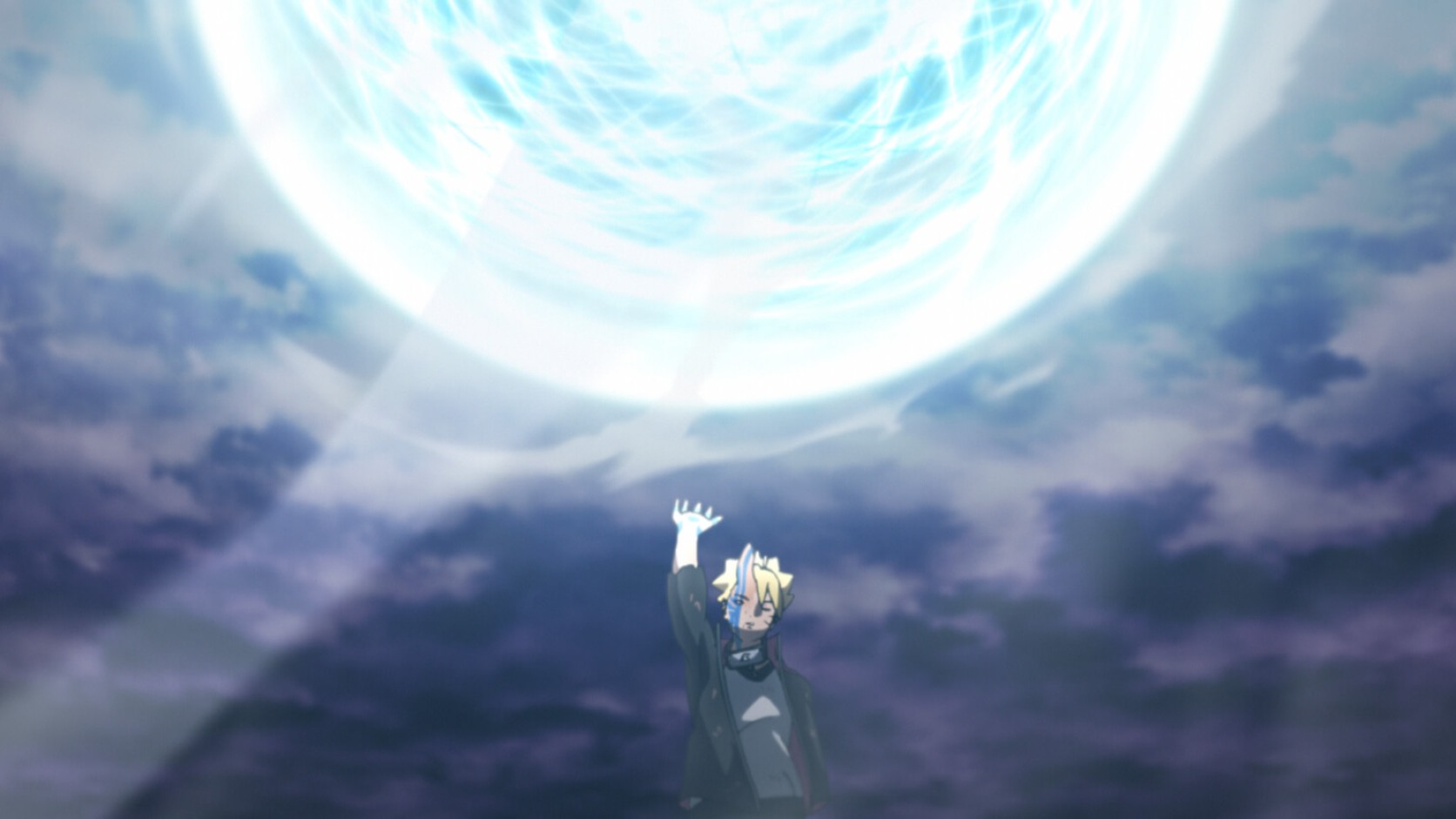
Momoshiki's Manifestation
Momoshiki ends Boro through Boruto’s unconscious body, proving that spectacular rescue and bodily violation can occupy the same terrible moment.
Series: Boruto: Naruto Next Generations
Episode: 208 · Momoshiki's Manifestation
Arc: Kawaki: Kara Clash
Release: July 18, 2021
Previous: Episode 207 · Regeneration
Directory: All 293 Boruto episodes
Bottom line
Boruto Episode 208 gives the team a spectacular rescue and refuses to let the spectacle feel clean. Boro’s uncontrolled body overwhelms four exhausted children. Boruto falls unconscious. Momoshiki manifests through Kāma, takes control, creates an enormous Rasengan, and destroys Boro with power Boruto cannot remember choosing. Team Seven recovers Naruto and returns home, where family gathers around the Hokage’s hospital bed. Kawaki and Boruto stand together carrying marks that make both bodies contested territory. The episode is called “Momoshiki’s Manifestation,” not Boruto’s transformation, and that wording matters. Another will appeared. Another will acted. Boruto survived the event, but survival does not convert possession into consent.
The title assigns the action correctly
“Momoshiki’s Manifestation” names the consciousness taking control. The title does not pretend Boruto unlocked a new form through training or intention.
That precision protects Boruto from being credited or blamed as though he were fully present. Language becomes the first safeguard against romanticizing the breach.
Boro becomes uncontrolled damage
Sarada destroyed the core regulating his regeneration. Boro’s body now grows and lashes out without coordinated repair.
The mutation proves that regeneration was never the same as health. Kara engineered output, not a humane failure state.
The team already earned the tactical victory
They identified the virus, developed antibodies, found the moving core, and destroyed the mechanism. Boro’s invulnerability ended through collective intelligence.
The final danger should not erase that work. Momoshiki arrives after Team Seven solved the central problem.
Exhaustion shapes the emergency
Everyone has spent chakra, absorbed injuries, and managed fear beside sealed Naruto. Their options shrink as Boro expands.
Fatigue is not a lack of courage. Bodies reach limits even when love and responsibility continue.
Boruto is beaten unconscious
His body stops responding before Momoshiki takes over. The loss of consciousness removes any plausible claim that Boruto authorized the transformation.
Vulnerability becomes access. Momoshiki treats incapacity as opportunity.
Kāma turns depletion into a doorway
The mark does not merely store power. Kāma carries Otsutsuki data and a route for another being to overwrite the host.
Low chakra weakens Boruto’s control, revealing that exhaustion has consequences far beyond ordinary collapse.
Momoshiki wears a familiar face
Boruto’s features remain recognizable while the horn, markings, voice, and behavior announce someone else. Friends must interpret a body they love as a possible threat.
Familiar appearance can make boundaries harder. Care requires distinguishing the person from the controlling presence.
The giant Rasengan invites the wrong celebration
The technique is beautiful, overwhelming, and connected to Naruto’s legacy. The visual language resembles heroic triumph.
Context changes meaning. Momoshiki uses Boruto’s body to wield that power. Awe and fear belong in the same frame.
Effectiveness does not create consent
The attack destroys Boro and saves Team Seven from immediate harm. A useful outcome can tempt everyone to excuse the method.
Consent cannot be granted retroactively because the result helped. Boruto never chose to disappear behind Momoshiki.
Rescue can contain another violation
Naruto is freed because Momoshiki ends the threat. Boruto’s bodily autonomy is compromised during that rescue.
Both truths matter. Ethical storytelling resists exchanging one person’s violation for another person’s safety without naming the cost.
Kawaki recognizes vessel logic
He understands what another will intends to do through a compatible body. Boruto’s transformation makes their shared danger visible.
Kawaki may see his own feared future reflected in his friend. Recognition can create solidarity and terror simultaneously.
Shared danger does not erase different histories
Kawaki endured deliberate preparation, abuse, and repeated procedures under Jigen. Boruto received Kāma during battle and grew up with support.
The marks connect them without making their experiences interchangeable. Each needs individualized care.
Sarada witnesses a teammate disappear
She led Boruto through the fight, relied on his choices, and then saw another consciousness control him. Command provides no simple answer for that change.
Sarada must protect everyone while refusing to reduce Boruto’s body to an enemy object.
Mitsuki witnesses his chosen person altered
Mitsuki has treated Boruto as a guiding light. Momoshiki’s manifestation disrupts any assumption that familiar presence equals familiar agency.
Care now requires discernment. Protecting Boruto may mean resisting actions taken through Boruto.
The team needs observable language
They should record what changed: consciousness, voice, horn, markings, chakra behavior, technique, duration, and recovery.
Precise observation avoids moral panic and creates information Boruto can use when he wakes.
Boruto cannot supply his own memory
Unconsciousness leaves a gap. He depends on witnesses to describe the event.
Witnesses should return knowledge without claiming ownership over his identity. “This happened through your body” differs from “this is who you are.”
Memory gaps can produce shame
Learning that one’s body acted powerfully or dangerously without conscious participation can feel alienating. Other people’s fear may deepen that shame.
Boruto needs factual explanation and repeated distinction between Momoshiki’s choices and his own.
The team may feel grateful to the intruder
Momoshiki prevented Boro from killing them. Relief is understandable.
Gratitude for survival should not become loyalty to the being threatening Boruto’s existence. Mixed emotion needs room without moral simplification.
Momoshiki conserves chakra for himself
His attention to Boruto’s depleted state reveals calculation. The vessel must remain viable for resurrection.
Protection of the body is not care for Boruto when the purpose is future replacement. Preservation can serve ownership.
The host's survival and the parasite's goal overlap temporarily
Momoshiki benefits when Boruto remains alive. Team Seven also needs Boruto alive. Shared immediate interest does not create shared ethics.
Temporary alignment can hide long-term opposition. Every intervention should be evaluated beyond the current battle.
Boro's defeat completes Sarada's plan
Without the destroyed core, Boro could regenerate after the Rasengan. The finish depends on the team’s earlier work.
Credit should follow causation rather than visual size. Sarada’s leadership remains central.
Mitsuki's antibodies remain part of the victory
No one reaches the final confrontation without medical protection from the virus.
Care work frequently disappears once a dramatic attack takes the screen. Remembering support keeps the team’s labor honest.
Kawaki's intelligence remains part of the victory
His knowledge of Kara directed the team toward Boro’s modifications and limitations.
The information belongs to a survivor using experience by choice. The village should not convert that choice into permanent obligation.
Boruto's earlier choices remain part of the victory
Before losing consciousness, he trusted Sarada, pressured Boro, protected teammates, and helped sustain the rescue.
Those deliberate actions belong to Boruto. Momoshiki’s final attack does not.
Victory needs a careful sentence
Team Seven defeated Boro and recovered Naruto. Momoshiki controlled Boruto during the final attack.
Combining both statements prevents celebration from erasing the autonomy crisis.
Recovering Naruto restores an advocate
Naruto understands involuntary hosting through his history with Kurama, though the relationship developed differently. He also promised to protect Kawaki and loves Boruto.
His perspective can help if he listens before assuming his own experience provides a complete map.
Kurama's history offers hope with limits
Naruto and Kurama moved from forced confinement toward mutual partnership. That change required recognition, communication, and respect.
Momoshiki currently seeks resurrection through Boruto’s erasure. Hope cannot skip the difference in intention.
A positive precedent can become pressure
Adults may tell Boruto that Naruto eventually befriended the being inside him. The comparison could make fear look immature or reconciliation obligatory.
Boruto owes Momoshiki no friendship. Safety, consent, and continued identity come first.
Naruto returns to a hospital bed
The Hokage comes home alive but injured and depleted. Family gathers around him.
The bed makes visible what constant public protection costs one body. Recovery must be allowed without turning rest into failure.
Hinata's vigil restores the family frame
Naruto’s disappearance affected a wife and children, not only command structures. Hinata’s presence keeps the aftermath relational.
Caregiving should not be treated as background decoration. Family labor holds recovery together after shinobi spectacle ends.
Himawari reaches for her father
Her fear and relief deserve space. Children living near heroes still experience absence as children.
Age-appropriate truth protects better than pretending the crisis left no emotional mark.
Boruto stands beside Naruto with private fear
He can feel relief about his father while carrying uncertainty about his own body. One emotion does not cancel the other.
The family may celebrate Naruto’s return before noticing Boruto needs care too.
Kawaki stands inside the family aftermath
He is not an outside witness. Naruto vanished while protecting him, and Kawaki helped bring him home.
Belonging becomes visible through presence during recovery, not only shared meals during calm.
Survivor guilt may follow Kawaki home
Jigen used his mark to reach Naruto. Boro guarded Naruto because of Kara’s plan. Kawaki may place the entire chain on himself.
The accurate account assigns choices to Jigen and Boro. Kawaki was exploited and then chose rescue.
Boruto may carry guilt for Momoshiki's attack
Boro was an enemy, so guilt may seem unnecessary. The deeper fear concerns loss of control and possible future harm to friends.
Boruto needs permission to discuss that fear before another incident forces the question.
The adults need to believe the witnesses
Sarada, Mitsuki, and Kawaki saw the manifestation. Their report may sound extraordinary even within shinobi life.
Taking them seriously respects both evidence and the burden placed on young witnesses.
Medical assessment must not become experimentation
Boruto’s Kāma needs urgent study. Researchers will want scans, samples, and stress responses.
Urgency cannot make his body public property. Explain procedures, limit access, and include advocates who can refuse on his behalf when necessary.
Kawaki should not become the automatic control sample
His mark provides useful comparison. Treating him as available data would repeat Kara’s logic.
Ask, explain, and allow refusal. Shared danger does not create unlimited access to either child.
The village needs a possession protocol
The team now knows low chakra may enable Momoshiki. Future missions require warning signs, retreat thresholds, restraint methods, and medical response.
The plan should be developed with Boruto, not hidden from him as a security secret.
A protocol must protect everyone
Boruto deserves dignity and continued participation. Teammates deserve safety if Momoshiki returns.
Ethical planning refuses the false choice between abandoning Boruto and exposing others to unlimited danger.
Chakra management becomes bodily autonomy
Conserving chakra is no longer only tactical efficiency. Depletion may weaken Boruto’s control over his own body.
Training plans must account for possession risk without blaming him for having limits.
Rest becomes a defensive technique
Shinobi culture often praises pushing beyond exhaustion. Boruto’s condition makes that habit dangerous.
Stopping early can protect identity, not merely stamina. Rest deserves the same strategic respect as another jutsu.
The mark complicates ordinary adolescence
Boruto should be developing friendships, skills, independence, and disagreement with family. Kāma places cosmic succession inside that process.
Adults must preserve as much ordinary life as possible rather than letting surveillance become his entire future.
Privacy and safety need negotiation
Monitoring symptoms may help prevent another takeover. Constant observation can make Boruto feel like a threat under custody.
Clear limits, review dates, and shared decision-making keep safety from becoming permanent control.
Sarada's captaincy continues after combat
She can help lead the debrief, ensure contributions are recorded, and name uncertainty without speculation.
Leadership after battle includes protecting teammates from distorted narratives.
Mitsuki needs support as a witness
Watching Boruto disappear behind Momoshiki can destabilize someone whose identity centers their bond.
Mitsuki deserves care beyond questions about what he observed medically.
Kawaki needs support as another vessel
The manifestation previews the future Jigen designed for him. Witnessing Boruto may intensify nightmares, urgency, or self-sacrificial plans.
Adults should ask about that impact directly rather than assuming shared experience makes him automatically resilient.
Boruto deserves authorship of the next decision
He cannot decide whether Kāma exists, but he should help decide monitoring, training, disclosure, and mission participation.
Agency can grow even inside constraints that were never chosen.
Secrecy can protect and isolate
Public knowledge may create panic or make Boruto a target. Total secrecy may leave him carrying fear without enough support.
The family needs a deliberate circle of informed people, not silence shaped by embarrassment.
The village should prepare without stigmatizing
Momoshiki can be dangerous through Boruto’s body. Boruto remains a child and community member.
Security language must keep those truths together. Calling him a weapon or vessel alone would help Momoshiki erase him socially before resurrection happens physically.
Manifestation changes the meaning of strength
The largest power in the episode belongs to a controlling consciousness. Strength cannot be judged only by output.
Boruto’s deliberate trust, Sarada’s analysis, Mitsuki’s care, and Kawaki’s courage represent healthier power because each preserves other people’s agency.
The hospital scene restores scale
After dimensional combat and a giant Rasengan, a family watches someone sleep. The quieter image reveals what everyone fought to protect.
Life is not valuable because life produces legendary attacks. Ordinary presence gives the attacks meaning.
Naruto's recovery should include the full mission story
He needs to learn how the children found him, how Sarada led, how Mitsuki countered the virus, how Kawaki shared Kara intelligence, and how Boruto lost control. A summary that begins and ends with Momoshiki would distort both danger and achievement.
Naruto can honor the rescue while responding as a father and Hokage. Those roles require gratitude, investigation, protection, and accountability at the same time.
Hinata deserves information rather than protective silence
Adults may try to spare her details about Boruto’s manifestation until experts know more. Withholding the core truth would prevent a parent from understanding risks affecting her child inside their home.
Information can be paced without becoming deception. Hinata should receive known facts, explicit uncertainty, and a real role in decisions rather than a polished reassurance after plans are already made.
Himawari needs age-appropriate truth
She does not need every technical detail or the burden of watching Boruto constantly. She does need an explanation for changed routines, medical visits, or adults reacting with fear.
Children often notice secrecy before adults realize how much has changed. Simple truth can prevent Himawari from inventing explanations that place blame on herself or her brother.
Family care cannot become family surveillance
Boruto may need people nearby when chakra drops, but relatives should not be transformed into unpaid guards who fear every sign of fatigue. That arrangement would damage relationships and hide a village responsibility inside the household.
Professional monitoring, emergency access, respite, and clear escalation paths can support the family. Love should remain larger than risk management.
The Hokage's office has a conflict of roles
Naruto is Boruto’s father, Kawaki’s guardian, the village leader, and a survivor with his own history of hosting another being. Each position shapes judgment differently.
No single person should make every decision. Medical experts, trusted family, security leaders, and advocates for both boys need defined voices so public safety does not erase private rights.
Boruto needs room to be angry
He may feel fear, shame, fascination, relief, or anger after hearing what happened. Anger at Momoshiki, the mark, secrecy, restrictions, or even the adults who cannot solve the problem would be understandable.
Support should not require inspirational composure. Boruto can love his family and resent what the crisis asks from him.
Teammates need permission to set boundaries
Sarada, Mitsuki, and Kawaki may want to protect Boruto while fearing another manifestation. They should be able to name limits without being accused of betrayal.
Honest boundaries create safer loyalty. Hidden fear can become avoidance, resentment, or a dangerous delay during the next incident.
The first debrief should separate facts from interpretation
Facts include Boruto’s unconsciousness, visible physical changes, Momoshiki’s speech, the Rasengan, Boro’s destruction, and Boruto’s later memory gap. Interpretations include motives, future frequency, and degree of control.
Separating those categories prevents panic from becoming certainty. The team can act on observed risk while researchers continue testing explanations.
Consent can guide emergency research
Boruto may agree to monitoring because he wants to protect friends. Agreement should specify which tests occur, who sees results, how long data remains, and when he can reconsider.
A broad request signed under fear would reproduce the control everyone claims to oppose. Consent becomes meaningful through understandable choices and continuing review.
Independent advocacy would help Boruto ask questions without worrying that disagreement endangers friends. A supporter outside command and research can keep his preferences visible when every expert arrives carrying an urgent reason to proceed.
What the episode gets right
“Momoshiki’s Manifestation” preserves both the thrill of Boro’s defeat and the terror of Boruto’s absence. The episode shows power without pretending power belongs cleanly to the body displaying that power.
The aftermath brings Naruto home and lets family care matter after Team Seven’s work.
Where the episode needs care
Fans and later storytelling may treat the manifested form as Boruto’s upgrade. That framing risks erasing possession.
The team’s contributions also need protection from the final attack’s visual dominance. Boro became defeatable through their plan.
RaeRae verdict
Boruto Episode 208 earns four and three-quarter bowls of ramen out of five. The Rasengan is enormous, gorgeous, and wrong in exactly the way the story needs. Momoshiki saves everyone while demonstrating that Boruto’s body is no longer reliably his alone.
Naruto waking near family brings relief. Kawaki and Boruto standing together brings dread. Both boys survived adults and gods trying to assign purpose to their bodies. Survival now needs to become a plan for keeping each boy present in his own future.
Before the next episode
Episode 209, “The Outcast,” turns toward Kawaki’s fear that his presence endangers the Uzumaki family. After Naruto’s abduction and Boruto’s manifestation, belonging may feel more dangerous than isolation.
Watch whether reassurance addresses Kawaki’s guilt or only asks him to stay comfortable for everyone else.
Sources and lawful viewing
The official Naruto site provides the Episode 208 synopsis and gallery. Crunchyroll carries “Momoshiki’s Manifestation” where regional availability permits. Release and streaming details can vary by country.
Official episode reference: Naruto Official episode guide
Licensed episode route: Crunchyroll licensed series page
After watching, describe the final attack with exact agency. Momoshiki controlled Boruto’s body. Team Seven made Boro vulnerable. Naruto was rescued. Precision keeps victory, fear, and credit in the same honest sentence.