
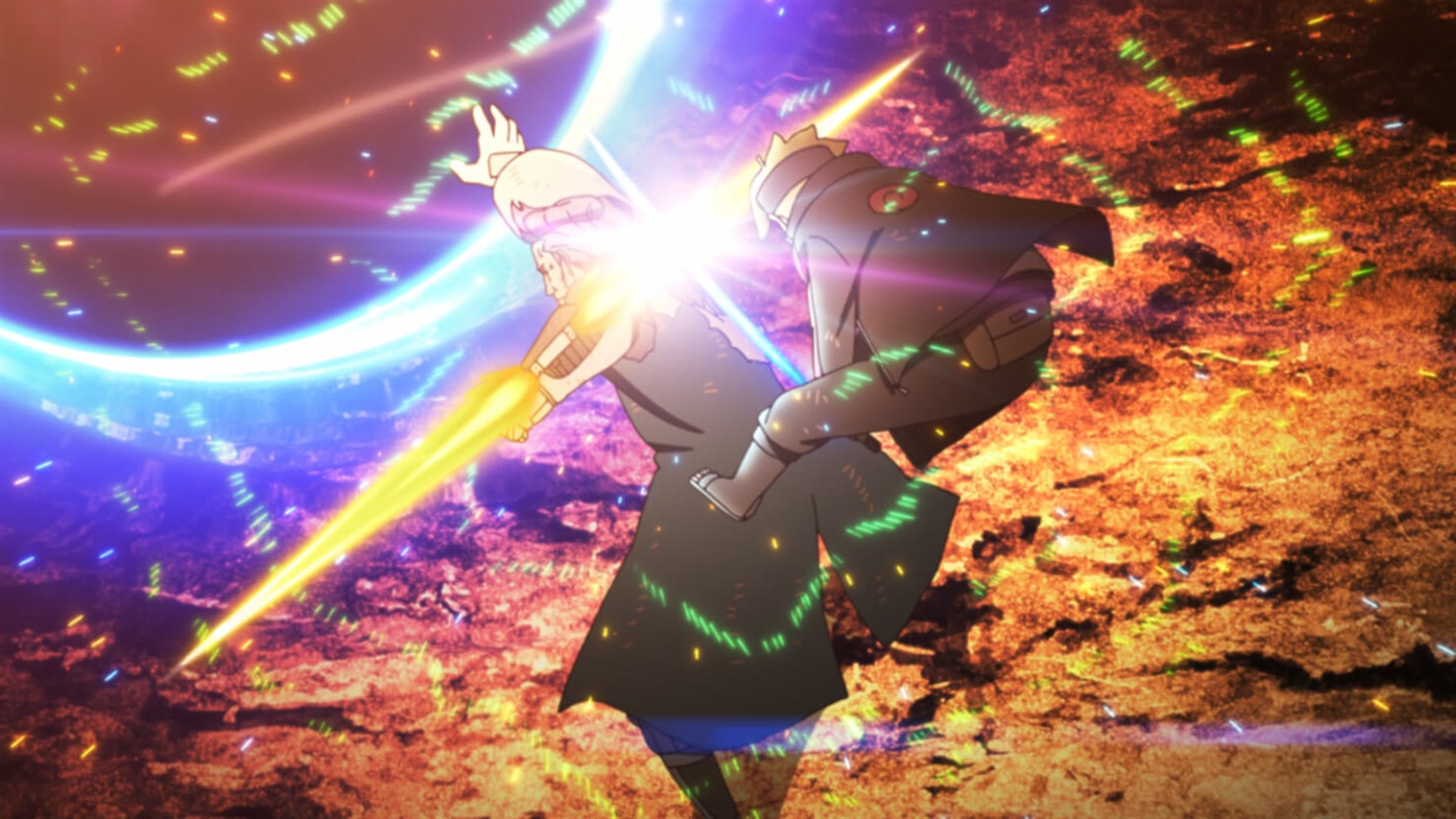
How You Use It
Team 7 combines shinobi training with accountable technology, breaks Ao’s weapon system, and proves that choosing how to use power includes choosing mercy.
Series: Boruto: Naruto Next Generations
Episode: 186 · How You Use It
Arc: Vessel
Release: 2021-02-14
Previous: Episode 185 · Tools
Directory: All 293 Boruto episodes
Bottom line
Boruto wins because Team 7 treats every weapon as one piece of a plan instead of a replacement for thinking. Mitsuki scouts and restrains. Sarada forces close-range openings. Konohamaru reads the aerial threat. Katasuke explains the hardware. Boruto uses a clone, the chakra blade, the absorption arm, Rasengan, explosive tags, shuriken, Water Release, and the screwdriver lesson Ao gave him on the train. Ao has more machinery and far more combat experience, but he has built his identity around being used. Boruto’s final mercy proves that choosing how to use power includes choosing when not to kill.
Mitsuki’s snake starts the fight before Ao arrives
Team 7 does not wait blindly for Ao. Mitsuki sends a snake to monitor the approach, creating an early-warning system from a familiar shinobi technique.
The choice immediately complicates Ao’s claim that modern tools have replaced shinobi. Biological partnership, chakra skill, and fieldcraft still shape the encounter. Technology joins that system rather than erasing every older method.
The plan begins with Ao’s habits
The group knows Ao absorbs ninjutsu, relies on scientific weapons, lacks his old Byakugan, and expects Boruto to matter. They build around those facts.
A good counter does not ask whether tradition or technology is morally superior. The group asks what Ao sees, what he trusts, what occupies his hands, and where his attention narrows.
Ao identifies the hideout fast
Ao reaches the abandoned building and attacks Mitsuki. His experience remains dangerous before any device activates. He reads terrain, pursuit behavior, and the likely location of wounded targets.
Calling Ao a machine would underestimate him. Kara equipped a veteran who already knew how shinobi think.
Mitsuki feeds the absorption pattern
Mitsuki counters with Lightning Release, knowing Ao can absorb the attack. The jutsu is not wasted because the absorption response supplies timing and position.
Team 7 uses Ao’s confidence as part of the battlefield. Every successful block encourages the habit they plan to punish.
Konohamaru spends chakra on purpose
Konohamaru follows with Fire Release. Ao notices the group appears careless about chakra conservation and correctly concludes that a larger strategy exists.
The observation shows why Ao cannot be fooled through one obvious trick. Team 7 must let him detect a plan while hiding the actual trap inside the detection.
Sarada attacks during the transition
Mitsuki forces Ao to move while the absorption system handles Konohamaru’s flames. Sarada closes distance and lands taijutsu strikes.
Her role proves that the plan needs varied pressure. An arm built to absorb chakra does not automatically stop a fist arriving during a hardware transition.
Shinobi-ware keeps Ao standing
Sarada’s hits connect, but Ao’s reinforced body absorbs punishment that would stop another opponent. His augmentations change durability as well as offense.
The scene avoids pretending courage makes material differences disappear. Team 7 has to learn what damage reaches Ao and what merely costs them energy.
Ao expands the absorption sphere
Ao creates a larger field capable of swallowing several attacks at once. The upgrade answers Team 7’s attempt to split his attention.
More coverage creates more confidence, and more confidence creates a sharper blind spot. Ao believes the sphere has solved the problem before locating Boruto.
Boruto’s absence becomes the loudest clue
Ao realizes Boruto has not joined the barrage and identifies him as the likely center of the strategy. That deduction is correct.
Team 7 does not need Ao to believe a false story from beginning to end. They need him to react predictably when the apparent answer finally arrives.
The chakra blade becomes bait
Boruto drops from above carrying the chakra blade. Ao blocks with his own, takes control of Boruto’s weapon, and drives the blade into him.
The scene looks like a catastrophic failure. Ao believes he has read the plan and converted Boruto’s prototype into the murder weapon.
The “Boruto” on the blade is a clone
Boruto grips Ao’s hands while Mitsuki stretches an arm around the handle. The stabbed body disperses. Ao has impaled a shadow clone.
The trap works because the clone carries familiar shinobi deception into a technology-centered fight. Old technique and new equipment become one strategy.
Complex machines expose the clone later
Shadow clones cannot reproduce intricate scientific ninja equipment perfectly. Ao later uses that limit to identify the original. The jutsu remains useful without becoming flawless.
Every system in this episode has a boundary: absorption needs activation time, drones depend on chakra control, blades drain users, and clones simplify machinery.
The chakra blade drains Ao instead
Mitsuki prevents Ao from releasing the handle while the activated blade consumes his chakra. The drawback that knocked Boruto unconscious becomes pressure against the enemy.
Katasuke never hid the cost. Team 7 can weaponize that known limitation because honest testing produced reliable information.
Boruto cancels absorption with absorption
The real Boruto attacks with Rasengan while using Katasuke’s fitted arm. His absorption sphere interferes with Ao’s defense long enough for the Rasengan to land.
The tool does not create Boruto’s technique. The device protects a narrow opening so his trained attack can reach the target.
The Chunin Exams comparison finally breaks
During the exams, Boruto hid a prohibited gauntlet and claimed jutsu he had not learned. Here, his team knows about the equipment, the mission requires survival, Katasuke fitted the device openly, and Boruto still supplies the judgment and skill.
Both scenes include scientific ninja tools. Only one involves deception for personal recognition.
Boruto returns Ao’s own lesson
Boruto reminds Ao that use determines what a tool does. The line could sound smug, but Ao earned the callback by turning a sound principle into an excuse for violence.
A tool does not excuse a user. Neutral hardware cannot absorb moral responsibility on behalf of the hand making the choice.
Ao discards the damaged arm
Boruto’s attack destroys the absorption system, and Ao removes the ruined component. The action shows how quickly Kara’s idea of value collapses around function.
Ao applies the same logic to himself. If usefulness defines existence, damage becomes a threat to personhood rather than a condition requiring care.
Konohamaru sees the attack Boruto misses
Drones strike from above. Konohamaru detects the danger, pushes Boruto aside, and takes the impact. Leadership becomes physical protection again, but not a planned suicide.
He preserves Boruto at immediate cost while the rest of Team 7 still has room to respond.
The mirror drones are Ao’s largest weapon
Ao controls several airborne discs that fire from shifting angles and intercept attacks. Katasuke identifies their chakra link.
The drones restore part of the broad awareness Ao lost with the Byakugan, but through external machinery rather than natural vision. They also create dependency on control and positioning.
Ao says Kara gave him a new existence
Ao argues that Kara saved him and allowed him to transcend the limits of ordinary shinobi. His words reveal gratitude tied to identity.
Katasuke’s prosthetics also saved Ao’s body. Kara supplied a role. Ao has confused being assigned a use with being restored as a person.
Not every shinobi can become a legend
Ao rejects a world where only naturally gifted or exceptionally trained shinobi hold meaningful power. His criticism has truth. Inherited techniques, chakra reserves, clan access, and elite teachers create inequality.
Scientific tools can widen participation. Kara exploits that valid argument to sell obedience and lethal augmentation as liberation.
Boruto assigns protection instead of chasing glory
Boruto asks Sarada and Mitsuki to guard Katasuke and the unconscious Konohamaru while he handles the drones. He does not claim that everyone else has become unnecessary.
The choice distributes responsibility around vulnerability. Winning means keeping the injured and noncombatant alive, not merely defeating Ao.
Boruto turns the drones into stepping stones
He leaps across the airborne weapons, plants explosive tags, and destroys others with electrified shuriken. The sequence looks spectacular because the tactics remain readable.
Boruto does not overpower every drone from the ground. He enters their formation and changes their advantage in altitude into a path.
Water Release meets heat and evaporation
Boruto attacks with Water Release, but the drones evaporate the water. Ao’s system answers another chakra nature without relying on the destroyed absorption arm.
Failure supplies information. Boruto adjusts rather than repeating the same attack with more volume.
Ao waited for death after losing the shinobi self
Boruto asks why Ao never returned to Kirigakure. Ao admits that life after the war left him waiting for death because he believed injury had ended his identity as a shinobi.
That pain deserves compassion. The belief also exposes a village failure. Veterans should not have to prove bodily continuity before receiving belonging, work, care, and community.
Kara offered purpose with ownership attached
Ao found a role, but Kara’s version of purpose required murder, secrecy, and obedience. The organization recognized his abilities while reducing his life to output.
Support should help a survivor choose a future. Recruitment that turns despair into dependency is exploitation wearing the language of rescue.
Ao spots the equipment mismatch
Boruto sends shadow clones, and Ao identifies the real body because only one carries the complex absorption arm. The weakness turns technology into a marker.
No upgrade arrives free. The device gives Boruto defense while narrowing one of his signature deceptions.
Boruto uses the marked clone anyway
He lets Ao target the apparent original holding the equipment, then reveals another layer of deception. The absorption arm becomes visible bait again.
Boruto wins the exchange because he accepts what the enemy knows and plans around that knowledge.
Rasengan destroys the weaponized arm
Boruto emerges from rubble, evades Ao’s strike, and lands Rasengan against the augmented arm. The drones fall when Ao loses control.
The victory attacks the weapon system without requiring Boruto to deny Ao’s humanity. Ao remains alive after the machinery fails.
The screwdriver becomes a mercy test
Boruto draws the screwdriver Ao used during their train conversation. Ao expects execution and tries to provoke the killing.
Boruto refuses. The object can repair, threaten, or kill. Choosing mercy completes the lesson more fully than winning the fight.
Mercy is not pretending Ao caused no harm
Boruto tells Ao to live with the tools Katasuke gave him. He does not forgive Mugino’s death on behalf of anyone else. Konohamaru intends to take Ao into custody once reinforcements arrive.
Accountability can include survival, testimony, investigation, and judgment. Death on the battlefield is not the only serious consequence.
Ao calls mercy naive because despair needs agreement
Ao wants Boruto to confirm that a broken tool should be discarded. Execution would validate the identity Kara sold him.
Boruto refuses the script. A wounded, defeated, guilty person still has choices and obligations. Ao cannot escape responsibility by making a child end his story.
Katasuke sees a future in Team 7
Katasuke watches the genin combine training, technology, teamwork, and restraint. Their conduct answers his fear that stolen research has ruined the field forever.
The future does not require perfect inventions or perfect users. The future requires people willing to expose limits, share plans, correct harm, and refuse disposability.
Kashin Koji interrupts before justice can begin
Ao notices Koji and warns the group. Koji summons a toad, turning the apparent resolution into another threat.
Kara does not intend to let a compromised operative become a witness. Ao’s usefulness has ended, so the institution he served prepares to dispose of him.
The choreography keeps changing the question
The fight does not repeat one central puzzle with larger explosions. Every exchange changes what Team 7 needs to solve. First they need to occupy Ao’s absorption arm. Then they need to trap his hands on the chakra blade. Then Boruto has to cancel the absorption field. Then the drones change the geometry from ground combat to aerial crossfire.
That progression makes the action readable without making Ao foolish. He adapts, and Team 7 adapts again. Strategy becomes the emotional language of the episode because cooperation is how these kids refuse Kara’s model of one controller and several obedient weapons.
Sarada deserves more of the second half
Sarada drives the early close-range pressure and understands why mixed attacks matter. Once the drones arrive, the episode moves most of the final answer to Boruto. Mitsuki pulls Sarada away from an incoming strike, and both shift into protection duty.
That division makes tactical sense after Boruto assigns roles, but Sarada’s leadership and Sharingan could have contributed more to reading drone paths. A Team 7 victory should keep Team 7 visible through the finish, especially after Sarada carried so much command responsibility during the Deepa fight.
Mitsuki’s restraint work is the hinge
The chakra blade trap fails without Mitsuki wrapping Ao’s arm and preventing release. That moment lasts only seconds, yet those seconds force Ao to pay the full energy cost of the device.
Mitsuki often performs the connective action between a bold Boruto idea and a result the team can actually use. His value lies far beyond emergency Sage Mode. Reach, timing, calm observation, and willingness to support another person’s opening make him indispensable.
Katasuke’s presence keeps the fight honest
Katasuke does not control Boruto from the sidelines. He provides equipment knowledge, identifies the drone link, and watches the users make field decisions. The distinction protects Boruto’s agency.
Good technical support remains available without pretending the engineer should command every use. Katasuke knows the hardware. Team 7 knows the evolving battlefield. Survival requires both forms of expertise to respect each other.
The absorption arm needs rules beyond this battle
Boruto uses the fitted arm responsibly here, but mission necessity cannot become a blank check. Konoha still needs rules governing who receives absorption technology, how use gets recorded, what training is required, and how captured units are secured.
Ao stole one arm during chaos and immediately changed the balance of the fight. Portable power without inventory control creates an obvious security problem. The episode celebrates smart use while leaving policy work waiting at home.
Ao’s argument about weak shinobi deserves a real answer
Ao points toward an unfair system where natural gifts and clan techniques shape who can become powerful. Boruto answers through conduct rather than policy. He proves tools and training can work together, but the village still has to decide who receives access.
If only elite teams and prestigious laboratories control supportive technology, scientific progress may reproduce the same hierarchy Ao condemns. Accessibility requires distribution, maintenance, education, and affordability, not one impressive prototype on the Hokage’s son.
The drones imitate lost vision without restoring belonging
Ao’s mirror drones surround the battlefield and feed attacks from multiple angles. Functionally, they compensate for some awareness lost with his Byakugan. Emotionally, they do nothing for the isolation beneath his choices.
Medical and assistive technology can restore capabilities, but community cannot be installed like a component. Katasuke helped rebuild Ao’s body. Kirigakure, the Allied Forces, or the veteran-care system still failed to give him a future he could recognize as his own.
Boruto’s mercy carries institutional risk
Leaving Ao alive creates danger. He knows Kara’s routes, methods, and people. Kara wants him silenced. Konoha needs custody procedures, medical care, interrogation boundaries, and protection from retaliation.
Mercy does not end responsibility at the dramatic moment. The ethical choice creates more work for everyone. That burden is worth naming because humane treatment always requires infrastructure after the hero lowers the weapon.
Ao could become evidence against Kara
Ao has seen Kara’s internal relationships, handled their technology, received orders, and met Koji. His testimony could reveal how Outers are recruited and controlled. His body may also contain identifiable components tied to stolen Konoha research.
Killing him would satisfy anger and destroy a major source of intelligence. Boruto’s refusal protects a life and preserves the possibility of accountability reaching beyond one operative.
The episode understands that restraint can be power
Boruto has already proven he can destroy Ao’s remaining weaponized arm. The screwdriver scene asks whether victory requires one more wound. He chooses no.
Restraint does not make the preceding violence disappear. Restraint marks the moment when force has achieved protection and further harm would become punishment. That boundary separates defense from revenge.
The title is a sentence aimed at every institution
“How You Use the Tool” applies to Boruto, Ao, Katasuke, Kara, and Konoha. Boruto uses equipment inside a transparent team plan. Ao uses support technology for murder. Katasuke uses expertise to repair damage. Kara uses wounded people as disposable operatives. Konoha must decide whether research serves residents or only strengthens state power.
The object never answers the question alone. Use includes access, rules, incentives, consent, maintenance, and who receives protection when a system fails. That wider answer matters long after the fight ends.
What I am watching next
Team 7 has defeated Ao but remains exhausted, injured, and exposed. Koji arrives with techniques that look disturbingly familiar to Konoha, and Ao now knows exactly how Kara rewards failure.
The missing Vessel still matters more to Kara than every body left near the wreckage. Episode 187 has to reveal why Boruto’s Kāma responds when the organization closes in.
RaeRae’s verdict
“How You Use the Tool” gives Boruto a victory built from everybody’s work. Mitsuki scouts and restrains. Sarada cracks Ao’s guard. Konohamaru protects Boruto from the drones. Katasuke supplies the fitted absorption arm and technical knowledge. Boruto carries the plan through shadow clones, Rasengan, explosive tags, chakra tools, and the willingness to improvise when Ao reads the first layer.
The fight also gives Ao more dignity than a simple machine villain. His anger at unequal shinobi power makes sense. His grief over losing his old identity makes sense. Kara exploiting that grief makes sense. None of those truths excuse murder. Boruto defeats the weapons, rejects Ao’s request for death, and tells him to live with the support Katasuke once provided. Mercy becomes the sharpest possible answer to a man who calls himself disposable. Then Koji arrives to prove Kara meant that word literally.
Sources and lawful viewing
Official episode reference: Naruto Official episode guide
Licensed episode route: Crunchyroll licensed series page