
The Hand
Boruto changes his mind because the lab gives him receipts: Sumire builds for coexistence, Chamaru runs on a prosthetic leg, and Katasuke lets every prototype show its cost.
Series: Boruto: Naruto Next Generations
Episode: 183 · The Hand
Arc: Vessel
Release: 2021-01-24
Previous: Episode 182 · Ao
Directory: All 293 Boruto episodes
Bottom line
Boruto changes his mind because the lab gives him receipts, not a lecture. He sees Sumire building a safer way to coexist with Nue, Chamaru running on a prosthetic leg, shinobi conserving chakra through mobility tools, and Katasuke designing inventions with failure limits instead of pretending every prototype is ready. Episode 183 does not ask Boruto to forget the Chunin Exams. The lab shows him that science can support a person’s existing ability, return a lost choice, or reduce unnecessary strain when researchers remember who the work is for.
Kara discusses betrayal while Konoha tests support
Code and Delta trade insults while waiting for Amado. He tells them Victor betrayed Kara and died for the attempt. Their conversation treats execution as project maintenance. Suspicion moves to Boro and anyone else who might have wanted the Vessel.
Across the story, Konoha’s research team is also performing maintenance. The difference lies in purpose. Kara maintains augmented members so they remain useful to Jigen. Katasuke and Akita maintain prosthetics so the patient can move through life.
The lab feels alive before any machine starts
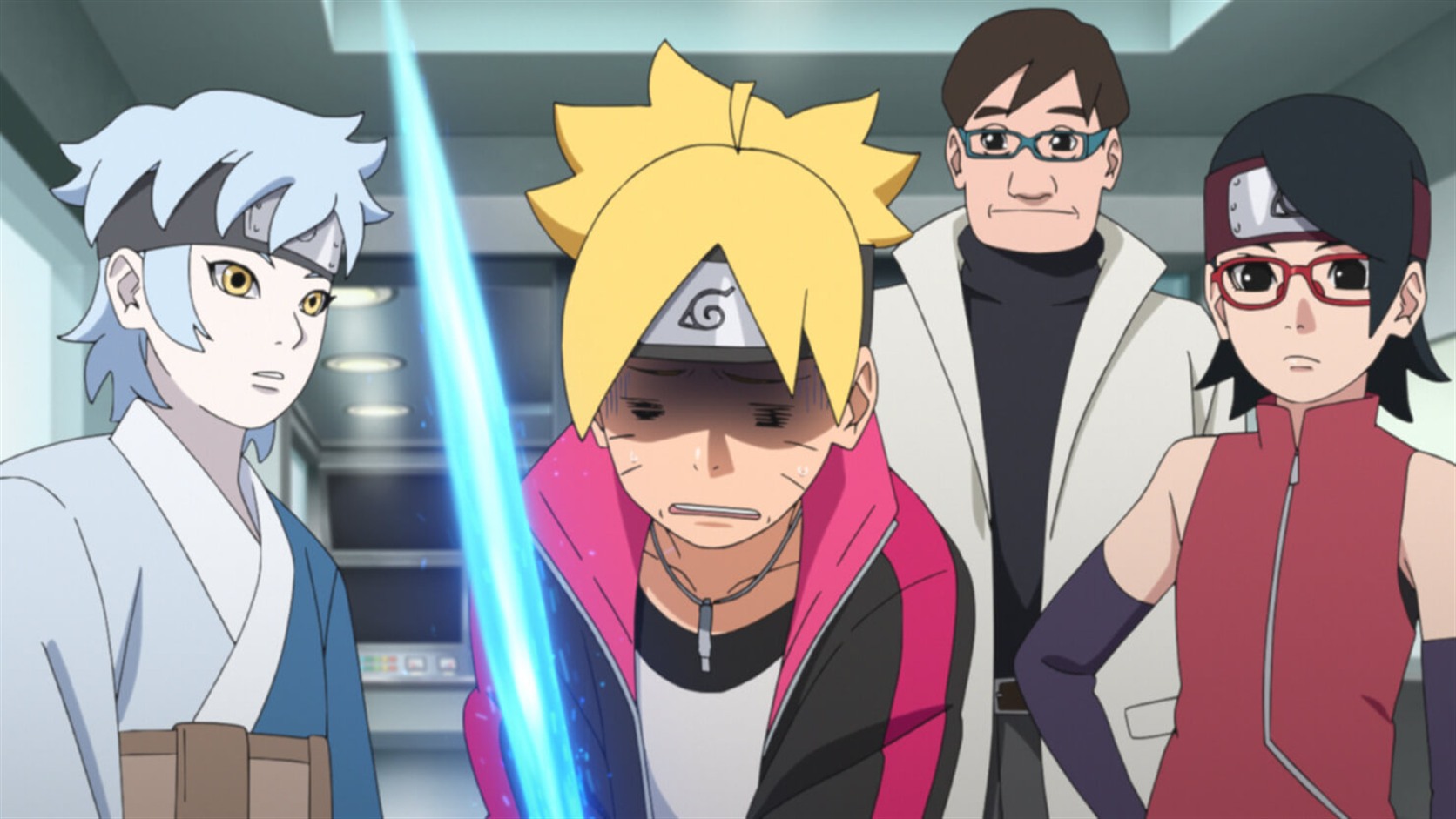
Team 7 arrives at the Advanced Technology Lab expecting a delivery handoff. Nue races through the facility, researchers respond, and Akita Inuzuka uses a Shinobi Gauntlet to perform Shadow Imitation and stop the chaos.
The introduction is messy, funny, and practical. This is not a silent room full of glowing products waiting for a sales presentation. Animals move, prototypes misbehave, people improvise, and the work exists because real bodies refuse to act like diagrams.
Sumire did not disappear after leaving Team 15
Boruto, Sarada, and Mitsuki are surprised to see Sumire at the lab. Her path away from a standard field team did not reduce her role. She has chosen research because her relationship with Nue demands knowledge that ordinary shinobi training cannot provide.
That choice gives Sumire agency beyond becoming somebody’s teammate or romantic possibility. She studies the problem shaping her life and intends to build a safer future herself.
Coexisting with Nue is the goal
Sumire wants a tool that helps keep Nue from losing control. She does not describe Nue as a defective weapon that needs erasure. Coexistence means protecting the village and respecting the bond she refuses to abandon.
The language matters. Good support technology does not force every unusual body or power into one acceptable shape. The tool should widen control and participation while preserving the person and relationship at the center.
Akita’s enthusiasm is allowed to be a lot
Akita greets Katasuke’s new prosthetic prototype with full researcher excitement. Her energy risks overwhelming Boruto, who already arrives suspicious of the entire field. She sees years of design questions. He sees the hand his father used to embarrass him in a spar.
Neither response exists in a vacuum. Researchers need enthusiasm to survive long testing cycles. Patients and users need space to ask what the excitement may overlook.
Boruto missed part of the assignment because he stormed out
Boruto thinks the escort ends after delivery. Team 7 also has to assist with testing the lab’s tools. His surprise comes from leaving Naruto’s office before the full briefing finished.
That detail is funny and deserved. Boruto’s anger may be understandable, but walking away has practical consequences. A mission does not shorten itself because one member wanted the last word.
Testing turns opinion into experience
Katasuke can explain that use determines morality all day. Boruto remains unconvinced until he handles the tools, feels their advantages, encounters their limits, and watches other people benefit.
Experience gives him evidence. The lab does not demand faith in science. The researchers invite evaluation, which means some tests can fail without the whole field becoming a fraud.
The smoke-flash tool changes a fight without adding strength
Sarada uses a prototype that overwhelms Boruto and Mitsuki through light, sound, and smoke. Mitsuki’s enhanced senses do not save him because the device targets those senses directly.
The test demonstrates that a tool can create tactical access without granting the user a larger chakra reserve or inherited technique. Sarada still needs timing and judgment. The device changes the available choice.
Silence becomes another form of terrain
The team enters a room where sound disappears. Shinobi depend on hearing movement, warnings, and teammates. Removing sound forces them to confront how much field awareness runs through one sense.
Research can recreate difficult conditions safely enough for training. The room supports preparedness rather than replacing skill. Nobody earns victory by owning the chamber.
Wall-walking without chakra has a real use
Specialized gloves and boots let users move along walls without spending chakra on adhesion. A shinobi can preserve concentration and energy for the part of a mission that actually requires jutsu.
Boruto initially sees shortcuts as cheating because his worst shortcut faked mastery. Conserving resources is different from lying about competence. A soldier carrying a lighter pack has not cheated at walking.
Accessibility and efficiency share design space
The same tool can help a skilled shinobi conserve chakra and help another person perform movement their body could not sustain alone. Efficiency is not automatically laziness. Accessibility is not an unfair advantage.
The useful question is whether the device supports the user’s goal with understood costs and honest rules. The Chunin Exams failed that test because Boruto hid a prohibited tool to claim abilities he had not learned.
Boruto gets hurt because prototypes are not toys
Boruto injures himself while trying an experimental flying device. His excitement outruns the design’s maturity and his control. The lab does not hide the failure behind heroic music.
Prototype testing involves risk, which is why supervision, consent, protective procedures, and honest documentation matter. “Science supports people” cannot become permission to place every half-finished idea on a child and hope.
Medical foam turns failure into another lesson
Sumire treats Boruto’s injury with healing foam developed through the same research ecosystem. One experiment causes a minor injury. Another tool supports recovery.
That does not magically balance a safety ledger. The scene shows how broad the field is. Scientific ninja tools include weapons, mobility aids, medical support, training environments, prosthetics, communication systems, and inventions nobody has named yet.
Sumire respects Katasuke for what he builds around people
Boruto notices Sumire’s respect for Katasuke. She has seen his work create practical support, not just tournament spectacle. Her perspective challenges the single story Boruto carries from the exams.
Respect should not erase Katasuke’s failures. Respect can rest on the work he did before and after those failures, especially when he accepts oversight and continues serving people who need the research.
Moving back to Konoha is a professional decision
Sumire tells Boruto that she will return to Konoha as Katasuke’s assistant. The move brings her closer to former classmates, but her reason is work. She wants access to the team, knowledge, and facilities that can support her research.
Her future is not a consolation prize for leaving frontline missions. Research is another route into protecting the village.
The plaque states the lab’s standard
Boruto reads Katasuke’s belief that science exists to support others. A slogan on a wall proves nothing by itself. The people and tools around the plaque provide the evidence.
Chamaru’s prosthetic leg, Sumire’s Nue project, healing foam, chakra-conserving equipment, and a hand built for Naruto all place the creed under practical examination.
Chamaru makes the argument without speaking
Akita’s ninken befriends Boruto, and Boruto notices the prosthetic rear leg. Chamaru runs, interacts, tracks, and works because the device restored movement after injury.
The prosthetic does not turn Chamaru into a symbol with fur. He remains Akita’s partner and a working ninken. Technology serves the life he already has.
Akita joined because care changed her family
Katasuke reached out after Chamaru lost his leg and developed the prosthetic. The experience led Akita to become his assistant. She did not join because a recruitment brochure promised innovation.
She saw what careful design gave back to someone she loved. Her research career grows from gratitude, curiosity, and a desire to extend that help.
Disability belongs inside the village’s future
Chamaru and Ao show different outcomes of prosthetic care. Both survive injury and regain function. Ao’s later choices do not make prosthetics suspicious. Chamaru’s loyalty does not make every scientific project safe.
Disability representation becomes stronger when technology supports varied lives without assigning moral purity or corruption to the body using the device.
The chakra blade looks incredible and drains the user
Katasuke lets Boruto try a prototype chakra blade. The weapon extends cutting power through chakra, and Boruto quickly feels how much energy the design consumes. A strong effect arrives with a strong cost.
That limitation protects the episode from product-demo nonsense. Innovation does not remove tradeoffs. The prototype needs refinement, training, and a user who understands when the drain becomes dangerous.
Limits are part of honest design
Katasuke does not pretend the chakra blade is ready for mass distribution. He allows Boruto to experience the drawback. Clear limitations help users decide whether a device fits the mission.
Kara hides limits because dependence creates control. Konoha’s lab gains trust by making weaknesses visible enough to test.
Boruto changes his position without pretending the past vanished
By the end of the lab visit, Boruto accepts that scientific ninja tools can support the village. He does not announce that every invention is wonderful or that the Chunin Exams no longer hurt.
That is believable growth. A person can revise an overbroad judgment while keeping a justified criticism of the event that created the judgment.
The hand in the title belongs to more than Naruto
Naruto’s prosthetic hand brought Team 7 to the lab. Ao’s prosthetic hand received maintenance on the train. Katasuke’s hands build. Sumire’s hands treat. Akita’s research helps Chamaru move. Boruto’s hand carries Kāma.
The title gathers technology, labor, care, and bodily autonomy into one image. A hand can hold a tool, become a tool, repair a life, or carry a mark somebody else intends to use.
Code and Delta model the opposite workplace
At Kara’s base, Code and Delta insult each other while Amado performs maintenance. Their bodies depend on the organization, yet the environment offers no trust. Every upgrade arrives inside a hierarchy built on secrecy and threat.
The lab in Ryūtan is chaotic but collaborative. Questions are allowed. Failures become test data. Kara’s modifications may be more powerful, but power without safe refusal is another leash.
Boro becomes the next convenient suspect
Code and Delta wonder whether Boro stole the Vessel before he reports in. Kara’s culture makes suspicion reasonable because every member has private motives and partial information.
An organization that treats betrayal as normal cannot build loyalty through fear alone. Members learn to hide better, blame faster, and prepare for the day usefulness expires.
Naruto’s call changes the mission immediately
Naruto contacts Boruto with news that Konoha has lost communication with Konohamaru and Mugino. Team 7 is closest, so the research mission ends and the rescue assignment begins.
The tools they just tested stop being classroom ideas. The team may need conserved chakra, medical support, tracking, and defensive technology before the day ends.
Two jōnin going silent is not a minor delay
Naruto, Shikamaru, and Sai understand that Konohamaru and Mugino are capable. Missing contact suggests a threat beyond routine trouble. Kara’s possible involvement raises the stakes further.
Leadership responds by using proximity and available resources rather than waiting for certainty. Team 7 receives responsibility because rescue time matters.
The airship exposes a security failure
An advanced craft crossed Land of Fire airspace without detection and crashed near the border. Kara has money, stealth technology, supply routes, and people placed close enough to exploit the aftermath.
The enemy is not one powerful fighter hiding in a cave. Kara is infrastructure. Defeating that threat will require intelligence, engineering, financial investigation, and field strength.
Funding is part of the enemy
Sai and Shikamaru recognize that an operation of this scale requires resources. Somebody pays for laboratories, augmented bodies, airships, weapons, maintenance, and Outer networks.
Following the money may reveal relationships that chakra sensing cannot. Shinobi security has to understand institutions, not only combat signatures.
Chamaru gives the rescue team more than a cute face
Akita’s ninken can track Konohamaru and Mugino. His prosthetic leg allows him to participate in the mission rather than remain behind as proof of Katasuke’s kindness.
That practical role completes the episode’s argument. Support technology matters when the person or animal using the device can act, choose, work, and contribute.
The episode risks making science look too easy
The lab sequence stacks useful inventions quickly, and most researchers appear thoughtful. Real development would include funding fights, failed trials, unequal access, maintenance costs, user training, and mistakes larger than Boruto’s minor injury.
Katasuke’s creed needs policies behind the plaque. Good intentions cannot replace consent, safety review, accessibility, and repair support after distribution.
Boruto’s conversion works because the evidence stays personal
He does not change his mind after hearing a speech about progress. Sumire describes her goal. Chamaru moves on a prosthetic leg. Akita explains why she joined. The chakra blade exhausts him. The lab lets him feel benefit and limitation in the same visit.
Specific lives defeat a generic prejudice better than a polished argument.
Katasuke does not demand forgiveness before doing useful work
The Chunin Exams remain the stain Boruto sees whenever Katasuke enters a room. Katasuke helped turn a child into a product demonstration, ignored the rules protecting the competition, and gave Momoshiki a weapon after the invasion. Genjutsu explains part of the later disaster, but Katasuke still crossed ethical lines before anyone took control of him.
Episode 183 makes a smart choice by refusing to stage a grand forgiveness ceremony. Katasuke keeps working, accepts Boruto's suspicion, shows limitations, and lets other people describe what his research has meant to them. Repair begins with conduct. The injured party does not owe a clean emotional ending so the adult can feel redeemed.
Boruto also does not betray himself by recognizing good work. He can condemn the exam scheme and respect Chamaru's prosthetic leg in the same afternoon. Moral judgment gets stronger when evidence changes the size of the claim. Katasuke made a harmful choice. That truth does not make every patient, assistant, prototype, and act of care fraudulent.
User consent separates support from control
Every successful lab example gives the user a meaningful role. Sumire chooses research because she wants a safer partnership with Nue. Akita understands Chamaru's needs and maintains his prosthetic. Sarada decides when to deploy the smoke-flash tool. Boruto feels the chakra blade drain and can stop the test.
Kara removes that space. Amado's modifications arrive inside an organization where Jigen decides assignments, access, punishment, and survival. A body may become stronger while the person gains fewer safe choices. That is not liberation with better hardware. That is control made expensive and difficult to escape.
Consent also has to continue after installation. A patient needs maintenance, repair knowledge, replacement parts, honest risk information, and the power to refuse an upgrade. One signature at the beginning cannot excuse permanent dependence on the institution holding the tools.
Access determines whether a miracle becomes public care
Chamaru receives a custom prosthetic because Katasuke notices the injury and offers help. The outcome is lovely, but one generous expert cannot become the village's entire accessibility policy. Who receives a device when the laboratory is busy? Who pays? Who travels for maintenance? What happens when a family cannot reach Ryūtan City?
The episode opens a door that the wider shinobi world still needs to walk through. Wars have produced amputees, chronic pain, damaged chakra networks, trauma, and displaced civilians for generations. Scientific ninja tools should not remain prestige equipment for famous shinobi or fortunate patients with the right connection.
Naruto's prosthetic hand proves the village can fund advanced care. Chamaru proves that care can restore ordinary work and joy. Fair access requires Konoha to turn isolated success into a durable service without treating recipients as advertisements for the laboratory.
Team 7 learns outside the academy model
Nobody awards points during the lab visit. Sarada, Mitsuki, and Boruto rotate through unfamiliar conditions, compare responses, fail in front of one another, and ask what each invention changes. The learning works because the consequences stay small enough to examine.
That kind of training matters for a generation facing technology their parents never studied. A shinobi who only memorizes known jutsu can misread an autonomous weapon, an absorption system, or a sensor that does not behave like a human opponent. Technical literacy belongs beside chakra control and tactical formation.
The lab also teaches humility across professions. Researchers need field users who can expose impractical designs. Shinobi need researchers who can explain mechanisms hidden behind an easy button. Neither group can solve Kara by treating the other as support staff who should remain silent.
What I am watching next
Team 7 is leaving a controlled research space for a crash site filled with Kara’s technology. Katasuke’s inventions will face tools designed without the same moral limits. The distinction between support and control will become physical.
Konohamaru and Mugino are injured, Ao is armed, and Boruto still thinks the man on the train gave him an honest lesson. Every relationship is heading toward the same wreckage.
RaeRae’s verdict
“The Hand” earns Boruto’s change of heart because the episode never asks science to save itself with branding. Sumire wants to coexist with Nue. Akita joined after Chamaru received a working leg. Katasuke shows the chakra blade’s drain instead of hiding the flaw. Boruto gets hurt, receives treatment, laughs during some tests, and slowly separates a whole field from one shameful choice.
The episode also keeps danger close. Kara uses advanced bodies to enforce secrecy while Konoha uses research to widen participation. Both sides understand that technology changes power. Only one side lets the user remain a person who can question the design. Boruto leaves the lab with a better opinion and immediately receives a mission that will test whether those principles survive outside the building.
Sources and lawful viewing
Official episode reference: Naruto Official episode guide
Licensed episode route: Crunchyroll licensed series page