
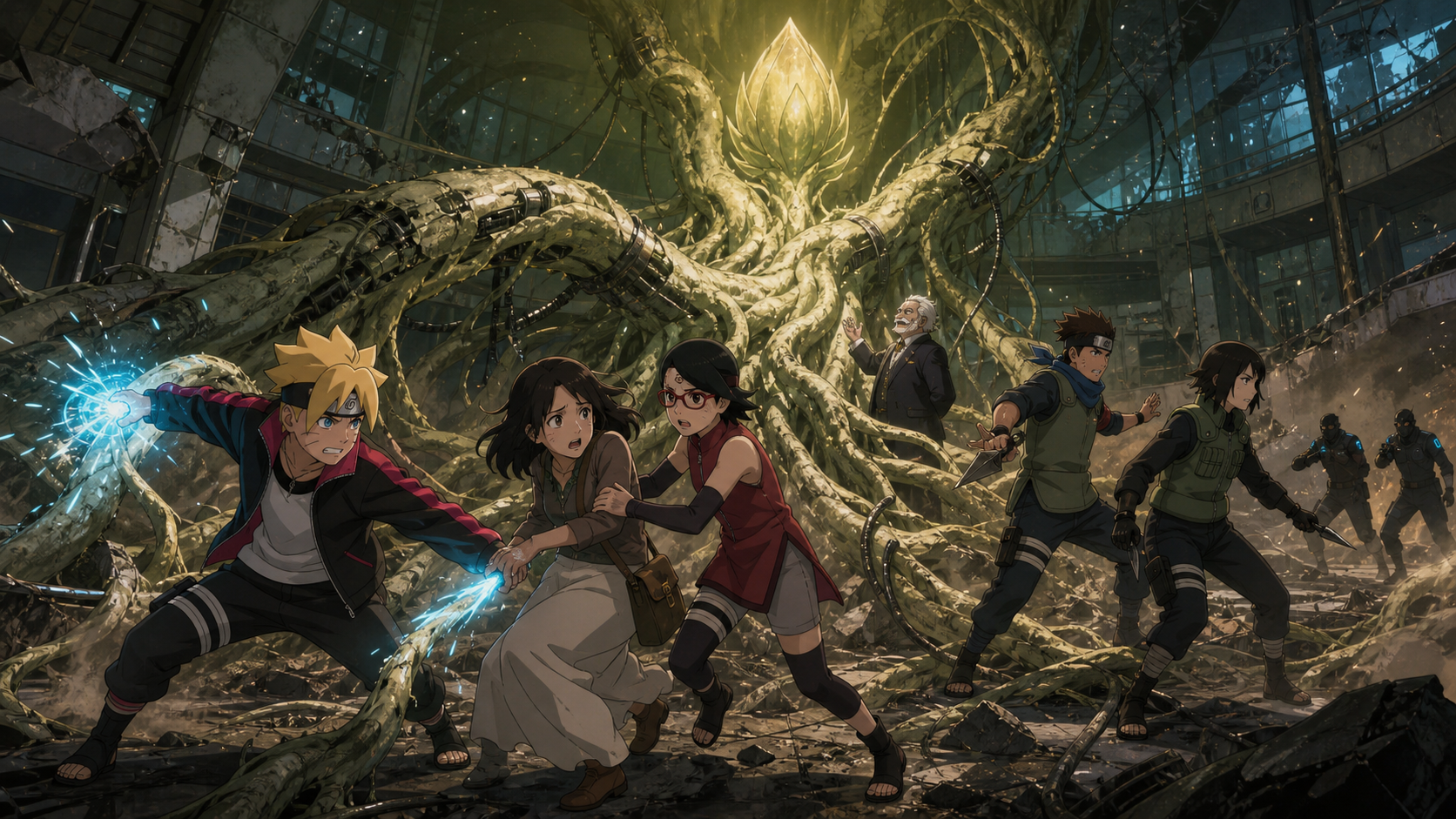
The Revival of the Divine Tree
Victor calls stolen chakra revival while roots consume his own facility. Boruto and Sarada have stronger techniques now, but evacuation proves whether stronger also means more responsible.
Series: Boruto: Naruto Next Generations
Episode: 174 · The Revival of the Divine Tree
Arc: Kara Actuation
Release: 2020-11-15
Previous: Episode 173 · The Secret Behind the Underground Room
Directory: All 293 Boruto episodes
Bottom line
Boruto Episode 174 turns Victor’s hidden laboratory into the outcome his entire company was built to create. The artificial Divine Tree erupts, roots tear through the facility, employees and test subjects become fuel, and Victor watches the bud with more concern than he shows any person trapped underneath. Boruto and Sarada arrive wanting to help their teacher. Their first responsibility becomes getting Mia and civilians away from a disaster manufactured by one old man’s refusal to accept mortality.
“The Revival of the Divine Tree” refuses the clean version of scientific ambition. Victor survived the Fourth Shinobi World War and carries injuries, fear, and rage about death. Those experiences explain his obsession. They do not authorize human experimentation, forced chakra extraction, corporate deception, or a tree capable of consuming a nation.
The episode also makes medical support part of the action rather than an afterthought. Sarada can assess injury and evacuation needs because Sakura taught her more than punching. Boruto can cut roots with new power, but Kakashi’s recoil warning remains active. Heroism here is not planting the biggest Rasengan in the nearest threat. Heroism is choosing which life needs protection before the building removes every choice.
Victor stops pretending the company serves people
The inspection mask collapses with the facility. Victor no longer needs polished laboratories or prepared explanations once the artificial tree activates.
His real priority becomes visible: reach the chakra fruit and secure the immortality or restoration he imagines waiting inside.
Employees, patients, the daimyō, and the surrounding nation become acceptable losses.
The artificial tree is built from theft
Victor did not grow a miracle. He assembled an imitation through stolen Hashirama cells, human subjects, chakra, machinery, and concealed research.
Every root carries a chain of nonconsensual contribution. Calling the result scientific progress would erase the people forced into the experiment.
The bud looks sacred only from a distance. Up close, the machine is organized theft wearing the shape of mythology.
War trauma explains Victor without excusing him
Victor survived the Fourth Shinobi World War and lost parts of his body. He watched overwhelming power decide who lived.
Fear of weakness and death can grow from that history. So can an obsession with replacing damaged flesh and controlling life.
Explanation matters because villains are more frightening when choices grow from recognizable wounds. Excuse would be different. Millions survived war without building a human-consuming tree.
Disability is not the villain
Victor’s injuries and prosthetic body should never become shorthand for moral corruption. His cruelty comes from decisions, not missing limbs.
The Naruto world contains disabled veterans, experimental survivors, and people living with altered bodies who do not become abusers.
Victor chooses to treat other bodies as material because he believes his survival outranks their autonomy.
The tree turns corporate crime into public disaster
Before activation, Victor could isolate harm underground and control information. The roots destroy that containment.
Hidden experimentation becomes visible through broken walls, fleeing workers, collapsing equipment, and chakra draining across the site.
The company’s private crime now threatens public land. Secrecy did not limit the danger. Secrecy delayed response until danger became enormous.
Boruto and Sarada arrive inside an evacuation
The teenagers come to support Konohamaru and Mugino. The scene immediately forces a change of plan.
Mia and other civilians cannot defend themselves against chakra-hunting roots. Reaching the adults means nothing if the route leaves people behind.
Training results become useful through rescue, not only combat.
Mia should not have to survive Victor twice
Victor already took Anato through deceptive research and returned only a company story. Now Mia enters the radius of the same experiment.
Protecting her carries moral weight beyond ordinary evacuation. The institution that stole her husband threatens to consume her too.
Boruto and Sarada owe her safety before they owe themselves a confrontation.
Sarada changes the plan like a leader
Sarada recognizes that the original goal no longer matches conditions. She redirects attention toward civilian protection and route assessment.
That flexibility belongs to her Hokage training more than any dramatic speech. Leaders revise plans when facts change.
Clinging to the old objective for pride would turn teammates and civilians into payment for consistency.
Sakura’s lessons enter the battlefield
Sarada’s recent spar taught her to connect perception, movement, chakra control, and bodily risk. Those skills help her guide Mia through unstable terrain.
Medical awareness also changes how she sees the scene. Injured people require prioritization, not motivational yelling.
Sakura’s influence becomes practical without needing Sakura physically present.
Boruto’s new Rasengan is a cutting tool before a finishing move
Boruto uses controlled chakra to break or divert tendrils blocking escape. The choice shows growing restraint.
The High Compression Rasengan could deliver enormous force, but using full output near Mia, unstable walls, and trapped workers might create another hazard.
Power proves maturity when the user knows how little force the moment requires.
Recoil remains part of every decision
Boruto recently landed in the hospital after testing compression. His arm has not become invulnerable because the emergency feels important.
Every use spends physical capacity he may need against Deepa or Victor. Repeating the technique recklessly could remove him before the final rescue.
Kakashi’s warning follows him into the collapsing company whether Boruto enjoys hearing the truth or not.
Konohamaru and Mugino fight on two fronts
The adult ninja face Victor’s employees while roots attack the facility. Human opposition and environmental danger combine.
Some employees may know the hidden work. Others may believe they are defending a legitimate company from foreign infiltrators.
Konohamaru and Mugino need enough force to survive without assuming every worker deserves death for Victor’s decisions.
Company loyalty becomes a weapon
Victor built an organization where staff protect the institution even as the institution consumes them.
Orders, salaries, fear, and compartmentalized knowledge keep security personnel fighting while roots spread behind them.
Corporate hierarchy can make ordinary people enforce a lie long after evidence becomes physically visible.
The daimyō’s survival matters beyond politics
The Land of Valleys ruler witnessed the underground room after the genjutsu broke. He can authorize investigations, emergency response, and consequences.
Victor has reason to prevent that testimony from leaving the site.
Protecting the daimyō is not worshiping status. A living witness with local authority can convert exposure into action for every victim.
Human test subjects need extraction, not spectacle
People trapped in the laboratory may be unconscious, altered, or attached to machinery. The tree’s activation increases their danger.
Rescuers need medical teams, transport, identity records, and evidence preservation. Pulling bodies free without understanding support systems could cause additional harm.
The story should treat those people as patients and witnesses, not creepy scenery.
Victor mistakes growth for control
The bud convinces Victor that his plan worked. He sees upward motion and interprets the movement as obedience.
The roots are unstable, indiscriminate, and connected to machinery already failing. Creation does not equal control.
Victor’s arrogance lies in believing that producing life-shaped power makes him master of the result.
A Divine Tree imitation carries real Divine Tree danger
The experiment may be incomplete, but the roots still absorb chakra and threaten lives. “Artificial” does not mean harmless.
Victor reconstructed enough of the process to create catastrophe without understanding the whole system.
Partial knowledge becomes more dangerous when confidence fills every missing piece.
The fruit fantasy erases every person below the bud
Victor looks upward while everybody else looks for exits. That contrast defines him.
The promised fruit represents restored body, power, and victory over death. People crushed underneath become invisible costs.
No future benefit can justify a research method that denies current lives all consent.
Deepa treats the emergency as another assignment
Deepa remains aligned with Kara’s goals and Victor’s operation without sharing Victor’s emotional obsession. The tree is a project outcome, not a sacred hope.
His presence means Boruto and Sarada cannot focus only on roots. The man who defeated Team 7 may intercept them once evacuation routes narrow.
Environmental crisis gives a predator more control over movement.
Team 7 is still incomplete
Boruto and Sarada enter without Mitsuki. Their new skills help, but the absence changes coordination.
They cannot rely on snake scouting, lightning support, or Mitsuki’s rescue speed. More importantly, they cannot ask him to spend Sage power again.
Every plan must work with the team physically present rather than imagining a healthy Mitsuki beside them.
Mitsuki’s recovery affects Orochimaru’s choices
Orochimaru knows Team 7’s danger through Mitsuki’s injuries and Team 5’s visit. Victor’s research also touches fields Orochimaru understands better than almost anyone.
An intervention would carry bitter irony. Orochimaru has committed human experimentation and pursued immortality through stolen bodies.
That history gives him expertise without granting moral superiority.
Orochimaru recognizing Victor does not absolve Orochimaru
If Orochimaru condemns unstable experiments or nonconsensual methods, viewers should remember who helped establish those traditions in the series.
Growth can include stopping another abuser. Accountability still requires acknowledging the resemblance.
The story becomes richer when Orochimaru acts usefully while remaining morally complicated.
Victor’s secretary helps keep the machine running
Corporate crimes rarely depend on one person moving every file and maintaining every room. Victor’s close staff protect access, information, and timing.
Participation should be judged through evidence. A secretary who knowingly maintains human experiments carries responsibility different from an uninformed technician.
The investigation must separate proximity from knowledge without pretending administrative labor is automatically innocent.
Rescue and evidence preservation can conflict
The collapsing facility may destroy records proving what Victor did. Stopping to collect evidence can cost lives.
People come first. Investigators can photograph, mark, or carry records only when those actions do not delay extraction.
Victor should not escape accountability because rescuers chose humanity over paperwork, but that tension is real.
The Land of Valleys pays for Konoha’s delay and Victor’s power
Konoha respected the nation’s border and waited for authorization, which was correct. Victor used time and local influence to advance the experiment.
The disaster shows why diplomacy and rapid protective mechanisms both matter. Respecting sovereignty cannot mean abandoning smaller nations to powerful companies.
Partnership should help the Land of Valleys investigate without replacing local authority with Leaf control.
Boruto and Sarada call Konohamaru “sensei” differently now
Their determination to reach him comes after defeat, hospitals, and individual training. The title carries responsibility rather than childish dependence.
They know Konohamaru entered danger to investigate the system that hurt their team and Anato.
Helping him now should mean following tactical direction, not forcing him to rescue them again.
The building becomes Victor’s moral portrait
Cracked glass, exposed roots, failing machines, and trapped people show the reality beneath the company façade.
Victor wanted a controlled path to regeneration. He created an environment where every support system collapses around one glowing bud.
The facility looks exactly like his priorities: enormous investment concentrated upward while human life disappears underfoot.
Revival is the wrong word for what Victor made
Revival suggests life restored. Victor’s tree drains life to manufacture a promise for one man.
The experiment does not reverse death. The experiment moves death onto people with less power.
That is not resurrection. That is extraction dressed in sacred language.
The episode prepares a climax without skipping consequence
Episode 174 positions Boruto and Sarada near Deepa, Konohamaru and Mugino near Victor, and the artificial tree above everyone. The battle lines are clear.
The stronger choice is keeping evacuation visible inside that setup. Mia, employees, the daimyō, and test subjects prevent the climax from becoming a private tournament.
Victor’s experiment threatens a community. The heroes must save that community while fighting the people who built the threat.
The bud cannot be allowed to open
Nobody knows whether Victor’s artificial tree can produce a stable chakra fruit. The uncertainty increases danger rather than reducing urgency.
An incomplete fruit could poison, explode, drain a wider region, or give Victor power nobody can predict.
The rational goal is stopping the process before curiosity becomes another excuse for sacrifice.
Survival must remain the result
Boruto and Sarada trained because Mitsuki paid for their earlier escape. This emergency tests whether they learned to value survival as more than consolation.
Getting Mia out matters. Protecting Konohamaru and Mugino matters. Saving test subjects matters. Preventing Victor’s fruit matters.
Defeating Deepa will feel satisfying, but a victory built on ignored casualties would repeat Victor’s logic. Episode 174 places every temptation in front of Team 7 and asks whether stronger children can make more responsible choices. That question matters more than the size of the next explosion.
Evacuation requires a chain of command
Boruto and Sarada can clear a path, but a collapsing research complex needs more than two capable teenagers making individual rescues. Somebody has to identify exits, count evacuees, mark blocked zones, establish a medical point, and prevent frightened workers from returning for possessions or missing colleagues.
Sarada's leadership instincts can begin that structure. She can assign Boruto to roots his new technique can cut, direct mobile adults toward trapped patients, and keep Mia beside somebody who knows the route. Clear roles reduce duplicated effort when every shout sounds urgent.
Konohamaru also needs to transfer authority if Victor separates him from the civilians. A rescue plan survives only when the next person knows what to do without waiting for the jōnin to reappear.
Mia is a witness, not merely somebody to carry outside
Mia knows Anato's assignment, Victor's promises, the company's response after her husband changed, and the route that brought her into danger. Her knowledge can connect the public company to hidden research once immediate safety is secured.
Rescuers should protect that testimony without turning Mia into another asset. She controls when she speaks, receives medical care first, and deserves an explanation of how her information will be stored and shared. Trauma can fragment recall, and pressure for a perfect statement may deepen harm.
Victor treated her questions as obstacles. A legitimate investigation begins by treating Mia as a person whose loss and choices matter beyond the case she can help prove.
The artificial tree creates an environmental crime
Roots do not respect the laboratory walls. Hashirama-cell material, chakra-draining tissue, chemicals, and damaged machinery may reach soil and water around the facility. Destroying the visible bud cannot become the final cleanup step.
The Land of Valleys needs sampling, quarantine boundaries, long-term health monitoring, and transparent reporting about what entered the environment. Farmers and nearby residents should not discover contamination only after symptoms appear.
Victor's company profited locally while hiding the risk. Corporate assets should fund repair before executives or creditors extract whatever value remains from the ruins.
Boruto's restraint answers the Chunin Exams better than shame
Boruto once used a scientific ninja tool to display abilities he had not earned. Episode 174 shows a different relationship with power. He has trained for the High Compression Rasengan, understands the recoil, and chooses smaller applications when civilians stand near the roots.
Growth does not require him to reject every shortcut or tool. Growth requires honesty about source, cost, permission, and consequence. Cutting an escape route with controlled force demonstrates more maturity than firing the strongest attack merely because the technique is available.
The Chunin Exams taught Boruto what false mastery looks like. This rescue teaches him that real mastery often looks like refusing spectacle.
Sarada practices Hokage work before the office exists
Sarada's dream can sound abstract when she announces the title during a fight. The evacuation gives the dream an ordinary shape. She notices who cannot protect themselves, changes the plan, weighs injuries, and accepts that reaching Konohamaru may have to wait.
Hokage leadership is full of that delay. The leader may want to confront the person responsible, yet food, shelter, medical care, routes, and reliable information determine whether residents survive the crisis.
Sarada earns the ambition when she protects people who cannot reward her with a dramatic victory. A title should recognize that habit rather than create the habit afterward.
Victor's fear of death has consumed his remaining life
Victor organizes money, staff, secrecy, and stolen biology around avoiding an ending. The obsession leaves no room for friendship, rest, grief, or responsibility toward people already beside him. He survives longer while living less humanely.
Mortality frightens him, especially after war and bodily loss. The fear becomes monstrous when he decides other people must die so he never has to face the same limit. Every victim becomes time he imagines adding to himself.
The artificial tree exposes the bargain. Victor may reach the bud, but the company, reputation, workers, and surrounding land collapse beneath him. He preserves nothing worth returning to.
Orochimaru and Victor reveal two stages of the same warning
Victor shows the active disaster: a researcher still willing to consume strangers for immortality. Orochimaru shows what happens when the world keeps a brilliant abuser nearby because expertise remains useful after formal defeat.
Orochimaru may stop the tree and protect Mitsuki. Those actions matter. The village still has to supervise his research, protect subjects, document access, and refuse the fantasy that helpful conduct erased earlier crimes.
The comparison should not flatten their differences. Orochimaru has developed attachments and accepts some boundaries Victor rejects. The resemblance remains necessary because reform without oversight can become reputation management around the same dangerous power.
The aftermath must name every category of harm
Victor's scheme produces deaths, injuries, missing people, stolen research, coerced labor, environmental damage, financial fraud, political manipulation, and trauma. A single criminal charge or destroyed tree cannot represent the entire record.
Different survivors need different repair. Families need truthful identification. Patients need continuing treatment. Workers need wages and legal protection. Researchers need attribution or accountability according to their choices. The Land of Valleys needs control over its evidence and recovery.
Comprehensive accounting prevents the largest spectacle from swallowing quieter harm. The glowing bud draws every eye, but justice lives in the names and needs below the roots.
The public record should also distinguish confirmed facts from unresolved suspicion. Victor's secrecy already damaged trust. Investigators cannot repair that damage by filling gaps with confident guesses. Regular updates, corrected errors, and survivor access to their own records matter long after the roots stop moving.
Sources and lawful viewing
Official episode reference: Naruto Official episode guide
Licensed episode route: Crunchyroll licensed series page