
I Can’t Stay in My Slim Form
Chocho’s appetite is fuel, her confidence is not a problem to solve, and protecting Anko and a stolen azuki-bean shipment finally makes Butterfly Mode belong to her.
Series: Boruto: Naruto Next Generations
Episode: 156 · I Can’t Stay in My Slim Form
Arc: Chocho Akimichi
Release: 2020-07-12
Previous: Episode 155 · Mitsuki’s Rainy Day
Directory: All 293 Boruto episodes
Bottom line
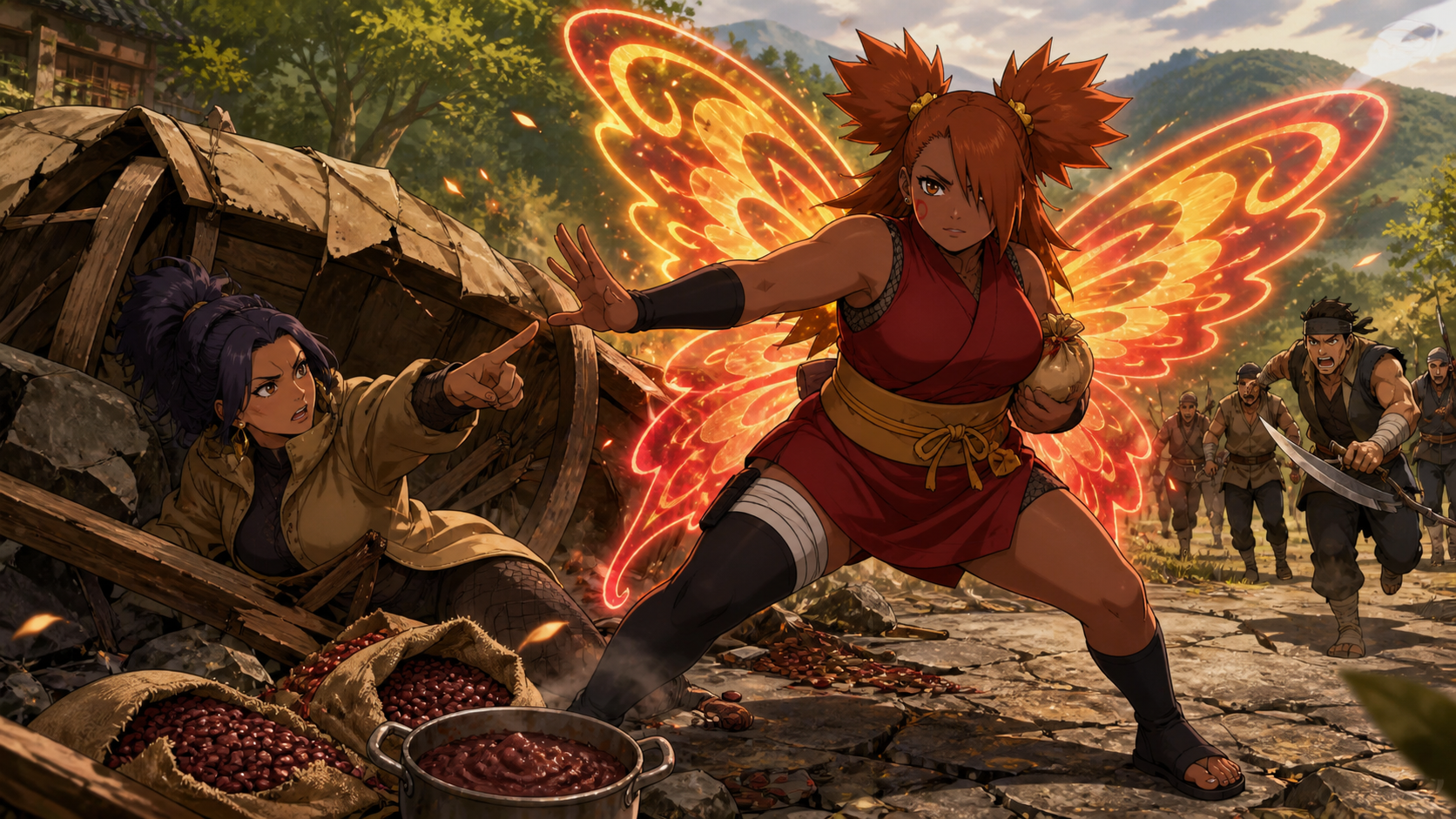
Boruto Episode 156, “I Can’t Stay in My Slim Form,” gives Chocho Akimichi a Butterfly Mode breakthrough through the two things the franchise keeps treating as jokes: her appetite and her confidence. Chocho protects a shipment of azuki beans with Anko, burns through her stored calories, cooks emergency bean paste, and finally activates the Akimichi technique because she wants to save both her teacher and the food supply from bandits.
The episode is funny, slight, and far more interesting than the title suggests. Chocho does not need to become thin to become worthy, disciplined, or beautiful. Her slim form is the physical cost of converting calories into chakra. The story understands that point better with Chocho than Boruto often does with Anko, whose adult body receives cheap visual jokes while her history and ability remain underused. Chocho’s victory works. The treatment of Anko still needs an intervention.
Choji begins with the family technique, not a diet lecture
Choji demonstrates Butterfly Mode while training with Chocho. His body becomes slimmer because the Akimichi technique converts stored calories into an enormous release of chakra.
The distinction matters because the clan does not treat fatness as an obstacle to power. Body mass is part of the mechanism. Food supports a combat system that can turn energy reserves into size, strength, and chakra wings.
Choji asks his daughter to understand the emotional trigger behind the technique. He is teaching inheritance, control, and purpose. He is not selling her a makeover.
Chocho refuses to perform insecurity for anybody
Chocho does not share her father’s urgency about mastering the slim transformation. She already likes herself. A temporary body change may look glamorous, but glamour does not automatically become a life goal.
That confidence makes parts of the fandom uncomfortable because many stories train viewers to expect a fat girl to apologize before receiving attention. Chocho rarely offers that apology.
She likes food, romance, style, strength, and her own reflection. The combination can become comic excess, but the self-regard is also one of the healthiest things Boruto gives a teenage girl.
The sweet shop turns scarcity into an emergency
After training, Chocho and Choji visit a sweet shop and discover that every azuki-bean item has sold out. Thieves have been attacking deliveries and reselling the stolen beans at inflated prices.
The setup treats dessert with the dramatic weight Chocho feels. That exaggeration is the joke. The supply problem underneath the joke is real.
A few bandits can control a local ingredient by disrupting transportation. Shops lose products, customers pay more, and ordinary workers absorb the consequences. Food supply chains become fragile long before an entire village runs out of meals.
Chocho cares about beans because beans connect people
Azuki beans are not a random snack prop. Sweet bean paste appears across Japanese desserts, and the shop’s missing menu represents recipes, labor, habit, and shared pleasure.
Chocho’s love of food is social. She trains with Choji, visits shops, argues with friends, and forms quick alliances around what people enjoy eating.
The episode turns that appetite into civic motivation. She wants her sweets back, yes. She also wants the thefts stopped so the shop and village can function normally.
Anko is the obvious partner and the frustrating missed opportunity
Anko joins Chocho because both characters love sweets and understand the urgency in their own wonderfully dramatic way. Their pairing should be comedy gold with a dangerous edge.
Anko trained under Orochimaru, survived his curse mark, fought through the original series, and later became an Academy instructor. She has enough history to recognize a young ninja whose humor protects a serious core.
Episode 156 uses her warmth and appetite, but the script also weakens her so Chocho can take the final victory. A mentor can create space for a student without looking helpless.
Boruto keeps treating Anko’s adult body as a punchline
The franchise repeatedly frames Anko’s weight gain as visual shorthand for decline. The camera and dialogue remember the thin teenage version as the real character and present the adult body as evidence that she stopped mattering.
That treatment is lazy. Bodies change with age, work, injury, medication, routine, hormones, and ordinary life. A former field ninja becoming a teacher does not owe viewers permanent adolescent proportions.
The deeper problem is not that Anko gained weight. The problem is that Boruto often removes her competence at the same time, teaching viewers to connect a larger body with diminished value.
Chocho’s story quietly argues against the same joke
Chocho carries power because her body stores the energy Butterfly Mode consumes. When she becomes slim, the change signals depletion rather than improvement.
The story cannot celebrate that mechanism honestly while treating Anko’s fatness as proof of failure. One character’s calories become inherited combat resources. The other character’s body becomes background comedy.
Chocho exposes the contradiction simply by winning as herself. Her strength does not begin after the transformation. The technique draws strength from what she already carries.
The delivery mission gives Chocho a concrete responsibility
Chocho and Anko position themselves to protect the next shipment. The assignment is small enough for a standalone episode and useful enough to justify shinobi involvement.
No world-ending threat appears. A merchant needs goods, a driver needs safe passage, and thieves need to learn that controlling a food route has consequences.
Naruto’s world benefits from missions like this because villages cannot survive on legendary battles alone. Security includes roads, crops, shops, and people trying to finish a workday.
The bandits are simple because the character problem is not
The thieves want profit. They disrupt deliveries, seize beans, and rely on local scarcity to increase resale value.
They do not need tragic childhoods or secret bloodlines. Their job is to pressure Chocho until she understands what Butterfly Mode requires from her.
Simple villains become a problem only when the heroes remain simple too. Chocho’s relationship with food, body image, inheritance, and motivation gives the episode enough internal material to carry the fight.
Chocho activates Butterfly Mode when the cart falls
Damage to the road sends the bean cart into danger. Chocho reacts to protect the shipment and suddenly produces the chakra wings Choji demonstrated.
The trigger sounds ridiculous if reduced to “she got powerful for beans.” The actual feeling includes responsibility, frustration, protection, pride, and the refusal to watch people steal something the community depends on.
Naruto characters have activated terrifying powers for headbands, promises, meals, pets, insults, and precious objects. Chocho’s beans are not less legitimate because the story lets the moment stay funny.
The first transformation does not solve control
Chocho reaches Butterfly Mode, spends the energy, and cannot reproduce the result on command. Anko becomes trapped beneath debris while the bandits remain active.
That failure saves the breakthrough from feeling free. One emotional surge reveals the route. Mastery still requires understanding the cost and recreating the conditions.
Chocho now has a teacher to protect and no immediate reserve large enough to force the technique again. The episode turns the clan’s calorie rule into a practical obstacle rather than trivia.
Anko gives the smartest instruction in the episode
Anko tells Chocho to use the available beans and spare ingredients to cook bean paste. The food will restore calories, and the restored calories can fuel Butterfly Mode.
That advice is Anko at her best. She reads the technique, inventory, environment, and immediate need. She does not tell Chocho to become more inspired or believe harder.
The solution is physical and specific. Eat because the jutsu has a measurable fuel cost. Cook because the raw material is sitting beside them. Survive first, then fight.
Cooking becomes part of the battle plan
Chocho prepares bean paste beside a damaged cart while enemies approach. The sequence is absurd, but the absurdity follows the established rules.
Food preparation becomes shinobi logistics. She needs energy quickly, and the stolen commodity contains the required fuel.
The scene also rejects the idea that eating interrupts heroic action. Eating is the action that makes the next heroic act possible. The body cannot spend resources that nobody replenishes.
The smell creates another tactical problem
Cooking beans produces an aroma that leads the bandits toward Chocho and Anko. Their solution creates a new risk.
That complication gives the comedy structure. Chocho cannot sit beside the pot and wait for a perfect meal. She has to avoid attackers, finish enough food, recover, and protect the injured mentor.
The episode earns the joke because cause and effect remain intact. Food helps, food smells, enemies can follow the smell.
Chocho finds the feeling behind the technique
Choji told Chocho that strong emotion unlocks Butterfly Mode. Her final realization combines love for the beans with concern for Anko.
The beans are not competing with the person. Both represent something she decided to protect. Chocho’s feelings do not need to arrive in a solemn hierarchy before becoming real.
She can care about her teacher, her village’s desserts, the driver’s livelihood, and her own pride at the same time. Human motivation is usually a crowded plate.
Butterfly Mode belongs to Chocho now
Chocho activates the technique again and defeats the bandits. The transformation is no longer a demonstration borrowed from Choji or a lucky reaction to a falling cart.
She understands the fuel, emotional trigger, and purpose well enough to repeat the result under pressure.
Inherited power becomes personal when the next generation learns why and when to use the technique. Chocho does not copy Choji’s exact emotional history. She reaches the same clan knowledge through her own priorities.
Slim form is an aftermath, not the prize
The episode title jokes that Chocho cannot remain slim because she needs to eat again. That joke can sound like a failed-diet punchline if the technique’s mechanics disappear.
Butterfly Mode burns calories rapidly. Remaining slim would mean remaining depleted. Recovery requires food and a return toward her ordinary body.
The healthy ending is not Chocho preserving the transformed shape. The healthy ending is her body recovering after extraordinary energy use.
Chocho’s confidence survives the transformation
Some stories grant a fat girl confidence only after changing her body. Chocho enters the episode confident and leaves confident.
Butterfly Mode adds a skill. The technique does not provide a personality transplant, romantic permission, or proof that she was secretly beautiful underneath.
She admires the slim form because Chocho admires many versions of herself. That pleasure does not require rejection of the body that carried her into the fight.
Choji teaches better by letting Chocho find her own reason
Choji explains the family technique, encourages training, and then allows experience to complete the lesson.
He cannot manufacture the emotion for her. His history with the Three Colored Pills, friendship, and self-sacrifice belongs to another generation and a much harsher battle.
Chocho deserves a route that fits her life. Protecting Anko and the bean shipment may sound smaller, but control learned without near-death trauma is progress, not weakness.
The episode undercuts Anko to elevate Chocho
Anko gets trapped and needs rescue after the bandits overwhelm the situation. Chocho’s victory requires the mentor to remain unavailable during the climax.
The structure is common and still frustrating. Anko could sustain an injury while protecting the cart, hold back part of the group, or deliberately assign Chocho the final task. Any of those choices would preserve competence.
Instead, the episode feeds the fandom’s claim that adult Anko became useless. Chocho does not need that sacrifice. Her breakthrough already has enough meaning.
The comedy works until the body becomes the whole joke
Chocho and Anko mourning missing sweets together is funny. Cooking bean paste during an ambush is funny. Bandits learning that stolen dessert ingredients can trigger an Akimichi transformation is very funny.
Repeated jokes that equate weight with failure are not the same kind of humor. Those jokes ask the audience to laugh at a body before a character has done anything.
RaeRae likes food comedy. RaeRae does not need the camera to punish women for visibly enjoying the food.
Chocho’s appetite is character, culture, and fuel
The episode works when food means more than a number. Chocho likes eating because pleasure matters. The beans connect a shop to customers and a seasonal tradition. Akimichi techniques convert calories into chakra and physical force. A meal can therefore be joy, community, preparation, and recovery at the same time.
That complexity is exactly why the body jokes feel so cheap. Chocho’s appetite has narrative function. Anko’s appetite has history and personality. Reducing either woman to “she ate too much” throws away material the episode already knows how to use.
Chocho never apologizes for wanting the sweets. She decides that protecting the shipment matters, puts her body into the work, and eats after the technique drains her. The sequence rejects the idea that a temporary slim silhouette should become a permanent reward.
Food returns her to herself. That is healthier storytelling than treating hunger as proof of discipline.
Butterfly Mode is inherited knowledge that still requires personal meaning
Choji can teach hand positions, chakra control, calorie conversion, and family history. He cannot hand Chocho the emotional focus that unlocks her best use of the technique.
That limit makes his parenting effective. He does not declare her incapable when the first attempt fails. He lets practice continue until the responsibility in front of her becomes emotionally specific. Chocho protects people, Anko, the cart, and the beans because all of them now belong to a promise she chose.
Inherited techniques often become stories about bloodline destiny. Episode 156 gives inheritance another shape. A clan can preserve knowledge, while each child decides what the knowledge means in her own life.
Chocho does not become Choji in a different outfit. Butterfly Mode becomes hers when her values supply the reason.
Anko should be the bridge between appetite, danger, and survival
Anko knows what happens when adults define a child through one trait. Orochimaru marked her, used her, and left his power attached to her identity for years. She later became a teacher and examiner responsible for children entering dangerous systems.
That history could make her an extraordinary mentor for Chocho. Anko can understand being underestimated, having the body carry another person’s narrative, and using humor without surrendering competence.
The episode instead treats her appetite as a setup and her capture as a platform for Chocho’s rescue. Anko can need help without becoming useless. Give the bandits a credible countermeasure, let her protect the cart before being overwhelmed, and let her advice draw from actual field experience.
Chocho’s success would grow stronger beside a capable adult rather than on top of an adult the script deliberately weakens.
Boruto’s joke is not harmless because the story gives him no correction
Children say rude things. Boruto does not have to arrive with perfect politics. The problem is the camera agreeing with him.
When he treats Anko’s current body as a shocking decline from her younger appearance, nobody tells him that adulthood changes bodies, medication changes bodies, trauma changes bodies, and none of those changes cancels skill. The joke lands, the scene moves on, and Anko absorbs the humiliation as atmosphere.
Chocho’s entire plot provides the response Boruto needs. Body shape is not a moral ranking. Slimness can be a temporary mechanical effect. Eating can be necessary recovery. Confidence does not need permission from a scale.
One line from Chocho could connect those lessons and defend Anko without turning the episode into a lecture. Silence lets the franchise celebrate Chocho while recycling the same contempt against another woman.
The bandits need competence if Chocho’s victory is supposed to measure growth
Protecting a supply route is legitimate shinobi work. Scarcity encourages theft, and a stolen shipment can damage a small business far beyond the value of one cart.
The opponents still feel arranged around the desired transformation. Their plan, intelligence, and combat ability stay thin until the story needs Anko restrained and the cart endangered.
A better confrontation would show them studying the route, exploiting terrain, separating the escort, or targeting the wheel. Chocho could then adapt using the same observation and cooking knowledge developed earlier.
Victory means more when the opponent creates a real problem. Making Anko suddenly ineffective and the bandits briefly dangerous does not prove Chocho became stronger. Letting her solve a coherent ambush would prove that skill, care, and clan training came together.
What works: Chocho remains funny without becoming the joke
Chocho’s humor comes from confidence, appetite, timing, and the scale of her reactions. She participates in the comedy instead of existing as the object everybody else examines.
That distinction protects the episode. A fat character can be funny, hungry, dramatic, vain, capable, irritated, and brave. The problem begins when fatness becomes the only punchline and the character loses control over the joke.
Chocho keeps control. She values the beans before anybody else understands why, treats the mission seriously on her own terms, and refuses to preserve the slim form as evidence of improvement.
The episode almost gives Anko the same dignity. Almost is the frustrating word. The writing knows how to let one woman’s appetite belong to her and then forgets that lesson when an adult woman enters the frame.
What Episode 156 gets right
The episode gives Chocho an individual mission, a clan-technique milestone, and a victory built around established rules. Calories matter. Emotion matters. Protection matters. Repetition turns the first accidental activation into controlled use.
Chocho remains confident, funny, capable, and recognizably herself. She does not become a generic serious heroine to earn respect.
The supply-route premise also grounds ninja work in village life. Protecting beans can protect merchants, prices, traditions, and ordinary pleasure.
What Episode 156 gets wrong
Anko deserves more than appetite jokes and a rescue position. Her history with Orochimaru, teaching work, and field experience should make her a fascinating mentor for Chocho.
The bandits could use a little more strategy to justify the danger. Anko’s defeat feels written backward from the desired Chocho rescue rather than earned by the opponents.
The script also needed one clear line separating Butterfly Mode’s calorie depletion from a beauty transformation. The mechanics imply the distinction, but years of fatphobic storytelling make directness useful here.
RaeRae’s read
Chocho saves the beans, saves Anko, masters Butterfly Mode, and refuses to make self-hatred part of the process. That is a win.
Her appetite supplies energy, pleasure, community, and motivation. The episode lets all four meanings coexist. Chocho becomes slim because a clan technique burns through calories, then eats because recovery matters more than preserving the temporary silhouette.
Boruto should extend that respect to Anko. A grown woman does not become a failed version of her teenage body. Anko can love sweets, carry more weight, teach children, and remain dangerous. Chocho’s episode already contains the argument. The franchise only needs to stop contradicting the lesson whenever the camera turns toward her mentor.
Sources and lawful viewing
Official episode reference: Naruto Official episode guide
Licensed episode route: Crunchyroll licensed series page