
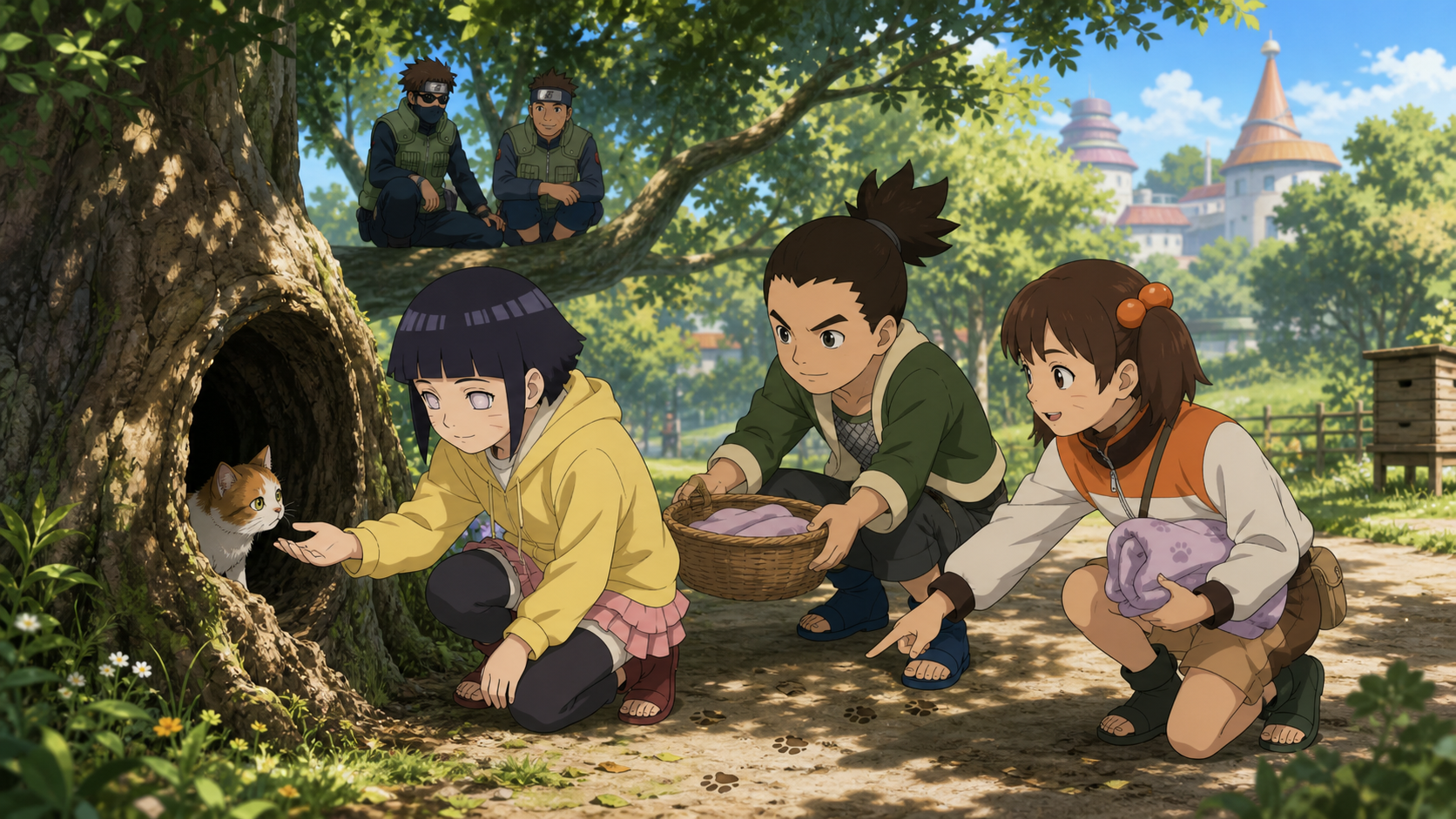
Himawari’s Ninja Trial Session
Himawari can outpace Ehō, use the Byakugan, and rescue a lost cat without owing Konoha a career decision before she has explored the rest of her future.
Series: Boruto: Naruto Next Generations
Episode: 154 · Himawari’s Ninja Trial Session
Arc: Himawari Uzumaki
Release: 2020-04-26
Previous: Episode 153 · Harmony in Gold
Directory: All 293 Boruto episodes
Bottom line
Boruto Episode 154, “Himawari’s Ninja Trial Session,” lets Himawari try shinobi life without demanding a career declaration before lunch. That uncertainty irritates Ehō because he has already built his identity around entering the Academy. Himawari outperforms him during physical exercises, admits she may choose another path, and becomes the target of his bruised pride during the lost-cat mission.
The episode’s best decision is allowing Himawari to remain undecided at the end. She enjoys training, uses the Byakugan effectively, notices danger, and helps repair a failing three-person team. Those strengths prove aptitude, not obligation. Naruto’s daughter and Boruto’s sister gets to ask what kind of life she wants before the village turns family power into another destiny assigned at birth.
Himawari walks through a village full of possible futures
Himawari passes Ino’s flower shop, Tenten’s weapons store, and other Konoha businesses while thinking about adulthood. The village offers more than one respectable path.
That opening matters because Naruto stories often treat the shinobi profession as the center of every meaningful life. Konoha also needs merchants, teachers, artists, farmers, medical workers, craftspeople, and civilians who do not carry weapons for the state.
Himawari’s uncertainty is not emptiness. She notices several kinds of work and has not yet decided which work feels like hers. A child exploring possibilities is doing the decision-making process correctly.
Hanabi offers experience instead of pressure
Hanabi gives Himawari a pamphlet for the Academy’s one-day trial session. The program exists for children who want to understand the curriculum before committing.
That invitation respects Himawari’s question. Hanabi does not point to the Byakugan and announce that a Hyūga must become a shinobi. She offers a structured experience with teachers, safety procedures, and age-appropriate exercises.
The trial creates evidence. Himawari can compare the idea of ninja life with the physical reality of training, teamwork, and mission responsibility.
Iruka remembers what the Academy is supposed to do
Iruka welcomes Himawari, Ehō Norimaki, and Yuina Itomaki. The small group attends because each child approaches the Academy from a different place.
Iruka explains that the session introduces interested students to Academy learning. The program does not require certainty as an admission price. Exploration is the purpose.
That educational philosophy fits Iruka. He knows children arrive carrying family names, grief, bravado, and incomplete ideas about the future. His work has always been helping them become people before measuring them as weapons.
The Hokage’s daughter enters as herself
Ehō and Yuina react when they learn Himawari is Naruto’s daughter. The title arrives in the room before her actual abilities do.
Himawari handles the attention without Boruto’s defensiveness or Tentō’s need to control the response. She participates, observes, and lets performance answer the curiosity.
The calm response does not mean the family name carries no pressure. Himawari has watched Boruto struggle beneath Naruto’s public image. She has also lived with the quieter expectation attached to Hinata’s Hyūga heritage. Her refusal to rush may be the healthiest response anyone in the family has produced.
The obstacle course wakes up Himawari’s competitive side
Shino leads the children through a physical course and tells them to proceed at their own pace. The instruction lasts about as long as three children standing beside a starting line can tolerate.
Ehō moves quickly. Himawari becomes energized, catches him, and finishes first. Her enjoyment looks natural rather than calculated. She likes using her body, solving immediate obstacles, and testing herself against another capable child.
The result surprises Ehō because effort and stated ambition form the center of his self-image. Himawari has not declared the same goal and still beats him. He reads her uncertainty as disrespect toward the work he values.
Talent creates a question, not an answer
Himawari’s physical performance confirms aptitude. She has trained with Boruto, lives in a shinobi household, and carries Hyūga potential. None of those facts decides what she must do with the aptitude.
Stories love converting gifted children into inevitable warriors. Real ability can support several lives. Fine vision, patience, coordination, and empathy would matter in medicine, craft, research, or countless civilian fields.
Himawari deserves the distinction Sarada learned in Episode 152. A family talent is an available tool, not a complete identity.
Tree climbing reminds everybody why teachers exist
Shino demonstrates chakra control by standing against a wooden surface and directing chakra through his feet. Ehō and Yuina fail. Himawari gets farther and also fails.
Shino jokes that teachers would have nothing to teach if the children mastered every exercise immediately. The line is gentle and important. Failure proves the class has a purpose.
Himawari does not collapse under the mistake because nobody told her the mistake threatens a declared dream. The trial format gives failure room to remain information.
Yuina studies because she has already chosen
Yuina explains that she wants to become a shinobi and has been learning about animal behavior and mission skills. Her preparation becomes useful during the lost-cat assignment.
The episode respects her certainty without using certainty to shame Himawari. Yuina knows what she wants right now and acts accordingly.
Her knowledge also prevents the team from becoming a contest between the two louder children. Yuina notices evidence, reads behavior, and gives the mission a practical route.
Ehō mistakes seriousness for ownership
Ehō trains with his grandfather and approaches the trial as a test of his future. He hears Himawari say she has not decided and feels that she is wasting an opportunity he values.
His frustration contains a recognizable insecurity. If an undecided child performs better, what does his commitment mean? Ehō protects the answer by declaring that commitment gives him more right to the space.
That conclusion is wrong. Seriousness does not grant ownership of education. The trial was designed for questions as much as certainty.
Anko gives them a mission, not another race
Anko assigns Himawari, Ehō, and Yuina to find a missing pet in Senju Park. The children receive emergency smoke signals and clear instructions to call for help if danger develops.
The assignment tests observation, cooperation, judgment, and responsibility. Catching the cat matters. Keeping three children safe matters more.
Anko emphasizes the three-person cell because the Academy is not auditioning solo performers. The trial asks whether they can share information and protect one another.
Yuina finds the first useful clue
Yuina identifies paw prints and reasons that a frightened house cat may seek dark, sheltered places. Her knowledge narrows the search.
Himawari praises her without feeling threatened. That response shows a team instinct before the team officially forms. She recognizes useful skill and encourages the person using the skill.
Ehō wants forward momentum, but Yuina gives the movement direction. The quietest participant becomes essential because the mission rewards attention more than speed.
Himawari realizes everybody else has a declared plan
Both teammates state that they intend to become shinobi. Himawari becomes self-conscious about being the only undecided participant.
The comparison distracts her from the search. She stops reading the environment and starts judging her presence in the group.
This is the social cost of treating certainty as moral superiority. Himawari came to learn. Now she wonders whether learning without a promise makes her dishonest.
Ehō throws one stone and creates a real safety test
Ehō tosses a stone while complaining, accidentally striking a beehive. The swarm forces the children to run.
Himawari reaches for the smoke signal because somebody could get hurt. Ehō tells her not to use the emergency tool because activation would mark the trial mission as a failure.
The disagreement exposes two definitions of success. Himawari prioritizes people. Ehō prioritizes the recorded result. A ninja who protects a passing score before protecting teammates has misunderstood the profession.
The smoke signal is not cowardice
Emergency procedures exist because missions can change faster than beginners can evaluate danger. Himawari’s instinct to request help follows the instruction Anko gave them.
Ehō sees the signal as surrender because he is desperate to prove readiness. That desperation makes him less ready. Judgment includes knowing when the assigned capability no longer matches the threat.
The bees eventually stop chasing them, but a safe outcome does not make Ehō’s objection correct. Luck should never become retroactive proof that risk was wise.
Ehō crosses the line
Ehō grabs and pushes Himawari while accusing her of treating the trial like play. He says he cannot work with somebody who has not decided to become a shinobi.
His fear does not excuse the physical behavior. He is allowed to care deeply about his future. He is not allowed to punish another child for approaching the program exactly as advertised.
The scene should feel uncomfortable. Himawari’s quietness often invites other characters to assume she will absorb whatever emotion they throw at her. Gentleness is not permission.
Himawari gets space to remember why she came
Left alone, Himawari thinks about her uncertainty. Iruka’s explanation of the trial matters because the program exists to help children learn whether the path fits.
She does not need a final answer to participate honestly. She needs to engage with the experience and fulfill her responsibility to the temporary team.
That realization lets Himawari return without apologizing for uncertainty. She can care about the mission before promising her entire future to the profession.
The cat mission rewards the skill combination
Yuina’s tracking knowledge, Ehō’s drive, and Himawari’s perception all contribute to locating the pet. The children work better once the argument stops determining every action.
Himawari’s Byakugan gives the search extraordinary range and detail, but the dōjutsu does not make Yuina’s clues irrelevant. Information guided the group toward the correct area. Visual power confirms and completes the search.
Ehō’s basket and willingness to help also matter once pride stops demanding leadership of every step.
Himawari’s Byakugan is powerful without becoming her destiny
Himawari activates the Byakugan deliberately enough to support the search. The ability is not only the frightening reflex that once knocked Naruto unconscious.
Control expands her choices. She can use the dōjutsu for rescue, observation, and nonviolent work. Those uses fit her temperament without reducing Hyūga power to combat.
The episode wisely refuses to say that controlled Byakugan use settles the career question. Power creates responsibility to understand the ability. Power does not require one employer.
Ehō learns that uncertainty did not make Himawari unreliable
Himawari returns to the team, uses her strengths, and completes the responsibility she accepted. Her uncertainty about adulthood never prevented commitment to the present mission.
Ehō has to separate those ideas. A person can be undecided about next year and reliable today. A person can declare a lifelong goal and still behave badly under pressure.
The trial measures what the children do together, not how confidently they announce their futures.
Boruto’s training appears through Himawari’s confidence
Himawari tells Yuina that she sometimes trains with Boruto. The detail gives their sibling relationship a useful dimension beyond household comedy.
Boruto’s attention has helped Himawari enter the trial with real physical and chakra foundations. He does not need to appear in every exercise for the influence to remain visible.
The training also challenges Boruto’s occasional assumption that Himawari needs only protection. He has already helped build her capacity to act.
The episode refuses the forced decision
After the trial, Himawari remains interested in several careers. She resembles Naruto when she enthusiastically lists possibilities, but her enthusiasm does not collapse into a final announcement.
Some viewers may find the ending evasive because later stories can still choose her path. I find the refusal honest. One day of enjoyable Academy exercises should not determine a child’s life.
The trial succeeded because Himawari gained information. She learned that she likes aspects of shinobi work, handles team responsibility well, and wants to keep exploring.
Hinata and Naruto should protect that freedom
Himawari carries enormous family symbolism. The Hokage’s daughter with a Byakugan can easily become a public project.
Naruto knows what a declared dream can provide, but his dream grew from loneliness, recognition hunger, and a specific political wound. Hinata knows how clan expectations can constrain a child’s identity.
Their experience should help them give Himawari what neither received consistently: time to choose without proving love, worth, or family loyalty through one profession.
A trial session should test the institution too
The children are evaluating the Academy while the Academy evaluates them. Teachers should ask whether instructions are clear, whether competition overwhelms cooperation, whether students feel safe asking for help, and whether one child’s aggression changes another child’s experience.
Himawari leaves with useful evidence because Iruka, Anko, and Hanabi create different windows into shinobi life. She sees physical training, chakra instruction, teamwork, uncertainty, and mission judgment. That breadth matters more than whether she finishes first.
The Academy also receives evidence. Ehō’s conduct shows how quickly commitment can become gatekeeping. Yuina’s knowledge shows that practical expertise may appear before combat talent. Himawari shows that undecided children can still participate responsibly.
A good trial does not sort children into winners and failures. A good trial reveals what support each child would need if enrollment becomes the next choice.
Ehō’s certainty is fear wearing a headband early
Ehō treats the shinobi path as already owned because another child’s uncertainty threatens the meaning he has attached to his decision. If Himawari can perform well without declaring lifelong commitment, effort no longer guarantees exclusive status.
That insecurity explains his behavior without excusing the grab, push, and accusation. Physical aggression is not leadership. Endangering a teammate to prove that emergencies happen is not realism. He creates the emergency he later uses to judge her.
The episode gives him a change in perspective after the cat mission, but learning privately is only half the repair. Himawari deserves a direct apology naming what he did. Yuina deserves one too because his obsession made the whole team less safe.
Children can grow from bad behavior. Growth becomes visible when the person harmed does not have to pretend the harm vanished.
Yuina’s knowledge deserves a future beyond supporting two louder children
Yuina studies animals, recognizes clues, and contributes the information that points the team toward the missing cat. Her skill is not decorative softness beside more obvious ninja talent. Tracking living creatures requires observation, patience, pattern recognition, and respect for behavior.
The episode could give her a stronger personal reason for choosing the Academy. Does she want to work with ninken, veterinary medicine, wildlife rescue, summoning contracts, or tracking teams? Certainty becomes more interesting when attached to a specific dream.
Yuina also models a version of readiness that Ehō overlooks. She prepares, listens, and uses what she knows without needing to dominate the group. Her confidence is quieter, but the mission would fail without her.
Himawari is the title character. Yuina should still leave the episode feeling like a child beginning her own story rather than a clue-delivery system.
Hinata knows exactly why talent cannot make this decision
The Hyūga marked children through birth, branch status, duty, and inherited technique. Hinata grew up under family expectations that treated gentleness as failure and combat aptitude as obligation. She understands the damage caused when adults confuse ability with consent.
That history makes her essential to Himawari’s choice. Naruto can protect time and opportunity. Hanabi can explain the shinobi path. Hinata can name why the Byakugan does not own the child who carries the Byakugan.
The episode leaves that conversation mostly implied. A direct mother-daughter scene could connect Himawari’s freedom to a family history where freedom was not equally available.
Choosing the Academy would not betray Hinata’s hope for a gentler life. Choosing another path would not waste Hyūga talent. Either decision can honor the family if the family honors the child first.
The Byakugan helps the team without solving the whole mission
Himawari’s eye gives the team extraordinary perception, but Yuina supplies animal knowledge, Ehō contributes effort, and the group still has to interpret what they find. The episode resists turning bloodline power into an automatic answer.
That balance protects Himawari as a character. Her inherited ability matters, yet judgment determines when and why she uses the ability. She activates the Byakugan in response to a real need rather than performing for the adults evaluating her.
Power revealing information does not decide what to do with the information. The smoke signal, regrouping, and cooperative rescue require choices.
If Himawari becomes a shinobi, that combination could define her: exceptional sight joined to a refusal to stop seeing the people around the target.
What works: the episode lets uncertainty produce attention
Himawari watches closely because she has not decided. She notices how lessons feel, how teammates behave, and what responsibility demands. Certainty might have encouraged her to perform the identity she already selected.
The trial format gives uncertainty a job. She is not waiting passively for inspiration. She gathers experience, tests assumptions, and learns what questions remain.
That approach offers a rare corrective in a franchise full of children announcing lifelong dreams before understanding the work. Ambition can be beautiful. Exploration can be responsible.
Himawari does not owe the village an immediate career decision because she performed well for one day. The adults’ best contribution is keeping education available while refusing to turn praise into pressure.
What Episode 154 gets right
The episode treats uncertainty as a valid reason to attend a trial. Himawari’s aptitude becomes evidence rather than a verdict. Yuina’s knowledge matters. Ehō’s commitment receives respect without excusing his hostility.
The pet mission tests actual ninja judgment. Observation, safety, emergency escalation, and teamwork matter more than flashy combat.
Himawari also retains her recognizable temperament. She is gentle without being passive, talented without showing off, and responsible without pretending she has every answer.
What could have gone deeper
Ehō’s physical aggression needed a clearer apology. Moving into successful teamwork does not automatically repair grabbing and pushing a teammate.
Yuina deserves more space as a person beyond her useful animal knowledge. Her certainty about becoming a shinobi could have contrasted with Ehō’s anxiety-driven version of certainty.
The episode could also show Hinata discussing the difference between Hyūga obligation and personal choice. Nobody is better positioned to understand that pressure.
RaeRae’s read
Himawari passes the trial before she decides whether to become a ninja. She passes because she uses the day for its real purpose: learning.
Ehō arrives with certainty and nearly fails the most important test by valuing a mission score above safety. Yuina arrives with preparation and turns knowledge into direction. Himawari arrives with questions and proves questions do not prevent courage, teamwork, or responsibility.
The village does not need another child drafted by talent and family history. If Himawari chooses shinobi life later, the choice should belong to her. Episode 154 gives her one good day of evidence and leaves the door open, which is exactly what a trial session owes a child.
Sources and lawful viewing
Official episode reference: Naruto Official episode guide
Licensed episode route: Crunchyroll licensed series page