
A New Path
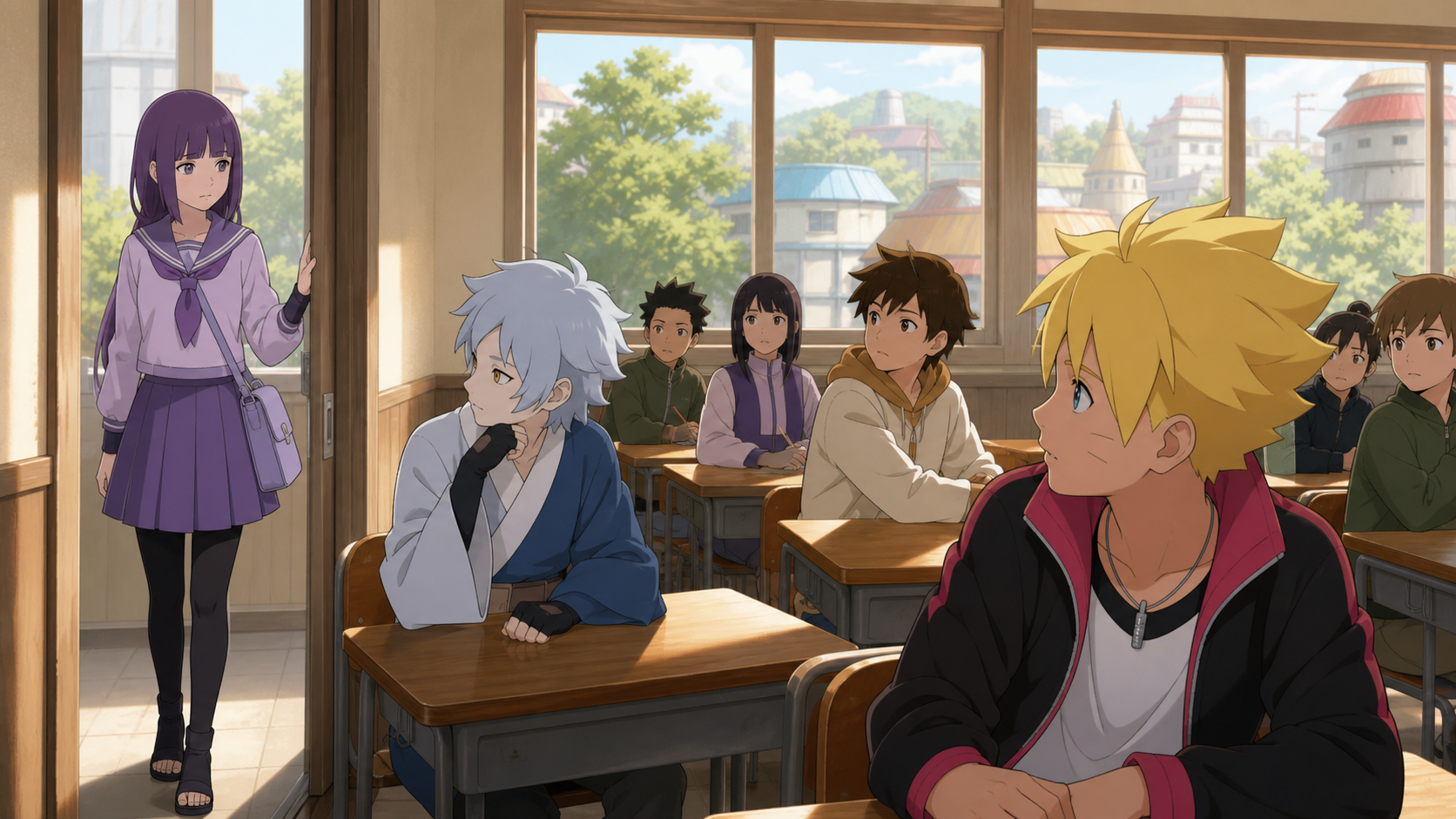
Sumire walks back into class, Boruto’s mysterious eye goes quiet, and Sasuke discovers that the Ghost Incident belongs to a much larger Ōtsutsuki warning.
Series: Boruto: Naruto Next Generations
Episode: 15 · A New Path
Arc: Academy Entrance
Release: 2017-07-12
Previous: Episode 14 · The Path That Boruto Can See
Directory: All 293 Boruto episodes
Bottom line
Boruto Episode 15 lets the Academy Entrance Arc breathe after fourteen episodes of possessed villagers, glowing chakra, secret Root experiments, and one enormous Nue trying to eat the village. That quiet is exactly why “A New Path” works. Boruto cannot make his strange eye activate again, Sumire has not returned to class, and everybody keeps pretending to discuss three-person teams while watching the empty Class Rep seat. The episode understands that the real ending was never Boruto winning a fight. The ending had to be Sumire walking back through the classroom door because she chose her classmates over the revenge her father planted inside her. I love that the reunion is awkward, loud, and immediately pulled into ordinary school chaos. Nobody delivers a perfect speech. Wasabi and Namida cry, Boruto beams, Mitsuki watches, and Shino looks like a teacher who has been holding his breath for weeks. Then the final minutes widen the entire series. Sasuke connects the Gozu Tennō to Kaguya, Toneri warns that gods are coming, and Momoshiki finally turns toward Earth. Boruto thought the Ghost Incident was his first finished mystery. The universe answers by showing him the front door of a much larger one.
Boruto keeps trying to summon an eye that has gone quiet
Boruto begins the episode staring into a mirror and bullying his own reflection like the eye owes him a repeat performance. Nothing happens. After weeks of seeing the dark chakra around possessed people and opening a path into Nue's dimension, the strange power simply refuses to clock in.
That frustration feels wonderfully like Boruto. He has already decided the eye is part of his skill set, so losing access feels less like a mystery and more like a personal insult. Boruto wants a button, a technique name, and preferably an audience. The eye gives him none of those comforts.
The silence also protects the power from becoming a cheap weekly solution. Boruto cannot scan every problem until a glowing trail appears. He has to keep paying attention with the ordinary eyes that got him through most of the crisis.
Konoha looks normal because the children carried the ugly part
Naruto, Sai, and Shikamaru walk through a peaceful village while discussing Sumire's confession. Shops are open. People move through the streets. Nothing in the scenery announces how close Konoha came to another disaster created by Danzō's leftovers.
Sai knows the hidden machinery because Root shaped his childhood too. His presence gives the conversation a weight the episode never needs to underline. Sumire was not born wanting to destroy Konoha. Her father handed her a mission, a seal, a creature, and a lifetime of grief dressed up as duty.
Naruto understands the part that matters most to him: children do not choose their parents, but they can choose friends. That thought is pure Naruto without copying one of his old speeches. Friendship did not magically erase the Gozu Tennō. Friendship gave Sumire a reason to stop following the only future her father ever described.
Shikamaru says the uncomfortable part out loud
Shikamaru warns that returning to the Academy may be hard for Sumire. He is not rejecting her. He is looking past the happy ending and noticing the classroom waiting on the other side.
Boruto and Mitsuki know the truth. Shino and the village leadership know more. Most of the class only knows that Sumire disappeared after the Ghost Incident. That gap creates awkwardness before Sumire even enters the building.
The episode does not turn Shikamaru into the cold adult standing against Naruto's compassion. He supplies the practical doubt Naruto tends to leap over. Sumire wants to return, but wanting does not guarantee an easy morning. Both men are right, and the story lets the difficulty sit between them.
Three-person teams become the funniest cover conversation possible
Shino announces trial teams of three so the students can test possible combinations before graduation. Everybody immediately begins negotiating like tiny clan diplomats.
Inojin, Shikadai, and Chōchō are already arranged as the next Ino-Shika-Chō formation because some family traditions apparently arrive with assigned seating. Iwabee and Denki have paired up, and Iwabee has already asked Sarada to join them. Boruto considers Metal Lee. Mitsuki, with absolutely no concern for subtlety, says he wishes Sumire could join them.
Boruto shushes him because the class does not know Sumire caused the incidents. Mitsuki's face carries the same innocent confusion he always wears after dropping something socially explosive. He understands secrets as information. Boruto has started understanding secrets as something that can hurt a person standing nearby.
The empty seat keeps winning every conversation
Sarada asks what everyone wants to know: when is Sumire coming back? Shino cannot give the class an answer, and the uncertainty changes the entire team exercise.
Nobody says Sumire's name every thirty seconds, but her absence shapes every possible group. The class had already built habits around Class Rep organizing, worrying, apologizing, and trying to keep Boruto from turning a normal day into a municipal incident. Her missing voice leaves a strange gap.
This episode feels honest about friendship among children. The class does not possess every fact, yet they know enough to miss her. Their concern does not need a complete briefing before becoming real.
Shino refuses to give up on another student
Shino visits Iruka because Sumire's return is not only a village-security decision. She is his student. He says he will watch over her if she comes back, and that promise lands harder after his own possession earlier in the arc.
Shino spent years feeling overlooked by Naruto's generation, and Boruto initially treated him like an embarrassingly dull teacher. The Ghost Incident forced the class to see how much loneliness he carried beneath the sunglasses. Now Shino recognizes a student who could easily disappear behind an official label.
His loyalty is not flashy. Shino does not storm a council chamber or threaten anybody. He keeps showing up, asks the necessary question, and makes clear that Sumire will have a teacher waiting if she chooses the Academy.
Naruto coming home early shocks Boruto more than the supernatural eye
Boruto finds Naruto home before the evening has vanished, and his surprise says everything about the Uzumaki household. A father arriving at a reasonable hour should not feel like a plot twist. For Boruto, the sight is unusual enough to stop him cold.
Their conversation about Sumire gives Naruto a chance to meet his son where Boruto already stands. Boruto does not need persuasion. He wants Sumire back. Naruto understands that desire because his entire childhood taught him what one open door can mean.
The scene stays small, which helps. Naruto is not addressing the village as Hokage. He is talking to a boy who refused to abandon a classmate in another dimension.
Sumire finally gets asked what future she wants
Shino meets Sumire and offers another place outside the village where she could take time to decide what comes next. His offer gives her a real choice. Nobody orders her to perform normality for the Academy, and nobody tells her exile is the only respectable answer.
Sumire chooses to return. That choice matters because her father's will controlled every major decision before the crisis. Even her gentle Class Rep personality began as camouflage. Walking back to school becomes one of the first futures Sumire selects for herself.
She is scared. Of course she is scared. The episode does not paint courage as the absence of dread. Sumire chooses the classroom while knowing every face may remind her of what nearly happened.
Inojin turns classified gossip into a school transfer theory
Inojin hears that Sai has files about other villages' academies and concludes Sumire may be transferred. The leap is ridiculous enough to sound exactly like students building a theory from one overheard adult detail.
Shikadai and Denki listen because uncertainty always makes bad information feel useful. Nobody has a direct answer, so fragments become a whole story before lunch.
The moment adds needed comedy without mocking Sumire. The joke belongs to the boys' detective work, especially Inojin acting as though access to his father's paperwork has made him an intelligence officer.
Capture the flag shows how quickly the class has grown
Shino returns the students to a flag exercise, echoing the earlier training that exposed how poorly they worked together. This time the class has history. They know one another's habits, strengths, and favorite ways to cause trouble.
Mitsuki helps Boruto reach the flag, and their coordination feels almost casual. The two boys have fought each other, investigated the Ghost incidents, entered Nue's dimension, and argued over whether Sumire should live. A classroom drill cannot reproduce those stakes, but the shared experience changes how they move.
The trial teams are supposed to predict future compatibility. Boruto and Mitsuki already look like a partnership the adults will eventually formalize, even if Sarada has not been pulled into that orbit yet.
Sumire's entrance is the emotional finish the arc needed
Shino steps away after receiving a message. When he returns, Sumire stands with him at the classroom door. The reaction arrives before anyone can overthink the situation.
Wasabi and Namida rush toward her. The room fills with relief. Boruto looks openly delighted because Boruto has never learned how to hide joy when somebody he cares about comes back. Sumire cries because the welcome confirms that the life she built at school was real, even though that life began under false pretenses.
The scene works because the class responds to the Sumire they knew. Their affection does not come from a formal ruling. They missed their friend.
Boruto earns no victory lap, which makes his role better
Boruto helped stop Sumire, yet Episode 15 never converts the reunion into applause for him. He does not stand at the front and explain her pain to everybody. He does not claim credit for changing her mind.
He watches her return and shares the happiness. That is enough.
Boruto's best moments throughout the Ghost Incident came when his loyalty outran his need to look impressive. He chased the truth because people were being hurt. He followed Sumire because he refused to accept Mitsuki's kill order as the only possible ending. The reunion belongs to Sumire, and Boruto allows the moment to remain hers.
Mitsuki has learned more than his mission expected
Mitsuki began the climax prepared to kill Sumire. Orochimaru sent him to investigate, and Mitsuki approached the assignment with the clean logic of someone taught to remove a threat before emotion complicates the work.
Boruto complicated everything. Sumire changed her choice. Nue protected her. The class welcomed her back. Mitsuki now has evidence that human bonds produce outcomes an order cannot calculate.
His quiet presence during the reunion fascinates me because Mitsuki is still studying Boruto as his sun. The light he follows is not raw power. Boruto keeps illuminating paths Mitsuki did not know were available.
The Gozu Tennō was never only a Root weapon
Naruto sends a shadow clone to meet Sasuke and hands over information about the Gozu Tennō. Sasuke recognizes a connection to Kaguya and believes the new evidence may help him reach her dimension.
That revelation changes the scale of the entire Academy Entrance Arc. Sumire's father used Root knowledge, but the underlying technique reached toward something much older and far more dangerous than Danzō's organization. A school mystery has brushed against the Ōtsutsuki problem Sasuke has been tracking beyond the village.
Boruto does not know any of this yet. The audience gets to feel the floor shift beneath a story that seemed safely resolved.
Sasuke apologizes to Sakura through Naruto again
Naruto asks Sasuke to stay in the village for a while. Sasuke declines, then asks Naruto to tell Sakura he is sorry before disappearing back into his mission.
Sir. Your wife is in the village. Your daughter is in the village. Naruto is not an apology delivery service.
The line is funny because Sasuke remains painfully Sasuke, but the humor has a bruise underneath. He is doing necessary work that protects everyone, and his family carries the daily cost of that absence. Episode 15 drops the issue lightly before the Sarada arc arrives to make the cost impossible to ignore.
Toneri confirms Boruto's eye belongs to a larger clock
On the moon, Toneri observes that Nue has been sealed and Boruto's eye will not appear for a while. He also warns that gods will descend upon the land again.
The scene answers Boruto's mirror frustration without giving him the answer. His power has not vanished. The eye is connected to events moving beyond his understanding, and Toneri knows enough to watch but not enough to prevent every threat.
That cosmic distance makes the ordinary classroom reunion feel precious. Sumire gets one peaceful return while forces across dimensions begin moving toward the children.
Momoshiki and Kinshiki turn the ending into a warning
Kinshiki reports abnormalities in Kaguya's world. Momoshiki decides to prepare for departure, and Boruto's first anime-original arc suddenly points straight toward the enemies who will define his next transformation.
The Ōtsutsuki pair do not need a long introduction. Their presence tells Naruto fans that Kaguya's history remains unfinished. Sasuke has been right to keep searching, and Konoha's peace rests beside a threat most residents cannot imagine.
Episode 15 closes one door and opens another without making Sumire's return feel disposable. The new danger does not erase the old victory. The children won a normal school day, and the ending shows how temporary normal can be.
The Academy Entrance Arc ends where Boruto truly began
This arc introduced Boruto as a talented, loud, resentful kid desperate to prove Naruto's shadow did not define him. Fifteen episodes later, his strongest achievement has nothing to do with defeating his father or displaying a famous technique.
Boruto noticed people. He saw Metal's panic, Shino's loneliness, Magire's obsession, and Sumire's hidden grief. The mysterious eye helped him locate chakra, but his attention made the information useful.
That distinction gives the arc a real identity. Boruto resembles Naruto, yet his early story is not a copy of Naruto's Academy years. He grows inside a full classroom, a modernizing village, and a family whose love is certain even when Naruto's time is not.
A new path belongs to more than Sumire
The title names Sumire's decision most directly. She rejects her father's revenge and returns to a life that was supposed to be a disguise. The title also fits Boruto, Mitsuki, Shino, and the entire class.
Boruto has to live without controlling his eye. Mitsuki has to consider answers beyond obedience. Shino discovers what kind of teacher he wants to become. The students start imagining future teams. Sasuke follows a new route toward Kaguya's dimensions. Momoshiki begins his journey toward Earth.
Everybody leaves Episode 15 facing a road that did not exist at the beginning of the arc.
The quiet classroom proves the crisis changed people even when Konoha looks unchanged
Konoha resumes traffic, work, and Academy lessons quickly because most residents never learned the full shape of the Ghost Incident. The students carry knowledge the public does not possess. They saw friends consumed by distorted chakra, followed a hidden system beneath the village, and learned that the Class Rep had been prepared as a weapon.
Ordinary routine therefore feels different. A team discussion cannot remain abstract after the class survived through cooperation. An empty seat cannot remain furniture after everybody understands why Sumire left. The village appears normal because children absorbed consequences adults classified away.
That imbalance deserves attention. Security may require limits around Gozu Tennō information, but silence can leave young witnesses processing danger alone. Shino's presence matters because he notices what the room is avoiding and keeps the possibility of Sumire's return alive.
Sumire returning is a choice toward accountability, not an instant erasure
Walking through the door does not undo the attacks, the deception, or the danger Nue created. Sumire returns knowing classmates may fear her and adults may continue monitoring her. The step matters because she chooses a future where other people can respond to what she did.
The class welcome is emotional without becoming a legal verdict. Wasabi and Namida can cry because their friend survived. Boruto can smile because the person he refused to abandon chose life. Those reactions do not require everybody to pretend the harm never happened.
Repair begins through ordinary participation: attending lessons, rebuilding trust, answering questions when appropriate, and developing an identity outside her father's command. The episode gives her a path rather than a clean slate.
Boruto losing access to the eye protects the mystery from becoming a convenient tool
Boruto repeatedly tries to activate the strange eye and receives nothing. The failure frustrates him because the ability shaped the entire investigation. He wants proof that the experience was real and control over the power that helped him see what adults missed.
The silence establishes a useful limit. Boruto cannot summon the eye whenever a problem needs hidden information. He has to develop judgment, observation, relationships, and ordinary shinobi skills while the larger ability follows rules he does not understand.
Toneri's warning confirms the eye belongs to a wider conflict without handing Boruto an instruction manual. Knowledge arrives in fragments, preserving danger around both the power and the forces noticing him.
Shino becomes a teacher by refusing to reduce Sumire to the worst file
Shino has reasons to feel betrayed. A student used the class environment to conceal a revenge plan, endangered peers, and connected the Academy to a Root weapon. He also knows children can be shaped by adults into roles they did not freely design.
His support does not mean removing boundaries. Shino believes education remains part of the answer. Sending Sumire away permanently would confirm her father's claim that no identity exists beyond the weapon.
The teacher chooses to keep a door open while the village handles security and consequence. That choice gives the entire class a model of accountability joined with continued human regard.
Mitsuki sees Boruto create an answer that obedience could not predict
Mitsuki entered Konoha with a mission and a framework built around observing Boruto. The Ghost Incident gives him evidence that Boruto's strength does not come only from power or strategic intelligence. Boruto changes outcomes by refusing the categories other people accept.
Sumire is enemy and classmate, perpetrator and victim, dangerous and worth saving. Mitsuki's original logic might choose the cleanest operational answer. Boruto keeps all the facts present and still reaches toward her.
That approach complicates Mitsuki's understanding of choice. If Boruto can reject an assigned conclusion, Mitsuki may eventually question whether his own path has to remain the one designed before he arrived.
Sasuke connects a local tragedy to the threat Naruto's generation never fully closed
The Gozu Tennō began with Root research and one father's revenge, but the underlying power reaches toward Kaguya's dimensions. Sasuke recognizes that the incident belongs to a larger pattern beyond Konoha's internal history.
His discovery prevents the arc from sealing Nue inside one villain's plan. Human institutions tried to weaponize forces they did not fully understand. The result now attracts attention from beings operating on a scale larger than the village.
Sasuke's separate investigation also shows the hidden labor supporting Naruto's peace. While the Academy returns to class, somebody must follow the dimensional evidence. Protection continues outside the public celebration.
Momoshiki and Kinshiki change the meaning of every small victory
The final reveal does not make Sumire's return insignificant. The cosmic threat makes ordinary bonds more valuable because those bonds determine what the characters will defend. Gods approaching Earth cannot replace the human work required inside one classroom.
Boruto's first arc taught him to notice invisible pain, trust classmates, and reject revenge presented as destiny. Those lessons will matter when power and inherited purpose arrive on a much larger scale.
The episode closes one path and opens another without pretending the stories exist separately. Root, Kaguya, Boruto's eye, Nue, Sasuke's mission, and Sumire's choice now occupy the same world.
Why Episode 15 stays with me
“A New Path” could have been a dry bridge between the Nue climax and the next storyline. Instead, the episode gives the first arc a human ending and a cosmic aftershock. Sumire comes back. Boruto fails to activate his eye. Shino keeps faith with a student. Sasuke discovers that the local crisis belongs to a much bigger mystery.
My favorite choice is still the classroom door. Boruto spends the arc chasing glowing evidence through streets, pipes, forests, and another dimension. The final answer arrives without a special effect. A frightened girl walks into class, sees that her friends saved a place in their lives, and chooses to stay.
That is the new path. Not a perfect pardon. Not a polished speech. A school day, a noisy welcome, and tomorrow waiting after the bell.
Sources and lawful viewing
Official episode reference: Naruto Official episode guide
Licensed episode route: Crunchyroll licensed series page