
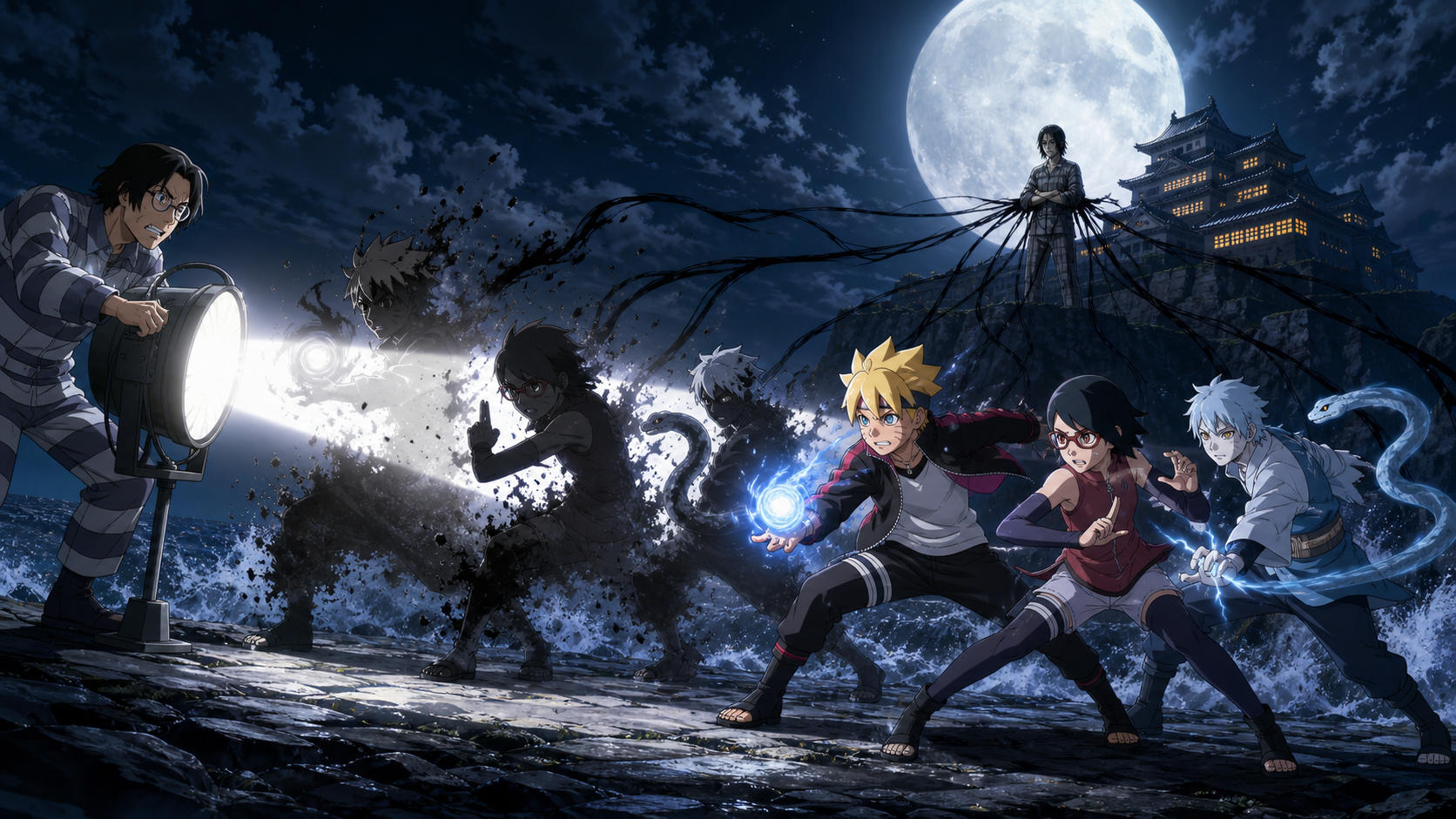
The Fateful Moonlit Battle
Kokuri breaks Tsukiyo’s moon-shadow advantage and preserves the Mujina notebook, but Team 7’s apparent rescue hides the arc’s cruelest loss.
Series: Boruto: Naruto Next Generations
Episode: 147 · The Fateful Moonlit Battle
Arc: Mujina Gang
Release: 2020-03-08
Previous: Episode 146 · Executing the Prison Break!
Directory: All 293 Boruto episodes
Bottom line
Boruto Episode 147 closes the Hozuki Castle escape with a gorgeous moonlit fight and one of the ugliest victories Team 7 has ever accepted. Kokuri does more than survive behind three young shinobi. He identifies the weakness in Tsukiyo's Moon Shadow Technique, protects Boruto from a lethal strike, operates the searchlight that dissolves the doubles, and hands over the notebook that can dismantle the Mujina Gang.
The episode then kills him where nobody can see. Tsukiyo pulls Kokuri into the sea, Shojoji uses the Corpse Clone Technique, and the person who swims back wearing Kokuri's face is the gang leader Team 7 was sent to identify. Boruto, Sarada, and Mitsuki believe they rescued their client because the replacement carries his appearance, memories, and swimming ability. The mission succeeds on paper while the human being at the center disappears beneath the water.
That ending changes the entire arc. Every earlier conversation about trust becomes darker because the final deception is not caused by Team 7 refusing to believe Kokuri. They believe him completely. Shojoji weaponizes that earned trust, and the episode lets the audience understand the loss while the characters celebrate a result that never happened.
Tsukiyo reaches the shore before the boat
Team 7 has escaped the prison walls and reached the moonlit shoreline, but the supply boat has not arrived. Tsukiyo steps into the gap between freedom and transportation.
Benga removed his Heavenly Prison seal before dying, which restores full access to his chakra. The chief guard's last corrupt bargain therefore survives longer than he does.
The confrontation proves that crossing the wall was only one part of escape. Hozuki Castle's failures follow the fugitives outside through the person Benga deliberately released.
Mitsuki blocks the first strike at Kokuri
Tsukiyo attacks Kokuri through shadow, and Mitsuki intercepts the technique. Team 7 immediately understands that protecting the client remains the priority.
The response matters because a spectacular enemy can pull attention toward combat pride. Mitsuki does not chase the strongest opponent for personal victory. He blocks the path to the person who cannot defend himself.
Kokuri still refuses to remain passive once the fight develops. His observations become the strategy that combat skill alone cannot provide.
Sarada recognizes a familiar shadow principle
Sarada compares Tsukiyo's ability to the Nara clan's Shadow Imitation Technique. The comparison gives Team 7 a starting model without pretending the techniques are identical.
Nara shadows restrain and mirror movement. Tsukiyo's Moon Shadow Technique produces combat doubles capable of using versions of the genin's own jutsu.
Sarada's knowledge helps the team ask the right question: where does the technique draw power, and what breaks the connection?
The full moon gives Tsukiyo his battlefield
Tsukiyo explains that moonlight brings the technique to maximum strength. The setting is not decorative atmosphere. The full moon functions as an environmental power source.
He creates shadow versions of Boruto, Sarada, and Mitsuki. Each double matches the original closely enough that a direct fight becomes a battle against the team's own abilities.
Tsukiyo chooses the shoreline because open moonlight removes the cover that could weaken his control.
Fighting equal copies creates a losing equation
Team 7 attacks the shadows and discovers that equal techniques produce stalemate. When they try to bypass the doubles and strike Tsukiyo, the shadows intercept them.
The originals tire. The copies keep applying pressure. Even if both sides spend chakra, Tsukiyo controls the pace and can continue targeting Kokuri while the genin fight themselves.
The setup works because strength is not the solution. Team 7 needs to change the conditions that make equality possible.
The copies expose Team 7's habits
Boruto faces the speed and directness he normally trusts. Sarada confronts her own precision. Mitsuki meets techniques designed around his flexible, unpredictable movement.
The shadows are not deep psychological doubles, but the fight still forces each genin to feel how an opponent experiences their favorite patterns.
A better version of the choreography could have crossed the matchups, letting Sarada solve Boruto's habits or Mitsuki counter Sarada. The episode keeps each hero beside the matching copy, which makes the visual clear but limits the tactical conversation.
Kokuri prepares for death through information
Kokuri believes Tsukiyo may kill him before the boat arrives. He gives Boruto a notebook containing everything he knows about the Mujina Gang.
That handoff is his most important act. He cannot guarantee personal survival, so he separates the mission's intelligence from his body. Shojoji may silence the witness, but the notebook can still reach Konoha.
Kokuri has spent the arc fearing death. Preparing evidence is not surrender. The notebook ensures that fear does not erase his decision to expose the gang.
The guards discover Benga's body
Inside the prison, guards find Benga dead. His attempt to conceal the breakout has created a crisis that can no longer be managed through his orders.
The discovery finally justifies outside intervention, but Team 7 remains beyond the walls with Tsukiyo. Institutional recognition arrives after the people in danger have solved most of the emergency themselves.
Benga's death also removes the person who could explain why Tsukiyo's seal was released.
Searchlights reveal the weakness by accident
Prison guards turn searchlights toward the shore while looking for escapees. Kokuri notices that the shadow connections avoid the artificial light.
The observation is excellent because the clue enters through normal prison procedure. Nobody announces a secret rule. The technique responds visibly to a different light source, and Kokuri pays attention.
Moon-made shadows cannot maintain the same form under the searchlights. Tsukiyo recognizes the danger and attacks the operators with lightning.
Tsukiyo attacks the evidence before the heroes understand
Taking down the searchlights confirms Kokuri's theory before Team 7 fully processes the pattern. Tsukiyo reveals the weakness by urgently removing the light.
Villains often lose because they explain too much. Here, his defensive reaction provides the clearest explanation.
Kokuri reads motive as evidence. If the searchlights were irrelevant, Tsukiyo would not spend chakra destroying them during a fight he already controls.
Kokuri protects Boruto from his own shadow
Boruto's shadow attacks, and Kokuri intervenes. The non-shinobi client places himself between a trained fighter and a technique capable of killing him.
The action completes his movement from guarded witness to active teammate. He no longer measures every choice only by personal survival.
Kokuri's courage remains grounded. He is terrified, physically outmatched, and still decides that watching Boruto die would be worse than taking the risk.
Sarada creates cover instead of chasing damage
Sarada punches the ground and raises dust around the battlefield. The smokescreen hides movement long enough for the team to reposition.
Her strength changes the information environment rather than merely producing a crater. Tsukiyo and the shadow doubles lose clear sight while Team 7 knows the next objective.
The choice reflects the team's growth. They stop trying to overpower equal copies and create a route for Kokuri to reach the light.
Prison guards become targets of the shadows
Guards reach the shoreline and encounter Tsukiyo. He turns the shadow doubles against them, expanding the danger beyond Team 7.
The guards entered expecting fugitives. They find a released gang lieutenant using a warden's revoked authority against everyone nearby.
Hozuki Castle's attempt to restore order collides with the consequences of Benga's private deal.
Kokuri names the actual rule
Kokuri explains that the Moon Shadow Technique depends on moonlight and loses form under another strong light source.
He cannot perform the attack that defeats Tsukiyo, but he identifies the condition that makes any attack possible.
This is why his background matters. Accountants survive through patterns, inconsistencies, and flows. Kokuri reads the battlefield the same way he once read money moving through suspicious accounts.
Team 7 turns the fight into a distraction
Boruto, Sarada, and Mitsuki attack the shadows and Tsukiyo together, creating enough noise and movement to hide Kokuri's route toward a surviving searchlight.
The team accepts that the visible fight is not the decisive action. Their job is to buy seconds for the least powerful person on the field.
Kokuri reaches the controls and directs the beam across the shadow connections.
Artificial light breaks the moon's copies
The searchlight dissolves the three shadow doubles. Moonlight remains across the shore, but the concentrated artificial beam interrupts the condition Tsukiyo needs.
The solution is simple after Kokuri identifies the pattern. Simplicity does not make the deduction cheap. The episode spends the fight showing what the shadows avoid and why Tsukiyo targets the lights.
Team 7 finally faces one exhausted opponent instead of three copies of themselves.
Tsukiyo's shadow sword survives the searchlight
Tsukiyo forms a sword from his own shadow, and the weapon does not disappear under the beam. His personal technique follows different rules from the copied shadows.
That distinction keeps the climax from ending with a switch. Kokuri removes the unfair numbers, but Team 7 still has to defeat the man controlling them.
Tsukiyo remains physically dangerous even after his greatest environmental advantage disappears.
Three teammates create one finishing attack
Mitsuki and Sarada accelerate Boruto toward Tsukiyo. The combined movement gives Boruto enough force and speed to throw him over the cliff.
The finish belongs to all three. Mitsuki supplies control, Sarada adds power, and Boruto becomes the point of impact.
Their teamwork answers the shadow copies. Tsukiyo duplicated individual abilities. He could not reproduce the choices three people make for one another in the moment.
Tsukiyo uses his fall to reach Kokuri
Tsukiyo lands on a rock below the cliff instead of falling directly into the sea. He grabs Kokuri, the rock breaks, and both men plunge into the violent current.
Boruto wants to jump after them. Mitsuki stops him because the water is too dangerous for a blind rescue.
The restraint is brutal but necessary. One more body in the current would not guarantee Kokuri's survival.
The returning face gives Team 7 the wrong relief
Kokuri emerges from the sea and reminds the team that swimming is his specialty. He says Tsukiyo exhausted himself and drowned.
The explanation matches facts Team 7 already knows. Kokuri survived a waterfall, described swimming ability earlier, and has every reason to look shaken.
Shojoji's deception works because the lie is built from true memory. The team is not careless for recognizing their client.
Sai arrives with the outside response
Konoha shinobi and prison guards reach the shore. Sai explains that Naruto grew concerned after losing contact with Mujo and coordinated with Kusagakure.
The response proves that outside safeguards existed, but communication delay made them function too late to prevent the prison break, Benga's death, or Kokuri's loss.
Boruto gives Sai the notebook. Kokuri's evidence reaches Konoha even though Shojoji now wears his face.
The notebook makes Kokuri's final choice survive
Shojoji cannot undo the handoff without revealing himself. Boruto already controls the intelligence Kokuri gathered.
That detail saves the arc from making his death meaningless. The mission fails to rescue the person, but his decision damages the organization that killed him.
Kokuri's legacy is not a speech about bravery. The legacy is a physical record now held by people with authority to act.
The Corpse Clone twist is horror, not clever disguise
The final reveal shows that Shojoji consumed Kokuri and copied his body, memories, and abilities. Tsukiyo was another stolen identity.
The technique violates more than appearance. Shojoji turns a victim's history into camouflage, using Kokuri's swimming memory and familiar speech to receive protection from the people who tried to save him.
Team 7 escorts the killer away from the prison because every human signal says their friend survived.
Kokuri’s notebook is evidence work performed under a death threat
Kokuri knows that survival is uncertain, so he separates the information from his body. The notebook can move even if he cannot.
That choice deserves recognition as active resistance. He records financial and operational details, protects the material through prison violence, and gets the evidence into Boruto’s hands during the narrowest window available.
The mission should therefore credit him as the source rather than treating the notebook as loot recovered by Konoha. Investigators need to preserve handwriting, page order, transfer history, and every detail identifying how Kokuri obtained the records.
Evidence becomes part of his testimony after death. The village owes his name a place in the case he helped build.
Corpse Clone turns relationship into an authentication vulnerability
Shōjōji does not copy a face alone. He copies memories and embodied knowledge well enough to swim, respond, and inhabit Kokuri’s trust network.
Team 7’s failure to recognize him is not proof that their friendship was shallow. The technique defeats the signals human beings normally use to recognize one another.
That horror creates a practical lesson. High-risk extraction needs verification outside memory: code phrases established before separation, medical seals, chakra signatures, paired witnesses, or questions whose answer is held separately from the protected person.
Security cannot eliminate trust. Security can stop one stolen body from carrying the entire burden of proof.
The prison’s emergency failure belongs in the final report
Benga’s corruption caused immediate damage, but the institution made his control possible. Mujo’s absence left an unstable command structure. External support arrived only after prisoners, guards, and Team 7 had already crossed multiple lethal thresholds.
A secure prison holding dangerous shinobi needs redundant emergency channels, independent oversight, protected medical access, and a way for staff to report command abuse without routing the report through the abusive commander.
Sai’s arrival shows that Konoha possessed the capacity to help. The question is why communication and authorization failed until the crisis reached the shoreline.
Calling the operation a difficult success would hide institutional choices that made the difficulty worse.
Team 7 wins the tactical fight and fails the protection objective
The combined finishing attack is earned. Sarada creates visibility and cover, Mitsuki controls space, Boruto applies force, and Kokuri operates the light that dismantles the copies.
Combat success can still coexist with mission failure. The assigned person dies. The killer exits inside his identity. Team 7 escorts the threat toward safety.
That contradiction should shape the debrief. Praising teamwork is appropriate. Examining extraction procedures is mandatory. The young shinobi should not carry sole blame for a technique nobody briefed them to expect, but the organization must learn from the failure.
A mission report that records only captured evidence and defeated enemies would repeat the exact erasure Kokuri feared.
Artificial light defeats the moon without making the solution arbitrary
Tsukiyo’s technique depends on a specific light source and shadow relationship. The searchlights change the environment rather than overpowering every copy individually.
Kokuri notices the rule because he watches what happens instead of trying to dominate the battlefield. Sarada turns observation into a plan. The group then protects the physical mechanism long enough for the plan to matter.
That sequence respects intelligence as action. Nobody produces a surprise immunity or a larger reserve of chakra. The team changes the conditions supporting the enemy’s advantage.
The surviving shadow sword prevents the weakness from becoming an instant victory button. Understanding one rule creates an opening; the team still has to fight through what remains.
Tsukiyo’s fall is a second attack, not an accident
Once defeat becomes likely, he uses his own movement toward the water to reach Kokuri. The action shows that destroying evidence matters more than preserving the operative.
Team 7 focuses on the visible battlefield because the apparent finishing moment invites relief. Tsukiyo exploits that emotional beat.
Protection missions need a rule for the seconds after a target falls. Secure the client, restrain the attacker, confirm the environment, and maintain observation until identity and medical checks are complete.
The episode punishes premature closure. The fight ends before the danger ends, and the gap costs the person who had least power in the entire operation.
The post-rescue medical check could have exposed the substitution
Kokuri was dragged underwater, injured during the escape, and subjected to extreme physical stress. Even without fear of Corpse Clone, immediate medical assessment should follow.
A medic could compare old records, injuries, chakra patterns, blood, scars, and physiological responses. Shōjōji may copy memories and appearance, but the technique needs an explicitly tested boundary. The extraction team never looks because relief replaces procedure.
Medical care should not become suspicion disguised as treatment. Kokuri genuinely needed care. The same examination could protect his health and provide independent confirmation that the person leaving custody remained the person Konoha promised to extract.
The failure belongs to the operation, not only the genin. Adults designed a mission where three young shinobi had to fight, evacuate, authenticate, preserve evidence, and manage trauma without a dedicated medic or identity specialist.
What worked for me
Kokuri drives the solution. He notices the searchlight behavior, protects Boruto, operates the beam, and preserves the notebook. The episode refuses to make his lack of combat power equal uselessness.
The Moon Shadow Technique creates a beautiful and readable threat tied directly to the environment. Artificial light defeating moon-made doubles feels logical rather than arbitrary.
The ending also carries real consequence. Team 7 can win a fight and still fail the person they promised to protect.
What needed more room
The episode moves quickly past the notebook handoff before revealing why that moment was Kokuri's final safeguard. A little more attention to his fear would deepen the later loss.
The shadow matchups could have crossed opponents to show how teammates understand one another's habits. Fighting exact doubles creates clarity but limits tactical variety.
The Konoha response arrives with enough force to expose how avoidable the crisis might have been if Mujo had a secure emergency channel.
The verdict
"The Fateful Moonlit Battle" gives the Hozuki Castle arc a victory that hurts. Kokuri solves the shadow technique and gets the Mujina notebook into Boruto's hands. Team 7 defeats Tsukiyo through combined strength. Sai arrives with official support.
The person they were sent to protect is still dead. Shojoji turns his body and memories into an exit pass, and Team 7 cannot recognize the substitution because trust has finally become complete.
Kokuri does not vanish without consequence. His notebook survives him. That evidence becomes the part of the mission Shojoji cannot swallow, copy, or drag beneath the moonlit water.
Sources and lawful viewing
Official episode reference: Naruto Official episode guide
Licensed episode route: Crunchyroll licensed series page