
Hiashi’s Birthday
Boruto goes hunting for a birthday present and discovers why Hiashi values ordinary family time after a lifetime shaped by clan fear, Neji, and regret.
Series: Boruto: Naruto Next Generations
Episode: 138 · Hiashi’s Birthday
Arc: Hyuga Family
Release: 2019-12-29
Previous: Episode 137 · The Samurai Exchange Student
Directory: All 293 Boruto episodes
Bottom line
Boruto Episode 138 turns a birthday present into a reckoning with the Hyuga family’s history. Boruto cannot figure out what Hiashi wants because the grandfather he knows does not match the man everyone describes. Hiashi spoils Boruto and Himawari, yet older relatives remember a rigid clan head who enforced rules capable of destroying his own family. Boruto goes looking for a gift and discovers that his grandfather’s softness was learned through grief, shame, Neji, and Naruto.
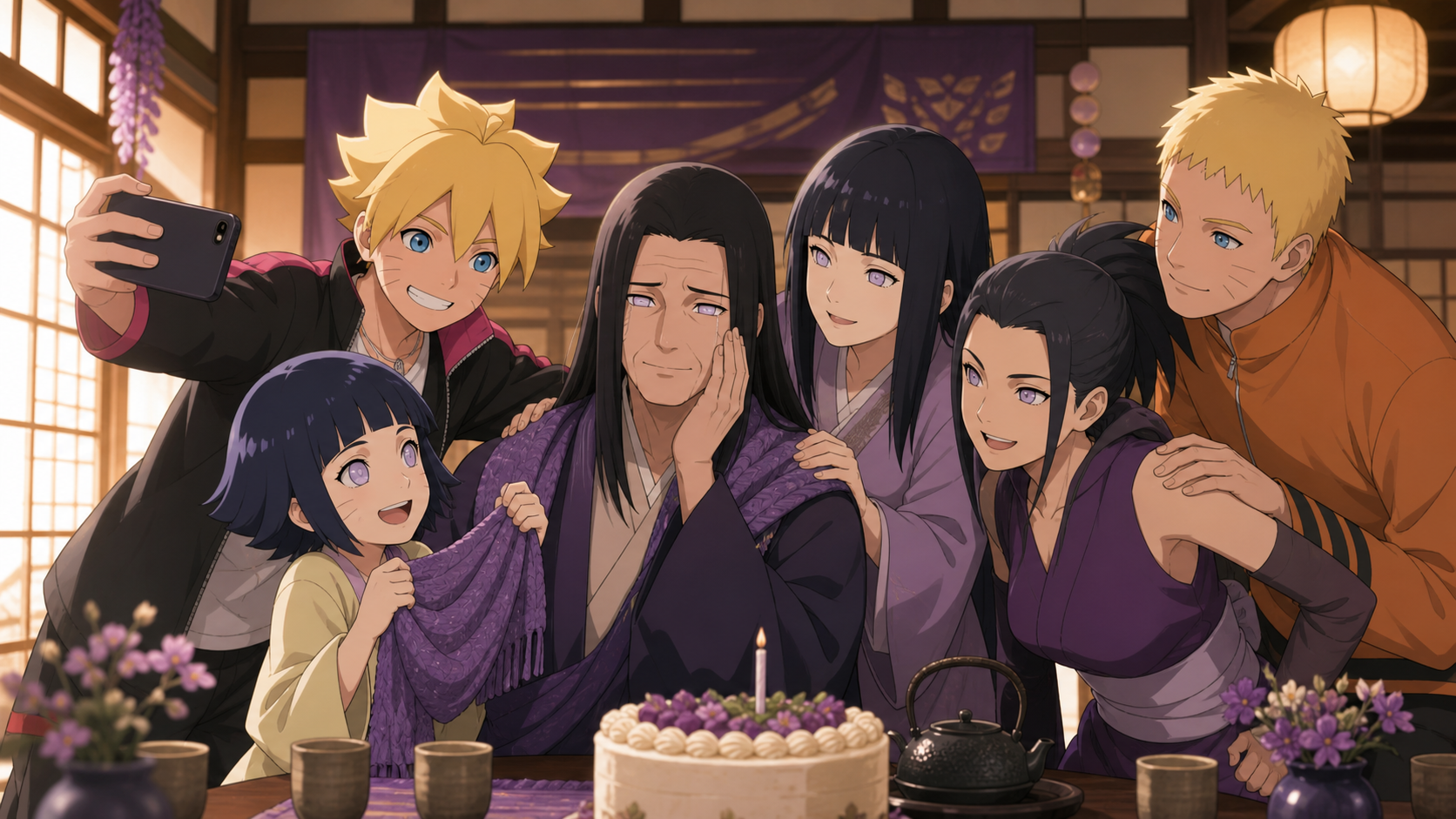
The family photo is the right answer because Boruto does not buy Hiashi another object. He gives Hiashi proof that the family survived long enough to become happy together. That photograph includes people whom the old Hyuga system would have separated by rank, duty, and fear. Hiashi can look at Hinata, Hanabi, Naruto, Boruto, and Himawari without asking who belongs to the Main House or who owes obedience to whom.
The episode is warm, but the warmth does not erase what Hiashi did. His tenderness with his grandchildren matters because change matters. His gratitude toward Naruto matters because Naruto helped Neji challenge the lie Hiashi had accepted. Forgiveness becomes meaningful only when the story remembers the harm beneath the birthday cake.
Boruto knows two versions of his grandfather
Boruto’s problem begins with contradiction. The Hiashi he visits is affectionate, attentive, and almost comically eager to spend time with his grandchildren. The Hiashi described by adults was strict enough to intimidate nearly everyone around him.
Children often meet a version of an elder that the elder’s own children never received. Grandparents may have more time, less fear, fewer responsibilities, or enough regret to understand what discipline cost the first generation. That later gentleness can be beautiful. The same gentleness can hurt the adult child who remembers begging for warmth that appeared only after childhood ended.
Boruto does not carry Hinata’s memories, so he approaches the mystery with curiosity instead of resentment. His confusion protects the episode from becoming a simple condemnation. The boy wants to know who Hiashi is, not gather evidence for a verdict he already chose.
Hanabi recognizes loneliness beneath Hiashi’s dignity
Hanabi suggests the birthday party because she notices that Hiashi has been down after spending less time with Boruto and Himawari. She reads the emotion behind his formal posture, which tells us how much their relationship has changed.
As a child, Hanabi was positioned as Hinata’s rival and possible replacement. Her talent became part of a clan decision about worth. Affection could never remain separate from succession while the Main House treated daughters as competing heirs.
Adult Hanabi can now tease her father, plan a celebration, and name his need for family contact without fearing that vulnerability will weaken the clan. That ease is one of the quietest signs that the Hyuga household has become healthier. Peace is visible in who gets to speak casually at home.
Mitsuki asks the question Boruto missed
Boruto tells Mitsuki that Hiashi used to be strict but now dotes on his grandchildren. Mitsuki immediately asks what caused the change. The question sounds obvious once spoken, yet Boruto had accepted both descriptions without connecting them.
Mitsuki often examines human behavior as a sequence of causes. His outsider perspective can feel clinical, but here the approach helps. A personality does not transform because the calendar advances. Something happened. Someone challenged Hiashi’s beliefs. Someone paid a cost large enough to make the old rules impossible to defend.
Boruto’s search for a present becomes a search for that cause. The episode gains weight when the shopping problem opens a family history Boruto inherited without understanding.
Gatai mistakes restraint for weakness
Gatai boasts at Lightning Burger that Hiashi is afraid to face him. Boruto cannot tolerate the insult because his grandfather’s reputation feels personal. The scene exposes Boruto’s own relationship with strength.
Boruto knows Hiashi possesses overwhelming Byakugan skill and Gentle Fist experience. Hearing a stranger confuse restraint with fear sounds absurd. Boruto responds by proving the family name through combat, which repeats the exact logic Hiashi has learned to distrust.
Gatai is not a sophisticated antagonist. He exists as a loud demonstration of how pride recruits pride. One man boasts, one grandson answers, and public damage begins because neither wants to let another person control the story people will tell about him.
Boruto defends Hiashi by ignoring Hiashi’s values
Boruto easily evades Gatai and becomes increasingly angry as the confrontation continues. His skill is never the real problem. His reason for fighting is.
He believes loyalty requires an answer to disrespect. That impulse feels recognizable for a child raised around shinobi legends and clan reputations. Boruto loves Hiashi, so he treats the Hyuga name as something he must defend immediately.
Love can still become possession. Boruto wants to decide which public opinion Hiashi should tolerate. The grandfather has already chosen not to answer Gatai with violence. Boruto overrides that choice because defending Hiashi’s image feels more urgent than respecting Hiashi’s judgment.
Hiashi stops the duel without humiliating Boruto
Hiashi arrives after hearing that the Hyuga name was invoked in a challenge. He could scold Boruto in public or crush Gatai to restore authority. Instead, he accepts responsibility for failing to teach Boruto enough about the consequences of violence.
That response shows genuine change. The old Hiashi relied on hierarchy. The current Hiashi begins with his own responsibility as an elder. He does not pretend Boruto’s choice appeared from nowhere.
Gatai backs down when Hiashi accepts the challenge, proving that the boast depended on never facing the person being mocked. Hiashi wins without striking. The restraint is not passivity. He controls the field through presence, reputation, and a refusal to feed the argument.
Power and fear once governed the Hyuga clan
Hiashi tells Boruto that settling conflict through power and fear creates tragedy and resentment. Those words are not a general peace slogan. Hiashi speaks from inside a clan that institutionalized both.
The Caged Bird Seal gave the Main House control over Branch House bodies. The system framed coercion as protection of the Byakugan and preservation of clan order. Neji grew up carrying a literal mark of subordination. Hizashi died inside a political arrangement shaped by that hierarchy.
Hiashi helped maintain the structure. His later regret cannot make the seal harmless or return Hizashi and Neji. The episode works because his warning carries the weight of participation. Hiashi knows where fear leads because he once called fear necessary.
The Hyuga Affair is not distant family gossip
Kurenai explains the Hyuga Affair after recognizing what Boruto needs to understand. Her hesitation matters. She is discussing trauma inside another family, including the death of Hinata and Hanabi’s uncle and the resentment inherited by Neji.
The Hidden Cloud attempted to abduct Hinata to obtain the Byakugan. Hiashi killed the kidnapper. The resulting demand for Hiashi’s body was answered through Hizashi, his twin brother from the Branch House. Political peace was purchased through a system that already treated one brother as more disposable.
No birthday article about Hiashi should skip that history simply because the present scene is sweet. The grandfather crying over a photograph is the same man who lived through and upheld choices that taught Neji fate could not be escaped.
Kurenai provides memory without taking ownership
Kurenai knew Hinata as her team captain and watched the young girl grow beyond the limits her family assigned. She can give Boruto context, but she does not pretend to own every private truth in the Hyuga household.
That boundary is respectful. Adults often tell children simplified stories about family because full truth feels dangerous. Kurenai offers enough for Boruto to understand the shape of Hiashi’s regret without turning another family’s wounds into entertainment.
Her presence also reconnects Hinata’s generation to the current story. Boruto knows his mother as a parent. Kurenai remembers a girl who struggled to speak, trained despite rejection, and found courage beside Team 8.
Neji changed Hiashi before Naruto received the thanks
Hiashi later thanks Naruto for changing Neji, himself, and the Hyuga clan. The gratitude is sincere, but Neji must remain a person rather than a bridge in another man’s redemption.
Naruto challenged Neji’s belief in fixed destiny during the Chunin Exams. Neji then chose how to live after that challenge. He rebuilt relationships with Hinata and Hiashi, fought for the village, and eventually died protecting Naruto and Hinata.
Hiashi’s transformation came through witnessing Neji’s pain and choices. Naruto opened a door, but Neji walked through a life the clan had tried to define before he could speak. Hiashi’s gratitude should include the uncomfortable fact that Neji had to become extraordinary before the Main House fully recognized his humanity.
Hinata’s quiet presence carries the longest memory
Hinata participates in the birthday celebration without turning the evening into a confrontation about her childhood. That restraint fits her, though the episode leaves much of her perspective unspoken.
She remembers being judged as an unworthy heir, compared with Hanabi, and removed from succession. She also knows the grandfather who adores her children. Those truths can coexist without canceling each other.
I wanted one private moment that belonged to Hinata and Hiashi. Boruto receives the history from Kurenai, while the daughter who lived under Hiashi’s old expectations remains mostly inside the family tableau. Healing should make room for her words, not only her willingness to attend.
Himawari’s scarf offers uncomplicated affection
Himawari gives Hiashi a scarf, and the gift suits their relationship. She made or selected something warm because she wants her grandfather to feel cared for. No investigation or historical revelation is required.
Her ease around Hiashi demonstrates how far the family environment has moved. Himawari can climb into his attention without calculating rank. She does not know the household as a competition between sisters or branches.
That innocence was purchased by older people finally changing the rules. Children should not have to carry gratitude for receiving ordinary safety, but the audience can recognize how extraordinary ordinary affection would have seemed to Neji and young Hinata.
Boruto chooses a photograph instead of a purchase
Kurenai helps Boruto understand that Hiashi values time with his grandchildren because the past taught him how easily family can be lost. Boruto answers with a photograph of the family happy together.
The choice is sharp because a photograph records relationships rather than possessions. Hiashi cannot use wealth or authority to manufacture the moment. Everyone has to agree to stand close enough for the image.
The photograph also freezes a version of the Hyuga family that the old clan hierarchy could not imagine: Naruto, once treated as a village disgrace, stands as Hiashi’s son-in-law and Hokage. Hinata stands without being measured against Hanabi. Their children belong without seals, succession tests, or Branch House status.
Hiashi’s tears are grief as much as happiness
Hiashi becomes emotional when Boruto explains the gift. The tears work because the image holds absent people too. Hizashi and Neji cannot join the photograph. Their absence remains inside every happy face Hiashi gets to keep.
Regret often arrives when a person finally reaches safety and can see how much earlier suffering was unnecessary. Hiashi has grandchildren who run toward him. He has daughters who can celebrate together. He has a son-in-law he respects. The life in front of him proves that control was never the only way to protect the clan.
The scene does not need a grand apology speech. Hiashi’s reaction tells us that the photograph is both gift and evidence.
Tea with Naruto closes the generational circle
After Hinata and the children sleep, Hiashi asks Naruto whether the photograph was his idea. Naruto says Boruto chose the gift himself. Hiashi then thanks Naruto for changing Neji, Hiashi, and the clan.
The conversation is quiet enough to feel earned. Naruto entered the Hyuga story as a loud child refusing Neji’s fatalism. Years later he makes tea in the family home as Hiashi’s son-in-law. The outsider became family without surrendering the beliefs that once made him unacceptable.
Naruto also understands the cost of missed family time. His Hokage duties have already damaged birthdays in his own house. Hearing Hiashi value ordinary time should land as a warning as well as gratitude.
Hinata deserves to narrate the change she had to survive
Boruto sees a gentle grandfather. Hinata remembers the father who judged her as weak, compared her to Hanabi, and raised both daughters inside a clan hierarchy backed by the Caged Bird Seal.
Her quiet acceptance matters, but silence asks viewers to infer too much. She should be allowed to say what Hiashi repaired, what remains painful, and which boundaries made a relationship possible.
Forgiveness does not require pretending the original harm was smaller. A changed parent can receive love while the adult child keeps an honest memory.
The birthday would become richer if warmth included the person who paid the greatest childhood cost for Hiashi’s old worldview.
Hanabi inherited status inside a system that hurt both sisters differently
She was positioned as the stronger daughter and potential heir. That status may have protected her from some rejection while increasing pressure to outperform the sister she loved.
Sibling comparison can damage both children. Hinata receives shame. Hanabi receives conditional approval attached to victory and usefulness.
Their current closeness shows that neither sister accepted the rivalry as destiny. The episode should give them a private exchange about the family they are helping build for Boruto and Himawari.
Hiashi’s change matters partly because his daughters refused to keep living as opponents.
The Caged Bird Seal needs more than symbolic rejection
Hiashi can regret the branch system, honor Hizashi and Neji, and treat his grandchildren with love. Institutional repair requires records, policy, and accountability.
Who still carries the seal? Can the seal be removed safely? What rights and compensation belong to branch-family members? Which elders authorized punishment, and what safeguards prevent restoration of the practice?
A family photograph cannot answer those questions. The photograph can show why the answers matter.
Ending one household’s emotional repetition is real progress. Ending a coercive clan structure requires deliberate work beyond one household.
Boruto’s defense of Hiashi repeats the power logic Hiashi is trying to leave
Gatai calls restraint weakness, and Boruto responds by preparing to prove strength through combat. His loyalty is sincere. His method accepts the challenger’s definition of worth.
Hiashi stops the duel because he no longer needs fear to establish authority. Refusing humiliation becomes evidence of change stronger than another victory.
Boruto learns that defending somebody does not always mean defeating the person who insulted them. Sometimes defense means respecting how the person chooses to respond.
The scene works best as a generational correction: the grandson reaches for old Hyūga logic, and the grandfather declines the logic.
The photograph is powerful because time cannot be bought back
Boruto begins with the language of presents. A purchased object could be beautiful and still fail to answer what Hiashi wants.
The photograph records presence. Several people stop, gather, and accept being seen together. Nobody can outsource that action or substitute money after the moment passes.
Hiashi’s tears carry happiness, grief, and recognition of everything missing from earlier family images. Hizashi and Neji cannot enter the frame. Their absence helps explain why the living matter so much.
The gift does not erase history. The gift refuses to let history steal another ordinary day.
Naruto should hear Hiashi’s lesson as a warning about his own home
Naruto understands neglected children better than almost anyone. The Hokage workload has still made him miss birthdays, meals, and emotional needs inside the Uzumaki household.
Duty explains absence without repairing absence. Hiashi’s gratitude for ordinary time should prompt Naruto to protect recurring family time before regret becomes another generational inheritance.
The parallel is uncomfortable because Naruto loves his children and works for the village. Hiashi once believed clan duty justified similar emotional distance.
Breaking a cycle requires recognizing the cycle when the justification sounds noble.
What worked for me
The episode gives Hiashi development without pretending development began recently. His gentleness with Boruto and Himawari has roots in the original Naruto story. Kurenai’s account connects the birthday to the Hyuga Affair, Neji’s anger, and Naruto’s challenge to fatalism.
Boruto’s gift is emotionally specific. The photograph answers the question he researched instead of serving as a generic sentimental ending. Himawari’s scarf supplies simple sweetness, while Boruto’s choice carries the family argument.
The final joke, with Hiashi appearing at the Uzumaki home because he wants more time with Boruto, prevents the episode from becoming solemn. Hiashi has changed enough to become an embarrassing grandfather. That freedom is funny and precious.
What needed more room
Hinata deserved a fuller voice. The episode explores Hiashi through Boruto, Mitsuki, Kurenai, Neji’s legacy, and Naruto, yet the daughter most directly shaped by his parenting receives little space to explain how she understands his change.
Hanabi also carries a complicated history as the child positioned above her older sister. A birthday conversation between the sisters could have shown whether those old comparisons left scars beneath their current affection.
Gatai serves his function, but the confrontation is broad. More time with family memory and less time with a disposable challenger would have made an already good episode stronger.
The verdict
“Hiashi’s Birthday” is a family episode that earns its warmth by remembering why warmth was once difficult inside the Hyuga household. Boruto begins worried about buying the correct present. He ends by recognizing that Hiashi wants time, closeness, and proof that the family no longer has to repeat the old system.
Hiashi cannot change the deaths of Hizashi and Neji. He can refuse to govern the living through the fear that shaped those losses. He can listen, show affection, accept Naruto as family, and let his grandchildren know a home without the Caged Bird Seal defining their worth.
The photograph does not prove a perfect family. The photograph proves that several generations chose something better and stood together long enough for Boruto to save the moment.
Sources and lawful viewing
Official episode reference: Naruto Official episode guide
Licensed episode route: Crunchyroll licensed series page