
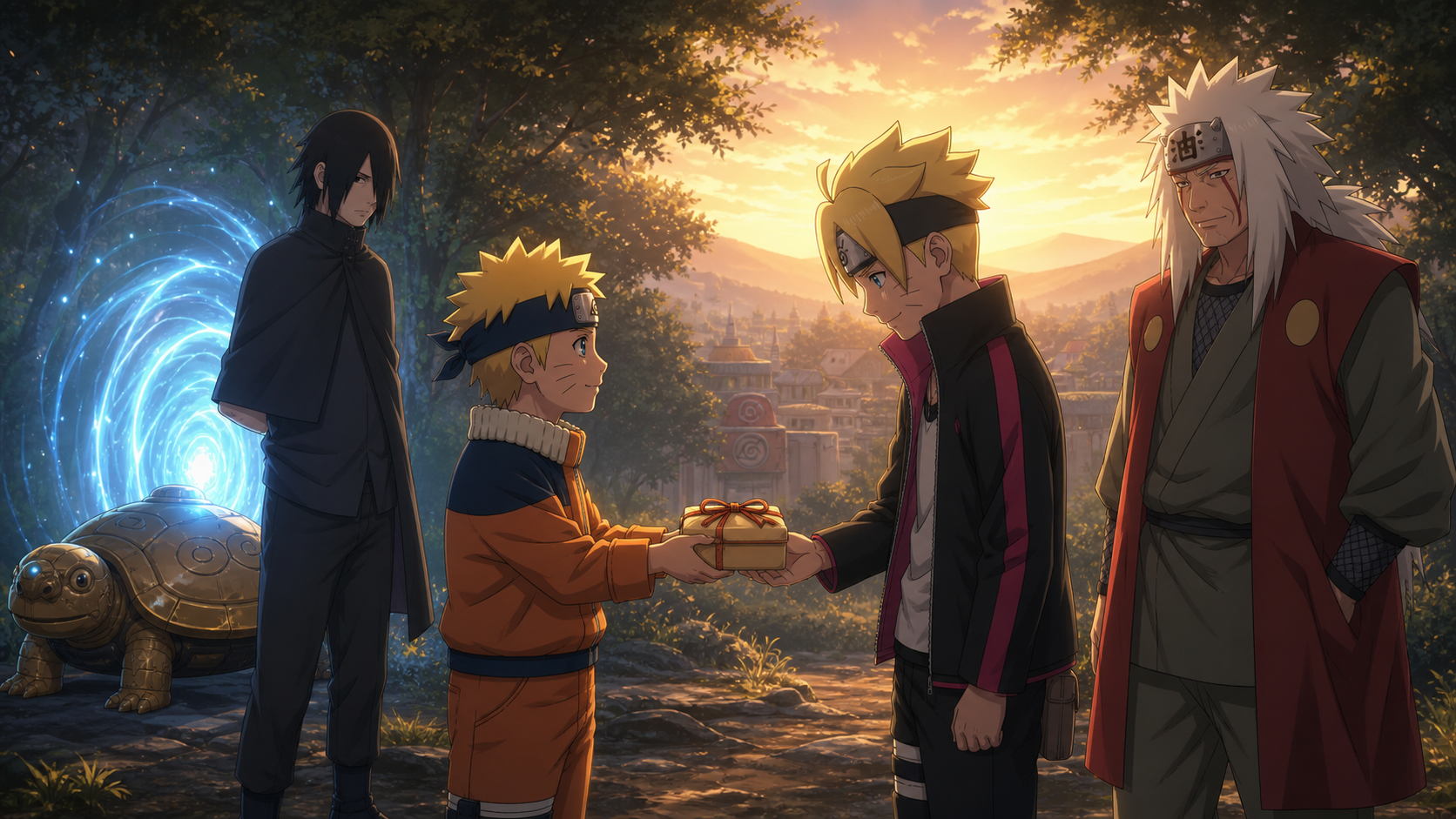
Crossing Time!
Boruto leaves his father’s childhood with a ramen gift, memories nobody else can keep, and a clearer understanding of the lonely boy behind the Hokage.
Series: Boruto: Naruto Next Generations
Episode: 136 · Crossing Time!
Arc: Time Slip Arc
Release: 2019-12-15
Previous: Episode 135 · The Last Battle, Urashiki
Directory: All 293 Boruto episodes
Bottom line
Boruto Episode 136 closes the Time Slip Arc by giving Boruto something more useful than a perfect goodbye. He leaves with a cheap special-edition ramen package from young Naruto, loses the right to be remembered by everyone he met, and returns home understanding his father as a person instead of a title that kept missing dinner.
The memory erasure remains convenient. Sasuke apparently wipes everyone Boruto contacted, which solves a sprawling timeline problem with one Sharingan sequence. Jiraiya requesting the erasure makes emotional sense because he already understands enough to know that foreknowledge could damage the story everyone still has to live. The mechanics deserve questions. The choice fits Jiraiya.
The episode's best scene arrives in the present. Naruto stands at Jiraiya's memorial. Boruto finds him, reveals the ramen gift, and shares the food with the adult version of the lonely boy who gave the package away. No speech can improve that circle. A disposable meal crosses time because two versions of Naruto use food to offer connection.
Konoha remembers the battle as a strange rumor
Team 10, Kiba, and Shino leave the hospital discussing what Konohamaru tried to explain. They missed the central fight and cannot fit the scraps into a believable account.
That confusion shows the cleanup problem before Sasuke uses genjutsu. A destroyed battlefield, injured strangers, Jiraiya's wounds, Sakura's exhaustion, and Naruto's disappearance have left evidence. The village cannot simply return to normal because the travelers decide to leave.
The episode treats most of that evidence lightly. A longer aftermath could have shown how shinobi institutions investigate unexplained damage. The arc wants the emotional farewell more than a full time-travel audit.
Jiraiya thanks Sasuke without demanding a confession
Jiraiya and Boruto find Sasuke on the hospital roof. Jiraiya thanks him for protecting Naruto and accepts the help without forcing the traveler to say who he is.
The restraint completes Jiraiya's role in the arc. He noticed the resemblance, Rasengan lineage, chakra patterns, knowledge, and behavior. He asked the direct question once. After Sasuke refused the truth, Jiraiya shifted toward protecting Naruto and preserving whatever future sent the pair back.
Trust does not require ignorance here. Jiraiya chooses not to use every fact he has gathered. A skilled spy knowing when to stop digging is more impressive than another clever deduction.
Sakura confronts the clue one last time
Sakura brings the damaged letter and asks Sasuke why her name and his name appear on the same page. She has every reason to reject the traveling-performer story. The stranger uses familiar techniques, protects Naruto, and carries a document tied to the teammate she is searching for.
Jiraiya rescues the lie with the most embarrassing explanation available. He claims the travelers are fans gathering information about his books and that Sasuke's name appears because of his connection to the group.
Adult Sasuke has survived war, dimensional threats, and international missions. Agreeing that he belongs to a Make-Out book fan club may be the hardest performance he gives during the entire arc.
The book excuse works because Sakura wants an answer
Jiraiya's explanation is ridiculous, but the absurdity provides enough social pressure to end the confrontation. Sakura does not have proof strong enough to accuse an injured adult stranger of being a future version of her missing teammate.
The scene also protects her from knowledge that would distort her next years. Learning that she marries Sasuke and has Sarada could turn every choice into obedience to a promised outcome.
Sakura deserves agency without a future guarantee. She continues training, fighting, forgiving, and setting boundaries because those decisions belong to her present self.
Naruto hears that Boruto is leaving
Naruto arrives and learns that Boruto and Sasuke plan to depart the next day. His disappointment is immediate because Boruto became a friend during a short, dangerous stretch.
Boruto knows the goodbye carries unequal weight. He will return to a home where Naruto is his father. Young Naruto will lose a new friend and continue facing Sasuke's absence, village prejudice, and the danger inside his seal.
The imbalance makes Boruto careful. He cannot promise they will meet again without revealing too much. He has to accept affection without giving the explanation Naruto deserves.
Karasuki wakes with enough chakra to leave
The time-travel turtle emerges ready to work after absorbing leaked Nine-Tails chakra. Karasuki can return Boruto and Sasuke to the moment shortly after their departure.
That recharge closes the practical route home, though the convenience fits a device whose limits were never fully stable. Karasuki remains more plot mechanism than character.
Boruto hiding the turtle from Naruto preserves the last secret. One glimpse of the machine would turn a difficult goodbye into questions nobody can safely answer.
Naruto gives away the food he values
Young Naruto gives Boruto a special-edition package of Ichiraku ramen and tells him to open the gift later. The item looks small because Naruto does not own much.
That scarcity makes the gesture bigger. Naruto's apartment, meals, and money have shown that food is not an effortless gift. Ramen is comfort, routine, and one of the few places where Naruto receives uncomplicated welcome.
He gives Boruto a piece of that comfort because friendship matters more than keeping the treat. Boruto understands the value only after returning home.
Jiraiya asks for the ending to remain unknown
Jiraiya tells Sasuke that he and Naruto learned things they should not know. He confirms Sasuke can erase memories and asks him to remove the information.
His reasoning returns to storytelling. A novel is more interesting when the reader does not know how the story ends. The joke fits an author, but the decision carries real weight. Jiraiya gives up proof that Naruto survives, becomes Hokage, has a son, and restores Sasuke.
Knowing those outcomes might comfort him. Foreknowledge could also change how he trains Naruto, approaches Pain, or responds to Sasuke. Jiraiya chooses the uncertain life already in motion.
Sasuke erases the people Boruto touched
Sasuke uses Sharingan genjutsu on Naruto and Jiraiya, then states that he removed the memories of everyone Boruto encountered in the past.
The scope is the episode's weakest convenience. Memory is not a neat file separated from later actions, injuries, notes, and conversations. Erasing a network of contacts from a distance raises questions the arc does not answer.
The emotional effect still lands. Neji forgets the nephew he advised. Hinata forgets the son who watched her childhood. Sakura forgets treating her future husband. Naruto forgets training and fighting beside his son.
Forgetting does not make the meetings meaningless
Boruto remains changed even when nobody in the past remembers him. He carries Neji's advice, Naruto's trust, Jiraiya's intelligence, Sakura's care, and Sasuke's visible regret back to the present.
That one-sided memory can feel cruel, but relationships do not require equal archives to matter. The lessons influence how Boruto sees people who cannot know where his new understanding came from.
The episode avoids suggesting that erased memories erase consequences. Boruto has become the archive. His behavior in the present becomes the only place those meetings survive.
Hinata and Neji find the emptied clearing
Hinata and Neji discover Naruto and Jiraiya unconscious after the genjutsu. They know someone was present but cannot hold the identity clearly.
Boruto has already said goodbye without being able to call either of them family. Now the last traces of recognition disappear before he leaves the era.
Neji's presence adds the hardest edge. Boruto returns to a world where Neji died before Boruto could know him. The conversation they shared exists only in Boruto's memory.
Karasuki chooses a future after serving others
During transit, Karasuki explains that enough chakra remains for another journey. Boruto suggests the turtle should do something for itself, and Karasuki interprets the suggestion as a command once the travelers leave.
The exchange gives the device a small release from ownership. Urashiki used Karasuki as transportation. Sasuke and Boruto used the same function to repair the damage. Boruto recognizes that endless service is not a life.
The idea is barely developed, but the kindness fits Boruto after the arc. Meeting young Naruto has made him more attentive to the person or being hidden beneath a useful role.
Sasuke gives Boruto the credit
Back in the present, Konohamaru finds the travelers. Sasuke reports Urashiki's defeat and credits Boruto with identifying the true target and helping them intervene.
The praise matters because Sasuke does not inflate his own role. Boruto found the blood clue, reached Naruto through the shroud, and synchronized the final Rasengan.
Naruto asks Sasuke to stay in the village more often. The request gains weight after Sasuke spent days walking through the pain his absence caused in the past.
Sasuke returns home and thanks Sakura
Sasuke goes home and thanks Sakura for everything. The words are simple because he cannot explain that her teenage self found him, treated him, and spent her chakra making his return to battle possible.
Adult Sakura hears gratitude attached to years of shared life. Sasuke carries a fresh memory of receiving care from her before that shared life existed.
The scene does not fix every problem in their marriage or Sasuke's long absences. The Time Slip Arc gives him another reason to recognize the labor Sakura performs without demanding attention.
Boruto looks at family photographs differently
Boruto studies family pictures with Hinata after returning. The images now connect to people he met before they became parents, spouses, and respected adults.
Hinata is no longer only Mom. Boruto watched her train with Neji inside a painful clan structure. Naruto is no longer only the overworked Hokage. Boruto saw his apartment, bad meals, loud insecurity, and desperate loyalty.
The photographs hold continuity Boruto can feel more deeply because the past stopped being an abstract prelude to his own life.
Naruto stands at Jiraiya's memorial
Boruto finds Naruto at Jiraiya's memorial. The location brings the erased past and remembered future together. Young Naruto forgot the strange visitors. Adult Naruto still carries the teacher who shaped his life and died before seeing him become Hokage.
Naruto asks what Boruto thought of him. The question invites an easy joke or sentimental verdict. Boruto's answer comes through the gift instead.
The ramen package proves that young Naruto gave something to Boruto even after the memory disappeared. An object crosses the gap that language cannot safely bridge.
Ramen finishes the conversation
Boruto and Naruto share the special-edition ramen. The meal connects young Naruto's generosity, adult Naruto's grief, Boruto's new empathy, and Ichiraku's long role as a place of belonging.
Boruto began the larger series resenting the Hokage office because the job kept taking his father away. The arc does not tell him to stop feeling neglected. Learning Naruto's childhood adds context without cancelling Boruto's own hurt.
Their relationship improves because Boruto now sees two truths at once. Naruto endured loneliness and became a father without a model. Naruto still has responsibilities to the children waiting at home.
Memory erasure solves continuity by creating a consent problem
Sasuke removes memories from people who helped, fought, feared, trusted, and made choices based on the visitors’ presence. Protecting the timeline gives the action a serious purpose.
The people losing memory never consent. Jiraiya can agree for himself after understanding enough of the risk. Young Naruto, Sakura, Neji, Hinata, and everyone touched by the event do not receive that choice.
The technique also edits emotional experience. Sakura spent chakra, Naruto formed attachment, and Jiraiya evaluated a future student. Erasing recall protects history by altering minds.
The episode treats the cleanup as necessary. An honest reading should still name the violation and ask whether narrower erasure, sealed memory, or a warning from Karasuki could reduce the harm.
Physical evidence does not disappear because memory disappears
Food packaging, battlefield damage, missing supplies, clothing fibers, chakra residue, written notes, wounds, and changed locations can remain after the mind forgets.
Sakura already found a clue strong enough to confront Sasuke. The book excuse satisfies her because the plot needs the question closed, not because every object has been accounted for.
Time-travel cleanup needs an inventory. Sasuke should recover foreign items, repair damage where possible, and record anything too risky to change. Karasuki should explain whether the timeline self-corrects around small residue.
Memory erasure without evidence control risks leaving people frightened by gaps they cannot explain.
Jiraiya sacrifices knowledge that could have protected him
Learning about the future might reveal death, betrayal, Naruto’s path, and choices capable of preventing enormous loss. He asks not to know.
That refusal protects the future from becoming a project designed around foreknowledge. Jiraiya chooses to trust the people who will live the years rather than seize control of those years.
The choice is noble and painful. Information about Pain could save his life or alter Naruto’s development beyond recognition. No answer comes without cost.
Jiraiya’s restraint fits a teacher who wants students to become people he cannot completely script.
Boruto becomes the only child carrying the shared past
Young Naruto forgets the friendship. Boruto remembers the meal, fear, arguments, generosity, and loneliness. That imbalance creates grief nobody around him can fully validate.
He cannot tell adult Naruto everything without reopening timeline questions. The ramen package becomes evidence for a memory he must hold mostly alone.
Boruto gains empathy and also inherits secrecy. Sasuke should recognize that emotional burden and offer a private space for questions after returning home.
Protecting history should not mean leaving one child to process history without support.
Sasuke’s thanks to Sakura is overdue and still meaningful
Young Sakura helped a stranger while receiving evasive answers and noticing details that threatened the cover. Adult Sasuke returns to a wife whose earlier kindness helped preserve him and Boruto.
He cannot explain the full reason, so gratitude arrives without context. Sakura has spent years living beside his silences. Another unexplained thank-you is tender and frustrating at once.
The episode uses the moment to connect his past dependence with his present family. A stronger aftermath would let him share what timeline safety permits rather than making secrecy the only form of protection available to their marriage.
Gratitude matters most when the person receiving gratitude is allowed to understand the relationship the gratitude belongs to.
Naruto’s gift becomes a message from a child who expected little
Young Naruto values the ramen because food, novelty, and being remembered all matter. Giving the package away is a real sacrifice, not a cute prop exchange.
He offers Boruto something before knowing who Boruto is and before receiving any future reward. The generosity challenges Boruto’s image of his father more effectively than a speech.
Adult Naruto later eats the gift without remembering the original choice. Boruto supplies the missing continuity.
The meal proves that forgotten kindness can still shape the people who remember receiving the kindness.
Karasuki choosing a future raises questions about ownership
The artifact served Urashiki and then helped Boruto and Sasuke return. Once awake and speaking, Karasuki demonstrates preference and agency.
An object capable of choosing should not simply become property in another person’s collection. Karasuki needs freedom to decide movement, service, rest, and disclosure about time travel.
The series often gives tools personalities while institutions continue treating tools as equipment. Karasuki’s choice invites a larger classification: companion, created being, artifact, or something new.
Agency should change the relationship even when the body looks mechanical.
The ramen scene adds context without cancelling Boruto’s neglect
Boruto now understands that Naruto grew up without parents, reliable meals, or a model for balancing duty and home. That history explains blind spots.
Explanation cannot erase missed birthdays, shadow-clone parenting, broken promises, or Himawari’s hurt. Boruto does not owe silence because his father suffered first.
The strongest reconciliation holds both realities. Naruto deserved care as a child. Boruto and Himawari deserve presence now.
Sharing ramen becomes progress because empathy moves in both directions rather than demanding that the younger person excuse everything.
Jiraiya’s memorial gives Boruto a place for grief he technically should not possess
Boruto met Jiraiya, watched him teach, saw his foolishness and perception, and then returned to a world where that meeting never entered Jiraiya’s remembered life. The memorial becomes the only public place connected to a private loss.
Naruto grieves years of shared history. Boruto grieves a brief relationship erased from the other participant. Neither grief cancels the other.
The location also protects Boruto from turning knowledge into trivia. Jiraiya is not merely a legendary figure he can now claim to have seen. The stone marks a person whose choices still shape the family standing nearby.
Sasuke should understand this form of grief. He carries people, timelines, and truths other characters cannot always share. A quiet acknowledgment from him could help Boruto recognize that secret memory still deserves care.
The ramen package becomes a small ritual object. Eating the food at the memorial lets Boruto return young Naruto’s generosity to the adult Naruto without exposing the timeline. The act holds gratitude, mourning, and family repair in one ordinary meal.
Final reaction
“Crossing Time!” earns its quiet ending by letting objects and choices carry more weight than explanations. Jiraiya gives up the future. Naruto gives away ramen. Sakura spends chakra on a stranger. Sasuke returns home with gratitude he cannot fully explain. Boruto keeps memories nobody else is allowed to hold.
The episode's timeline cleanup is too easy. Sasuke's broad memory erasure raises more questions than the story wants to answer, and physical evidence receives almost no attention. That weakness belongs in any honest discussion of the arc.
The emotional conclusion remains strong. Boruto does not return believing Naruto was secretly a perfect child or perfect father. He returns understanding the labor, loneliness, friendships, teachers, and stubborn choices that built the man.
Sharing ramen at Jiraiya's memorial closes the arc without pretending grief disappeared. Young Naruto's gift reaches adult Naruto through the son he could not yet imagine. For one meal, past and present sit at the same table.
Sources and lawful viewing
Official episode reference: Naruto Official episode guide
Licensed episode route: Crunchyroll licensed series page