
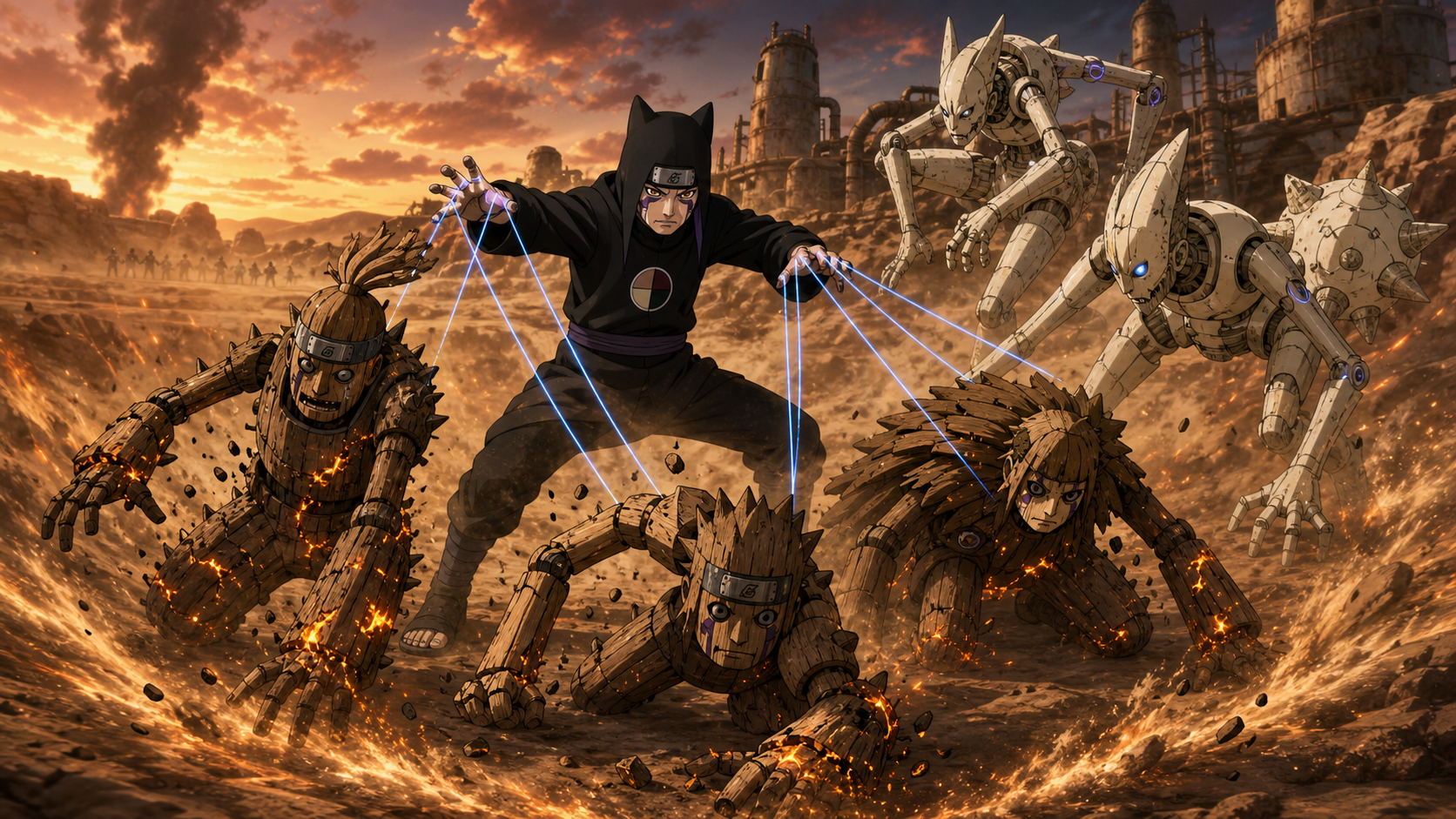
The Puppet Battle!
Kankuro stays behind against Urashiki’s puppets, leaving Boruto and Shinki to decide whether loyalty means returning for family or carrying the mission forward.
Series: Boruto: Naruto Next Generations
Episode: 122 · The Puppet Battle!
Arc: One-Tail Escort Arc
Release: 2019-09-01
Previous: Episode 121 · The Entrusted Mission: Protect the One Tails!
Directory: All 293 Boruto episodes
Bottom line
Boruto Episode 122 stages a puppet fight, then spends most of the episode asking what loyalty looks like when the mission and the person you love pull in opposite directions. Kankurō stays behind against Urashiki's puppets so Shinki and Boruto can carry Shukaku toward Konoha. His own puppets are outnumbered, damaged, and eventually detonated in an explosion large enough to convince the boys that he may have died with them. Shinki insists they continue because the One-Tail cannot fall into Otsutsuki hands. Boruto hears that logic as family betrayal and turns back. Shukaku explains that Shinki once resembled the young Gaara, and Naruto gave Gaara another way to live: protect people without surrendering to hatred or hopelessness. Temari and Shikadai join Boruto's search, while Shinki continues alone and walks straight into a surviving puppet. The episode refuses an easy answer. Shinki protects the mission. Boruto protects the missing person. Both choices carry consequences because loyalty does not become simple merely because everybody uses the word shinobi.
Kankurō makes the split before the puppets control the route
The enemy is gaining on the escort, and the tea kettle contains the exact target Urashiki wants. Kankurō does not wait for the group to become surrounded.
He tells Boruto and Shinki to continue with Shukaku while he uses the battlefield he understands. Puppet combat belongs to him more than either genin.
The decision is tactical, but the family cost lands on Shinki.
The Sand's puppet master finally gets the title fight
Kankurō has spent much of Boruto's era as Gaara's trusted adviser and the uncle who can read Shinki better than Shinki reads himself.
Episode 122 remembers that he is also one of Sunagakure's finest puppet users. Chakra strings, hidden weapons, traps, poison mechanisms, and misdirection are not side hobbies.
His expertise deserves the spotlight even when the episode does not give him every puppet in his collection.
Otsutsuki puppets are not ordinary tools
Urashiki's pursuers move with unfamiliar construction and enough force to overwhelm standard defenses. They do not panic, negotiate, or hesitate when one body breaks.
Kankurō knows human puppet masters. These machines belong to an enemy whose technology and chakra methods sit outside the usual village system.
Recognition gives him an advantage, not a guarantee.
Kankurō summons more bodies as the pressure grows
He answers numbers with numbers. His puppets create angles, screens, and attacks that one human body could never manage alone.
The fight makes puppet technique look like battlefield coordination compressed into one set of hands. Every string carries a separate decision.
That complexity also creates vulnerability. When enemy puppets close distance and destroy his tools, Kankurō loses pieces of his defense all at once.
He did not bring the entire collection
The episode acknowledges that Kankurō entered the escort without every weapon available to him. That limitation raises the danger, though the writing also invites a fair complaint.
Transporting Shukaku during an Otsutsuki pursuit is exactly the kind of mission that deserves the best equipment. The rushed departure explains some of the gap, but not every viewer will accept the convenience.
Fandom can enjoy the battle and still question why the specialist arrived under-equipped.
The fight becomes a delaying action
Kankurō does not need to destroy every enemy for the mission to succeed. He needs to create distance between the puppets and Shukaku.
That objective changes how the battle should be judged. Survival matters, yet pursuit time matters too.
Every second he holds the machines gives Shinki and Boruto another stretch of desert toward Konoha.
Boruto keeps looking backward
He worries about Kankurō because leaving somebody alone against a superior force feels wrong. The concern reflects Boruto's best quality and his recurring weakness.
He notices the person before the procedure. That instinct lets him reach frightened civilians and lonely children. The same instinct can make him abandon the reason everybody accepted danger.
Boruto has not learned how to care and continue at the same time.
Shinki keeps his eyes on the destination
Shinki understands that Kankurō stayed behind so the escort would move. Returning could place Shukaku beside the enemy and turn Kankurō's risk into wasted time.
His voice sounds cold because he refuses to perform fear while carrying the mission.
The absence of visible panic does not prove the absence of love. Shinki's control often hides how much he feels.
The explosion looks like a death
Kankurō reaches the point where his puppets cannot win through ordinary exchanges. He detonates them around the remaining attackers.
The blast crosses the desert and reaches the boys as sound, smoke, and terrible possibility.
Neither child can see whether Kankurō escaped. They receive evidence without certainty, which is exactly the kind of gap fear fills with the worst answer.
Self-destruction has a long shinobi shadow
Shinki says Sand shinobi may destroy themselves to eliminate an enemy and protect the mission. His statement sounds horrifying because the culture has trained children to treat bodies as expendable resources.
Kankurō detonates puppets, not a confirmed human body, but the boys do not know that from a distance.
The willingness to imagine his uncle choosing death reveals what Shinki believes duty may demand.
Boruto hears cruelty where Shinki means respect
Shinki wants to honor Kankurō's order by moving forward. Boruto hears a nephew refusing to check whether his uncle survived.
They argue past each other because each boy uses a different definition of loyalty.
Boruto equates loyalty with returning for the person. Shinki equates loyalty with completing the purpose that person accepted danger to protect.
Shinki hears selfishness where Boruto means hope
From Shinki's perspective, Boruto wants to risk Shukaku, Gaara's order, and Kankurō's sacrifice because uncertainty hurts.
Turning around may soothe guilt, but the decision could deliver the One-Tail to the surviving enemy.
Shinki is right about the danger. His mistake is treating Boruto's concern as nothing more than emotional indiscipline.
Shukaku enters the argument as a witness
The supposed cargo has known Gaara longer than either child. Shukaku remembers the hatred, isolation, and survival logic that shaped the Kazekage.
He tells Boruto that Shinki once resembled Gaara. The comparison explains why discipline can become a wall instead of merely a skill.
Shukaku does not offer a sentimental speech. He gives Boruto the history needed to read Shinki more accurately.
Young Gaara fought because hatred was the only path he knew
Adults taught Gaara that his life existed as a weapon, then feared him for behaving like the weapon they created. He protected himself because nobody else seemed safe.
That history matters when Shinki speaks as though individual life must always submit to mission need.
Children learn what adults reward. Sand history rewarded endurance, control, and sacrifice long before Gaara changed the village from inside the Kazekage's office.
Naruto gave Gaara another model
Naruto did not defeat Gaara by offering cleaner doctrine. He recognized the loneliness because he carried a parallel wound.
Their fight showed Gaara that strength could grow from protecting people rather than proving nobody could hurt him.
Shukaku remembers that change because Naruto's influence reshaped both Gaara's life and the One-Tail's future.
Boruto chooses to return
He decides that Kankurō may still be alive and that leaving without checking crosses a line he cannot accept.
The choice is risky. The episode does not make the risk disappear because Boruto's motive sounds compassionate.
Hope becomes action, but action pulls one escort away from Shukaku and leaves Shinki carrying the target alone.
Shinki continues with the kettle
He refuses to follow Boruto back. The mission now rests on one genin moving through hostile desert with the most valuable target in the region.
Shinki's choice honors the order and increases his personal danger.
Calling him heartless misses the fact that he accepts the loneliest route so somebody keeps moving toward Konoha.
Temari arrives with Shikadai
Temari reaches the Land of Wind already sensing that something has gone wrong. Family instinct and shinobi experience point in the same direction.
Shikadai comes with her, connecting Konoha's next generation to the Sand family crisis.
Their arrival gives Boruto help without magically resolving the conflict he created with Shinki.
Yodo and Araya carry Gaara home
The Sand genin explain Urashiki's attack, Sasuke's disappearance, and Shukaku's escort. Temari orders them to continue protecting the injured Kazekage.
The distribution of labor matters. Gaara needs care, Shukaku needs movement, Kankurō needs locating, and Urashiki's seal may fail.
No single rescue impulse can cover every responsibility at once.
Temari understands Boruto and corrects him
She respects his refusal to abandon Kankurō, but she also reminds him that emotion cannot control a mission.
That response gives Boruto what the argument with Shinki lacked: acknowledgment before correction.
Temari does not call care foolish. She demands that care remain aware of the people endangered by the choice.
Shikadai reads the battlefield instead of the argument
He studies the destroyed puppets and notices a hole leading beneath the sand. The physical evidence suggests the explosion did not end every threat.
Shikadai's observation changes the search from grief into immediate danger assessment.
Intelligence becomes useful because he looks at what the enemy did, not only what everybody fears happened.
One puppet follows Shinki underground
The surviving machine uses the sand itself as cover and pursues the isolated escort.
Boruto's return did not save Shinki from danger. Shinki's forward movement did not outrun every enemy.
The episode makes both choices pay a price instead of rewarding one boy with instant proof of moral superiority.
Shinki has to fight while protecting Shukaku
He cannot use power with total freedom while carrying the kettle. Defense, distance, and target protection compete for attention.
Iron Sand gives Shinki formidable control, but the puppet arrives designed for relentless pursuit.
His calm now faces the test Boruto warned about: a mission can become impossible when one person tries to carry every burden alone.
Urashiki breaks Gaara's seal
The temporary prison finally fails, and Gaara senses the release. The clock established in Episode 121 reaches zero.
Urashiki can resume the hunt while the escort has split into three groups: Kankurō's uncertain battlefield, Boruto's search party, and Shinki alone with Shukaku.
Every earlier disagreement now exists under a faster threat.
The title promises more battle than the episode delivers
Kankurō's puppet work is enjoyable, but the episode spends substantial time on the boys' argument, Temari's arrival, and the wider escort crisis.
Viewers expecting a full showcase of Kankurō's arsenal may feel shortchanged, especially when he lacks several signature tools.
The emotional conflict carries the episode, but the title makes the limited battle footage a fair criticism.
Kankurō's delaying action needs a recovery plan, not only admiration
Kankurō stays behind because the escort cannot outrun every puppet while protecting Shukaku. The tactical need is clear. The plan becomes troubling because nobody establishes a reliable signal, rendezvous point, or rescue threshold before separating.
Shinobi stories often praise the person who says “go” and remains alone. Praise can hide preventable planning failures. A delaying action should define how long the defender must hold, where the defender retreats, and what evidence triggers a search. Kankurō's self-destruction removes communication and leaves children interpreting smoke as death.
Boruto's refusal to accept the apparent death comes from attachment, but the uncertainty also belongs to the mission design. Shinki has no proof that returning will help. Boruto has no proof that continuing honors a living sacrifice. Better coordination would not eliminate danger. Better coordination would give both boys more than grief and doctrine to guide the choice.
Kankurō deserves respect for taking the fight. He also deserves teammates who plan to recover him rather than turning survival into a pleasant surprise after the objective moves on.
Puppet technique is strategy made visible
Kankurō does not simply throw constructed bodies at an enemy. Every puppet creates angles, hides weapons, redirects attention, and lets one shinobi occupy several positions. The technique rewards preparation and deception more than brute force.
That makes the Otsutsuki machines a strong opponent. Their unfamiliar construction prevents Kankurō from relying entirely on known joints, poison responses, or human movement. He must read another culture's weapon system while protecting the route behind him.
The episode title promises a showcase and delivers only part of one. More time with Kankurō's full arsenal would strengthen the tactical contrast between Sand craftsmanship and Otsutsuki automation. Leaving signature tools behind may reflect time pressure, but the script needs to say so when the mission involves a Tailed Beast and a dimensional hunter.
Even with limited equipment, Kankurō proves why puppet users matter. He turns one body into a controlled battlefield and buys distance through planning rather than pretending raw power matches the pursuers.
Boruto and Shinki confuse moral certainty with emotional control
Boruto feels fear for Kankurō and treats returning as the humane choice. Shinki feels the same danger and treats continuing as the respectful choice because Kankurō stayed specifically to protect the escort. Each boy converts emotion into a rule, then accuses the other of failing that rule.
Boruto is not free from mission responsibility because compassion motivates him. Returning may expose Shukaku and waste Kankurō's stand. Shinki is not free from attachment because discipline motivates him. Continuing without a recovery plan may abandon a living ally and leave one injured child carrying the entire target.
Temari provides the missing adult language. She acknowledges Boruto's concern before warning that emotion cannot make decisions alone. Acknowledgment matters because correction without recognition sounds like contempt for caring.
Shinki needs the same balance. Control should organize fear rather than deny fear. Boruto needs to learn that care becomes more effective when paired with evidence, timing, and shared responsibility.
Shukaku refuses to let Gaara's history become a slogan
Shukaku remembers the child Gaara was before Naruto reached him. Hatred kept Gaara alive because every relationship around him taught that vulnerability invited betrayal. Strength became isolation, and isolation became proof that nobody else mattered.
Shinki inherits discipline from the man Gaara became, but discipline can resemble the old armor when Shinki refuses to name attachment. Shukaku sees that resemblance and also sees the difference. Shinki protects because Gaara gave him a family and purpose, not because hatred is the only available fuel.
Boruto carries Naruto's influence through noisy insistence that people remain part of the objective. That instinct can become reckless. The instinct also challenges the emotional isolation Shinki mistakes for efficiency.
Shukaku's testimony matters because he lived beside both models. He does not reduce Gaara's transformation to “friendship fixed him.” He recognizes how another person offered a new source of strength and how difficult accepting that source became.
Temari and Shikadai turn rescue into distributed responsibility
Their arrival prevents the conflict from remaining two children arguing without information. Temari can search for Kankurō, Shikadai can read the battlefield, and Shinki can continue moving Shukaku. Responsibility spreads across people whose skills fit different needs.
That distribution is the answer the earlier plan lacked. One person does not have to choose between every life and the main objective when reinforcements divide the work intelligently. Temari's family stake does not disqualify her. Her knowledge of Kankurō and the Sand gives the search context nobody else possesses.
Shikadai notices the underground route because he studies physical evidence instead of accepting the explosion as a complete story. His observation reveals another threat and proves that rescue work includes analysis, not only emotional return.
The episode makes teamwork messy because real distribution requires updates when new evidence appears. Shinki continuing was reasonable. Boruto returning created a rescue route. Temari and Shikadai make both choices less catastrophic by covering responsibilities the boys could not hold alone.
Urashiki's escape punishes the team's fragmented clock
Gaara's seal always had a limit. Every puppet fight, argument, detour, and injury consumes that limit while the escort loses cohesion. Urashiki does not need to defeat every defender at once. He needs the temporary prison to fail when the target stands isolated.
The escaping villain turns time into another enemy. Kankurō bought distance. Boruto spent some distance returning. Temari and Shikadai recover information. Shinki continues while poisoned. Each action has value, but the combined clock keeps moving.
That pressure explains why Shinki sounds harsh without excusing every conclusion. He knows delay has a cost even when nobody can see the seal. Boruto sees the people absorbing that cost. The mission needs both forms of awareness.
Episode 122 ends before either boy can integrate them. Urashiki's return removes the luxury of finishing the argument first.
Final reaction
“The Puppet Battle!” works best when the episode stops pretending duty and love can be separated with one clean rule. Kankurō stays because somebody has to slow the pursuers. Shinki continues because somebody has to keep Shukaku moving. Boruto returns because somebody has to act on the possibility that Kankurō survived. Each choice protects something real, and each choice leaves another need exposed.
Kankurō's fight reminds viewers why puppet technique deserves more screen time. One shinobi manages several bodies, weapons, traps, and movement lines while reading machines built by a completely different culture. The self-destruction creates a strong cliff edge, though the missing arsenal feels convenient. A jōnin escorting a Tailed Beast during an Otsutsuki attack should have brought every useful nightmare in storage if time allowed.
The Boruto and Shinki argument lands because both boys are partly right and personally irritating about the part they miss. Boruto treats returning as the only proof of care. Shinki treats forward movement as the only proof of respect. Boruto risks the target. Shinki risks becoming alone with the target. Neither child has enough experience to hold mission logic and human uncertainty without choosing one against the other.
Shukaku supplies the history that keeps Shinki from looking like a robot. Gaara once survived through hatred because adults gave him almost nothing else. Naruto showed him that protection could become a source of strength. Shinki inherited Gaara's discipline and some of Gaara's old emotional armor. Kankurō knows that. Shukaku knows that. Boruto finally begins to understand.
Temari offers the mature version of the argument. She honors Boruto's concern and warns him that emotion cannot erase mission consequences. That balance is what both boys need. Care without judgment can endanger everybody. Judgment without visible care can isolate the person carrying the burden.
The surviving puppet proves the cost of the split. Shinki moves forward and still gets caught. Boruto turns back and may still arrive too late for Kankurō. Urashiki escapes Gaara's seal while the escort is scattered. Nobody receives a gold star for choosing the pure option because no pure option existed. That discomfort makes Episode 122 more useful than a simple puppet exhibition, even if Kankurō deserved a longer fight.
Sources and lawful viewing
Official episode reference: Naruto Official episode guide
Licensed episode route: Crunchyroll licensed series page