
With Sasuke as the Goal
Boruto reaches his mentor, but crossing a border without permission and interrupting an Otsutsuki battle turns Sasuke’s attention into the most expensive lesson possible.
Series: Boruto: Naruto Next Generations
Episode: 120 · With Sasuke as the Goal
Arc: One-Tail Escort Arc
Release: 2019-08-18
Previous: Episode 119 · Konohamaru’s Ninja Way
Directory: All 293 Boruto episodes
Bottom line
Boruto Episode 120 lets Boruto chase his hero across national borders, then makes him confront people who do not experience shinobi as heroes. “With Sasuke as the Goal” begins with a day off and a stolen look at Sasuke's message. Boruto sneaks toward the Land of Wind, misses the passenger train, hides on freight, gets off one stop early, and nearly dies from desert heat. Isago rescues him. Her father Gojō wants the ninja gone because allied shinobi destroyed his village during the Fourth War while trying to flush out enemies. Boruto then protects their farm from men using intimidation and chemicals to force a land sale for a power plant. Gojō lends him a trolley, Boruto reaches Sasuke's location, and the episode immediately punishes his success: Urashiki steals Sasuke's chakra while Sasuke protects the child who entered an active battle uninvited, then sends Sasuke through a portal. Boruto wanted training. He arrives as a liability and learns that reaching a mentor is not the same as earning the mentor's time.
Everybody has plans for the days off
The Konoha genin compare schedules at Lightning Burger. The scene feels normal after four episodes of curses, confinement, and memory loss.
Boruto does not want the family camping plan. He wants Sasuke to fulfill the promise of more training.
Rest sounds like wasted time when a child is measuring himself against a legendary mentor who rarely comes home.
Sasuke's hawk becomes irresistible
Boruto spots the messenger bird arriving at the Hokage's office and knows Sasuke has sent information.
The message is not addressed to him. The contents concern a dangerous investigation and official movement between villages.
Boruto manufactures a distraction and listens anyway because admiration has convinced him that wanting access is almost the same as having permission.
Sasuke is tracking Urashiki toward the Land of Wind
The information tells Boruto exactly where his mentor might appear. The Otsutsuki threat should be the warning that keeps him home.
Instead, the danger makes the opportunity feel urgent. Sasuke could leave again before Boruto gets another lesson.
Hero worship narrows his attention until the missing permission, international travel, and active enemy all become background details.
Boruto lies and leaves the village
He avoids the family trip and heads for the train without arranging a mission, escort, or legitimate reason to cross the border.
This is not cute independence. Hinata believes her son is following an ordinary plan while Boruto enters a region connected to an Otsutsuki pursuit.
The episode keeps his energy entertaining, but the choice is reckless before anything goes wrong.
Temari and Shikadai take the train he misses
They are traveling to the Land of Wind for family reasons. Boruto sees the legitimate route disappear because he arrives too late.
Missing the train could have ended the plan and sent him home.
Boruto treats the obstacle as proof that he needs a more creative form of trespassing.
The freight train is not a heroic shortcut
He hides aboard cargo headed in the same direction. The ride gets him across the distance without solving food, water, timing, or the final route.
Boruto has ninja skill and city confidence. Neither replaces preparation in a desert.
The transport system carries him farther than his plan deserves.
One station early becomes a survival problem
Boruto gets off before the destination and decides to walk. Heat and thirst dismantle him faster than an enemy would.
The landscape does not care whose son he is or which jutsu he knows.
An ordinary water plan would have served him better than every dramatic reason he invented for leaving.
Isago saves the shinobi
She finds Boruto unconscious and brings him to her home. The supposed adventurer reaches the Land of Wind because a civilian rescues him from his own choices.
Isago offers shelter, food, and time to recover. Her kindness does not demand that he prove ninja usefulness first.
Boruto's journey toward Sasuke pauses inside somebody else's life.
Gojō wants him gone
Isago's father does not welcome the Leaf headband. He tells Boruto to leave and rejects help around the property.
The hostility initially reads as stubbornness. Then Gojō explains what shinobi mean to him.
Boruto grew up hearing that ninja saved the world. Gojō survived the part of the war that heroic summaries prefer to skip.
Allied shinobi destroyed Gojō's village
Forces on his own side attacked the settlement to force hidden enemies into the open. The tactic may have served a battlefield goal, but civilians lost their home to the people officially protecting them.
Gojō does not divide shinobi cleanly into heroes and villains because the same uniform can save one village and sacrifice another.
Peace did not refund what his family lost.
Isolation is Gojō's attempt to protect Isago
He moved away from shinobi society so his daughter would never experience the destruction that shaped him.
The decision offers safety and loneliness at the same time. Isago welcomes Boruto partly because visitors are rare.
Trauma builds a fence long before the property harassers damage the physical one.
Shinobi Bout creates a bridge
Boruto and Isago play the card game at night. Legends become entertainment in a home where real shinobi history created fear.
The contrast is not accidental. Children can collect heroic images while parents remember smoke, rubble, and decisions made over civilian heads.
Fandom and lived history occupy the same table without agreeing.
The damaged fence is not random vandalism
An alarm reveals another attack on the property. People want Gojō to leave so a power plant can be built.
The project promises public benefit, which gives private coercion a respectable slogan.
Gojō has already lost one home to somebody else's strategic necessity. Now development language asks him to surrender another.
A useful project does not justify stealing the land
Electric infrastructure could help many residents. The men pursuing the deal use threats, sabotage, hostage-taking, and crop destruction.
Public good becomes camouflage for refusing the owner a meaningful choice.
Boruto has just left Remon's village, where communal safety also placed one person's future under pressure. He should recognize the pattern.
Isago asks him to stay
She wants one more night before Boruto continues his trip. The request reveals how isolated her life has become.
Boruto leaves because the Sasuke goal still controls the schedule. Friendship cannot compete with the imagined training opportunity.
His choice is understandable and another sign that he keeps treating people as stops along his route.
The harassers prepare to poison the crops
Boruto catches the men with chemicals meant to destroy the family's greens before harvest. Financial pressure will make the land easier to seize.
They hold Isago hostage and demand Gojō's signature while planning to ruin the farm regardless.
Nothing about the power plant excuses this. Development without consent is dispossession wearing an efficient jacket.
Boruto uses the Rasengan as a warning
He shows enough force to make the men understand that the child they dismissed can stop them.
Then he threatens to report the scheme to Gaara. That name matters because lawful authority can protect the family after Boruto leaves.
The solution combines immediate power with accountability instead of beating everybody unconscious and assuming the land stays safe forever.
Gojō changes his judgment carefully
One Leaf child does not erase the village destroyed during the war. Boruto does give Gojō a new example of what a shinobi can choose to do.
Trust begins as a specific response, not a command to forgive an institution.
Gojō thanks him by sharing the trolley he built, allowing Boruto to continue without pretending the history vanished.
Wind Release turns the trolley into a desert sprint
Boruto uses chakra to accelerate along the track and finally reaches the stone pillars named in Sasuke's message.
The sequence is fun because improvised travel has become purposeful instead of merely reckless.
He still arrives without authorization, but the journey now carries a civilian relationship that challenged his simple image of shinobi heroism.
Amaterasu marks the real danger
Black flames burn near the destination. Boruto recognizes evidence of Sasuke's technique and follows the trail.
Amaterasu should tell him the mentor is not waiting for a casual lesson. Sasuke is fighting somebody serious enough to require an extreme ability.
Boruto keeps moving toward the battle because reaching Sasuke has remained the only goal.
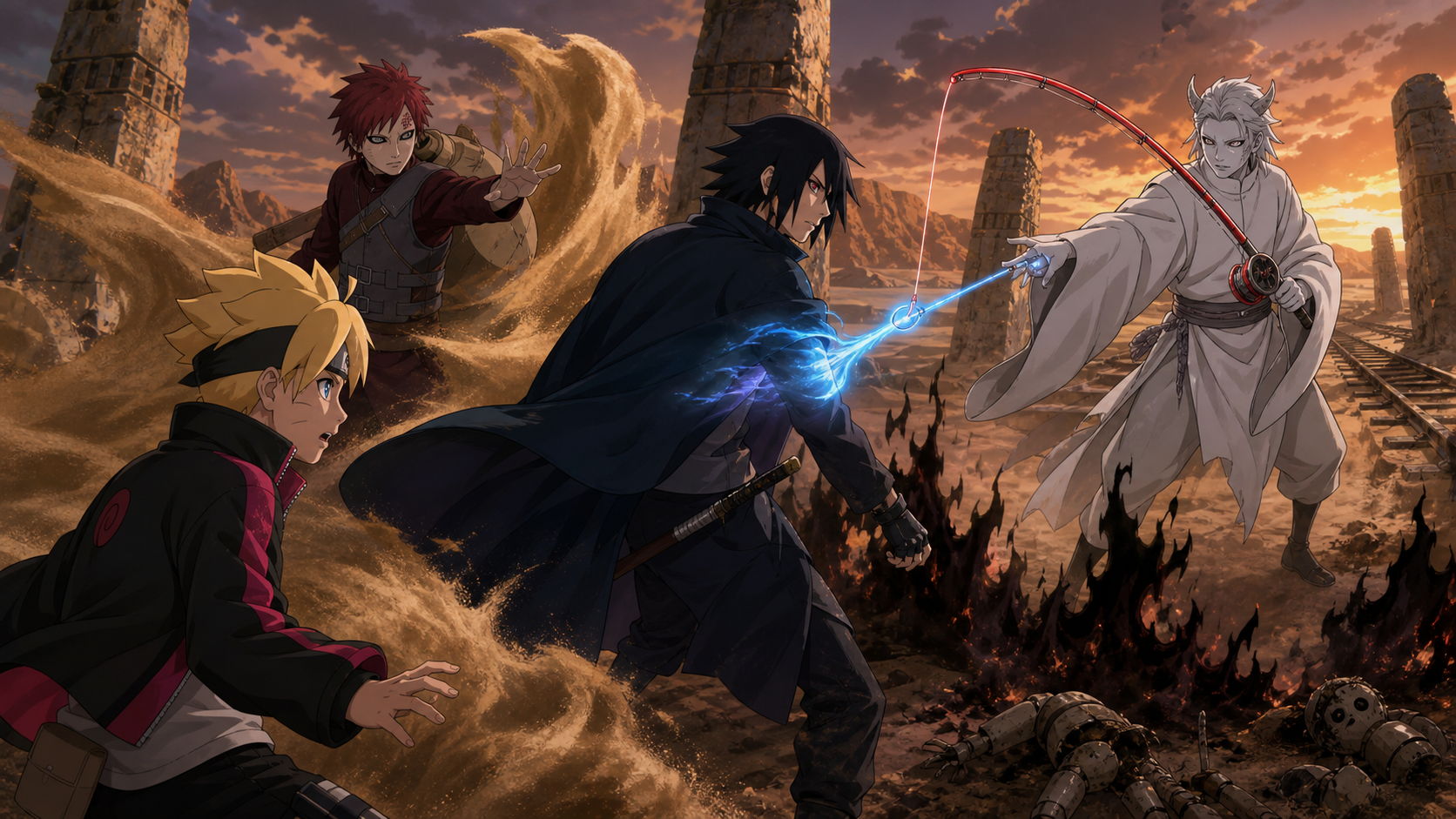
Sasuke and Gaara are already fighting Urashiki
The two elite shinobi face an Otsutsuki opponent supported by puppets connected to Toneri.
Boruto has entered a confrontation far beyond the training session he imagined. Nobody invited him because nobody wanted a genin inside this threat.
The episode makes the scale mismatch unmistakable before allowing him to speak.
Boruto announces himself at the worst moment
He calls to Sasuke during active combat. The mentor's attention shifts toward protecting the child.
Boruto has worked hard to arrive, helped a family, crossed the desert, and shown real courage. None of that makes interrupting the battle safe.
Effort does not cancel consequences.
Urashiki steals Sasuke's chakra
While Sasuke shields Boruto, Urashiki catches the opening and takes chakra with his fishing-rod weapon.
The loss is directly connected to Boruto's presence. Sasuke chooses protection because a mentor does not let a child die to teach responsibility.
Boruto gets the attention he wanted and immediately learns how expensive that attention can become.
Sasuke is sent through a portal
He charges Urashiki after the theft, and the Otsutsuki removes him from the battlefield through a dimensional opening.
The episode ends before Boruto can process what his arrival helped trigger.
His mentor is gone, Gaara remains under threat, and the Land of Wind crisis has become his responsibility whether he is ready or not.
The title changes meaning by the final scene
Sasuke begins as Boruto's destination. The boy believes reaching the man will produce training and personal progress.
By the end, Sasuke becomes the person Boruto endangered and now has to help recover.
A goal is not only where someone wants to arrive. A goal should include what happens to everybody affected by the journey.
Reading the hawk message violates trust before the journey begins
Boruto sees Sasuke's message and treats access to the information as permission to act. Those are different things. The hawk carries operational details for Naruto, not an invitation for a genin to cross borders and join the investigation.
Curiosity becomes a privacy and security problem because the message identifies Sasuke's route and target area. Boruto then lies to leave Konoha, which prevents adults from planning protection or warning Sasuke that a child may appear. Every later rescue problem grows from the decision to make the trip invisible.
Wanting mentorship does not grant ownership over a mentor's schedule, mission, or classified communication. Sasuke has encouraged Boruto's ambition and sometimes rewarded persistence. Boruto mistakes that relationship for unlimited availability.
The episode works because consequences answer the mistake without denying Boruto's value. He remains brave and capable. He also violates a boundary and creates danger. Both receipts belong in the same reaction.
The desert exposes preparation as part of courage
Boruto crosses into the Land of Wind without enough water, route knowledge, backup, or a reliable arrival plan. Physical determination cannot replace those missing resources. Heat and distance turn the heroic shortcut into a survival problem before any enemy attacks.
Shinobi training should make preparation feel obvious. Boruto knows missions require supplies and communication. Personal excitement narrows his attention until reaching Sasuke becomes the only fact he treats as real.
Isago rescues him because civilian knowledge and care compensate for his failure. That help should not become proof that reckless travel works out. A stranger spends resources and accepts risk because Boruto refused to involve the adults responsible for him.
Courage begins before departure through planning, honest communication, and respect for terrain. Running farther after a bad start may look determined while making rescue harder.
Gojō's anger belongs in the war record
Gojō does not hate shinobi because a cartoon villain poisoned his mind. Allied forces destroyed his village during the Fourth Shinobi World War, and peace arrived without restoring what his family lost. The victors tell a story about saving the world. Civilians can carry a different receipt from the same campaign.
Boruto represents the generation enjoying the resulting peace. He did not destroy Gojō's home, but his headband connects him to institutions that did. Demanding immediate gratitude would turn peace into another form of authority.
The episode allows trust to remain narrow. Boruto protects Isago and the crops. Gojō responds by helping Boruto continue. Nobody declares the entire shinobi system forgiven. One useful action creates one useful bridge.
That restraint matters. Reconciliation becomes dishonest when the harmed person must erase history to prove kindness. Gojō can recognize Boruto's character while keeping his judgment about the war.
The power plant dispute shows public benefit cannot erase consent
New infrastructure may serve communities, create jobs, and support the broader region. Those benefits do not authorize intimidation, land seizure, or poisoning crops to force a sale. A project advertised as progress becomes another attack when planners treat residents as obstacles.
Boruto intervenes because the methods are wrong, not because every power plant is wrong. That distinction keeps the story from collapsing into a vague nature-versus-technology speech. Development requires negotiation, fair compensation, environmental review, and the ability for affected people to refuse or challenge terms.
The harassers rely on the belief that Gojō's isolation makes him easy to pressure. Isago and Boruto break that assumption by building connection. Community protection becomes practical rather than sentimental.
The dispute also mirrors the episode's central boundary problem. Boruto ignores permission to pursue a goal he calls important. The developers ignore permission to pursue a project they call important. Scale and harm differ, but good intentions do not erase other people's agency in either case.
Sasuke protects Boruto because mentorship creates obligation
Boruto's arrival forces Sasuke to divide attention during an Otsutsuki fight. Sasuke could let the lesson become lethal and preserve his offensive position. He chooses the child because a mentor accepts responsibility for a student's safety even when the student caused the danger.
Urashiki exploits that choice and steals chakra. The theft belongs to Urashiki, but Boruto's unauthorized presence creates the opening. Accountability does not require blaming Boruto for an enemy's violence. Accountability requires naming how his decision changed Sasuke's options.
The protection also clarifies why access boundaries matter. Sasuke keeps Boruto away from certain missions because the power gap makes supervision impossible. Boruto interprets distance as rejection and learns too late that proximity can weaken the person he wants beside him.
Mentorship is not constant availability. Trust should include believing that “not this mission” can protect both teacher and student.
Boruto's good deed cannot purchase forgiveness for the original lie
Helping Gojō and Isago proves Boruto can notice injustice, connect with suspicious civilians, and use strength without humiliating weaker people. Those actions matter. They do not cancel reading the message, lying to his family, crossing the border unprepared, and interrupting combat.
Moral accounting is not a points system where one rescue erases one reckless choice. The farm story changes Boruto and gives the journey value beyond his selfish goal. The final battlefield still presents the cost created by that goal.
This tension makes the episode useful. Characters can do something generous inside a trip they should never have started. Fans can praise the generous action and criticize the decision that placed everybody there.
Boruto's next responsibility is not self-hatred. He needs to help recover Sasuke, protect the people Urashiki targets, tell the truth about his choices, and learn that apology without changed behavior becomes another demand for attention.
Final reaction
“With Sasuke as the Goal” is messy on purpose and sometimes messy beyond purpose. Boruto's route contains enough bad decisions to make a parent start yelling before the freight train leaves Konoha. He reads a classified message, lies about his plans, crosses a border alone, forgets desert preparation, and interrupts an Otsutsuki battle because he wants a lesson.
The middle story with Gojō and Isago saves the episode from becoming a simple reckless-child travel montage. Gojō's anger reminds Boruto that shinobi history has civilian casualties hidden beneath the victory speeches. Allied forces destroyed his village during the Fourth War. Peace does not erase the fact that people wearing friendly symbols decided his home was acceptable damage.
The land dispute repeats the same moral structure on a smaller scale. A power plant may benefit many people, but public benefit cannot make threats, hostage-taking, or poisoned crops legitimate. Boruto protects the family without demanding that Gojō suddenly love shinobi. He earns one specific act of trust.
Then the episode refuses to let that good deed excuse the original mistake. Boruto reaches Sasuke and becomes a liability. Urashiki steals Sasuke's chakra during the protection response, and Sasuke disappears through a portal. The boy wanted his mentor's attention so badly that he never asked whether the mentor could safely give attention.
That consequence is exactly what the episode needs. Boruto is brave, talented, generous, and still capable of making a dangerous choice for selfish reasons. Fandom does not require pretending the favorite child was right. Sometimes loving a character means watching him create the mess he must now help clean.
Repair begins with truth rather than dramatic guilt
Boruto will want to blame himself for everything that follows. Guilt can become another form of self-centeredness when the injured person has to comfort the one apologizing. Sasuke does not need Boruto to collapse. Sasuke needs accurate information, recovery support, and a student who changes how he handles boundaries.
The first repair step is telling Naruto, Gaara, and the others exactly how Boruto found the message, traveled, and entered the fight. Hiding details to avoid punishment would repeat the decision that created the crisis. The next step is following the mission assigned after Sasuke disappears rather than inventing another private rescue.
An apology matters when Boruto can offer one directly. Changed behavior matters longer. He must learn to ask before joining dangerous work, prepare for travel, and understand that protecting a mentor sometimes means staying where the mentor placed him.
Consequences should teach responsibility without convincing a child that one bad choice defines his character. Boruto created an opening. Urashiki chose the attack. Sasuke chose protection. Repair requires holding those separate responsibilities clearly.
Sources and lawful viewing
Official episode reference: Naruto Official episode guide
Licensed episode route: Crunchyroll licensed series page