
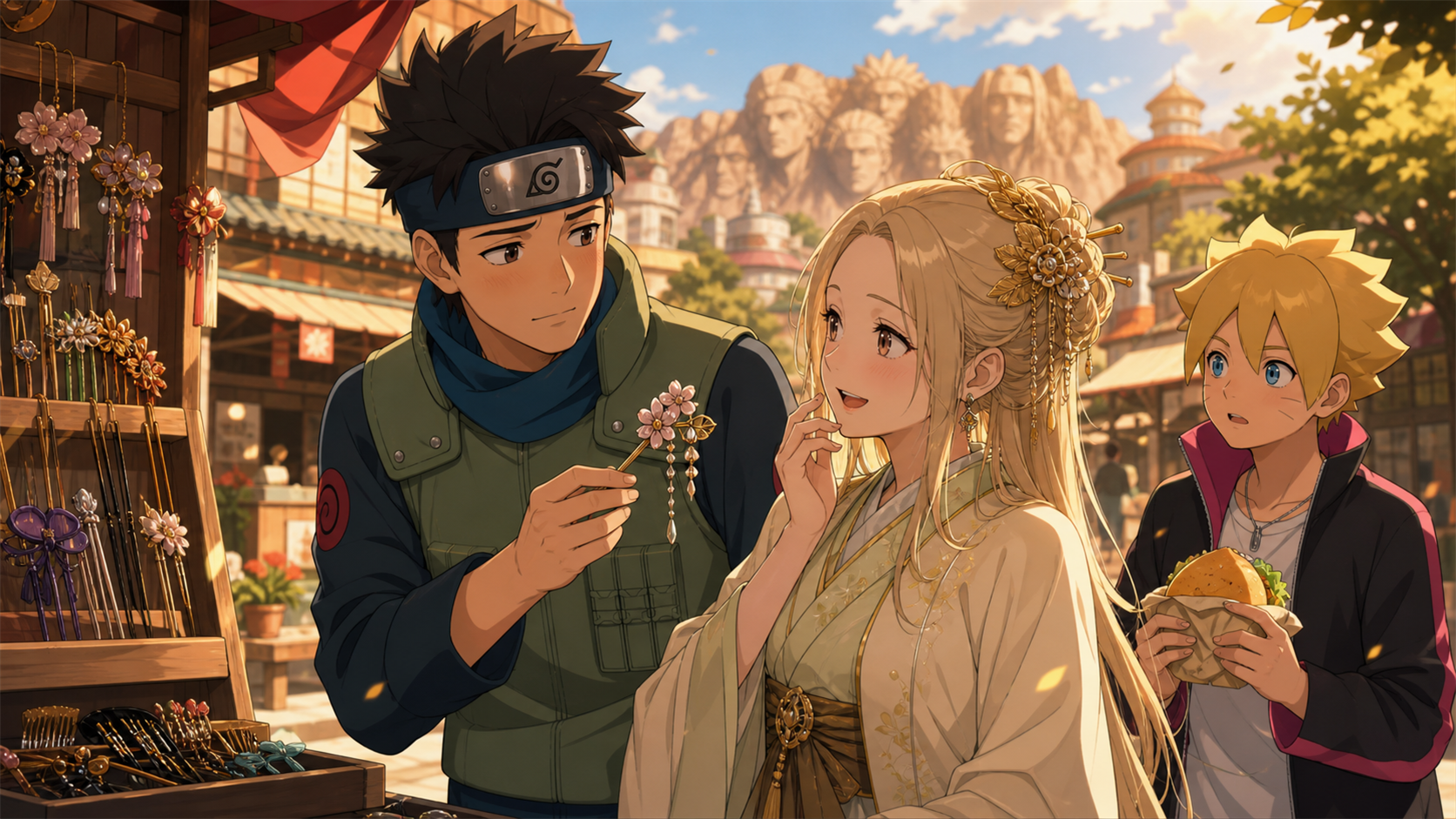
Konohamaru and Remon
Konohamaru can rescue a stranger across the rooftops, but one handkerchief and a shared blush leave the future Hokage candidate completely unprepared.
Series: Boruto: Naruto Next Generations
Episode: 116 · Konohamaru and Remon
Arc: Konohamaru’s Love Arc
Release: 2019-07-21
Previous: Episode 115 · Team 25
Directory: All 293 Boruto episodes
Bottom line
Boruto Episode 116 gives Konohamaru something the franchise rarely allows him to have: a life that is not entirely built around Naruto, Team 7, or becoming Hokage. “Konohamaru and Remon” opens with Boruto failing to understand a romance movie, then makes him watch a real attraction develop directly in front of him. Konohamaru rescues Remon Yoimura from men chasing her through Konoha, carries her across the rooftops, and agrees to help with her sightseeing. A sour lemon burger, a borrowed handkerchief, a hair clip, and a tour of the Hokage Rock turn one afternoon into the beginning of a crush neither adult knows how to name. Remon eventually admits that the pursuers are household guards and returns with them. The next day, Boruto realizes Konohamaru is staring at her handkerchief because he misses her. They visit Remon's estate, only for the warm woman from yesterday to say she never wants to see them again while a stern man watches from above. The cliffhanger is obvious manipulation, but the episode earns concern first by letting Remon and Konohamaru enjoy one uncomplicated day before duty closes around her.
Boruto watches romance like somebody assigned homework
Sarada and Chōchō understand the emotional point of the movie. Boruto sees events without reading the feeling between them.
That blindness becomes the running joke. He can identify an enemy's feint during battle, but two adults blushing at each other might as well be advanced sealing script.
Sarada and Chōchō want him to watch the film again. Boruto escapes before the second lesson, then walks into a live demonstration.
Konohamaru claims romance would distract from Hokage training
When Boruto asks whether he watches romantic films, Konohamaru dismisses the idea. Becoming Hokage remains his declared priority, and apparently affection must wait outside until the career plan finishes.
The answer sounds disciplined and defensive. Konohamaru has repeated his dream since childhood. He knows how to pursue a title. He has far less practice admitting that another person can matter without threatening the dream.
Then Remon runs past, and the lecture loses control of the afternoon.
Remon is being chased through Konoha
Several men pursue a young woman who clearly wants to get away. Boruto and Konohamaru do not stop for a committee meeting. They follow.
Remon loses her footing on the stairs, and Konohamaru catches her before she falls. He then carries her across the rooftops while she stares at the village from above.
For a woman whose movements are usually controlled, that brief flight feels like freedom before anybody explains the cage.
Konohamaru gets a proper hero entrance
Boruto often uses Konohamaru as a teacher, backup fighter, or adult who arrives after the children have already decided the plan. Episode 116 lets him look capable without making competence the whole personality.
He saves Remon cleanly, checks whether she is safe, and does not turn the rescue into a performance.
Remon's delight embarrasses him more effectively than any enemy attack.
Remon's story already has a hole in the middle
She introduces herself as a tourist who became lost and upset some strangers. The explanation is thin, but Konohamaru accepts her immediate safety as the priority.
Boruto is more interested in lunch than interrogation. His stomach accidentally gives Remon the ordinary afternoon she escaped to find.
The men looked organized. Remon's expensive ornament suggests wealth. The episode plants the answer without making the boys suddenly brilliant.
The lemon burger is absurd and perfect
Lightning Burger has released a painfully sour Lemon Burger. Remon has never eaten a burger, loves sour food, and responds as though Konoha has invented happiness between two buns.
She jokes that the taste could convince her to live in the village. Konohamaru tries one at their urging and immediately regrets every confident choice that brought him to the table.
Romance needs room for ridiculous food. Shared laughter tells us more than a polished speech would.
The handkerchief gives Konohamaru an excuse
Remon offers her handkerchief when the sour burger overwhelms him. Konohamaru promises to wash and return the cloth.
Boruto calls the whole exchange uncool because Boruto remains committed to missing the point.
The handkerchief becomes a tiny future appointment. Neither person says they want another meeting. Courtesy builds the bridge for them.
Sightseeing becomes an accidental date
Boruto and Konohamaru offer protection while showing Remon around Konoha. Nobody calls the tour a date, which makes the date behavior louder.
They eat together, walk through market stalls, stop at the Hokage Rock, and keep finding reasons for Konohamaru and Remon to speak directly.
Boruto serves as the world's least observant chaperone.
The hair clip reveals what Remon values
Remon pauses at a stall selling simple hair clips. Konohamaru offers to buy one and asks her to choose. She asks him to pick.
Boruto notices the expensive ornament she already wears, but cost is not the point. The existing piece belongs to her family history and duties. The small market clip would belong to one free afternoon and Konohamaru's taste.
A cheap object can carry more personal choice than jewelry guarded for generations.
Konohamaru talks about Hiruzen without disappearing behind him
At the Hokage Rock, Konohamaru explains that his grandfather named him after Konoha. Hiruzen's legacy has shaped how the village sees him since birth.
The scene does not make Konohamaru a footnote beneath the Third Hokage. He speaks about inherited responsibility while standing as an adult who has built his own service record.
Remon listens because she recognizes the pressure of family history before the episode tells us why.
Remon hears courage in his grandfather's story
She says learning about Hiruzen motivates her. That reaction sounds warm during the tour and becomes heavier once the estate appears.
Remon did not visit Konoha only to collect tourist memories. She needed air before returning to an obligation waiting at home.
Konohamaru's family story gives her language for duty, but duty should never become an automatic excuse for whatever her household demands.
The verbal tick becomes flirting
Remon notices Konohamaru's familiar speech habit and repeats the phrasing when she says goodbye.
Teasing can become cruel quickly, but her imitation carries affection. She noticed a small part of how he speaks and gives that attention back.
Konohamaru, who once shouted for an entire village to recognize him, is completely defeated by one woman noticing him carefully.
Boruto almost notices the atmosphere
Remon trips again, Konohamaru catches her, and both adults become visibly awkward. Boruto senses that something has changed without identifying the obvious answer.
His delay keeps the comedy gentle. Boruto is not mocking them or forcing a confession. He simply lacks the emotional vocabulary Sarada and Chōchō gained five minutes into the movie.
Recognition arrives a day late and with backup.
The pursuers are Remon's own household guards
The men finally catch up at sunset. Remon stops Konohamaru from fighting and admits she left without informing her household.
That revelation changes the chase without making the situation harmless. Guards can protect somebody and still enforce control. Remon clearly chose escape because ordinary permission was unavailable.
Her safety and her freedom are not the same question.
Remon chooses to go back
She thanks Boruto and Konohamaru, says the story of Hiruzen strengthened her, and leaves with the household men.
Konohamaru does not grab her arm or decide that attraction grants him authority over her choice. He accepts the goodbye despite wanting more time.
That restraint matters. The episode can be romantic without turning Remon into a reward for the hero who caught her.
Konohamaru stares at the handkerchief the next morning
The fearless jōnin has washed the cloth and now holds the clean excuse with no plan for using the excuse.
Sarada and Chōchō read him instantly. Chōchō says he is in love. Boruto rejects the answer until both girls remind him that he failed the movie's basic emotional test.
The flashback clicks into place. Boruto finally sees the date he attended.
Boruto becomes an aggressive wingman
Once Boruto understands, he commits with typical speed. Returning the handkerchief becomes a mission, and extra Lemon Burgers become the offering.
Konohamaru barely gets time to maintain the fiction that this visit is only polite.
Boruto's enthusiasm is sweet because he wants his teacher to have a personal happiness that Konohamaru never asked his students to manage.
Remon's estate confirms the class divide
Her home is not a modest tourist lodging. The stately estate, household staff, guarded movement, and formal preparations explain the expensive ornament and pursuit.
Konohamaru comes from the Sarutobi family, so status itself should not intimidate him. The problem is the wall of rules around Remon.
Konoha gave her a few hours where nobody introduced her through family duty first.
“I never want to see either of you again” is not believable
Remon sees them and turns cold. She rejects the visit with language designed to close the door completely.
Nothing in the previous afternoon supports that reversal. She borrowed Konohamaru's speech, thanked him, and left carrying a simple hair clip chosen during their walk.
The contradiction is the cliffhanger. Somebody is watching, and Remon is performing distance for that person.
The man on the balcony controls the temperature
A stern figure watches the exchange from above. Episode 116 does not yet explain Kankitsu, the wedding, or Sōma, but his position tells enough.
Remon faces Konohamaru while surveillance hangs over her shoulder. Her words protect something, obey somebody, or both.
Konohamaru came to return a handkerchief and walked into a family structure that treats private affection as a threat.
Konohamaru deserves a story outside Team 7
The episode works because Konohamaru is not merely Boruto's teacher. He is a man carrying a famous surname, a lifelong political dream, grief from the Fourth War, and almost no explored personal life.
Remon responds to the man rather than the title he wants. She laughs at his burger reaction, notices his verbal habit, and listens when he discusses Hiruzen.
That attention makes the sudden rejection hurt before the supernatural plot even begins.
Remon's escape should be treated as information before comedy
Konohamaru and Boruto first see Remon running from armed pursuers. The scene delivers a heroic entrance and romantic spark, but a woman fleeing household guards is also evidence of a safety problem.
Remon's explanation contains gaps, and later episodes reveal memory interference. Those gaps should make the team more careful rather than less concerned. Asking where she wants to go, whether the guards can lawfully detain her, and whether she needs medical help would preserve her agency without assuming every pursuer is a villain.
Konohamaru protects her from immediate force, which is correct. Protection should then create room for Remon to speak privately. Returning someone to a wealthy household because guards claim authority can reproduce the danger the rescue interrupted.
The comedy works because Boruto reads every interaction as romance. The adults still need to read the escape as a report.
The estate reveals why Remon's spoken choices require context
Remon's household controls guards, property, information, and the public presentation of her future. Konohamaru and Boruto arrive as outsiders with little standing. The class divide shapes every conversation before Kankitsu appears.
When Remon says she never wants to see them again, the line conflicts with the warmth she showed earlier and with the pressure visible around her. That conflict does not authorize Konohamaru to ignore the words. The conflict does justify concern about coercion and a careful attempt to verify safety through an independent channel.
Wealth and tradition can make confinement look polished. A secure estate, formal clothing, and respectful guards do not prove consent. Control becomes harder to name when every restriction arrives through manners.
The story needs the next episodes to examine those systems rather than using the estate only as a barrier between romantic leads.
Independent contact would help confirm that Remon's return remained voluntary after the guards closed the estate gates.
Konohamaru's Hokage ambition cannot require emotional emptiness
Konohamaru claims romance would distract him from training to become Hokage. The statement sounds disciplined and also suspiciously convenient. Naruto became Hokage while loving family, friends, mentors, and the village. Leadership requires emotional judgment rather than the absence of attachment.
Konohamaru may fear that wanting a personal life makes his ambition less serious. Growing up beneath Hiruzen's legacy already taught him that public duty defines the Sarutobi name. Remon's arrival tests whether he can care for one person without interpreting care as failure.
Romance should not automatically become destiny because they share one day. The larger lesson is that a future leader needs boundaries, relationships, and the ability to recognize coercion. Emotional life can sharpen those skills when the person refuses to confuse affection with ownership.
Becoming Hokage should expand Konohamaru's humanity, not demand that he amputate everything unrelated to the office.
Hiruzen's story gives Konohamaru a voice and leaves difficult receipts
Konohamaru speaks about his grandfather with more confidence than the child who once rebelled against being known only as the Third Hokage's grandson. He can honor Hiruzen without disappearing behind the title.
Remon hears courage in the story, which helps explain why Konohamaru becomes meaningful to her. The story also carries uncomfortable history. Hiruzen protected Konoha and failed people inside Konoha, including Naruto and the Uchiha clan, through decisions, delays, and systems he allowed to continue.
Konohamaru does not need to deliver a full political history during sightseeing. Editorial coverage should avoid turning inherited admiration into proof that every Hokage choice was righteous.
Legacy becomes mature when descendants can carry love and criticism together. Konohamaru's ninja way should learn from Hiruzen's courage and from the consequences Hiruzen left unresolved.
Boruto's wingman behavior keeps stepping over the people involved
Boruto recognizes chemistry and immediately decides Konohamaru needs help pursuing Remon. His enthusiasm comes from affection for his teacher. The enthusiasm also treats two adults as characters inside a romance Boruto wants to advance.
Remon may be in danger, engaged, coerced, confused, or simply uninterested in continuing contact. Konohamaru may need time to understand his own feelings and professional responsibilities. Neither person owes Boruto a satisfying next scene.
Useful support means giving Konohamaru space, returning property respectfully, and helping verify Remon's safety. Aggressive matchmaking becomes another pressure when the situation already contains household control.
The joke works because Boruto has the subtlety of a thrown chair. Growth requires learning that caring about someone's happiness does not appoint him director of the relationship.
The handkerchief and hair ornament carry different kinds of agency
Remon's handkerchief gives Konohamaru a socially acceptable reason to return something she left behind. Returning property respects a boundary when the visit does not become an excuse to demand affection.
The hair ornament matters more because Remon values the object as part of family history and protection. Episode 117 will reveal how closely the piece connects to memory and Sōma. Episode 116 already signals that the ornament is not casual decoration.
Objects can hold agency when people around a character control speech and movement. Remon chooses what she carries, what she gives, and which story she tells about the piece. Later attempts to remove or destroy the ornament become attacks on that protected self.
The episode plants both objects inside romance framing. One becomes a gentle connection. The other becomes evidence that danger preceded the meeting.
Konohamaru deserves development that does not turn Remon into a lesson object
Konohamaru has spent much of Boruto serving as Team 7's responsible adult, mission leader, and occasional benchmark. A personal arc gives him desire, embarrassment, family reflection, and room to make choices outside supervising children.
Remon must remain more than the beautiful stranger who teaches him sacrifice and leaves him sadder. Her family duty, memory protection, fear, and decisions deserve the same depth as his emotional growth.
The arc succeeds when Konohamaru responds to Remon's agency rather than collecting character development from her suffering. His later refusal to impose a goodbye moves in that direction.
A romance can remain brief and still matter. The writing should preserve two people rather than building one fuller character from the other's loss.
Final reaction
“Konohamaru and Remon” is light, obvious, and much more charming than a romance setup built from familiar pieces has any right to be. The episode knows exactly what the audience will notice before Boruto: Konohamaru falls first, Remon feels the same pull, and neither adult has enough freedom to say so plainly.
The lemon burger could have been disposable product comedy. Instead, the sour meal becomes the taste Remon associates with choice. The handkerchief could have been a generic token. Instead, the promise to return the cloth gives two shy adults a believable reason to meet again. The hair clip could have been another market trinket. Instead, a simple accessory chosen freely sits beside the expensive family ornament that will matter when memory and obligation enter the arc.
Konohamaru also benefits from being allowed to look foolish without losing competence. He can rescue Remon across rooftops, explain the Hokage legacy, and still choke on a burger or stare helplessly at a square of fabric. Adulthood does not mean becoming emotionally finished. Konohamaru grew up loudly declaring every dream, yet romantic interest turns him quiet.
Remon's household complicates the sweetness before the episode ends. Her guards are not random attackers. Her estate is not a home she can enter and leave casually. Her rejection does not sound like the woman who spent yesterday laughing with them. The balcony watcher makes sure we understand that the coldness belongs to pressure, even before the next episode names the fiancé and the curse.
Boruto may have missed the movie's message, but he learns fast once Sarada and Chōchō translate the obvious. His decision to help is nosy, sincere, and exactly the kind of fandom friendship this site understands. When somebody you love is staring at a handkerchief like the answer might appear in the stitching, you bring the lemon burgers and get moving.
Sources and lawful viewing
Official episode reference: Naruto Official episode guide
Licensed episode route: Crunchyroll licensed series page