
The Steam Ninja Scrolls: Potato Chips and the Giant Boulder!
A forgotten village needs one impossible rock moved, Chōji needs calories, and Mirai needs another honest story about the father everybody else knew.
Series: Boruto: Naruto Next Generations
Episode: 109 · The Steam Ninja Scrolls: Potato Chips and the Giant Boulder!
Arc: Steam Ninja Scrolls
Release: 2019-06-02
Previous: Episode 108 · The Steam Ninja Scrolls: The Haunted Inn!
Directory: All 293 Boruto episodes
Bottom line
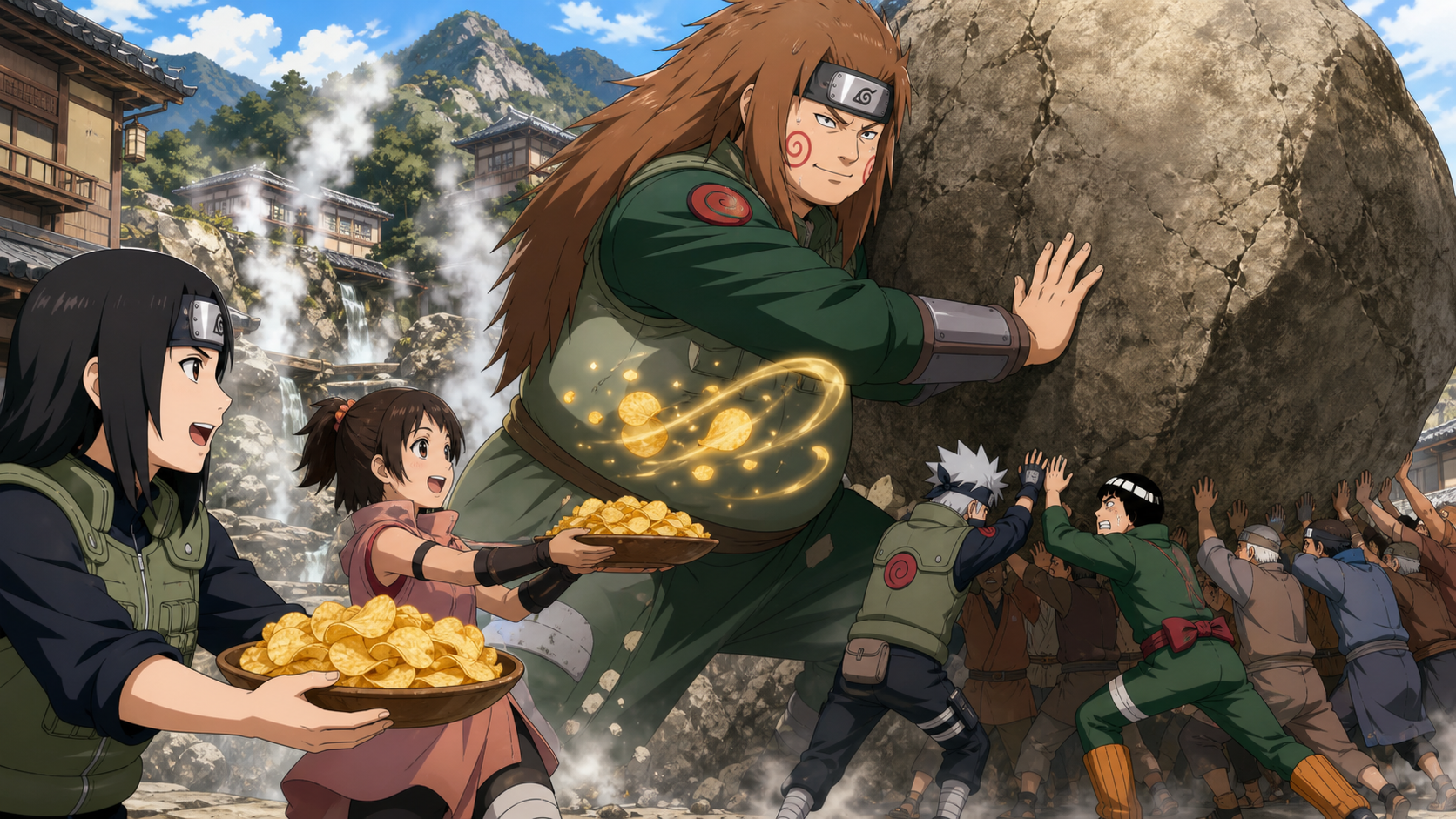
Boruto Episode 109 builds an entire rescue mission around a bag of chips and somehow makes the joke carry one of Mirai's most useful lessons about Asuma. “The Steam Ninja Scrolls: Potato Chips and the Giant Boulder!” brings Mirai, Kakashi, Guy, and Tatsumi to a mountain village whose secret hot spring sits under a massive fallen rock. Mirai tries raw strength, fails, and starts measuring herself against impossible standards. Kakashi calls Chōji, the obvious specialist, but Chōji arrives too hungry to use the Akimichi clan's Super Expansion Jutsu at full power. Roasted potatoes do not have enough fat, so Mirai and Tatsumi make chips from scratch while Chōji provides the most committed cooking commentary of his life. The food restores him. Chōji expands, the shinobi and villagers push together, and the spring flows again. That is the physical plot. The emotional story lives in the pauses. Chōji talks about Asuma's encouragement, the earrings he gave Team 10, and the question about the “king” that Shikamaru still will not let anybody answer for Mirai. Mirai wants facts about her father. Chōji gives her evidence of how Asuma made people stronger. Then Mirai does the same thing for a village without noticing that she has already learned part of the answer.
Shikamaru opens with the question he still will not answer
The episode begins with Shikamaru remembering a shōgi game with Asuma. Younger Shikamaru did not understand who the king represented. Adult Shikamaru knows, and he believes Mirai will understand when she is ready.
That restraint can feel maddening because Mirai has spent her life receiving Asuma in fragments. Everybody around her knows something she wants. Still, the king cannot become another fact copied into a notebook. The answer matters because a person grows into the responsibility behind the word.
Shikamaru is not hiding trivia. He is protecting the moment when the idea becomes hers.
Tatsumi asks which parent Mirai resembles
On the road, Tatsumi asks whether Mirai is more like her mother or her father. The question is ordinary for most children and nearly impossible for Mirai.
She knows Kurenai through daily life. She knows Asuma through stories, inherited techniques, photographs, and the way other adults pause when they say his name. How can somebody compare herself with a parent she never had the chance to observe?
Tatsumi does not mean to hurt her. Both girls are traveling through the shape of parental absence, so the question arrives without cruelty and lands with weight anyway.
The secret hot spring is buried under a month-old disaster
The village was supposed to offer a quiet, lesser-known spring. Instead, a giant boulder sits in the center of the settlement after falling from the mountain and crushing part of the community.
The rock has blocked the spring for a month. Villagers cleared mud and smaller debris, but the central obstacle remains too large. Tourism income, local routine, and a place the residents value all sit behind stone.
The episode refuses to treat the village as a cute travel delay. People have been living around this damage while waiting for help they do not expect to receive.
Yugakure has a worse emergency and the village knows that
Nearby Yugakure has been dealing with reports of young women disappearing. The villagers understand that missing people take priority over a blocked bath.
That detail quietly connects this light episode to the danger building underneath the Steam Ninja Scrolls arc. Tatsumi's hot-spring journey will soon move toward the same disappearances.
The villagers are not angry that Yugakure chose the larger emergency. They have simply accepted that nobody else will come.
The Land of Fire feels too far away to ask
Residents assume the Land of Fire would ignore a remote request or send low-ranking shinobi without enough authority to solve anything. Their expectation says more than a speech about peacetime government could.
Peace has not made every village equally visible. A small community can still disappear between jurisdictions, budgets, and assumptions about whose problem counts.
Mirai hears that resignation and immediately wants to prove the villagers wrong. Her mission does not require moving the boulder, but her understanding of duty cannot walk past people who stopped believing help would arrive.
Mirai tries the boulder alone because failure feels personal
She puts her strength against the stone and gets nowhere. The attempt is brave, stubborn, and tactically useless.
Mirai sees a problem and assumes a proper shinobi should possess the direct technique needed to solve the problem. When she cannot move the rock, she calls herself weak instead of asking whether strength is the right tool.
That habit comes from inherited pressure. Asuma's daughter should be capable. Kurenai's daughter should be perceptive. A Sarutobi should not need to admit that one body cannot handle a mountain.
Kakashi sees the debris field before Mirai does
He stops her from treating the boulder like an isolated object. Moving such a huge mass carelessly could trigger more rock, mud, and structural collapse.
Kakashi's contribution is judgment rather than spectacle. He surveys the risk, identifies the specialist, and contacts Chōji, who is already working nearby.
Experience means knowing that solving the visible problem can create a deadlier one. Mirai wants action. Kakashi gives the village a plan that will not bury rescuers under the next slide.
Chōji is the correct answer and arrives completely empty
The Akimichi Super Expansion Jutsu gives Chōji the size and force required to move the boulder. He reaches the village after another mission with no potato chips left and barely enough energy to stand.
Naruto has spent years using Chōji's hunger as a joke, but the Akimichi techniques make food operationally important. Calories become chakra. A depleted Chōji is not being dramatic about lunch. His clan's power runs on fuel.
The joke works because he can discuss chips with sacred seriousness while a rock crushes the village behind him.
Roasted potatoes are good food but the wrong fuel
An older resident offers potatoes cooked in an underground pit. Chōji eats them eagerly, but the dish lacks enough fat to restore the reserves his technique needs.
That distinction is funny and practical. Food is not one interchangeable resource. The technique asks for a specific energy load, and local ingredients have to be adapted.
Mirai cannot summon packaged chips to a remote mountain. She can learn how to make the required food from what the village has.
Mirai and Tatsumi make the mission in a frying pan
The girls slice potatoes and cook fresh chips while Chōji supervises from the floor with the energy of a man who may be dying but still has standards.
His commentary turns the cooking sequence into comedy, yet Mirai's response shows growth. She does not dismiss food preparation as work beneath a shinobi. The chips are mission equipment because Chōji's body needs them.
Tatsumi helps without being treated as baggage. One episode after Mirai brings her into the group, she contributes to the next village's rescue.
Chōji remembers Asuma through ordinary instructions
While they wait for the chips, Chōji talks about his teacher. Asuma smoked too much, spoke vaguely, and offered advice that made more sense after his students grew older.
That description gives Mirai something precious because Asuma stops being a polished memorial. He becomes an adult with habits, irritating communication choices, and lessons that took years to ripen.
Children of dead parents often receive a saint instead of a person. Chōji gives Mirai the person.
Team 10's earrings were trust made visible
Chōji explains that Asuma gave earrings to his students. The gift marked their bond and the tradition they carried forward as Ino-Shika-Chō.
Asuma did not build Team 10 by demanding instant perfection. He watched three children grow into complementary adults and gave them symbols of belonging before they fully understood the responsibility.
Mirai keeps looking for a single technique or phrase that will explain her father. Chōji's memories show a teacher who invested in people over time.
Homemade chips pass the only review that matters
Chōji questions the shape, which is exactly the sort of criticism one expects from the Leaf's leading potato-chip authority. Then he tastes them and approves the flavor.
The scene lets Mirai succeed at something small before the giant rescue. She could not move the rock. She could feed the person who could.
Support work is not lesser work. The boulder does not move without the chips, and the chips do not exist without Mirai and Tatsumi deciding that cooking counts as action.
Super Expansion turns calories into public infrastructure
Chōji enlarges his body and braces against the rock. The technique that once made him a target for cruel jokes now becomes the exact tool a forgotten village needs.
His body is not comic decoration. Akimichi physiology, training, and food knowledge create a rescue capacity nobody else in the group can replace.
The episode still enjoys the visual absurdity of a giant Chōji powered by handmade chips. Respect does not require removing humor from a character who has always loved food.
Everybody pushes because Chōji is not a machine
Kakashi, Guy, Mirai, Tatsumi, and the villagers join the effort. Chōji carries the greatest force, but the final movement belongs to the group.
That image answers Mirai's earlier failure. She could not move the boulder alone because nobody should have moved the boulder alone. Strength includes organizing enough hands around the right specialist.
The villagers who expected abandonment become participants in their own recovery rather than spectators waiting for a shinobi miracle.
Chōji spends the stored energy and comes out thinner
He converts calories into chakra for the last push. The boulder shifts, the spring returns, and Chōji's body visibly reflects the cost.
The transformation gives the rescue consequence. The chips were not a magical joke token. His body burned through real reserves to create enough force.
Chōji's power has always challenged the idea that one body shape represents laziness or weakness. Episode 109 lets his full form save the village and his slimmer form record the labor.
Mirai downplays the contribution only she could make
When the villagers thank her, Mirai insists she did very little. Chōji moved the boulder. Kakashi made the call. Everybody pushed.
Mirai misses the connective work. She refused to accept the village's resignation, found a way to fuel Chōji, involved Tatsumi, and kept the rescue moving when direct strength failed.
Leadership often looks small from inside because the leader sees every person who supplied a piece. The community sees who made the pieces meet.
Asuma encouraged Chōji before the jutsu worked
Chōji remembers struggling to master techniques and hearing Asuma's encouragement. His teacher did not wait for success before expressing belief.
That memory matters to Mirai because she knows Asuma as a heroic absence. Chōji knew him as the adult who stood beside failure and said growth was still coming.
Mirai does the same for Tatsumi and the villagers. She treats their incomplete effort as a foundation, not proof that they should give up.
The king remains a question Mirai has to live into
Chōji mentions Asuma's question about the king. Mirai asks for the answer, and he refuses because Shikamaru told him not to give the lesson away.
The choice frustrates her, but the episode has already staged the unnamed answer. A shinobi's duty centers the next generation and the people whose future depends on protection.
Mirai spends the day protecting a village that assumed nobody important would come. She helps Tatsumi continue a journey for her mother. She is not waiting outside the answer. She is already practicing that responsibility.
The restored spring gives both girls one quiet night
Mirai and Tatsumi soak after the work is finished. The bath is no longer simply a tourist reward. Warm water flows because an abandoned community, visiting shinobi, homemade food, and inherited trust joined together.
Tatsumi wanted to visit springs for her mother's memory. Mirai wanted stories about Asuma. Both receive something through a rescue neither expected.
The quiet ending gives them room before the arc's missing-women danger pulls Tatsumi toward a much darker promise.
A month-old blocked spring is an infrastructure failure, not bad luck forever
The landslide happened weeks earlier, and the village still cannot reopen a resource tied to local tourism and daily life. The boulder becomes more than a scenic inconvenience when recovery stalls without equipment or outside support.
Yugakure faces another emergency and must prioritize immediate danger. That choice explains why help is unavailable. The explanation should trigger a wider request rather than leave residents waiting indefinitely.
Regional authorities can coordinate engineers, earth-style specialists, evacuation crews, and funding after local capacity becomes overwhelmed. Distance from the Land of Fire capital should not decide whether one community receives disaster recovery.
The episode solves the blockage through lucky access to Chōji. A durable system cannot depend on a famous shinobi vacationing nearby with enough snacks.
Mirai treats the boulder as a test nobody assigned
Mirai tries to move the obstruction alone because Asuma's legacy, Kakashi's presence, and her misunderstanding about the mission have turned every problem into evidence of whether she deserves the assignment.
The boulder does not care about family pride. Repeated solo attempts waste chakra and risk injury without changing the available leverage.
Asking for help is not failure when the task exceeds one person's physical capacity. A skilled escort should assess terrain, identify specialists, protect civilians, and avoid becoming another person needing rescue.
Mirai's determination remains valuable. Leadership begins when determination serves the problem rather than the performer's fear of looking inadequate.
Local residents understand the consequence better than visiting shinobi
The villagers know how long the spring has been inaccessible, what the closure costs, and which routes or tools already failed. Their knowledge should shape any removal plan.
Kakashi can read the debris field. Mirai can provide security and labor. Chōji can supply extraordinary force. None of them should treat the community as an audience waiting for heroes.
Residents can identify safe work zones, downstream risks, and whether moving one stone may destabilize more material. Disaster recovery becomes safer when technical power listens to people who live with the terrain.
The restored spring belongs to the community. The mission succeeds when local life resumes, not when one shinobi receives applause.
Chōji needs fuel matched to the jutsu, not generic food
Super Expansion converts enormous chakra and stored calories into force. Roasted potatoes provide food but fail to create the immediate energy and familiar preparation Chōji needs after arriving depleted.
Mirai and Tatsumi make potato chips because they understand the difference between feeding someone and preparing a specialist for a specific task. Oil, salt, carbohydrate density, and emotional familiarity all matter.
The episode keeps the food funny while treating nutrition as operational logistics. Sending Chōji into high-output work without adequate fuel would be like sending another shinobi without weapons or water.
His appetite is not a moral flaw. His body and technique require resources that teammates should plan for rather than mock.
The frying-pan work makes Mirai and Tatsumi part of the rescue
Neither girl can lift the boulder through raw strength. They solve the constraint preventing the person who can move the boulder from using his technique.
Preparing chips requires ingredients, heat, timing, and persistence. The task appears domestic beside giant-jutsu spectacle, which makes the contribution easy to dismiss.
Mirai later downplays her role because she did not perform the visible final action. That instinct repeats a narrow definition of heroism where support disappears behind the person in the largest frame.
Chōji could not complete the work without fuel. The residents could not reopen the spring without removal. The result belongs to a chain rather than one giant hand.
Chōji's Asuma memory connects care to practical instruction
Asuma encouraged Chōji before the expansion technique worked reliably and understood that confidence needed concrete support. Team 10's earrings made trust visible, but daily teaching carried the relationship.
Chōji remembering ordinary instructions protects Asuma from becoming only the man who died. Mentors survive through habits students continue using long after formal lessons end.
Mirai receives another part of her father through someone who knew him as a teacher and teammate. The story does not give her a supernatural conversation. Chōji gives her lived evidence.
That exchange helps answer which parent she resembles without forcing one parent to win. Mirai carries Kurenai's genjutsu foundation and Asuma's protective orientation while becoming her own shinobi.
Super Expansion solves the force problem and creates safety obligations
Chōji's enlarged body can move the boulder, but massive force near unstable terrain may injure workers, damage buildings, or trigger another slide. The group needs clearance zones and coordinated pushing rather than treating the jutsu as a clean button.
Everybody joining the push matters emotionally and operationally. Smaller contributions stabilize movement, watch edges, and signal when conditions change. Chōji remains the primary force without becoming a machine others point at debris.
His consent and physical limits matter. The visible weight change after the technique shows a real bodily cost. Recovery food, rest, and medical monitoring should follow the public celebration.
Infrastructure repaired through one person's body still creates responsibility toward that person.
The king question remains a direction rather than a quiz answer
Shikamaru asks who the king is, repeating a lesson Asuma once gave Team 10. Mirai does not need a rehearsed answer to prove connection with her father.
The king represents the future generation and the responsibility to protect lives beyond personal glory. Episode 109 makes that principle practical through villagers, Tatsumi, and shared labor.
Mirai protects the future when she makes space for other people to contribute, preserves Chōji's strength through food, and helps restore a community resource.
Living into the answer matters more than reciting the sentence before experience gives the words weight.
Final reaction
“The Steam Ninja Scrolls: Potato Chips and the Giant Boulder!” should be disposable comedy. Chōji needs chips. Mirai cooks chips. Giant Chōji moves giant rock. The episode refuses to stop there.
Food becomes a real part of shinobi logistics. Chōji's body becomes specialized rescue power. A small village's political invisibility becomes the reason Mirai cannot walk away. Chōji's memories turn Asuma from legend into teacher, complete with cigarette smoke, vague advice, and patient faith in a struggling student.
Mirai begins the problem believing she lacks enough strength. She ends after doing the work that strength required: noticing neglected people, accepting specialist help, creating fuel, organizing cooperation, and refusing to take credit alone. The rock moves because Chōji is powerful. Chōji can use that power because Mirai and Tatsumi feed him. The village joins because somebody finally treats their problem as worth solving.
Shikamaru and Chōji keep the king's identity from Mirai, but the secrecy is almost funny by the closing bath. She has already chosen the village, Tatsumi, and the future over her own embarrassment at failing. She wants her father's answer. Episode 109 lets her become part of that answer first.
Sources and lawful viewing
Official episode reference: Naruto Official episode guide
Licensed episode route: Crunchyroll licensed series page