
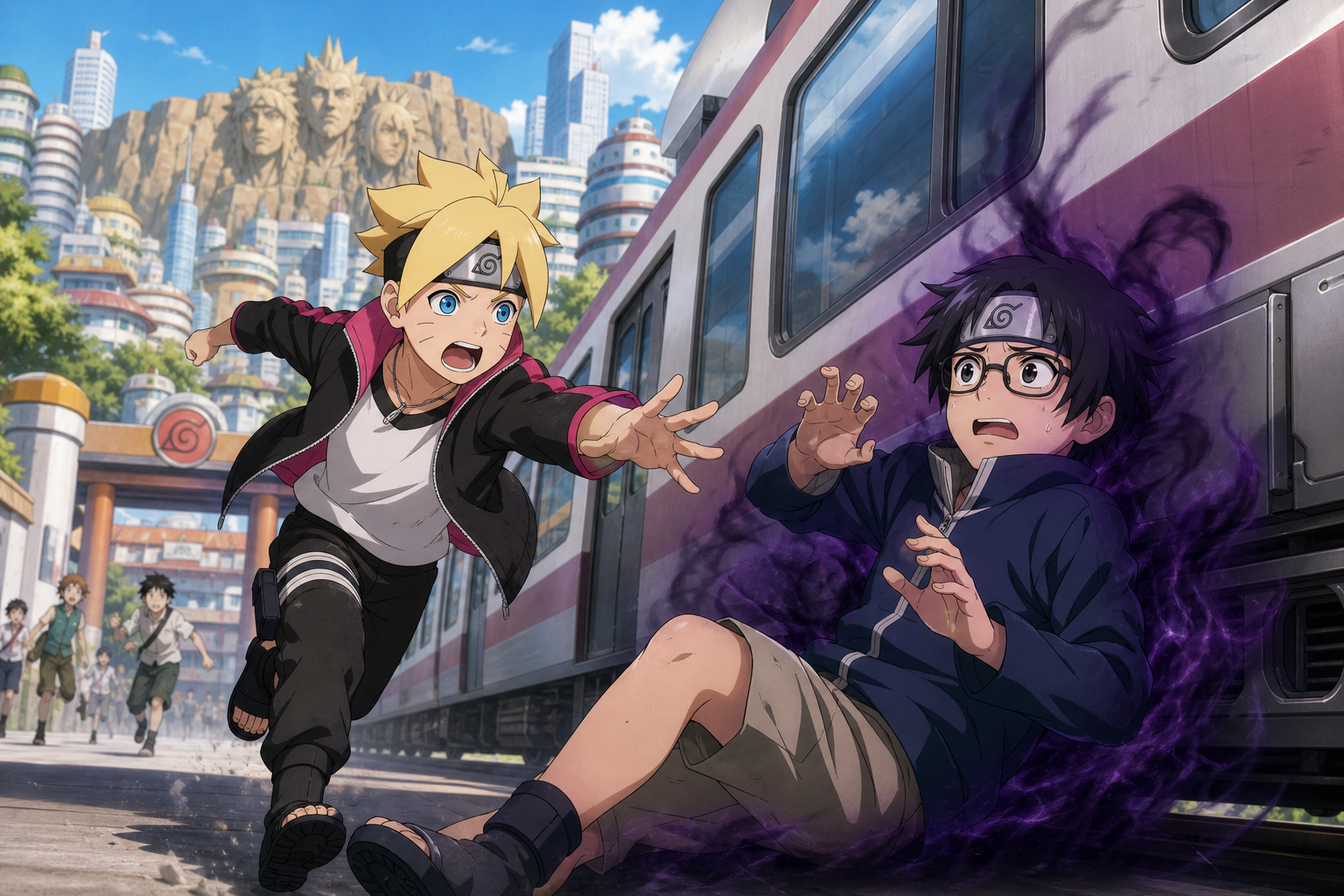
Boruto Uzumaki!
Boruto begins his story by saving Denki from bullies, an abusive idea of masculinity, and a runaway train. The ninja world has smartphones now. The children still inherit adult damage with the family name printed on top.
Series: Boruto: Naruto Next Generations
Episode: 1 · Boruto Uzumaki!
Arc: Anime episode
Release: 2017-04-05
Series position: Premiere · Start here
Directory: All 293 Boruto episodes
Bottom line
Boruto Episode 1 opens with a ruined Konoha and then rewinds to the bright village Boruto Uzumaki takes for granted. He meets Denki, sees dark chakra push another child toward violence, stops a train disaster through equal parts courage and terrible judgment, and crashes straight into the public monument representing his private anger at Naruto. The premiere succeeds because Boruto is neither a miniature Naruto nor a heartless spoiled heir. He is funny, talented, lonely, privileged, reckless, and already willing to risk himself for somebody nobody ordered him to save. Denki gives that instinct a human target. Kawaki and the flash-forward give the instinct a frightening future. Everything between those points begins with one child trying to become visible beneath the Hokage's name.
The ruined village comes before the bright one
The episode opens in a damaged Konoha with an older Boruto facing Kawaki above the Hokage Monument. Buildings have fallen, the village is scarred, and the age of shinobi is being discussed like something already ending. Then Boruto addresses the audience and pulls the story backward. He says this began when he was still a brat and, importantly, that the story belongs to him.
That declaration is doing franchise labor. Boruto lives under Naruto’s face literally and commercially. The sequel knows viewers arrived carrying years of attachment to his father. Boruto’s insistence on authorship is defensive before we know him, which makes perfect sense. Every child born to a legend enters a conversation already in progress.
The flash-forward also announces destruction before showing peace. Modern Konoha has trains, businesses, screens, crowded streets, and new construction. We are allowed to admire what Naruto’s generation helped build, but not assume that development ended conflict. Peace changed the tools and the pressure points. Development did not retire human suffering because a shopping district opened.
Scene-by-scene recap and RaeRae reaction
Young Boruto moves across the modern village with the ease of someone who has never known its streets as a battlefield. Rail lines cut through Konoha. Technology sits beside shinobi architecture. The village has expanded beyond the compact military settlement Naruto once ran through. Boruto treats that transformation as ordinary because modern Konoha is his ordinary.
His confidence is immediate. He is athletic, observant, mouthy, and completely uninterested in behaving like the Hokage’s son should behave. That last part matters. Naruto spent childhood trying to force the village to attach honor to his name. Boruto begins with too much honor attached to his. He wants room between “Boruto” and “Naruto’s son.”
This is not the same pain, and the series is better when the story refuses to pretend the pain is. Naruto was denied belonging. Boruto has belonging and doubts whether people see anything underneath the famous name. One child shouts to become visible. The other resists the visibility assigned before he speaks.
Boruto finds Denki being bullied. The immediate cruelty comes from other boys, but Denki’s deeper fear comes from home. His father wants him to become physically and emotionally tougher before entering the Academy. Denki understands technology and thinks carefully, yet those strengths do not satisfy the version of manhood being demanded from him.
The episode could have used Denki as a helpless prop who makes Boruto look cool. Instead, the premiere introduces a child whose intelligence belongs to the new Konoha economy. Rail systems, engineering, and business power matter in this world. Denki has useful ability. The adults around him have chosen a narrower scoreboard.
Boruto intervenes because he hates inherited scripts, even when the script belongs to somebody else. He does not deliver a perfect counseling session. He challenges the bullies, talks back, and tells Denki that his life should not be organized by fear of his father. The delivery is bratty. The principle is sound.
Boruto sees a strange shadow distorting Denki’s chakra. The visual introduces the eye ability the anime will build around him, but the moral point is more interesting than the mystery. The outside force amplifies anger, shame, and helplessness that already exist. The shadow does not create the family pressure or the bullying.
That distinction protects Denki from becoming “the nice kid who randomly turned evil.” His plan to retaliate grows from real injury. The supernatural influence lowers restraint and feeds obsession. The episode is not saying pain excuses harm. The episode says harm becomes easier to weaponize when nobody addresses the pain underneath the behavior.
This is a recurring Naruto-world pattern. Curses, beasts, seals, and alien powers matter, but they find leverage inside human relationships. The franchise keeps dressing pain in visible chakra because some viewers apparently need emotional damage to glow before admitting that damage exists.
Denki uses the new rail system to trap the bullies and push his revenge toward disaster. The setting is not decorative modernity. Technology increases scale. A conflict among children can now endanger passengers and crash through the village. Progress gives people better tools. Progress does not improve their judgment for free.
Boruto reaches Denki and refuses to reduce him to the dangerous thing he is doing. That is the episode’s strongest inheritance from Naruto. Boruto confronts behavior while still seeing the person. He does not need Denki to become innocent before deciding he deserves rescue.
The train sequence also lets Boruto act through improvisation rather than rank. He has not officially begun Academy life, yet his shinobi instincts, physical ability, and willingness to accept risk are already active. Like Naruto, he performs outside the institution before the institution certifies him. Unlike Naruto, he does so with family training, social capital, and a genetic résumé the village already respects.
Boruto notices the corrupted chakra through his right eye. At this stage, the episode presents the ability as a question rather than a complete system. That boundary matters. Later franchise language and fandom shorthand often call the eye the Jōgan, but Episode 1 itself gives viewers a visual phenomenon and Boruto’s confusion, not a technical manual.
The eye risks turning empathy into superpower: Boruto sees suffering because a special ability highlights the damage. Yet the episode avoids that trap because noticing the shadow is not the same as caring. Boruto still chooses to stop, ask, pursue, and help. Power supplies information. Character decides what to do with that information.
That is the better inheritance story. Boruto has gifts connected to his lineage, but lineage does not make the moral decision. If bloodline alone created virtue, the Naruto universe would have been a much shorter and stupider franchise.
Saving Denki does not deliver Boruto neatly to orientation. The train crashes into the Hokage Monument and turns his entrance into spectacle. This child cannot arrive at school without converting public infrastructure into a family conversation. Naruto vandalized the monument for attention. Boruto damages the monument while helping someone and still gets read through his father’s reputation.
The parallel is obvious enough to be intentional, but the consequences differ. Naruto’s prank announces exclusion. Boruto’s crash announces complicated privilege. His name may soften how some adults view the incident, while the same name increases public scrutiny. Privilege is not the absence of pain. Privilege creates an uneven distribution of protection, access, and consequences.
Denki decides to enter the Academy. That choice is the real payoff. Boruto does not rescue him into permanent dependence. He helps Denki recover enough agency to choose a path. The next episode can begin with social fallout because this one has already established the relationship.
A ninja village after the war
Boruto’s Konoha is proof that peace produces infrastructure. The older series treated travel as gates, dirt roads, forests, and mission time. This village has a rail system. Economic life is more visible. Corporate families such as the Kaminarimon household hold power beside shinobi clans and government offices.
That development changes what competence looks like. Denki’s technical intelligence would have seemed peripheral in Naruto’s Academy. In Boruto’s era, Denki’s skill belongs to the systems moving people through the village. The sequel’s strongest worldbuilding question is whether shinobi education can respect new forms of knowledge or whether the Academy will keep measuring children against wartime ideals.
The answer cannot be “technology replaces ninja” or “ninja tradition defeats technology.” Both are lazy. Tools enter existing power structures. A train can connect neighborhoods or become a weapon. Scientific ninja tools can expand ability or enable fraud. The human choice does not disappear because the interface got shinier.
Fathers, sons, and inherited definitions
The premiere places these families beside each other without pretending the problems are identical. Boruto has enough security to rebel loudly. Denki has learned to fold inward. Boruto’s intervention works partly because he recognizes the prison of somebody else’s name.
A Confucian reading makes the conflict sharper. Filial duty does not mean a parent can demand obedience without reciprocal care. Role ethics cut both ways. A child owes respect within the family, and a parent owes guidance that develops the child rather than protecting adult pride. Both fathers are publicly successful. The episode asks whether their authority is producing trust at home.
Boruto’s resistance is not automatically wisdom. He judges Naruto before fully understanding the scale of Hokage responsibility. Naruto also mistakes provision and public duty for enough presence. The relationship needs fewer symbolic victories and more ordinary time. Unfortunately, this family lives in an action franchise, so ordinary time is always the first budget cut.
The adults keep mistaking fear for weakness
Denki’s father and the bullies share a belief that fear must be beaten out of a boy. That idea produces concealment, humiliation, and eventually danger. Denki does not become brave because somebody insults him efficiently. He becomes able to act after another child treats his fear as information instead of proof of worthlessness.
Boruto’s version of masculinity is messy but more relational. He is competitive and physically confident, yet his first episode centers rescue rather than domination. He wins Denki’s trust by standing beside him. The train action matters because Boruto uses ability in service of another person, not because the sequence gives him a cool pose.
Denki is not weak because he feels afraid. He becomes braver after Boruto treats fear as useful information instead of proof that something is wrong with him. Denki names the pressure, accepts help, and chooses a next step. His father’s “stop being weak” demand only lets an adult dump his discomfort on a child.
Japanese performance and production
TV Tokyo’s original launch announcement credits Noriyuki Abe as chief director, Hiroyuki Yamashita as director, Makoto Uezu for series composition, Ukyo Kodachi for story supervision, Tetsuya Nishio and Hirofumi Suzuki for character design, Yasuharu Takanashi and YAIBA for music, and Studio Pierrot for animation production. The episode premiered in Japan on April 5, 2017.
Yūko Sanpei performs Boruto in the original Japanese cast, with Junko Takeuchi returning as Naruto. The official cast also includes Kokoro Kikuchi as Sarada, Ryūichi Kijima as Mitsuki, Nana Mizuki as Hinata, Saori Hayami as Himawari, Kenshō Ono as Shikadai, Ryōko Shiraishi as Chōchō, and Atsushi Abe as Inojin. Those credits establish that the sequel carries vocal continuity while building a new ensemble.
I am not inventing line delivery, breath, pitch, or comic timing without the heard Japanese scene. What can be said from the credited structure is that Boruto’s voice is designed to lead a generation rather than imitate Naruto’s exact vocal identity. Shared family energy does not require performance cloning.
What the premiere gets right
The premiere gives Boruto a moral action before asking us to tolerate his attitude. He helps Denki because he sees a person being cornered. That choice prevents the famous child’s arrogance from becoming his complete introduction.
The episode makes modernization part of the plot. The train, business family, screens, and expanded village change how conflict moves. This is not Konoha wearing a few gadgets like accessories.
The episode also treats Denki as a bridge between eras. His intelligence belongs to the peaceful village Naruto’s generation wanted to create, while his family pressure proves that peace does not automatically teach adults how to raise children.
Where I am already giving the sequel side-eye
The flash-forward promises catastrophe before the audience has learned to care about the peaceful world being threatened. The flash-forward is an effective hook and a giant franchise promise that destruction will return. “Do not worry, destruction is coming” should not be the only way to convince battle-anime viewers that domestic life matters.
The mysterious chakra shadow can also become an excuse if mishandled. Denki’s anger grows from home and the bullies before the shadow amplifies that anger. If the plot treats removing the shadow as solving the problem, the writing has learned nothing. His father, bullies, and fear remain after the glow leaves.
Finally, Boruto’s inherited talent needs accountability. The episode knows he is privileged, but the larger series must keep distinguishing confidence earned through effort from access provided by family, teachers, genes, and reputation. A protagonist can be gifted. The writing cannot act confused when other children notice.
Fandom arguments, because peace was never an option
“Boruto is just spoiled Naruto.” He is spoiled in specific ways, and he is not Naruto. That distinction is the point. His material and social security create different blind spots, not an absence of real emotional needs.
“Modern technology ruins the ninja world.” No. A village that survived repeated wars would logically develop infrastructure. The interesting question is how technology changes power, labor, education, and combat.
“Denki was weak.” Denki was afraid, bullied, and controlled. He also understood systems the Academy would increasingly need. Calling every untrained child weak is how adults keep confusing harm with curriculum.
“Naruto became a bad father.” Naruto’s absences hurt his family. His public responsibility and childhood history explain the pattern but do not erase its impact. Explanation is not acquittal, and criticism is not hatred.
RaeRae verdict
“Boruto Uzumaki!” works because the first person Boruto saves is not a legendary shinobi or a future vessel for destiny. Denki is a scared child whose strengths do not match his father’s fantasy. Boruto sees him before the Academy does. That is a credible foundation for a protagonist who insists this is his story.
The premiere is strongest when modernization and emotion share the same machinery. The train represents peace, development, family business, mobility, and sudden danger. The Hokage Monument carries Naruto’s achievement and Boruto’s resentment. Konoha looks brighter while the children reveal what adults still refuse to fix.
Overall: 8.4/10. A lively sequel premiere with a solid moral center, useful worldbuilding, and enough inherited baggage to fill the entire train.
The flash-forward refuses a comfortable sequel
The premiere opens by destroying the safest assumption a Naruto sequel could make. Konoha is damaged, Naruto is absent from the battlefield, and Kawaki speaks as though the age of shinobi has already ended. Boruto stands across from him wearing Sasuke's cloak and carrying consequences the bright Academy story cannot yet explain.
That opening changes every cheerful scene that follows. The clean village, the crowded streets, and the ordinary family arguments exist under a future the audience has already seen broken. Peace is real, but peace is not permanent scenery guaranteed by the previous generation's victory.
The choice also prevents Boruto from surviving on inherited nostalgia alone. Viewers may arrive to see Naruto's family, yet the series immediately promises a conflict built around Boruto's decisions, losses, and relationship with Kawaki. The old heroes matter. Their achievements do not remove the next generation's responsibility.
Denki's rescue defines Boruto before the Academy does
Boruto meets Denki before teachers, rankings, and classmates can assign him a reputation. Denki is frightened, cornered by his father's expectations, and vulnerable to the dark chakra Boruto barely understands. Helping him gives Boruto a first identity beyond the Hokage's son.
Boruto does not rescue Denki because a mission ordered him to intervene. He sees another child being pushed toward a life chosen by somebody else and recognizes the anger immediately. Their circumstances are not identical, but both boys resent fathers who define success without listening closely enough.
The train disaster shows Boruto's central contradiction. He will take an absurd risk to protect somebody and create an enormous new danger while doing so. His heart reaches the right person before his judgment catches up. Heroism and recklessness arrive in the same move, which is exactly the problem the series needs him to outgrow.
Naruto's monument becomes a family argument written across Konoha
Driving a train into the Hokage Monument is spectacularly irresponsible, and the target carries meaning beyond property damage. Naruto's face belongs to the village as a symbol of survival and achievement. Boruto experiences the same face as the public version of a father who keeps missing private life.
The collision makes resentment visible on the largest surface available. Boruto cannot force Naruto to sit at the table, but he can interrupt the ceremony surrounding Naruto's office. The stunt guarantees attention while making a productive conversation nearly impossible.
Naruto has every reason to impose consequences. Boruto has every reason to want more than discipline from him. The premiere refuses to solve that conflict because one apology would be dishonest. Their relationship will need repeated attention, and both of them are much better at dramatic action than ordinary repair.
Hinata keeps the household from becoming Naruto versus Boruto
Hinata understands the child who misses his father and the Hokage carrying a village that never stops asking. She does not pretend Boruto's stunt was harmless, and she does not reduce his anger to spoiled behavior. Holding both truths makes her the emotional adult in a house full of powerful people who communicate through collision.
Her presence also protects Himawari from disappearing inside the louder conflict. The family includes a younger child who experiences Naruto's absences and Boruto's reactions without controlling either. Hinata keeps daily life moving while father and son turn attention into a contest.
The premiere could have used her as a soft voice explaining the men to each other. Instead, the household scenes show practical authority. She knows Boruto's habits, recognizes the performance beneath his complaints, and expects accountability without withdrawing affection.
The first episode makes modern Konoha worth protecting
The train, technology, shops, and crowded streets establish a village that has changed because the original generation succeeded. Peace did not freeze Konoha in Naruto's childhood. People built infrastructure, expanded opportunity, and created problems that cannot be solved through wartime instincts alone.
Boruto's frustration grows partly from that success. He inherits safety without understanding the price that created safety, while adults sometimes use their sacrifices to dismiss what children need now. Both generations risk turning history into a weapon during ordinary disagreement.
Denki represents the new village especially well. His family belongs to technology and business rather than a famous combat clan, yet his choices matter to the shinobi future. The Academy will have to decide what strength means in a world where information, engineering, and social judgment can matter as much as a powerful jutsu.
The ruined flash-forward makes the bright city more than background. Every working train and ordinary street becomes evidence of something the characters can lose.
Sources and lawful viewing
Official episode reference: Naruto Official episode guide
Licensed episode route: Crunchyroll licensed series page