
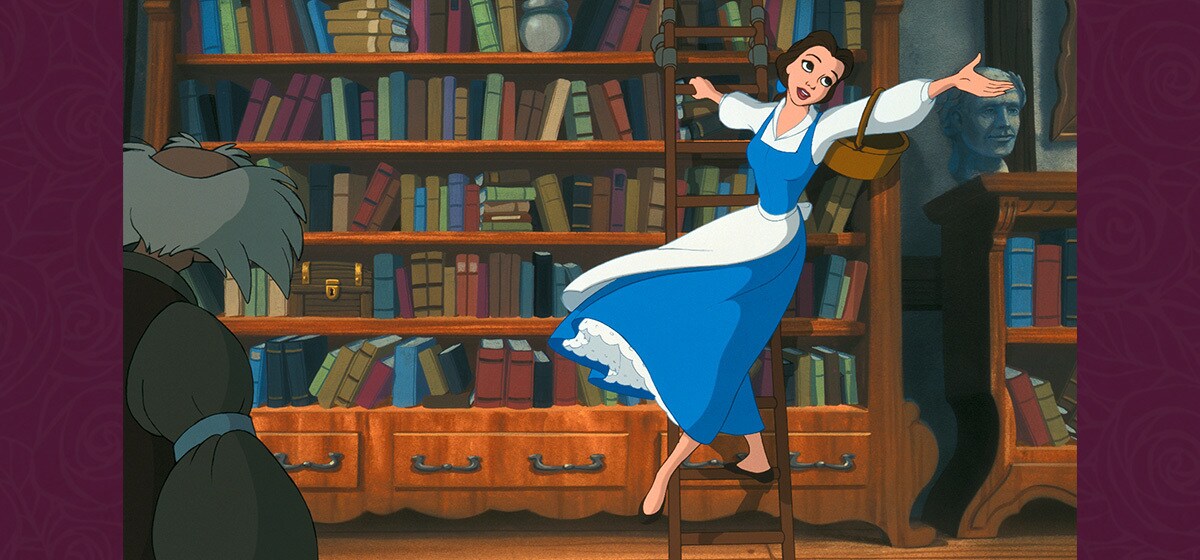
The Library Gift
He finally listened. One spectacular room still cannot do the work of an apology.
The library is a gift and a power transfer
Beast does not merely hand Belle one beautiful object. He opens a room containing thousands of voices, histories, arguments, and possible worlds. The scale makes the gesture feel romantic because he has finally noticed what gives her joy. Access to knowledge is also access to a resource his household controlled. The scene matters most when the library is understood as a transfer of use, not a glittering purchase meant to settle an emotional account.
Belle told the whole village what she wanted
Her opening song names books, faraway places, and a life larger than repetitive provincial expectations. The village hears those desires and translates them into eccentricity. Gaston hears them and imagines books disappearing after marriage. Beast begins to change when he remembers the information. Recognition is romantic because Belle has been legible from the beginning. The problem was never that her desires were mysterious. It was that the people around her considered them inconvenient.
Gaston treats reading as a defect to remove
He takes Belle’s book, interrupts her attention, and boasts that women should not read because independent thought threatens his preferred household. His imagined marriage contains children, hunting trophies, and service, but no intellectual life that belongs to Belle. The library becomes Gaston’s negative image. Beast does not need to understand every book she will choose. He needs to accept that her mind contains projects unrelated to pleasing him.
Beast asks Lumiere for help
The gift begins with a question about doing something special for Belle. Beast does not already know the answer, and the servants help him connect her interests to a meaningful action. Asking matters because his earlier leadership treated uncertainty as humiliation. Here, not knowing becomes the start of attention. He allows other people’s knowledge of Belle to improve his behavior.
The servants are facilitating their own rescue too
Lumiere and Cogsworth want the relationship to deepen because breaking the curse restores everyone’s bodies. Their advice can be affectionate and strategic at the same time. That dual motive complicates the gift without invalidating it. The library still answers Belle’s desire. The staff’s survival interest simply means viewers should not treat the castle as a neutral dating coach.
The room existed while Belle was forbidden to explore
Beast initially restricts movement and declares the west wing off limits. The castle contains abundance while Belle experiences captivity, uncertainty, and controlled access. Opening the library therefore reverses a pattern he created. It is not generosity floating outside the power imbalance. It is one step toward removing a barrier that should not have governed her life in the first place.
Belle’s wonder belongs to her
The camera gives her time to look upward, move through shelves, and absorb the scale. Beast watches rather than narrating what she should feel. That restraint preserves the reaction as Belle’s. He does not interrupt the joy to ask whether she likes him more now. A gift becomes less manipulative when the receiver is allowed to experience it without performing gratitude on demand.
A library is not an apology
Books cannot erase imprisonment, threats, Maurice’s treatment, or the danger that drove Belle into the snow. An extravagant gesture does not perform accountability automatically. The film uses the library as evidence of changed attention, not as a complete repair scene. Viewers should resist upgrading it into absolution simply because the room is gorgeous.
Recognition is still emotionally powerful
Belle has been treated as strange for loving stories. When Beast reveals a room built around the thing everyone else dismisses, she experiences being seen at the level of desire rather than appearance. That feeling can be transformative without settling the ethics of the relationship. People are allowed to treasure a moment of recognition and continue evaluating the person who offered it.
The books offer lives beyond the castle
Reading gave Belle routes out of the village before her body could leave. Inside captivity, the library restores access to distance, imagination, and intellectual movement. The gift therefore expands freedom symbolically even before Beast opens the castle door. It cannot substitute for physical freedom, but it returns part of the interior life confinement threatened to narrow.
Ownership language makes the moment unstable
Beast can say the library is hers because he controls the castle. That sounds generous and reminds us the resource was his to grant or withhold. A healthier future would treat the room as shared access rather than benevolent ownership. Belle’s joy should not depend on remaining pleasing enough for permission to continue.
The scene changes what wealth is for
The castle’s luxury previously expressed isolation. Vast rooms, furniture, food, and art could not create relationship because Beast used power to defend himself from vulnerability. The library becomes meaningful when wealth serves somebody else’s flourishing. Resources stop being scenery around a lonely ruler and begin participating in shared life.
Belle does not become materialistic for loving it
There is a lazy reading that treats her reaction as proof every woman can be won with the correct expensive gift. That ignores what the gift contains. Belle loves the library because it respects an established intellectual hunger. The emotional value comes from specificity, not price. A diamond necklace would not mean the same thing because it would not show that Beast listened.
Listening is the actual romantic action
The gift works because Beast remembers what Belle enjoys after conversations and shared time. Attention turns information into care. Listening also changes him. He must stop centering his deadline long enough to ask what might make her life larger whether or not the gesture immediately breaks the curse.
The scale risks swallowing Belle visually
Towering shelves make her appear small, emphasizing wonder and the overwhelming size of the collection. The architecture can read as freedom or as another form of castle power. Belle’s movement prevents the room from becoming a monument that dominates her. She climbs, reaches, selects, and turns scale into usable possibility.
A library is not neutral knowledge
Collections reflect who had wealth, which texts survived, what languages were valued, and whose stories were excluded. The movie treats abundance as universal without asking how the archive was built. That omission does not ruin the scene. It gives a deeper guide question: what would Belle add, translate, preserve, or challenge once the library becomes a living intellectual space rather than inherited decoration?
Belle could transform the collection
Her curiosity suggests she would not simply consume the shelves. She would organize discoveries, compare stories, ask where books came from, and notice gaps. The gift becomes more interesting when imagined as stewardship with agency. Belle is not a decorative reader placed inside a rich man’s room. She can become a maker of knowledge.
Maurice belongs in the meaning of the scene
Maurice encouraged Belle’s imagination even when the village mocked both of them. Her love of books exists inside a father-daughter relationship built on curiosity and mutual defense. The library does not replace that bond. It offers another environment where the part of Belle Maurice protected can expand. That is why Beast’s later willingness to help Maurice matters more than competing with him.
The scene exposes how little the village offered her
Belle did not demand a palace. She wanted conversation, stories, and the possibility of more. The village had books but treated her reading as evidence that she failed at womanhood. The castle’s library feels miraculous partly because ordinary society made ordinary intellectual respect scarce. That scarcity is a cultural failure, not proof only a prince could understand her.
The gift comes before informed freedom
Belle still does not know the full curse mechanics or the staff’s dependence on her feelings. She receives the room inside a relationship missing critical information. The emotional moment remains real. The secrecy remains a problem. Romance should not require us to forget that consent includes context, not only an immediate yes.
The library helps Beast practice non-transactional care
He wants Belle’s love because the rose creates a deadline. Every kind action risks becoming a strategy toward survival. The gift approaches sincerity when he does not demand a measurable return. Belle’s joy is allowed to be the immediate outcome, and Beast experiences pleasure in having understood rather than having secured a promise.
Giving access is different from making somebody indebted
A manipulative gift creates a ledger. The giver reminds the receiver of cost, sacrifice, or generosity whenever disagreement appears. The film does not show Beast using the library that way. He does not later argue that Belle owes him presence because he opened the doors. That restraint keeps the gesture from becoming a velvet chain.
The scene needs the later release to become trustworthy
If Beast kept Belle captive after the library, the gift would remain an upgraded room inside a prison. Beauty cannot convert confinement into freedom. When he later lets her leave for Maurice, the library is retroactively clarified as recognition rather than bait. He proves that access was not payment for surrendering the right to go.
Belle’s reading does not need to cure Beast
Stories often assign women the work of educating dangerous men into kindness. Belle’s intelligence can influence Beast without becoming a treatment plan she owes him. He must choose to learn from interaction, staff, consequences, and his own capacity for reflection. Her mind is not a rehabilitation service attached to her captivity.
The library is a fantasy of being understood accurately
Many viewers respond because the scene imagines somebody noticing the part of you other people trivialize and making space for it at full scale. That fantasy is not shallow. Being understood accurately is one of intimacy’s deepest pleasures. The challenge is remembering that accuracy must continue after the reveal, especially when interests create disagreement rather than cinematic wonder.
The books complicate the beauty-within slogan
Belle is attracted to interior life because she already values stories, thought, and imagination. The library gives the film a concrete language for looking beyond surfaces. Yet the slogan should not require her to ignore conduct. Inner goodness becomes meaningful only when behavior makes it accessible. Books can contain hidden worlds because readers consent to open them. People do not owe the same access to someone who harms them.
The reveal gives Belle a room without prescribing the book
Beast opens the doors but does not select one approved story and call the task complete. The abundance matters because it leaves choice with Belle. She can follow curiosity instead of performing interest in whatever he considers educational. That difference separates recognition from management. A controlling partner may support reading only when the reading reinforces his worldview. Real intellectual respect includes the possibility that knowledge will sharpen Belle’s disagreement, widen her ambitions, or help her imagine a future beyond the castle.
Books create privacy inside a crowded household
The enchanted staff are loving, anxious, and constantly present. Their future depends on the relationship, so Belle receives very little emotional space untouched by observation. Reading can restore an interior room nobody else controls. A library offers solitude without isolation. Belle can enter another mind, test an idea, and return when she chooses. That privacy is especially important in a castle where doors, hallways, meals, and even romance have been organized around Beast’s moods and the servants’ hope.
The room should belong to the household too
The curse transformed servants who had no role in rejecting the enchantress. If the library becomes Belle’s private treasure while the staff remain objects performing labor, the gesture reproduces hierarchy in prettier form. A repaired castle would treat knowledge as shared infrastructure. Chip should grow up with books. Mrs. Potts should have access beyond service. Lumiere and Cogsworth should not need a prince’s permission to learn. Belle’s love of reading can open the room outward rather than merely elevate her within the existing order.
The scene changes the meaning of grand gestures
Grand gestures become suspicious when they replace daily behavior. Beast’s gift works only because it sits among smaller changes: eating beside Belle, feeding birds, laughing in snow, receiving correction, and trying again after embarrassment. The library magnifies a pattern instead of manufacturing one. That is the standard the scene quietly establishes. Spectacle can celebrate repair, but it cannot create repair in the absence of listening, boundaries, and repeated conduct when nobody is applauding.
RaeRae’s final reaction
I understand why this scene owns people. Belle spends an entire village being told her mind is a problem, and then somebody opens a door to more books than she can count. I would need a minute too. But I am not letting one spectacular gift do the work of an apology, a released prisoner, and a rebuilt power structure. The library is a receipt that Beast listened. It is not the entire receipt book. A beautiful room cannot cancel the ugly choices that made repair necessary. What makes the scene romantic is not that he is rich enough to own the room. It is that he finally uses what he has to enlarge Belle’s world, then later proves the enlargement was not conditional by letting her walk out of it. That later choice is the receipt I actually trust completely right now.