
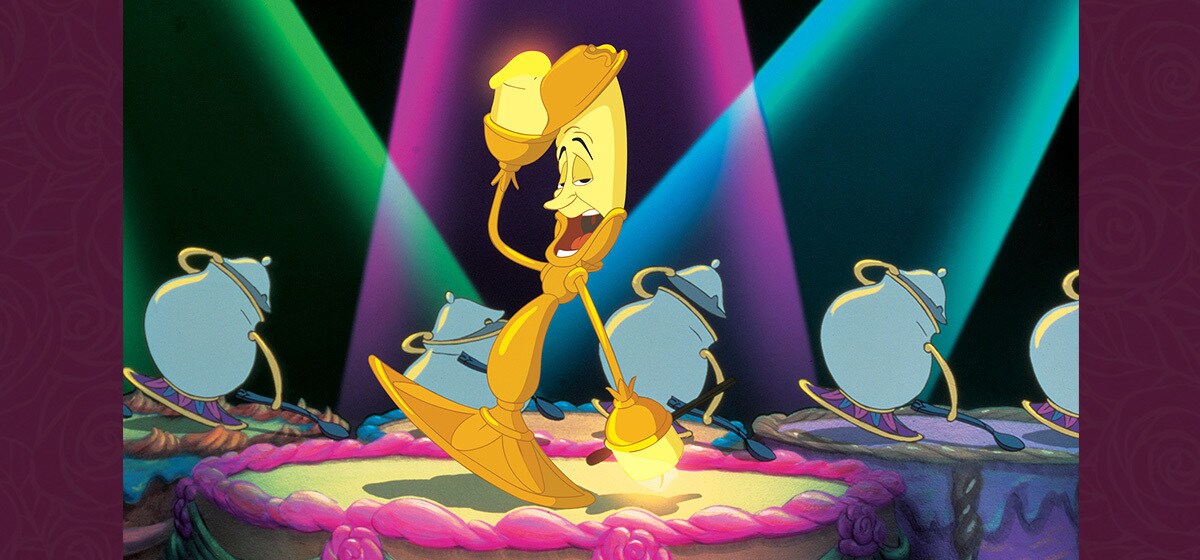
Be Our Guest
Belle needed dinner. The castle gave her a labor uprising with choreography.
Belle asked for dinner, not a Broadway rescue mission
Belle is hungry after refusing to dine with Beast, and the household answers a basic need with chandeliers, dancing plates, synchronized napkins, and enough choreography to make a health inspector resign. The comedy works because the response is hilariously larger than the request. That excess also tells us something uncomfortable. In this castle, ordinary care has become impossible to separate from the servants’ desperate need to create romance before the rose dies. Feeding Belle is kindness, strategy, performance, and workplace emergency at the same time.
Lumiere turns hospitality into rebellion
Cogsworth repeats Beast’s order that Belle cannot eat if she will not join him. Lumiere hears the same instruction and decides a guest does not stop being hungry because the master is sulking. His disobedience is playful, but the ethical choice is serious. Hospitality becomes a small refusal of authoritarian control. The servants use the limited agency left inside enchanted bodies to protect Belle from a punishment they recognize as cruel, even while they remain dependent on the man who issued it.
The song makes labor look effortless on purpose
Dishes arrive polished, courses appear instantly, and every object seems delighted to work. Musical spectacle hides the exhaustion required to create abundance, which is exactly what luxury hospitality often does. Guests see grace while workers absorb heat, timing, danger, and cleanup. The joke becomes darker because these workers literally are the furniture and utensils. Their transformed bodies turn service roles into anatomy. A plate cannot clock out from being a plate, and a wardrobe cannot step away from the room where somebody stores clothes.
The servants perform because their survival is attached to Belle
Lumiere wants Belle comfortable, but he also knows intimacy between her and Beast may restore every human body in the castle. The dinner is not a neutral welcome. It is part of a rescue plan whose stakes Belle has not been told. That hidden motive does not make the affection fake. It makes the relationship structurally unfair. Belle receives genuine warmth from people who cannot disclose how badly they need her feelings to develop in a particular direction.
Howard Ashman understood exposition as character
The number explains the castle, introduces personalities, establishes the servants’ collective rhythm, and gives Belle her first experience of joy inside captivity. None of that arrives as a lecture because every fact is carried by desire, joke, movement, or musical escalation. This is why the scene remains memorable beyond nostalgia. The song does story work while feeling like a glorious interruption. It teaches us who controls the castle socially even when Beast controls it legally.
Lumiere is the emcee because optimism is his coping mechanism
He refuses to let the curse reduce the household to waiting. Performance gives him a way to create momentum when the official plan has failed and the master has retreated. His confidence can look reckless, but passivity would leave Belle hungry and everyone hopeless. The number reveals optimism as labor. Lumiere manufactures possibility for other people, keeps frightened coworkers moving, and risks Beast’s anger so the room can remember what pleasure felt like before punishment became routine.
Cogsworth objects because somebody has to measure risk
His warnings are played for laughs, yet he understands the danger of disobeying Beast better than anyone in the room. A household under volatile authority often produces one person who tries to keep everyone safe by obeying every rule precisely. Lumiere and Cogsworth are not simply courage versus cowardice. They represent competing survival strategies. One creates freedom through improvisation; the other tries to prevent retaliation through control. Both developed under the same threat.
Belle finally gets to laugh without managing Beast
Earlier interactions require her to resist demands, protect Maurice, navigate locked rooms, and survive Beast’s temper. During the dinner, Beast is absent. That absence creates the first space where Belle can enjoy the castle without monitoring its ruler. Her pleasure belongs to her because she is not performing gratitude for him. The servants want a romantic outcome, but the immediate scene lets Belle eat, smile, and be entertained without negotiating his mood.
Food becomes the first language of safety
A meal cannot repair imprisonment, but hunger makes every other moral argument harder to process. The servants begin with the body. They offer warmth, variety, and attention after Beast tried to turn food into leverage. That choice matters because care is credible when it meets the need that exists instead of the need the caregiver wishes would exist. Belle did not need another speech about giving Beast a chance. She needed dinner.
The abundance is ridiculous because isolation has made it useless
The castle possesses fine china, wine, desserts, and an entire culinary workforce, yet nobody has enjoyed a normal guest in years. Wealth sits trapped in repetition until Belle gives it an audience beyond the curse. Her presence does not create the servants’ value, but it gives their skills somewhere to go. The number releases stored social energy. Hospitality becomes a reminder that these people had identities, pride, and community before enchantment reduced them to functions.
The enchanted bodies make every gag carry grief
A spoon diving into punch is cute until we remember the spoon may be a person. A napkin dancing is charming until we ask whether that body can stop. The animation constantly invites delight while the premise keeps whispering loss underneath it. That double register is the scene’s secret strength. Children can enjoy the choreography. Adults can notice an entire workforce turning bodily violation into a show because despair would be even less survivable.
Mrs. Potts makes care feel domestic rather than transactional
Her presence steadies the spectacle. Lumiere sells the event, while Mrs. Potts communicates that Belle deserves food because she is a person in the house, not because she passed a romantic test. The distinction is vital. A guest should not have to earn basic care through compliance. Mrs. Potts repeatedly models a household ethic that Beast has forgotten: authority does not erase responsibility toward somebody more vulnerable.
Chip turns the dinner into a family moment
Chip’s curiosity and excitement keep the scene from becoming only a seduction machine. He likes Belle because she talks to him as a child with a personality, not as a miraculous teacup. His participation also raises the stakes of the curse. This is not merely a group of adult employees seeking their jobs back. A child is growing inside an object while adults gamble on a romance he cannot fully understand.
The menu promises France without asking who can access it
The song celebrates cuisine, ceremony, and abundance as national charm. It offers an imaginary France where luxury is available on command and class disappears beneath choreography. The castle can perform universal welcome because invisible hierarchy pays the bill. Belle receives the fantasy version of aristocratic hospitality while the people producing it remain bound to property, title, and a prince’s emotional development.
The number is funny because consent keeps changing scale
Belle agrees to eat. She does not explicitly request an army of dishes, a spotlight, or furniture circling her chair. The scene treats surprise as harmless because she is delighted and can respond freely. That does not create a universal rule that bigger gestures are better. The ethical signal is her visible comfort. Lumiere watches and adjusts to her reaction instead of demanding that she appreciate the effort.
Spectacle gives Belle information words could not
The servants’ coordination shows a functioning community hidden beneath Beast’s rage. They tease one another, argue, take risks, and create beauty together. Belle learns the castle is not emotionally identical to its master. That discovery affects her later choices. Compassion for the household does not require romantic love for Beast, but it complicates the idea that leaving means abandoning only the person who imprisoned her.
Nobody tells Belle the truth during the party
The staff can sing about service for several minutes without explaining that they are humans under a curse, that the rose creates a deadline, or that her emotions are being treated as the possible cure. The omission protects the film’s pacing and weakens informed consent inside the story. Joy and manipulation can occupy the same room. A scene does not become ethically simple because the music is excellent.
The song turns waiting into collective action
The curse has trained the household to count years, watch the rose, and endure Beast’s despair. Preparing dinner lets them do something tangible. They convert anxiety into choreography and recover a sense of competence. Action can be psychologically protective even when it cannot solve the central problem. The number is a group refusing to let helplessness become their only culture.
Animation makes impossible hospitality emotionally legible
Live action can reproduce flying plates and digital candlesticks, but drawn animation lets objects bend, stretch, multiply, and synchronize without asking the audience to calculate physical credibility. The movement follows musical feeling before material logic. That freedom is not decorative. It lets the servants express human exuberance through nonhuman bodies. Their personalities push against the shapes imposed on them, which is the entire tragedy of the curse in miniature.
The choreography keeps Belle centered without making her responsible
Everything moves around her, yet she does not conduct the show. She is the recipient of communal energy, not the manager of it. For once, adults handle the crisis while she is allowed to experience pleasure. That is a generous choice after a plot that repeatedly asks Belle to solve other people’s problems. She protects Maurice, confronts Beast, and later becomes the curse’s emotional hinge. Dinner gives her a temporary break from unpaid salvation work.
Beast’s absence exposes the household’s better instincts
Without him in the room, rules loosen, food appears, jokes return, and Belle is treated as welcome. The contrast suggests the castle’s cruelty is not inevitable. It is enforced through one person’s authority and everybody else’s fear. That makes his later change more demanding. He does not need to invent kindness from nothing. He needs to stop obstructing a community that already knows how to practice it.
The cleanup is the part musicals never show
Hundreds of dishes, spilled drinks, collapsing towers, and exhausted performers disappear when the final note lands. The omission is funny and revealing. Spectacle depends on labor continuing after the guest leaves the frame. A deeper reading remembers the workers after applause. Hospitality should not require cheerful self-erasure, especially from people whose bodies have already been converted into tools.
Service is not the same thing as servitude
Lumiere takes pride in welcoming guests. Mrs. Potts finds meaning in care. Those preferences are not automatically false because hierarchy surrounds them. Work can contain craft, identity, and pleasure. The problem is the absence of choice. The curse and class system decide what bodies are for. Liberation would preserve skill and affection while returning the right to refuse, rest, change roles, or leave.
Belle’s appetite is treated as normal
Female characters are often allowed elegant bites while male hunger becomes comedy and abundance. Here, Belle sits down because she is genuinely hungry, watches course after course, and enjoys the meal without the story shaming her body. That ordinary permission contributes to the scene’s warmth. Intellectual desire and physical appetite coexist. Belle can love books and need dinner. Neither makes her less romantic or refined.
The party offers belonging before romance
The most immediate bond created by the song is between Belle and the household. She is welcomed into a community of personalities who have missed company, conversation, and celebration. That belonging matters independently of Beast. A franchise hub should not reduce every relationship to the central couple when the emotional architecture of the story depends on found family, labor, friendship, and shared survival.
The scene earns its joy by leaving discomfort visible
Beast is still dangerous. Belle is still confined. The servants still have motives they conceal. None of that prevents the dinner from being sincerely joyful. The movie lets pleasure happen before justice is complete. That is emotionally honest. People living under bad conditions still make jokes, cook, dance, and care for one another. Joy can be resistance without becoming proof that the conditions were acceptable.
The song is a promise the castle has not yet kept
“Be our guest” sounds like unconditional welcome, but Belle entered as a prisoner and remains subject to Beast’s rules. The number imagines the household the castle could become before its ruler has earned that transformation. Performance creates a temporary future in the present. For a few minutes, the castle behaves as though hospitality, freedom, and mutual delight are already normal. The rest of the film must catch up to the song.
RaeRae’s final reaction
I love this number because it is gorgeous, ridiculous, and doing far more emotional labor than a dancing fork should ever be asked to carry. Belle needed food. Lumiere gave her an event because subtlety left the castle years ago. I also cannot watch it now without seeing workers performing cheer while their bodies, freedom, and future depend on a prince learning basic emotional regulation. That does not ruin the fun. It explains why the fun feels so urgent.
The real magic is not endless dessert. It is a frightened household choosing generosity when obedience would have been safer. They feed Belle before Beast deserves credit, and for one song the castle remembers that care can be offered without making somebody beg for it.