
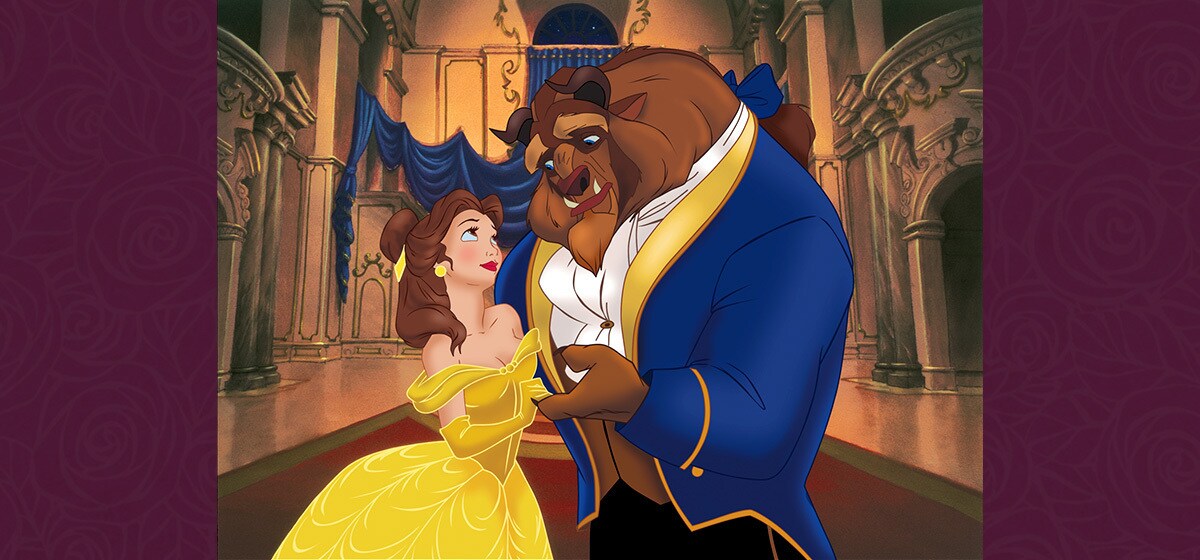
The Ballroom Dance
The dress is beautiful. The real romance is that Beast finally learned to listen.
The ballroom does not begin with the dress
The ballroom sequence begins after behavior has changed. Beast has stopped treating Belle’s presence as a debt he can collect through anger. Belle has seen him risk his life, struggle with gentleness, and learn to share space without demanding gratitude on command. That history matters more than the yellow dress. A beautiful room can decorate coercion just as easily as romance. The scene works because the movie spends time making the dance an invitation Belle can accept rather than another order issued by the owner of the castle.
Belle enters because she chooses to
Belle walks into the ballroom knowing who waits there. Nobody drags her down the stairs, threatens Maurice, or explains that the curse requires a dance before midnight. Her participation is legible as a choice. Choice does not erase the captivity that brought her into the castle. The scene cannot rewrite the bargain. It can show that the relationship inside that compromised beginning has changed enough for Belle to decide what she wants in this moment.
Beast is more frightened than commanding
His body still occupies enormous space, but his posture is tentative. He watches Belle for cues, adjusts his hands, and allows uncertainty to remain visible. The man who once filled rooms with volume now risks looking awkward. That awkwardness is not a cute accessory. It is evidence that control has loosened. Beast cannot guarantee Belle’s response, and for once he does not punish the discomfort of not knowing.
The dress becomes a public transformation
Belle’s yellow gown announces that the evening is different from ordinary castle life. The staff have prepared her, the architecture opens, and the color turns her into the visual center of a room previously defined by Beast’s isolation. But clothing should not be confused with character growth. Belle does not become worthy of tenderness because she appears in formal dress. The gown stages a transition the story already earned through conversations, meals, snow, books, and changed conduct.
The blue coat changes how Beast uses size
Beast’s formal coat contains his silhouette without hiding it. Broad shoulders, claws, horns, and fur remain present. The sequence does not require him to look human before intimacy can occur. What changes is movement. He makes room for Belle, bends toward her scale, and uses strength to support rather than intimidate. The same body communicates a different ethic because behavior alters what power feels like nearby.
Mrs. Potts sings from inside the curse
The title song arrives through a servant who was transformed for a prince’s failure. Mrs. Potts wants the relationship to succeed because her child, friends, body, and future depend on it. Her warmth therefore contains a pressure the romance cannot fully escape. Angela Lansbury’s performance makes the moment feel generous instead of transactional, but the structure remains. The staff are not neutral wedding guests. They are people watching their chance at restoration move across the floor.
The servants’ hope is loving and unfair
Lumiere, Cogsworth, Mrs. Potts, Chip, and the wardrobe care about Beast. They also need Belle to solve a catastrophe she did not create. Their encouragement can be sincere while placing impossible consequence on one young woman’s feelings. The movie softens that burden through comedy and affection. A deeper viewing should keep the receipt. Nobody should have to fall in love so an entire household can regain human bodies.
Belle does not know the full deadline
She knows the castle is enchanted but does not receive the complete operational truth about the rose, the deadline, or the requirement attached to her feelings. That missing information protects the romance from overt bargaining and denies her informed context. If she knew everyone’s bodies depended on her love, every tender response would carry institutional pressure. The secrecy creates emotional space while raising an ethical question the film never fully resolves.
The camera enters a space hand drawing could not move through easily
The ballroom’s computer-generated environment allows the viewpoint to sweep, rotate, rise, and follow the pair through architectural depth. Hand-drawn Belle and Beast move inside a digital room without the technology announcing itself as the subject. The technical achievement matters because motion produces feeling. Instead of observing a dance from a fixed proscenium, viewers seem to enter the room and orbit the fragile possibility forming at its center.
Technology serves intimacy instead of spectacle alone
A moving camera could have turned the sequence into a demonstration reel. The film uses it to make privacy feel expansive. Belle and Beast occupy a vast room, yet the movement keeps returning attention to hands, eyes, hesitation, and rhythm. That balance is why the scene became a landmark. The innovation does not replace character acting. It creates space where subtle acting can feel momentous without requiring louder dialogue.
The waltz teaches them mutual timing
Dancing requires attention to another body. Speed, distance, balance, and direction cannot be decided by one partner without consequence. Beast has to notice Belle rather than simply act near her. The waltz becomes a behavioral test. Can somebody accustomed to command participate in a form where leadership still requires response? His success is not perfect footwork. It is the willingness to adjust.
Belle leads more than the framing admits
Beast’s size and the conventions of ballroom dance can make him appear to lead. Belle sets the emotional conditions. Her comfort determines how close they stand, whether the dance continues, and when the interaction becomes playful. She is not passive because the movement is soft. Agency does not require rejecting every invitation or physically overpowering a partner. It appears in the ability to accept, redirect, pause, and leave.
The title song avoids promising permanence
The lyric describes change as old and surprising, not guaranteed. The melody observes something forming rather than declaring the curse already solved. That restraint gives the scene room to remain a possibility. Belle has not said she loves Beast. Beast has not earned a permanent claim. The dance is meaningful because it does not function as a signed contract for the ending.
Romance arrives through changed habits
Before the ballroom, Beast learns to eat without making Belle absorb his embarrassment, gives her the library without demanding payment, plays in the snow, and listens. The relationship grows through repeated ordinary corrections. The dance gathers those habits into one image. It would be empty if the film asked a gown, a song, and a polished floor to substitute for accountability.
The library is present even when it is offscreen
Giving Belle access to the books matters because Beast finally notices a desire that does not revolve around him. The gift is powerful when understood as recognition, not purchase. That distinction follows them into the ballroom. Belle is not dancing because a library bought consent. She is responding to a person who has begun to see her interior life and act without immediate reward.
Gaston is the romance’s negative image
Gaston also imagines formal union with Belle. He prepares a wedding, assumes her answer, and treats public spectacle as proof that private consent is irrelevant. His certainty leaves no room for her actual desire. Beast enters the dance uncertain and remains responsive. The comparison is not handsome man versus frightening creature. It is entitlement versus the capacity to hear no.
The scene does not erase Beast’s earlier violence
He imprisoned Maurice, accepted Belle’s exchange, restricted movement, screamed about the west wing, and frightened her into fleeing. A dance cannot cancel those actions. Character growth becomes meaningful when the past remains part of the evaluation. Belle can recognize change without pretending the harm never happened. Viewers can enjoy the scene while keeping accountability inside the romance.
Forgiveness is not the same as access
Belle allows closeness because Beast’s conduct has changed enough for her to want it. The film does not give us a formal apology adequate to every harm, which leaves some repair implicit. Her decision belongs to her, not to a universal rule that harmed women should reward improved men. One person’s chosen reconciliation cannot become a template requiring everyone else to reopen a door.
The ballroom makes isolation visible by contrast
Earlier castle spaces feel cold, shadowed, oversized, and empty. During the dance, light, music, movement, and witnesses fill the same architecture. The building has not changed shape, but relationship changes how it feels. That contrast clarifies the curse as social as well as physical. Beast’s punishment is not only fur and claws. It is a household organized around fear, suspended time, and a leader unable to participate in mutual life.
Chip watches a future adults keep negotiating
Chip is a child living inside a teacup body because of an adult ruler’s failure. His excitement reads as adorable, but it also reminds us who carries consequences while Beast learns. Children in damaged systems often become enthusiastic about signs of repair because their safety depends on adults sustaining change. The hope is genuine and heavier than the film’s cute framing admits.
The sequence lets quiet become evidence
Beast once used volume to control rooms. In the ballroom, long stretches require no spoken instruction. He trusts music, movement, and Belle’s expression enough to avoid filling uncertainty with demands. Quiet becomes one of the clearest signs of growth. He can remain present without forcing the moment to confirm what he wants it to mean.
The dance is not the curse-breaking act
The rose remains under glass. The household remains transformed. Belle can share a tender evening without producing the exact feeling the enchantress’s rule requires. That separation protects her agency. Enjoyment is not automatically love, and love is not automatically a magical resource others may extract on schedule.
Then Beast has to let her leave
The real test follows the ballroom. When Belle sees Maurice in danger, Beast opens the door and releases her even though her departure may condemn him and the staff to permanent transformation. Letting her go proves more than the dance. He acts for Belle’s need when the action directly threatens his own hope. Romance becomes credible when care survives the loss of control.
The mirror turns freedom into continued connection
Beast gives Belle the magic mirror so she can look back if she chooses. The object can function as surveillance in other hands, but here it becomes access she controls after leaving. He does not demand a promise to return. The gift acknowledges relationship without converting relationship into a leash.
The scene is beautiful because it remains morally unfinished
The ballroom is not proof that captivity was secretly good, that gifts erase coercion, or that attraction cures violence. It is one moment where changed behavior creates enough safety for mutual pleasure. The unfinished quality makes the beauty usable. We can celebrate what has grown while asking what repair still requires and why the staff’s freedom was attached to Belle at all.
The choreography makes trust measurable
Belle and Beast begin with visible caution. Their steps become smoother as each person learns the other’s pace, and the distance between their bodies changes without a sudden command from the story. The choreography lets trust accumulate in motion instead of announcing that an argument has been solved. Small adjustments matter because Beast could overpower the dance physically. He chooses control of himself rather than control of Belle. She responds by moving closer, smiling, and allowing the evening to become playful. Mutuality appears through a sequence of readable choices.
Howard Ashman’s story work keeps the song from floating away
The title song sounds timeless, but it is placed at a precise dramatic threshold. Belle and Beast have moved beyond open hostility, while the curse and Gaston’s threat still remain. The music honors possibility without pretending danger disappeared. That placement reflects Howard Ashman’s larger contribution to the film. Songs do not pause the story for decoration. They organize desire, conflict, social pressure, and change so the audience can feel structure before consciously naming it.
The room witnesses without interrupting
The enchanted staff watch from the edges, emotionally invested and barely containing hope. Their presence prevents the ballroom from becoming a sealed romantic fantasy. An entire household has history with Beast and a future tied to what happens next. Yet they do not enter the floor and direct Belle’s hands. The restraint is imperfect because they helped arrange the evening, but it gives the pair enough privacy to produce a moment that belongs partly to them rather than entirely to the curse.
RaeRae’s final reaction
Yes, the dress is gorgeous. Yes, the camera sweep still does exactly what Disney wanted it to do to my feelings. But the part that gets me is Beast looking nervous enough to listen. Belle does not owe him the dance because he saved her, fed birds, or opened a library. She chooses it because his actions have begun matching the gentleness he wants credit for. The ballroom works when it is read as evidence of change, not payment for improvement. Then the movie makes him prove it by opening the door. That is the receipt. Anybody can behave beautifully while the person they want is moving toward them. Love becomes real when he lets Belle move away.