
RaeRae Review · Beauty and the Beast · 2017
Disney Explained the Missing Mother, Fixed the Curse Math, and Still Could Not Manufacture the 1991 Film’s Pulse
The remake is lavish, intelligent in places, and determined to answer every question. Explanation gives Belle history and the Beast a song. It also turns mystery into production design with receipts.
Review receipt
Film: Beauty and the Beast (2017). Director: Bill Condon. Screenplay: Stephen Chbosky and Evan Spiliotopoulos. Music: Alan Menken. Original lyrics: Howard Ashman. New lyrics: Tim Rice. Principal cast: Emma Watson, Dan Stevens, Luke Evans, Kevin Kline, Josh Gad, Ewan McGregor, Ian McKellen, Emma Thompson, Audra McDonald, Gugu Mbatha-Raw, Stanley Tucci, and Hattie Morahan.
This is a spoiler-complete editorial review. It examines Belle’s invention and mother, the Beast’s education, the enchantress, the servants’ culpability, Gaston’s war history, LeFou, the Paris trip, the new songs, photoreal enchanted objects, captivity, consent, the mob, transformation, and whether fidelity can become a creative cage.
The remake opens by making excess the prince’s original language
The 2017 prologue turns the prince’s life into a decadent party. Makeup, clothing, music, bodies, and performance establish vanity as a social system rather than one cruel answer at a door. The enchantress enters a room already organized around looking.
This gives the curse more context and makes the prince visibly adult, repairing the original film’s awkward age arithmetic. It also shifts blame toward a whole court that participated in his culture before becoming household objects.
The servants are cursed because they failed him, and the fix creates another problem
The remake suggests the staff bears responsibility for raising or enabling the prince. That explanation answers why innocent workers share punishment. It also treats servants as accountable for an aristocrat whose legal and economic power exceeded theirs.
A household can enable abuse without every worker possessing equal freedom to oppose the master. The revised curse exchanges arbitrary collateral damage for a class argument the film does not fully examine.
The enchantress stays inside the story this time
Agathe appears as the village beggar, observes events, aids Maurice, and returns at the climax. The moral authority behind the curse is no longer a prologue device who disappears after sentencing everyone.
Her continued presence creates accountability and surveillance. It also makes the villagers’ treatment of poverty part of the test. The community ignores the person with the power to transform their world because they have already decided she does not count.
Belle is an inventor because the remake wants visible modern competence
She builds a washing mechanism so repetitive labor can release time for reading and teaching. The choice links her to Maurice while giving intelligence a physical result. She does not only consume books; she designs systems.
The village responds by destroying the machine. Their hostility becomes institutional rather than conversational. Belle threatens gendered labor because an invention reveals that drudgery is not destiny.
The washing machine is a good idea the film abandons
Its destruction demonstrates how communities enforce roles through access to labor and time. A device that would let girls read is treated as disorder. The scene gives Belle a political conflict larger than being called odd.
Afterward, the film rarely returns to her engineering. The castle’s abundance makes the problem disappear. Modernization becomes character branding rather than an arc about what Belle might build with resources.
Emma Watson’s Belle is guarded before the castle
Her performance emphasizes observation, reserve, and refusal to perform warmth for a village that polices her. This Belle seems less swept away by books and more consciously managing a hostile environment.
The approach supports the invention subplot and makes Gaston’s attention feel immediately unwelcome. It can also reduce the vocal and emotional buoyancy that made the 1991 opening feel like thought becoming song.
Autotune becomes audible because the songs were never decorative
The musical material requires speech, breath, character, and rhythm to move together. When vocal correction becomes perceptible, it reminds the listener that a performance is being engineered toward a familiar recording.
Technical polish is not automatically dishonest. The problem is that these songs carry psychology. A too-smoothed line can preserve pitch while flattening the small instability through which desire sounds alive.
Kevin Kline gives Maurice dignity before the plot threatens it
This Maurice is a skilled artist and craftsman rather than a broad comic inventor. His relationship with Belle contains shared grief, mutual protection, and a quieter domestic rhythm. The village’s dismissal becomes less about slapstick eccentricity and more about vulnerability.
The change makes the asylum scheme feel even more clearly manufactured. Gaston cannot rely on Maurice appearing ridiculous enough to discredit himself, so coercion has to become deliberate.
The missing mother becomes a question both father and daughter avoid
Belle knows Maurice has withheld the circumstances of her mother’s death. His silence is protective and isolating. She wants knowledge not only for curiosity, but because her own identity has been built around a blank space.
The remake uses this absence to connect Belle and the Beast through parental loss. Shared grief offers intimacy beyond books while adding explanatory machinery the original did not need.
Gaston returns from war with a community ready to reward him
The remake gives Gaston military history and moments when anger must be managed. Luke Evans makes charm, command, vanity, and danger occupy one disciplined body. The village admires a hero whose violence has already received public legitimacy.
War does not excuse entitlement. It explains why leadership language comes easily and why a mob can be organized like a unit. His private rejection becomes a campaign.
Luke Evans understands that Gaston should be enjoyable before he is terrifying
His singing carries theatrical confidence, and his physical performance treats every room as an audience. Gaston’s humor is not a separate phase before villainy. It is the method by which villainy stays socially welcome.
The remake occasionally signals darkness too early, but Evans preserves enough pleasure that the tavern’s admiration feels plausible. Communities follow people who make domination look like entertainment.
LeFou is given conscience without enough freedom
Josh Gad’s LeFou notices Gaston’s cruelty, redirects rages, expresses attraction, and eventually changes sides. The film advertised a small step in queer representation that arrives mostly through implication, jokes, and a brief final dance.
The character receives moral movement but remains attached to the man harming him until the climax. His queerness becomes publicity larger than the text was willing to risk.
The village dress incident turns gender nonconformity into a contested joke
Madame de Garderobe dresses attackers during the castle battle. One man appears delighted instead of humiliated, modifying the 1991 gag. The moment allows pleasure where the original depended more heavily on panic.
It remains extremely brief and structured around involuntary clothing. A generous reading can see recognition; a cautious reading can see a joke asking for credit as representation without giving the character a life.
Maurice taking a rose returns to older fairy-tale logic
The original film imprisoned him for trespass and shelter. The remake has him take a rose promised to Belle, reconnecting the bargain to source traditions in which the requested flower triggers the Beast’s claim.
The change gives the object narrative weight and makes Maurice’s act understandable. It still leaves the Beast responding to a small theft with indefinite imprisonment.
Belle’s exchange remains coercion despite the improved backstory
She chooses the cell to save Maurice inside a threat the Beast created. More dialogue, richer sets, and a more articulate captor do not make the bargain free. The remake preserves the original moral problem because fidelity depends on it.
Belle’s ingenuity in switching places helps agency at the level of action. It cannot remove the power imbalance defining the choice.
Dan Stevens gives the Beast language earlier
This Beast reads, argues, jokes, recognizes literature, and communicates with greater verbal precision. Shared intellectual interest makes the developing bond more explicit. Belle finds a reader rather than teaching a barely social creature to converse.
The gain is compatibility. The loss is the visible behavioral distance the 1991 Beast had to travel. A polished wit can make captivity feel less frightening without making it less real.
The Beast mocking Belle’s favorite romance is useful friction
He does not instantly admire her taste. Their literary disagreement creates personality and gives Belle somebody capable of meeting her on the terrain the village dismisses. Attraction begins through argument rather than gratitude.
The exchange also humanizes him before he has earned moral trust. Intellectual compatibility can coexist with abusive power, which is why the release still matters more than the banter.
The enchanted objects gain detail and lose readable faces
Photoreal materials, ornament, metal, porcelain, feathers, fabric, and mechanical transformation make the household technically impressive. Their designs appear integrated into a live-action castle instead of resembling animated characters pasted into it.
Complexity can reduce instant expression. The 1991 shapes communicated emotion through clear silhouettes and large facial changes. Realistic objects ask voices and camera placement to carry work simple drawings accomplished in a glance.
Ewan McGregor’s Lumiere performs around the design
The voice supplies warmth, charm, rhythm, and mischief that the ornate candelabra body cannot always express easily. Lumiere remains a host because the performance creates movement beyond the metal.
His French accent exists in the theatrical register of the remake rather than historical realism. The film wants recognizability, not a linguistically consistent French village in which most principals speak British English.
Ian McKellen’s Cogsworth makes anxiety sound like accumulated service
His dry timing and irritation give the clock a sense of adult history. Cogsworth is not only afraid of rules; he understands the household’s decline and the danger of another failed opportunity.
The remake’s additional servant culpability makes his caution more morally complicated. He may be managing a prince he once failed to challenge, but the power he ever possessed remains unclear.
Audra McDonald gives Garderobe an interior scale larger than the wardrobe
Her voice carries operatic authority, grief, comic size, and romantic longing for Maestro Cadenza. The remake expands the household by giving transformed servants relationships threatened by bodily decay.
This is one of the adaptation’s strongest additions. The curse separates partners and makes furniture transformation progressive, allowing the cost to become more than waiting in whimsical bodies.
The servants becoming less human raises the deadline’s physical stakes
As petals fall, the objects lose mobility and recognizable features. The curse is no longer a stable condition that becomes permanent at the end. It is an ongoing erasure of personhood.
The visual rule makes their desperation legible. It also intensifies the ethics of relying on Belle. Her romantic decision becomes the only barrier between an entire workforce and oblivion.
“Days in the Sun” gives the household memory outside service
The new song lets servants recall human lives, the young prince remember his mother, and Belle consider hope inside captivity. It links several forms of loss without turning them into identical experiences.
The number adds emotional history the original compressed. Its quieter register fits the remake’s desire to explain why these people keep believing change remains possible.
The prince’s dying mother introduces another failed parent
He loses a loving mother and remains with a cruel father who shapes the adult the enchantress later condemns. The backstory gives his damage a lineage. It does not make the household’s suffering deserved.
Explanations can invite compassion before accountability. The film generally preserves the distinction, but the cumulative backstory sometimes works harder to defend him than to examine the people he harmed.
The enchanted book turns travel into memory therapy
The Beast shows Belle a magical atlas that can transport them anywhere. She chooses Paris and the room where her mother died. The sequence gives Belle truth Maurice could not speak and lets the Beast accompany rather than direct her grief.
The device expands the magic system while creating a major question: if instantaneous travel exists, why has the Beast not used it to change circumstances or seek help? Fairy tales tolerate selective magic more easily than explanatory remakes.
Paris gives Belle a past and Maurice a morally complicated silence
She discovers the plague mask and understands that her mother died during an epidemic after urging Maurice to flee with the baby. His withholding came from trauma and protection, not indifference.
The scene is moving because objects carry historical terror. It also closes a mystery Belle may have needed to discuss with her living father, converting relational work into magical evidence.
The Beast shares the Paris grief without claiming it
He watches Belle learn, offers presence, and does not turn her loss into a speech about his own mother. Shared experience creates connection through restraint.
This is an important evolution from the captor who organized every early interaction around his needs. Empathy appears as the ability to accompany a feeling without becoming its center.
“Evermore” finally gives the Beast a complete solo
The stage musical had already recognized that the character needed an interior musical statement. The film gives him a new Menken and Rice song after releasing Belle. He sings from loss without trying to call her back.
The number strengthens the central act of love. Freedom hurts, and he accepts the hurt. The castle architecture turns isolation into scale while the vocal line lets longing remain active rather than possessive.
The song’s best idea is that Belle’s absence does not end her influence
The Beast imagines her moving through the world while remaining present in his perception. Love changes the person who stays behind without requiring the loved person’s physical captivity.
That is the moral answer to the curse. He can carry relationship without owning proximity. “Evermore” states what the release scene means.
“How Does a Moment Last Forever” organizes memory across generations
Maurice’s music box, Belle’s mother, the Beast’s lost childhood, and the film’s concern with preserving people through objects meet in the song. Memory becomes craft, repetition, and chosen story.
The theme also describes the remake’s existence. Disney attempts to make a 1991 cultural moment last through new bodies, technology, performers, and commercial scale. Preservation can honor and flatten at once.
The remake keeps “Be Our Guest” because fidelity is the main event
The number expands through digital transformation, camera movement, food, surfaces, and impossible choreography. It is designed to reproduce recognition while demonstrating what newer tools can add.
Technical abundance sometimes crowds the underlying loneliness of a household performing for its first guest in years. More visible objects do not automatically create more emotional information.
Emma Thompson wisely avoids copying Angela Lansbury note for note
Her Mrs. Potts is warmer, more conversational, and connected to a visible human family the curse threatens. The title song still carries enormous inherited expectation, but the performance finds its own maternal steadiness.
Comparison is unavoidable because the arrangement and scene remain so close. The remake asks actors to be distinct inside a structure built to trigger memory of definitive voices.
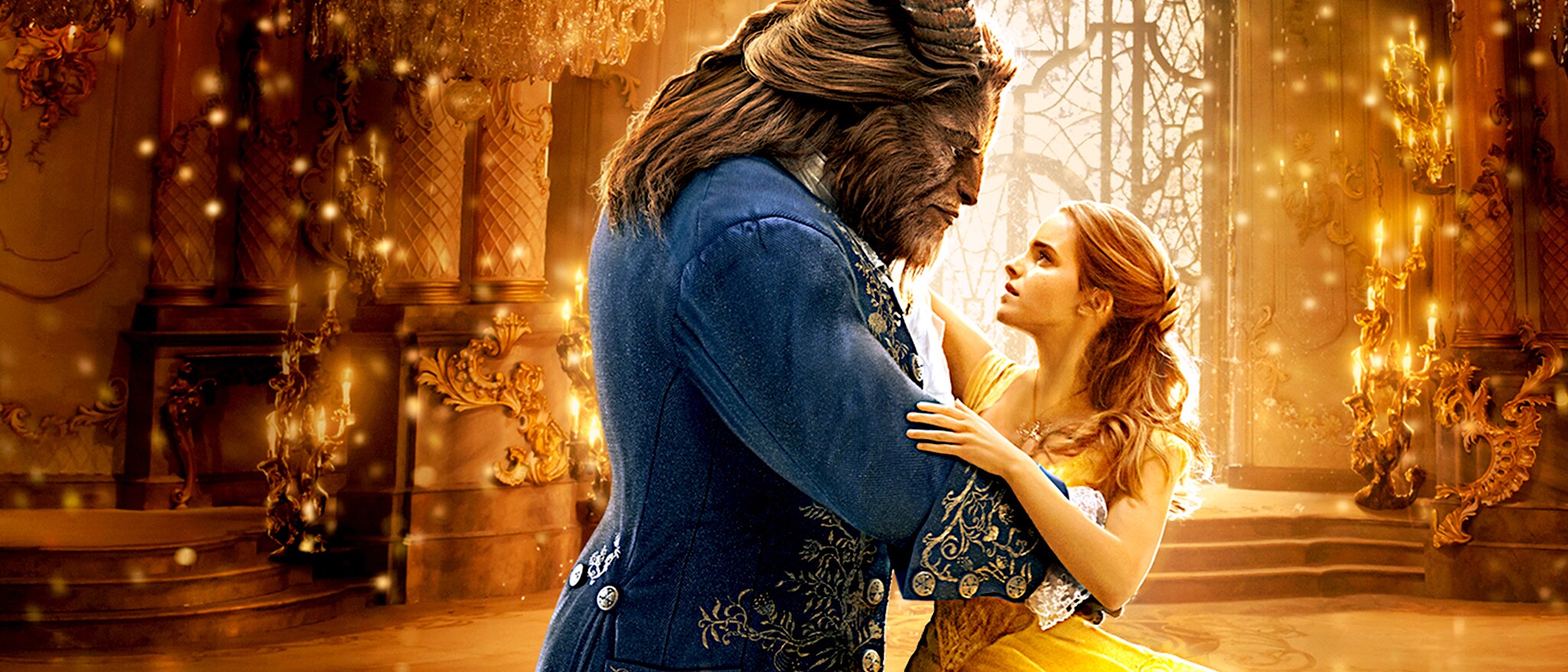
The ballroom is luxurious and less miraculous
Costume, set, lighting, visual effects, and camera create a tactile courtly space. Belle’s gown moves as real fabric, and the Beast’s digital body shares physical floor and light. The craft is considerable.
The 1991 ballroom changed what viewers thought animated space could do. The remake’s sequence is beautiful inside an industry already fluent in digital environments. Fidelity reproduces composition without reproducing historical surprise.
The yellow dress became a cultural argument before the dance began
The gown had to reference an iconic animated shape while functioning on Emma Watson’s body and within modern costume expectations. Choices about corsetry, movement, material, and silhouette became symbolic claims about Belle’s agency.
No dress can solve the politics of the scene. Freedom depends on whether Belle can leave, not whether the garment looks less restrictive. Costume can support character without becoming proof of feminism.
Foundation verdict
The 2017 film improves continuity, gives Belle a maternal history and mechanical skill, gives the Beast a genuine solo, gives servants relationships and progressive bodily loss, and makes Gaston’s public authority more politically legible.
It also explains mystery into machinery, reproduces the original’s moral problems at greater length, and sometimes mistakes photoreal detail for emotional depth. Foundation verdict: thoughtful additions inside a remake too loyal to escape comparison, with real feeling whenever it stops proving how carefully it remembered the earlier film.
A remake can be faithful to scenes and unfaithful to velocity
The 2017 film preserves iconic lines, compositions, songs, costumes, plot turns, and character functions while adding nearly forty-five minutes. The sequence is familiar, but the rhythm changes. Explanation occupies space the animated film used for compression, gesture, and musical momentum.
Longer is not automatically deeper. A new scene earns its place when it changes how later choices read. The Paris visit does. Some connective dialogue merely confirms what the audience already understood through animation.
The project’s central commercial promise is recognition
Disney sells the pleasure of seeing a known animated world acquire physical texture, famous actors, elaborate sets, fabric, digital creatures, and expanded songs. The audience is invited to compare at every turn because resemblance is the product.
That arrangement makes creative independence difficult. A radically different adaptation could justify itself artistically and fail the recognition contract. The film’s caution is not only a directorial preference. It is industrial strategy.
The castle is designed as memory made expensive
Rooms echo animated layouts while adding carvings, stone, metal, fabric, grime, candlelight, and vast architectural depth. The environment communicates aristocratic wealth and supernatural decay with extraordinary craft.
Physical detail creates credibility and can make the prison more seductive. The better the room looks, the easier it becomes to mistake access to luxury for freedom. Belle remains confined even when the camera admires every surface.
Belle’s practical pockets became a feminism headline
Costume discussion emphasized movement, boots, lifted skirts, and pockets as signs that this Belle could act rather than pose. Those choices support the inventor characterization and help Watson move through village and castle spaces with purpose.
Pockets cannot carry the full political burden assigned to them. Agency comes from decisions, resources, and freedom. A costume feature is useful when it serves action, not when publicity treats it as proof the adaptation solved gender.
The blue village dress quotes animation while changing material life
The familiar silhouette and color make Belle instantly legible. Layers, stitching, aprons, bodice, and boots translate a drawing into clothing that must survive weather, labor, and movement. Costume turns an icon back into an object someone wears.
The translation reveals the remake’s best craft question: what would this shape need to become if a body lived inside it? Fidelity becomes interesting when practical consequence alters design.
The yellow gown carries too much inherited expectation
It must trigger recognition, move through the ballroom, photograph as luxury, appear modern enough for publicity, and remain distinct from the animated dress viewers remember as almost pure shape. No material solution can reproduce the drawing’s impossible simplicity.
The result is judged less as a costume than as a cultural referendum. That burden shows how thoroughly the earlier film converted design into memory. The remake cannot merely dress Belle; it has to negotiate ownership of an icon.
Dan Stevens performs through capture, prosthetic scale, and voice
The Beast exists through a hybrid process rather than a costumed actor alone. Stevens supplies movement and performance data while visual-effects artists construct the final body. Voice, eyes, posture, and timing must survive translation across departments.
When the result works, the Beast feels physically present and emotionally specific. When it does not, viewers notice the processing before the thought. Photoreal creatures demand subtle integration while animated designs can declare expression more openly.
The Beast’s face is more human and less graphically elastic
The design preserves horns, fur, fangs, muzzle, and aristocratic clothing while keeping eyes and facial proportions capable of recognizable performance. It avoids a fully animal face that might make romance visually harder for a mass audience.
That compromise reduces some of the 1991 character’s enormous emotional swings. Realism disciplines expression. Rage, embarrassment, humor, and wonder live inside a narrower range because the body must remain believable under live-action light.
The objects risk becoming décor with celebrity voices
Lumiere, Cogsworth, Mrs. Potts, Garderobe, Plumette, and Cadenza are lavishly designed, technically integrated, and performed by major actors. Their surfaces communicate status and era. Their faces can be difficult to read at a glance.
The voices restore personality, but the split matters. Animation usually lets body design and vocal performance push the same expression. Here, ornamental realism sometimes asks sound to fight the image for emotional clarity.
Plumette gains a name, relationship, and body the story keeps threatening
The feather duster becomes Lumiere’s partner rather than a flirtatious prop with little independent presence. Gugu Mbatha-Raw gives her warmth, wit, and reciprocal desire. Their separation makes the curse intimate.
She still receives less narrative space than the male servants. Expansion improves personhood without fully escaping the household hierarchy inherited from the original.
Cadenza turns music into a punished body
Stanley Tucci’s Maestro Cadenza is transformed into a harpsichord while Garderobe becomes a wardrobe. The couple’s physical separation and the instrument’s bodily damage give music a material cost inside the curse.
His teeth-key joke is grotesque and comic, but the larger idea is poignant: a musician becomes the object through which music is produced. Labor, identity, and anatomy collapse together.
The servants’ human faces arrive late enough to ask recognition from scratch
Famous voices have carried the objects, but the transformation reveals actors the audience may recognize differently. The film depends on continuity across radically changed bodies, repeating Belle’s task with the prince across an entire household.
The emotional success varies because some servants received enough relationship and voice to feel present before restoration. Human form is moving when the person was already legible inside the object.
The village is more racially diverse than its historical argument
The cast places actors of color in the castle and village without making racial difference a plot obstacle. This can be read as inclusive fairy-tale casting rather than documentary realism. The world accepts identities the production wanted audiences to see as ordinary.
The film also invokes plague, war, class, and period institutions with selective seriousness. Historical texture appears when it deepens character and recedes when it would complicate the fantasy. That is a genre choice, not neutral accuracy.
Audra McDonald’s casting expands the world and exposes selective realism
Madame de Garderobe’s status as an acclaimed singer within the prince’s court makes artistic sense, and McDonald’s performance brings extraordinary vocal presence. Her relationship with Cadenza gives the household a mature love story.
Viewers who demand rigid racial history from her presence often accept magic, moving castles, selective accents, and compressed French culture without complaint. The question is not whether fantasy may cast inclusively. It is why realism becomes a weapon only around certain bodies.
The plague mask is a sharper historical object than the rest of the setting
In Paris, the mask provides immediate visual evidence of epidemic death. Belle understands her mother’s fate through an object associated with fear, disease, and failed protection. History enters the fairy tale with unusual specificity.
The scene’s power comes partly from contrast. The village normally floats in stylized period atmosphere. One object suddenly insists that people died in a recognizable material world.
Maurice’s silence is love shaped by untreated trauma
He withholds the truth because remembering his wife’s death remains painful and because he believes Belle was too young to carry it. Protection becomes a wall between them. Belle’s questions show that silence also creates harm.
The magical trip resolves information faster than relationship. Maurice and Belle still need to discuss what he chose and why. The film offers reconciliation but gives the enchanted device most of the investigative work.
The Beast’s book makes him useful and dangerously convenient
Instant travel answers Belle’s deepest personal question and allows the Beast to facilitate healing. It also gives him a resource so powerful that captivity appears increasingly unnecessary. He could send Maurice home, move Belle safely, or seek knowledge beyond the castle.
The film introduces magic for one emotional sequence and then contains its consequences. Explanatory fantasy often creates more questions because each new rule interacts with every old conflict.
Belle and the Beast connect through grief before romance
Both lost mothers and live with fathers whose choices shaped their isolation. The Paris room lets them acknowledge pain that books and snowball fights cannot reach. Shared loss creates recognition without requiring identical history.
The connection is strongest when the Beast does not use his childhood to excuse adulthood. He accompanies Belle, and the film trusts silence more than explanation for a few crucial moments.
The father backstory risks turning male cruelty into inherited tragedy
A cruel king raised the prince after a loving mother died. This explains how vanity and emotional violence became normalized. It also participates in a common narrative pattern where an abusive man’s childhood receives more dramatic attention than the people endangered by his adult behavior.
Context is worthwhile when it sharpens responsibility. The Beast must still choose differently with the power he has now. Belle is not compensation for the mother he lost.
Gaston abandons Maurice before buying institutional violence
He initially offers help, grows furious when Maurice rejects the marriage proposal, ties him to a tree, and leaves him for wolves. The act makes murderous capacity explicit before the asylum scheme. Agathe saves Maurice, linking the ignored beggar to moral witness.
The escalation is less subtle than 1991 but gives LeFou a clear line he knows has been crossed. Complicity becomes a choice maintained after attempted murder.
LeFou’s change of side is morally correct and dramatically late
He begins questioning Gaston, lies to protect him, sees continued brutality, and eventually joins the castle defenders. The arc acknowledges that admiration and dependence can keep someone beside an abuser after recognition begins.
The film gives him a redemption beat without enough aftermath. Changing sides during battle matters. Accountability for earlier participation would require more than a comic final dance.
Gaston uses Belle’s competence as another reason to control her
Her intelligence does not intimidate him into retreat. He imagines marriage as a way to contain a woman the village cannot discipline. Desire and social correction become the same project.
The remake makes the pattern explicit through the destroyed washing machine and asylum threat. Gaston offers protection from a community whose rules he embodies.
The tavern number is staged as masculine choreography with a crack in it
Tables, mugs, bodies, antlers, rhythm, and collective praise build Gaston’s identity through synchronized witnesses. LeFou directs the room’s attention and restores the hero after rejection.
Small moments of doubt do not interrupt the celebration. The sequence shows how charisma absorbs contradiction. A man can be unstable, vain, and dangerous while the group calls the same qualities leadership.
“Gaston” remains one of the adaptation’s easiest victories
Luke Evans and Josh Gad possess the theatrical skill the number demands. The scene welcomes broad performance rather than asking every musical gesture to look naturalistic. Live-action bodies become stylized through choreography.
The success reveals a problem elsewhere. Musicals need heightened behavior. When the remake chases realism too strictly, the songs can feel like famous audio placed inside cautious blocking.
“Belle” struggles when a moving community becomes a set of marks
The opening number must introduce dozens of villagers, daily labor, gossip, Gaston, LeFou, Belle’s interiority, and geography. The animated film could shift scale, silhouette, and timing with graphic precision. Live-action crowds require physical staging and camera coverage.
The remake preserves lyrics and functions but feels heavier. Fidelity retains every obligation while the medium changes the cost of movement.
The new lyrics coexist with the shadow of Howard Ashman
Tim Rice extends Menken’s musical world through “Days in the Sun,” “Evermore,” and new material. The additions honor the score’s theatrical logic and give characters interior space unavailable in the 1991 cut.
They also enter a work whose original lyrical voice was unusually unified. Respectful continuation cannot reproduce Ashman’s exact compression, humor, and social observation. The difference should be heard rather than treated as failure by default.
“Days in the Sun” earns expansion through parallel longing
The song gathers childhood memory, romantic separation, servant hope, and Belle’s uncertain future into one nighttime structure. It pauses spectacle and lets multiple people reveal what restoration means to them.
Unlike connective dialogue, the number adds emotional architecture. It makes the curse communal and gives the household history beyond waiting for the prince’s love story.
“Evermore” is the remake’s strongest argument for existing
The Beast finally receives a feature-film solo capable of holding remorse, release, longing, and changed identity. Dan Stevens sings after Belle has left, so the number cannot pressure her. It belongs to the cost of doing the right thing.
The castle’s vertical scale and moving architecture support the music without reproducing an exact 1991 sequence. The remake becomes most alive when it adds something the earlier film genuinely lacked.
The song turns the curse into a test he stops trying to game
Early behavior focuses on getting Belle to dinner, creating proximity, and hoping romance breaks the spell. After release, he accepts that she may never return. “Evermore” finds dignity in the absence of control.
This is redemption expressed as changed relationship to outcome. He loves without demanding that love solve his body.
The title song cannot arrive as a surprise twice
Viewers know the melody, dance, dress, and narrative function before the first note. The remake can deliver beauty, performance, and craft, but it cannot recreate discovery for an audience carrying the earlier scene.
Its task is therefore interpretation. Emma Thompson’s phrasing, the physical gown, the Beast’s captured performance, and the room’s design must justify returning rather than merely confirm memory.
The dance is more physically grounded and emotionally less weightless
Live fabric, foot placement, body scale, and a realistic floor give the couple mass. The Beast must move as a large creature beside a human performer. The sequence achieves tactile elegance.
The 1991 animation used impossible camera freedom and graphic motion to make the moment feel newly airborne. Grounding improves physical belief while sacrificing some of the dream.
The library is still the gift every reader remembers
The live-action room makes shelves, ladders, light, scale, and book density physically overwhelming. Belle’s reaction validates that the Beast has listened to her. The gift remains attentive rather than generic wealth.
It also repeats the class fantasy at greater visual scale. A private aristocratic collection solves one woman’s intellectual isolation while the village destroys a machine designed to let another girl read. Access depends on proximity to power.
Belle’s teaching scene identifies the larger intellectual injustice
She helps a girl read while the village reacts with hostility. Literacy is not simply Belle’s personality trait. It is a resource whose distribution threatens social order.
The castle then removes Belle from the community instead of changing that order. The film introduces an education politics it never resolves, making her final royal position a missed opportunity to imagine public access.
The Beast’s literacy makes the library less one-sided
He knows books, argues about authors, and can share the room as a reader. The gift becomes an invitation into common ground rather than a wealthy man purchasing whatever a woman likes.
That compatibility strengthens romance while making his early violence more unsettling. Educated taste never guarantees ethical conduct. The film refuses the village assumption that refinement equals goodness.
The release remains the moral hinge no remake can decorate around
Belle sees Maurice in danger, and the Beast lets her go despite the falling rose. New backstory, songs, and shared grief support the moment, but freedom itself remains the evidence. He stops using power to secure the desired outcome.
If the scene failed, every romantic addition would remain trapped inside coercion. It works because Belle actually leaves.
“Evermore” prevents the release from feeling emotionally effortless
The Beast does not become morally correct and immediately serene. He experiences grief, anticipates permanence, and carries Belle’s influence inside absence. Ethical action costs him something the film allows him to feel.
The song avoids turning pain into a claim on Belle. He never sends the music after her as a demand. The audience witnesses an interior consequence she does not have to manage.
The mob sequence becomes a collision of cinematic genres
War veteran Gaston organizes villagers, magical objects prepare defenses, Belle races toward the castle, and musical rhetoric converts fear into movement. The remake increases physical scale, digital action, and individual servant beats.
More action can dilute the clean moral geometry of the animated climax. The essential conflict remains simple: Gaston cannot tolerate Belle choosing somebody outside his control.
The servants defend bodies already disappearing
Progressive transformation makes the battle urgent. They are not only protecting the Beast; they are fighting before they lose the capacity to move. Household tools weaponize their assigned functions one last time.
The comedy contains terror. A teapot, clock, candelabra, wardrobe, feather duster, and harpsichord defend personhood through bodies designed for service.
Agathe restores the last petal after witnessing change
The enchantress’s presence at the climax makes judgment active rather than automatic. She sees Belle’s love, the Beast’s death, and the household’s collapse before reversing the curse.
This increases her agency and raises questions about why she waited through so much suffering. A moral observer with power remains responsible for the duration of the test she designed.
The transformation trades hand-drawn ecstasy for visual-effects precision
The Beast’s body changes through particles, anatomy, light, and live-action compositing. The servants regain human forms, relationships reunite, and the castle revives. The sequence coordinates numerous technical transitions.
The 1991 transformation used elongated motion and graphic abstraction to make bodily change feel overwhelming. The remake’s realism explains where forms go. Precision can make magic more comprehensible and less uncanny.
The prince’s human face is not supposed to be the reward Belle wanted
She identifies the person through continuity rather than conventional attractiveness. The remake gives Dan Stevens’s human form enough presence that audiences recognize the actor whose performance inhabited the Beast.
The fairy tale still rewards inner change with restored beauty, preserving the original contradiction. The film cannot fully critique appearance while making a handsome body the visual sign that justice is complete.
The final ballroom broadens inclusion without changing hierarchy
Human servants reunite, LeFou dances briefly with a man, interracial couples and performers occupy the celebration, and Belle and the prince preside. The image presents a court more inclusive than the village’s earlier social order.
Servants remain servants, royalty remains royalty, and Belle’s education politics disappear into the dance. Representation expands who can be seen inside the hierarchy without asking whether the hierarchy should remain.
Fidelity creates tiny improvements and giant inherited problems
The remake clarifies the prince’s age, servant culpability, Belle’s mother, the Beast’s education, Gaston’s violent history, LeFou’s conscience, and the household’s bodily stakes. Each change answers a question viewers have asked.
It also preserves imprisonment, collective punishment, beauty as restoration, aristocratic reward, and a heroine whose public ambitions narrow into marriage. Repairing continuity is easier than rewriting ideology.
The film is not empty because the business model was obvious
Corporate strategy does not erase the work of actors, designers, musicians, craftspeople, effects artists, choreographers, writers, and technicians. The film contains sincere interpretation and moments of genuine emotion.
Criticism should hold labor and industrial purpose together. A remake can be made with skill and care inside a strategy built to monetize recognition.
The film is not automatically necessary because it added details
A mother, song, invention, backstory, new servant, and revised curse can enrich character. Additions do not prove the adaptation found a new overall perspective. They may fill negative space the original used deliberately.
Necessity is not a fair requirement for art, but distinction is. The strongest moments reveal a reason to inhabit this medium and cast beyond seeing the old scene again with more texture.
Deepening verdict
Beauty and the Beast 2017 is strongest when it permits new interiority: Belle and Maurice’s grief, the Beast’s “Evermore,” the servants’ relationships, Agathe’s witness, and Gaston’s public violence. It is weakest when photoreal detail and exact quotation substitute for interpretation.
The remake knows the original’s questions and often answers them intelligently. It has more difficulty asking a question the original did not already make profitable. Deepening verdict: a beautiful archive with living rooms inside it, but still an archive whose walls determine where almost every person may go.
Bill Condon directs a musical that sometimes apologizes for being one
The film wants the grandeur of classic musical theater and the credibility of contemporary live action. Those ambitions cooperate in “Gaston” and “Evermore,” where performance is allowed to become heightened. Elsewhere, staging can feel cautious, as if spontaneous singing must be made reasonable before it can be enjoyed.
Musicals do not need realism in the ordinary sense. They need emotional rules strong enough that song feels like the necessary next form of speech. The 1991 film trusted those rules immediately. The remake occasionally places realism between the character and the note.
The camera admires production value before it always finds character
Sets, costumes, crowds, objects, visual effects, and landscapes invite wide views and moving surveys. The audience is repeatedly shown that the world has been built. This is understandable when craft is one of the remake’s main promises.
Character scenes require a different priority. A face, pause, hand, or change in distance may carry more story than another reveal of architecture. The film is best when spectacle stops asking for acknowledgment.
The opening party establishes vanity through labor nobody names
The prince’s court is dressed, lit, fed, entertained, and arranged by workers whose effort supports aristocratic decadence. The scene condemns surface obsession while displaying the labor and wealth required to produce it.
When the household becomes furniture, that invisible service turns literal. The curse punishes workers by making their usefulness inseparable from anatomy. The prince’s moral lesson continues to depend on their bodies.
Agathe is ignored in the village because poverty is treated as visual noise
She appears among people who sing about Belle, admire Gaston, trade goods, and perform ordinary social life. Her marginal position shows that the enchantress’s original test was not only about one prince. The village also looks past people it has classified as unimportant.
The film does not curse the village for that failure. Moral judgment remains concentrated on the aristocratic household, even though Agathe’s continued disguise reveals a broader culture of appearance and exclusion.
The remake fixes the prince’s age and sharpens adult culpability
The 1991 timeline can imply a child received an extreme curse. The 2017 prologue presents an adult prince actively participating in decadent cruelty. The enchantress’s target is clearer, and the moral test no longer depends on confusing arithmetic.
Clarity does not make collective punishment fair. The servants’ enabling role offers explanation, but an adult ruler still possessed the greatest power. Equal transformation can disguise unequal responsibility.
The staff’s guilt becomes a reason they push Belle harder
If they helped form the prince’s cruelty, Belle’s arrival represents a chance to repair their failure and regain their bodies. Their enthusiasm contains remorse alongside self-preservation. The romance becomes a household rehabilitation project.
Belle never consented to perform that work. The staff can regret the past without making a captive responsible for the future. Their kindness remains real and ethically pressured.
Mrs. Potts admits the household failed the child prince
The remake gives the servants language for responsibility, which protects them from being purely innocent victims. It also suggests adults recognized what was happening and lacked or did not use the power to stop it.
That admission is valuable because it rejects the idea that abuse appears from nowhere. It remains incomplete because the film does not distinguish between caregivers, workers, court culture, and the cruel father who actually ruled.
The king’s cruelty is an absent force still governing the castle
He does not appear in the present story, yet his parenting shapes the prince and the servants’ guilt. Patriarchal violence continues after the patriarch disappears because everyone learned roles around it.
Belle enters a household already organized by inherited harm. Love can interrupt the pattern, but the remake risks asking one young woman to complete work an entire court avoided.
Belle’s invention makes her useful in the language Disney remakes prefer
Modern adaptations often add technical skill to prove a heroine is active. Engineering is worthwhile and fits Maurice’s influence. The danger is treating competence as moral insurance, as if reading and refusal were not already forms of agency.
Belle does not need a machine to deserve narrative respect. The machine should expand what she can do after the plot, not simply reassure viewers that the familiar princess has been updated.
The film gives her a tool and then gives the Beast the more powerful magic
Belle’s washer saves time and is destroyed by villagers. The Beast possesses a library, castle, mirror, and book capable of instant global travel. Their intellectual compatibility exists inside an enormous resource imbalance.
A more ambitious adaptation might let Belle’s invention transform castle life or village access. Instead, her technology establishes character while his inherited magic moves the central revelations.
Maurice’s art makes memory visible before Paris explains it
He builds small objects, paints, and preserves the image of Belle’s mother through craft. His work turns grief into things he can control when language fails. The domestic scenes give him interiority beyond being lost in the woods.
The music box also foreshadows the remake’s concern with preservation. Art can hold a moment without resolving the pain surrounding it. Disney’s remake attempts the same operation on the 1991 film at blockbuster scale.
“How Does a Moment Last Forever” is the remake singing about itself
The song asks how love and memory survive time through stories, objects, and repeated acts. Inside the plot, it belongs to Maurice, Belle, and the family history hidden in a small room. Outside the plot, it describes a corporation rebuilding a beloved film for a new release cycle.
That double meaning is moving and commercially revealing. Preservation is never neutral. Someone chooses which moment lasts, which details change, and who receives ownership of the new version.
The Paris sequence earns tears without earning every rule it creates
Belle’s discovery of the plague mask, abandoned room, and maternal sacrifice gives emotional specificity to a blank family history. Emma Watson and Dan Stevens play the scene with restraint. The Beast’s presence becomes compassionate rather than corrective.
The magical atlas still opens continuity questions the film ignores. Emotional truth can justify selective magic, but a review should name the convenience rather than pretend the world-building is airtight.
The remake’s explanations can reduce audience participation
The original asks viewers to infer how loss, shame, and household history formed the characters. The remake names mothers, fathers, war, guilt, enabling, and progressive transformation. These additions create information and close interpretive space.
Clarity is not the enemy of art. The question is whether an answer produces a richer conflict or merely prevents viewers from asking. Paris deepens Belle. Some curse exposition behaves like a frequently asked questions page.
LeFou’s attraction should not be treated as proof Gaston became less abusive
His loyalty, admiration, and desire coexist with being struck, manipulated, and implicated in violence. Queer longing does not make the attachment comic by definition. It can make dependence more painful because the desired person exploits devotion.
The film gestures toward that complexity and retreats into sidekick humor. A fuller arc would let LeFou name what he mistook for love and reckon with the people harmed while he protected it.
The “exclusively gay moment” publicity exceeded the text
Marketing conversation elevated a brief dance and suggestive characterization into a cultural event. The discrepancy matters because representation was used to differentiate and promote the remake while the film maintained plausible deniability.
Small visibility can matter to viewers. Criticism should not mock the people who valued it. The accountable target is a studio willing to collect attention for courage larger than the risk visible on screen.
Gaston’s violence toward Maurice strips away romantic competition
Leaving Maurice tied in the forest makes clear that Gaston is not merely a vain alternative suitor. He is willing to kill a father because the father refuses to facilitate access to Belle. Marriage becomes control backed by lethal force.
The explicit act simplifies audience judgment and reduces the slow horror of a community gradually authorizing him. The remake chooses clarity over the original’s tighter escalation.
The asylum threat remains frightening because it is administratively ordinary
Monsieur D’Arque arrives with institutional authority that can be purchased and directed against an eccentric man. Magic is unnecessary. A signature and public reputation can imprison someone more efficiently than the Beast’s tower.
Belle faces a second coerced exchange: marry Gaston or lose Maurice. The parallel confirms that handsome social legitimacy can hide a more deliberate captor.
The mirror again demonstrates that evidence belongs to whoever frames it fastest
Belle shows the Beast to validate Maurice’s account. Gaston immediately converts the image into proof of danger. The crowd sees the same body and receives a ready-made interpretation from the man they trust.
The remake’s historical texture makes this feel political rather than purely fairy-tale panic. Authority, fear, gender, and social familiarity determine what truth can do.
“The Mob Song” gains force from Gaston’s military history
He knows how to issue commands, create an enemy, organize bodies, and make attack feel preventive. Villagers move from tavern admiration into disciplined violence because his public identity already includes protection.
The story shows how war language can be redirected toward a private grievance. Gaston does not need the Beast to threaten anyone. He needs the village to imagine the threat vividly enough.
The castle battle gives every servant a final claim to personhood
As faces and movement fade, the household objects fight through the functions imposed on them. Cadenza uses music and weight, Garderobe uses clothing, Lumiere uses flame, Mrs. Potts and Chip use kitchen bodies, and Cogsworth uses mechanism and blunt force.
The action is comic but not trivial. They defend the right to remain persons before the curse turns them into ordinary objects forever.
Belle participates in the climax rather than waiting for rescue
She escapes confinement, returns to the castle, confronts danger, reaches the Beast, and declares love. Her movement ties Maurice’s invention, Agathe’s intervention, and her own choice together.
The remake reinforces activity without changing the emotional hinge. She matters most not because she runs quickly, but because she chooses after freedom and recognizes the person before restoration.
The Beast spares Gaston, and the remake preserves the important restraint
Despite greater physical spectacle, the moral action remains mercy. The Beast has power to kill and refuses. Gaston attacks after being released, revealing that his entitlement cannot survive another man’s continued existence.
The scene confirms change through behavior under pressure. Books, grief, and songs help, but restraint when violence appears justified is the test.
The Beast’s death makes the servants’ collapse simultaneous
As the last petal falls, the Beast dies and the household becomes ordinary objects. Couples lose each other, voices stop, and bodies freeze. The remake stretches the moment so viewers experience the collective cost before Agathe intervenes.
This is emotionally effective and ethically revealing. An enchantress engineered a system in which one romantic deadline could erase many people. Her eventual mercy does not make the design humane.
Agathe chooses restoration after the test technically fails
Belle’s declaration arrives at the edge of the deadline, and the enchantress responds to the demonstrated love rather than bureaucratic timing. Judgment becomes interpretive. She values moral truth over the petal clock she created.
That flexibility is welcome and exposes that the years of suffering were always under her discretionary control. The story needs benevolent magic at the end because punitive magic created the crisis.
The transformation reunites couples the original barely named
Lumiere and Plumette, Garderobe and Cadenza, Mrs. Potts and her family, and the broader household regain human contact. Restoration is distributed across relationships rather than concentrated entirely on the prince’s face.
This expanded joy justifies some of the remake’s added characters. The curse ends as communal repair, even if class positions remain intact.
Mrs. Potts’s husband introduces a memory problem the film barely touches
He lives in the village while the curse obscures or displaces awareness of the castle and family. Their reunion suggests magic interfered with human memory for years. An intimate relationship was erased or suspended to protect the curse’s secrecy.
That consequence expands the enchantress’s reach far beyond transformed bodies. The film uses reunion for warmth without examining what lost time means to the people outside.
The curse protects itself by changing public knowledge
A vanished castle, servants, prince, and families should leave political and emotional traces. The remake implies magic alters memory and perception enough to isolate the household. That makes the enchantress not only a transformer but an editor of social reality.
World-building answers why nobody searches and creates a new moral offense. Removing people from memory is another punishment imposed on those who never faced her test.
The final dance makes inclusion visible and labor invisible again
The restored court celebrates, couples reunite, LeFou receives his brief dance, and Belle jokes with the prince. Music, costume, and movement present a repaired social body.
The staff immediately returns to service positions around royalty. The film’s most diverse image is still hierarchical. Magic changes who can appear in the ballroom more readily than who owns it.
Belle’s future as an inventor remains offscreen
The opening promises a woman interested in systems, education, and releasing girls from repetitive labor. The ending confirms romantic happiness but offers no evidence of what she builds with royal resources.
This is the missed opportunity created by the remake’s own addition. If invention matters enough to update Belle, it should matter after she gains access to a workshop larger than Maurice’s home.
The village girl Belle taught remains outside the castle
Her brief presence represents the social consequence of literacy and the hostility directed at girls who seek it. The narrative then leaves her behind when Belle enters the enchanted plot.
A final image of education, books shared publicly, or a changed village could have connected personal reward to communal transformation. The remake chooses the familiar ballroom instead.
The film modernizes individual traits more than systems
Belle invents, Gaston’s violence is clearer, LeFou doubts, servants have guilt, and Agathe remains present. These revisions improve motivation and representation at the character level.
Marriage still resolves Belle’s wide-world desire, monarchy remains reward, servants return to service, and village institutions remain available for abuse. Contemporary polish sits over inherited structure.
The 1991 film is not superior simply because it arrived first
Historical priority explains surprise and influence, not automatic artistic victory. The remake has stronger material on Belle’s mother, servant relationships, “Evermore,” Agathe, and the bodily progression of the curse. Those additions deserve judgment on their own terms.
Comparison should identify what each medium and structure accomplishes. Nostalgia can become as lazy as remake marketing if it ends analysis before the new performance begins.
The remake is not equal simply because it worked harder visibly
More sets, fabric, effects, cast members, songs, minutes, backstory, and photoreal detail demonstrate enormous production labor. Quantity of visible labor does not guarantee a more coherent emotional object.
The animated film compressed. The remake accumulates. Each strategy can succeed, but accumulation often asks viewers to admire the archive instead of surrendering to the scene.
The music keeps the remake emotionally attached to Howard Ashman
Even new performances and Tim Rice additions exist inside melodic and dramatic structures Ashman helped define. “Belle,” “Gaston,” “Be Our Guest,” “Something There,” “The Mob Song,” and the title song keep his storytelling intelligence present.
The remake cannot treat those songs as neutral intellectual property. They carry the voice of an artist whose final work shaped Disney’s revival. Every quotation is inheritance and responsibility.
Alan Menken bridges memory and new interiority
He revisits a score inseparable from his career while adding music for new scenes and emotional needs. The challenge is not simply imitation. New songs must sound as if they belong to the world without pretending thirty years did not pass.
“Evermore” succeeds because it extends a character gap rather than replacing a beloved number. The music honors the past by creating necessary present tense.
The score can trigger emotion before the remake earns it
Familiar melodies carry decades of memory. A phrase may move viewers because of childhood association, the 1991 performance, stage productions, family repetition, or the current scene. Those sources cannot be separated cleanly.
The remake benefits from emotional capital accumulated elsewhere. That does not make the feeling fake. It makes attribution complicated, which is central to judging adaptation.
The film’s box-office scale changed what Disney would keep remaking
Its commercial success reinforced a strategy of translating animated catalog titles into live-action or photoreal spectacles. Beauty and the Beast became not only one adaptation but evidence that recognition could support enormous budgets and global returns.
That industrial legacy affects how the film reads now. Craft and emotion sit inside a model that encourages repetition. The movie helped make its own approach feel inevitable.
A remake can preserve a classic and crowd it at the same time
New releases return attention to songs, artists, characters, and the older film. They can introduce children to a story and inspire comparison. They can also dominate marketing, search results, merchandise, and cultural conversation with the newest corporate version.
Preservation is not only keeping an older work available. It is keeping its authorship, medium, labor, and historical difference visible beside the remake.
The film’s best moments stop asking whether they are iconic yet
Belle and the Beast in the Paris room, Maurice remembering his wife, LeFou’s discomfort after violence, servants singing “Days in the Sun,” and the Beast alone in “Evermore” create feeling through new circumstances.
These scenes are less burdened by exact visual comparison. They demonstrate that the cast and crew could build something alive when recognition was not the only instruction.
The film’s weakest moments reproduce an image without reproducing its reason
A pose, line, camera angle, or musical beat may be included because audiences expect it. If medium, pacing, or performance changes the function, accuracy becomes empty resemblance.
Fidelity should preserve dramatic purpose, not inventory. The remake occasionally treats the original like a checklist whose completion is confused with understanding.
The earned final verdict
Beauty and the Beast 2017 contains genuine interpretation: Belle’s family grief, the Beast’s maternal loss and literacy, servants with relationships and culpability, an enchantress who witnesses consequences, a more politically legible Gaston, and “Evermore,” which gives release its own emotional life. The production design, costume, music, performance capture, visual effects, and ensemble labor are substantial.
It also demonstrates the limitation of explanation as depth. Every answered question creates another rule, every photoreal surface competes with expressive clarity, and every iconic quotation reminds viewers of a leaner scene built for animation. The romance remains defensible for the same reason it did in 1991: Belle refuses, the Beast changes conduct, and he frees her before love becomes an answer. Final verdict: lavish, sincere, uneven, and most beautiful when it stops embalming a classic long enough to admit it has a voice of its own.
The ballroom returns to beauty without proving the kingdom learned anything
The closing celebration is designed as emotional release. Bodies return, lovers recognize one another, the prince regains his name and face, and Belle receives the future the opening village could not imagine for her. Yet the film does not show whether the restored court has understood the conditions that made the curse possible. The prince began as a ruler who treated a vulnerable stranger with contempt. His private education matters, but a ruler’s transformation should eventually become public conduct.
That missing political aftermath matters because the remake repeatedly enlarges the world beyond a private romance. It gives the servants families, gives Gaston military history, gives the village institutions capable of confining Maurice, and gives magic the power to manipulate communal memory. Once the story introduces systems, the ending cannot fully satisfy by changing only a man. The kingdom deserves evidence that mercy will become policy rather than remain the personality of a newly married prince.
Belle choosing the Beast is not the same as Belle choosing confinement
The most careless criticism of the story collapses every stage of Belle’s experience into captivity. She does not fall in love while the Beast is demanding obedience. She challenges him, leaves when his violence crosses the line, returns after he saves her, and gradually encounters a person learning how to behave differently. Most importantly, he releases her without a bargain when her father needs her. The romance becomes possible only after the jailer gives up the power that made romance impossible.
That sequence does not erase the coercive beginning, and viewers are right to remain alert to the fantasy’s influence. It does, however, locate the moral hinge precisely. The Beast cannot earn love through suffering, wealth, loneliness, or a tragic childhood. He earns the possibility of being seen differently through changed conduct and an act that may cost him everything. Belle’s choice is meaningful because she is free when she makes it.
The remake mistakes explicit consent language for complete ethical repair
The 2017 screenplay is visibly conscious of modern criticism. Belle is more verbally resistant, the Beast’s behavior is contextualized, and their shared interests receive more screen time. Those changes help clarify agency, but clarity is not the same as repair. The servants still maneuver Belle toward romance because their survival depends on it, which places an enormous hidden burden on her emotional life. Their warmth does not remove the pressure built into the curse.
The film could have confronted that pressure directly by allowing Belle to learn the full stakes earlier and reject responsibility for solving them. Instead, the household’s desperation remains part comedy and part sentiment. This is where the remake’s desire to answer criticism stops short. It modernizes the vocabulary surrounding choice while preserving a magical system that makes one woman’s affection responsible for an entire community’s bodies.
The enchanted objects are an Easter egg archive and a graveyard of labor
The castle is packed with visual references to French decorative arts, earlier Disney designs, stage traditions, and familiar silhouettes from the animated film. Spotting those details is fun because the production invites close looking. A candelabra gesture, a wardrobe flourish, a clock face, a teacup placement, or a ballroom composition can connect versions across decades. The best Easter eggs reward memory without interrupting the scene to congratulate the audience for remembering.
But the objects also represent people whose labor became their prison. Lumiere illuminates rooms, Cogsworth regulates time, Mrs. Potts serves tea, and Garderobe performs ornament even after transformation. The curse literalizes how service workers are treated as functions rather than full lives. That reading gives the design more weight than a reference hunt. Every clever household object is also a person reduced to the task the castle expected from them.
Photoreal magic changes the emotional contract of transformation
Animation can stretch a face, bend a body, and let an object move according to feeling rather than anatomy. The remake asks textured metal, ceramic, wood, fur, and fabric to perform within a more physically persuasive world. That technical achievement creates detail, but it also narrows exaggeration. Expressions that read instantly in hand-drawn animation may become smaller, stranger, or harder to locate when a clock must remain convincingly clocklike.
This is why debates about whether the objects look charming miss the deeper adaptation problem. The designers are translating emotional legibility between incompatible visual grammars. Their solutions are sometimes marvelous and sometimes overworked. The question is not whether the remake copied the old designs accurately. It is whether the new materials can communicate fear, vanity, grief, affection, and comic timing before the audience becomes busy inspecting the machinery.
The story’s enduring question is whether love recognizes humanity or grants it
The curse appears to say that the Beast becomes human because Belle loves him. The stronger reading is that Belle can love him because he has already begun behaving humanely. His body remains monstrous while he learns restraint, curiosity, embarrassment, generosity, and grief. The transformation makes visible what his conduct established before the spell changed him back. Love witnesses the change; it does not manufacture a worthy person from nothing.
That distinction is why the tale survives weak retellings and lavish ones. It asks whether appearance reveals character, whether punishment teaches morality, whether loneliness excuses cruelty, and whether another person is obligated to reward reform. The best answer the film offers is uncomfortable and useful. Nobody is owed Belle. The Beast’s growth matters even if she never returns. Becoming humane must be valuable before it becomes romantically profitable.
What the remake adds to the original argument about grief
Nearly every major character is carrying an absence. Belle lost her mother and lives with a father who protects the wound through silence. The Beast lost his mother and was shaped by a cruel father. Gaston returns from war needing a village to keep confirming the identity violence gave him. The servants have lost their bodies and fear losing even their consciousness. Agathe inhabits the edge of a community that refuses to recognize her until her power becomes undeniable.
These griefs do not make the characters morally equivalent. They show grief as pressure rather than destiny. Belle turns loss into inquiry and care. The Beast initially turns it into isolation, then learns vulnerability. Gaston turns insecurity into domination. The servants turn fear into manipulation as well as tenderness. The remake is most thoughtful when it lets similar wounds produce different choices, because humanity is revealed less by what happened to us than by what we permit ourselves to do afterward.
The real Easter egg is how often the film argues with its own inheritance
Many references are obvious: melodies return, costumes echo animation, camera positions recall famous frames, and familiar dialogue arrives with carefully measured pauses. More interesting are the moments when the remake quietly debates the earlier film. Belle questions the castle library instead of merely gasping at it. The Beast reads and jokes. The servants admit culpability. The enchantress remains nearby. Maurice’s past becomes specific. Each addition says that the old story left a door open.
Not every answer improves the mystery. Sometimes an unanswered space lets a fairy tale breathe, while explanation turns symbolic logic into paperwork. Still, those arguments are the remake’s most valuable Easter eggs because they reveal active interpretation. The film is not merely hiding objects for fans to spot. It is leaving evidence of writers, performers, designers, and musicians negotiating with a cultural object too famous to approach innocently.