
RaeRae Review · Beauty and the Beast · 1991
Belle Wanted Adventure and Got Imprisonment, Emotional Labor, and One Excellent Library
The songs are perfect. The ballroom still glows. The romance works because Belle refuses the Beast before she can love him, not because captivity was secretly romantic.
Review receipt
Film: Beauty and the Beast (1991). Directors: Gary Trousdale and Kirk Wise. Producer: Don Hahn. Screenplay: Linda Woolverton. Music: Alan Menken. Lyrics: Howard Ashman. Principal voices: Paige O’Hara, Robby Benson, Richard White, Jerry Orbach, David Ogden Stiers, Angela Lansbury, Bradley Pierce, Rex Everhart, Jesse Corti, and Jo Anne Worley.
This is a spoiler-complete editorial review. It examines Belle’s dissatisfaction, Maurice, Gaston’s entitlement, the Beast’s violence, the castle staff’s pressure, imprisonment, consent, class, the curse, the songs, Howard Ashman’s storytelling, the ballroom, the mob, transformation, and the uncomfortable labor required to turn a captor into a romantic lead.
The stained glass begins by deciding whose version becomes history
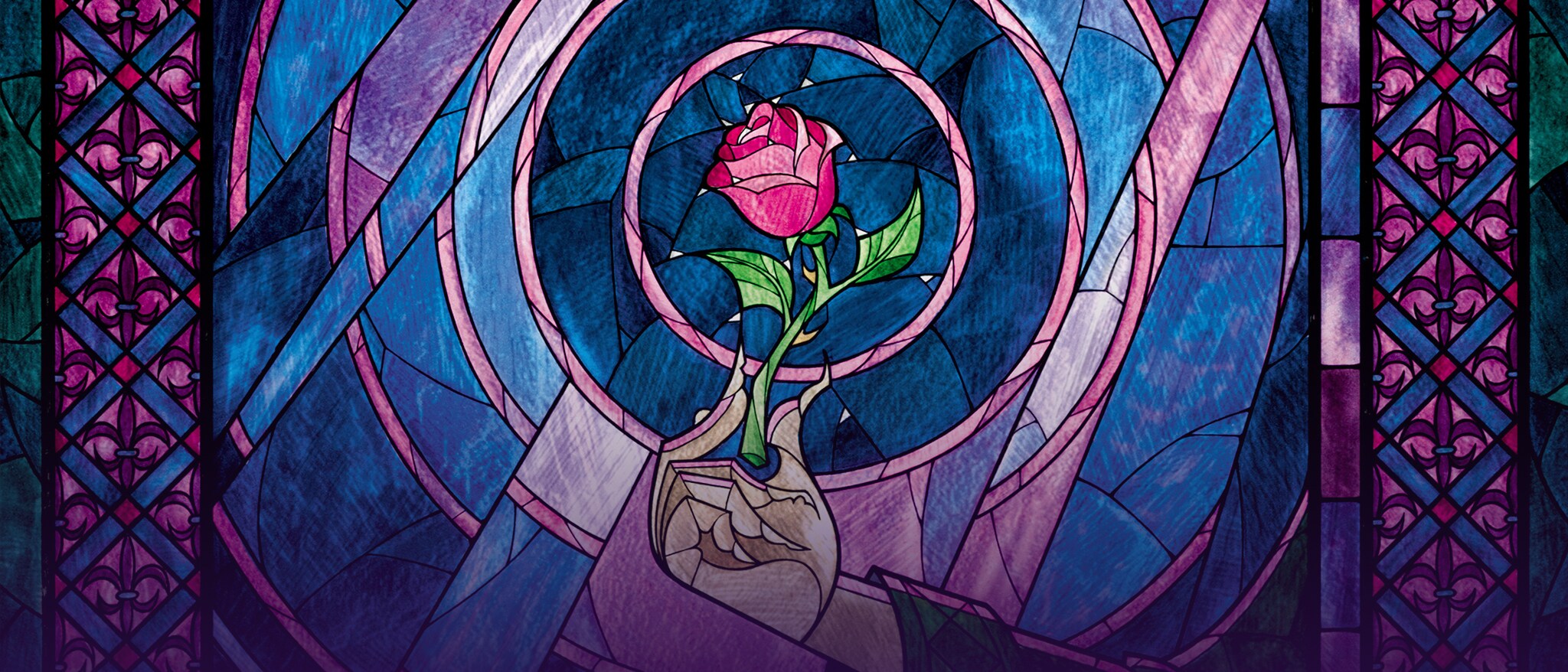
The prologue reduces a prince’s cruelty, an enchantress’s judgment, a household’s collective punishment, and years of isolation into images that resemble sacred history. Stained glass makes the curse feel ancient and morally settled before any living character can question it.
The narrator calls the prince spoiled, selfish, and unkind. The facts support punishment, but the spell also transforms servants who did not refuse shelter. The film frames that collateral damage as fairy-tale order because asking who deserved what would destabilize the romance before Belle enters.
The prince fails a test designed around appearance
An old woman asks for shelter and offers a rose. He rejects her because he is repulsed by her appearance, so she reveals beauty and turns his exterior into a reflection of the ugliness she found inside. The lesson appears simple: do not judge by looks.
The punishment still uses ugliness as moral language. A beastly body becomes evidence of bad character, while transformation into a conventionally handsome prince confirms redemption. The film critiques appearance through a visual system that keeps rewarding beauty.
The curse gives him a deadline and everybody else the consequences
The Beast must learn to love and earn love before the last petal falls. The household becomes furniture, tools, and domestic objects, their bodies tied to the prince’s emotional development. His failure would make their condition permanent.
That arrangement turns servants into stakeholders in his romance. Their enthusiasm for Belle is affectionate and desperate. If they pressure her toward the Beast, survival sits underneath hospitality.
Belle’s morning song is an entire social map
“Belle” introduces the village through repetition, work, commerce, gossip, gender expectation, and a heroine moving against the current. She reads while everyone else names her strange. The song establishes admiration and surveillance in the same breath.
Howard Ashman understands that a musical opening can do more than announce desire. Every returned phrase shows how a community converts difference into a public identity. Belle wants more partly because the village has decided what her life should contain.
Reading is freedom and insulation
Belle’s books give her far-off places, sword fights, magic spells, and princes in disguise. They expand possibility beyond the village and let her remain internally elsewhere while people discuss her in front of her.
Reading can also protect her from direct engagement. She knows the baker’s routine but has few reciprocal friendships. The town’s contempt is real, and Belle’s withdrawal helps the film romanticize intelligence without exploring what community she would build if she could choose one.
The village calls Belle odd while accepting Gaston as normal
Gaston interrupts her reading, touches her book, blocks her movement, plans their marriage, and treats her refusal as a challenge to his status. The town admires him because his entitlement matches local gender rules. Belle is strange because she objects.
The contrast exposes how communities label resistance as deviance. Gaston’s behavior does not become monstrous when he raises a mob. The mob reveals what earlier admiration already authorized.
Gaston wants Belle because she resists being another trophy
He praises her beauty and ignores her mind. Her refusal makes possession more attractive because conquest would confirm that nobody remains beyond his reach. Marriage is not intimacy in his fantasy. It is the final item mounted above the fireplace.
The film makes him funny early enough that viewers can underestimate the threat. Richard White’s performance lets charm and force share a voice. The comedy is never separate from coercion; it is the social coating that keeps coercion welcome.
Maurice loves Belle and still leaves her carrying the village’s judgment
He supports her imagination and calls her anything but odd. Their relationship contains genuine warmth, and Belle’s willingness to search for him grows from mutual care rather than princess obligation.
Maurice is also vulnerable, distracted, and easily dismissed. Belle becomes his defender in a community that mocks both of them. The household asks her to be daughter, advocate, and emotional stabilizer before the castle adds another person to manage.
The invention matters because failure does not cancel imagination
Maurice’s wood-chopping machine rattles, explodes, and eventually works. Belle encourages him before success arrives. Their shared faith establishes a domestic relationship in which unusual ideas receive patience.
This is the opposite of Gaston’s home fantasy. Maurice wants Belle to have a life larger than the village. Gaston wants her labor arranged around his boots, children, hunting stories, and public image.
The forest turns ordinary travel into a class border
Maurice leaves a modest home for the fair and becomes lost in a landscape that leads to a hidden castle. The journey separates village economy from aristocratic ruin. One man invents for a living; another prince owns an enormous estate nobody knows exists.
The castle’s isolation protects the Beast from accountability. He can imprison a traveler without law, neighbor, or witness. Magic is not the only power operating there. Property and distance matter.
The enchanted objects recognize a guest before their master does
Lumiere, Cogsworth, Mrs. Potts, and the others respond to Maurice with curiosity, fear, hospitality, and disagreement. Their independent judgment proves the castle is a community, not an extension of the Beast’s mood.
The Beast’s entrance crushes that hospitality. He decides trespass deserves indefinite imprisonment. The servants know this is wrong and survive by negotiating around authority they cannot remove.
Belle trades herself for Maurice, and the film should call that coercion
She offers to remain if her father is released. The Beast accepts. Belle chooses within a situation he created, which makes her sacrifice brave without making the agreement free. Consent under threat remains compromised even when the person speaks first.
The scene matters to the romance because Belle’s initial relationship to the Beast is not ambiguous. He is her captor. Any later love must be built after his claim over her ends, not used to rewrite the cell as a strange first date.
The Beast cannot offer “the castle” while forbidding departure
He moves Belle from a dungeon to a bedroom and tells her the castle is her home except for the west wing. Material comfort does not convert imprisonment into hospitality. A beautiful room is still controlled space when the door out is unavailable.
The language resembles possessive generosity: everything here is yours because you are mine. Belle’s refusal to dine challenges the idea that comfort creates obligation.
Belle says no repeatedly, and the movie lets each no matter
She refuses Gaston’s proposal, refuses dinner, refuses the Beast’s commands, rejects his excuses after the wolf attack, and leaves when she must protect Maurice. Her agency appears through boundaries more often than action spectacle.
The romance becomes possible only when the Beast begins responding to those boundaries. He can rage, but the story does not make Belle’s surrender the cure. He has to change the behavior that made refusal necessary.
The west wing is privacy enforced through terror
The Beast forbids one part of the castle without explanation, then explodes when Belle enters. The room contains the damaged portrait, shattered furniture, mirror, and rose, making it an archive of shame he protects by threatening other people.
Privacy is legitimate. Violence is not. Belle crosses a stated boundary, and the Beast responds with disproportionate force inside a prison he controls. The film preserves both facts instead of needing one person to be entirely innocent.
The wolf rescue does not erase why Belle was in the forest
The Beast saves her from wolves after his rage drives her from the castle. His physical courage is real, and the injury creates a moment in which power shifts because he needs her help.
Belle returns by choice to treat him. That choice is the first meaningful opening in their relationship because she could continue toward home. Gratitude begins after escape becomes possible.
The wound-cleaning argument is the first honest conversation
Belle condemns his temper. He points out that she ran away and entered the west wing. They stop performing captor and obedient guest long enough to name mutual grievance. Neither wins the exchange.
The scene works because care does not require silence. Belle tends his injury while refusing his version of events. The Beast experiences concern that includes accountability rather than submission.
“Something There” is built from observation, not a makeover
Belle notices gentleness beneath the Beast’s earlier behavior. The Beast notices that she no longer flinches at every movement. The song uses small acts, glances, uncertainty, and surprise instead of announcing destiny.
He changes conduct before the romance rewards him. Feeding birds, reading, playing in snow, and sharing space are ordinary enough to make transformation believable. The body remains the same while behavior becomes newly visible.
The library is a gift and an apology without the words
The Beast gives Belle access to the room that best matches her desire. He has listened closely enough to know what abundance means to her. The gift does not purchase affection, but it demonstrates attention beyond his own fear.
The class politics remain extravagant. A prince can offer thousands of books because wealth has been waiting unused behind locked doors. Belle gains intellectual freedom through proximity to aristocratic property rather than through any change in the village’s access to knowledge.
“Be Our Guest” is labor pretending to be leisure
Lumiere turns dinner into spectacle while a household of transformed servants performs for one captive guest. The number is irresistible because Ashman and Menken make service exuberant. It is also a fantasy in which domestic labor sings about its own availability.
The staff wants Belle comfortable and needs her emotionally close to the Beast. Hospitality, survival strategy, and performance merge. The plates cannot clock out, and the curse has made their bodies identical to their jobs.
The servants are people trapped inside class roles made literal
A butler becomes a clock, a maître d’ becomes a candelabra, a housekeeper becomes a teapot, a maid becomes a feather duster, and a child becomes a cup. The curse translates labor into anatomy.
This is one of the film’s richest accidental arguments. The prince remains an animalized owner with mobility and authority. The servants become tools whose functions continue benefiting the estate.
Chip reveals the cruelty of punishing a household across generations
Chip is a child living as a cup because of a prince’s failed moral test. The film treats his design as adorable and his curiosity as comic, but his body is evidence that the enchantress’s justice reached someone with no power over the original refusal.
The curse can only be called fair if servants are extensions of aristocratic property. The story wants us to know they are persons while avoiding the conclusion that the punishment exploited them.
The ballroom works because technique disappears into feeling
The camera circles Belle and the Beast through a computer-assisted environment while hand-drawn characters remain emotionally central. Don Hahn later described the paradox: use available technology to tell the story without making the audience stare at technology.
Soft gold inside and vibrant blue outside create warmth held against winter. The room does not merely look expensive. It feels temporarily safe enough for two guarded people to move in agreement.
Angela Lansbury sings the title as somebody who has watched the change
Mrs. Potts narrates the dance from inside the household rather than letting the lovers explain themselves. Her voice carries age, tenderness, and caution. The song describes change as barely perceived until it becomes undeniable.
That perspective makes the romance communal. The servants have watched terror, hope, and small improvements. Their joy is sincere even when their survival depends on the outcome.
The magic mirror gives Belle information and gives Gaston surveillance
The Beast uses the mirror to show Maurice in danger, enabling Belle to act. He then releases her and gives her the mirror as a way to remember the castle. A device once linked to control becomes an object transferred without condition.
Gaston later uses the same image as proof that fear should organize the village. Technology does not carry one moral purpose. The person framing the image decides whether it becomes care or propaganda.
Releasing Belle is the Beast’s first act of love
He knows the curse may become permanent and opens the door anyway because Maurice needs her. Love becomes credible when he accepts the loss of the outcome he wants. He stops treating Belle’s presence as something his suffering entitles him to keep.
The scene repairs the imprisonment more effectively than an apology speech could. Freedom is material. Belle leaves. The story allows her later return to be a choice rather than the continuation of captivity.
Belle returns home and the village tries to institutionalize difference
Gaston arranges for Maurice to be taken to an asylum unless Belle agrees to marriage. He weaponizes a local institution against a man already mocked as eccentric. The plan turns social ridicule into legal force.
Belle reveals the Beast to prove Maurice was telling the truth, then has to watch truth become fuel for a mob. Evidence cannot protect people when power controls interpretation.
“The Mob Song” exposes masculinity as a group performance
Gaston converts private jealousy into public danger by calling the Beast a threat to children and the village. Men who have never seen the castle accept his authority because fear offers them a heroic role.
The song echoes the opening number’s community structure. The same town that narrated Belle as strange now narrates violence as duty. Repetition becomes radicalization.
Gaston and the Beast are not opposites until the Beast chooses restraint
Both men begin with physical power, entitlement, rage, and a desire to control Belle’s movement. Gaston remains socially polished; the Beast is visibly frightening. Appearance initially disguises their similarity.
The Beast changes when he spares Gaston and releases Belle. Gaston refuses every limit and attacks after mercy. Inner beauty is not a hidden essence waiting to be noticed. It is behavior practiced when violence would be easier.
Belle’s return is not proof that captivity was good for her
She goes back because she cares for the Beast and recognizes the mob’s danger. The return occurs after he has freed her without condition. That sequence is the moral hinge.
Romanticizing the original imprisonment erases the work the movie performs to end it. Belle can love a person who once harmed her because he changed and surrendered control. The story does not require viewers to recommend that risk in real life.
Gaston dies because he cannot stop after winning space to leave
The Beast spares him. Gaston could retreat. He attacks from behind and loses his footing. The death follows the logic of entitlement that cannot tolerate another person’s continued existence.
The film avoids making the Beast execute his rival, preserving the moral distinction created through mercy. Gaston destroys himself by treating mercy as weakness.
The transformation makes love visible and creates a new problem
Belle declares love before she knows the Beast can become human. Her choice therefore answers the curse on its intended terms. Light, motion, and bodily reconstruction then reward the relationship with conventional princely beauty.
The visual payoff is powerful and ideologically untidy. The film asks us to look beyond appearance, then removes the difficult appearance as confirmation that the correct soul was found.
Belle has to recognize the prince through his eyes
The transformed body is unfamiliar. Belle looks for continuity and finds it in the eyes, a detail that lets personhood cross radical physical change. Recognition precedes the kiss.
That moment protects the romance from becoming attraction to the reward body. She verifies that the person she knew remains present. The prince’s beauty follows identity rather than replacing it.
Howard Ashman gave the fairy tale its emotional engine
Disney’s own production history credits Ashman’s understanding of where songs could move plot farther than dialogue. “Belle,” “Gaston,” “Be Our Guest,” “Something There,” “The Mob Song,” and the title song are not detachable performances. They are structure.
The film’s dedication says he gave a mermaid her voice and a beast his soul. That language is earned. The Beast’s soul becomes legible through a musical architecture Ashman helped build while seriously ill.
The Best Picture nomination recognized craft, not innocence
Beauty and the Beast became the first animated feature nominated for the Academy Award for Best Picture and won for song and score. The recognition matters to animation history because it challenged the assumption that the medium belonged in a smaller artistic category.
Canonization should not end criticism. A landmark can contain coercive romance, class fantasy, collateral punishment, and gendered labor. Loving the film enough to examine those structures is more respectful than repeating “tale as old as time” until every problem disappears.
Foundation verdict
Beauty and the Beast works because Belle’s boundaries remain active, the Beast changes behavior before he receives love, the songs carry plot and psychology, and the artists build a world where objects, light, color, and performance remember what dialogue cannot hold.
It remains uneasy because a captive performs emotional labor for a violent prince while cursed servants depend on her success. Foundation verdict: a masterpiece of musical storytelling whose romance survives serious scrutiny only when freedom, accountability, and Belle’s repeated refusal remain at the center.
The film inherits a fairy tale and rewrites the daughter’s desire
Earlier versions of Beauty and the Beast often organize the heroine around family duty, promises, and the moral education of recognizing virtue beneath appearance. Disney keeps the exchange of a daughter for a father and the enchanted household, then gives Belle a specific dissatisfaction before the castle. She does not merely endure a strange marriage plot. She already wants a world larger than the one available.
That desire prevents the castle from becoming her only imaginable escape. Gaston offers status inside the village. The Beast offers danger inside aristocratic isolation. Belle wants adventure, reading, intellectual companionship, and freedom. The romance has to become more than choosing the richer prison.
The “tale as old as time” language makes a new screenplay feel inevitable
The title song describes the relationship as ancient, familiar, and barely surprising. That framing gives emotional legitimacy to a story the film has radically structured through musical theater. A narrative assembled in late twentieth-century animation begins to feel as if audiences have always known this exact Belle, Beast, ballroom, and rose.
Inevitability can comfort and conceal. It lets viewers surrender to the romance while skipping the choices that made it work: Belle’s repeated refusal, the Beast’s release of her, the servants’ intervention, and the film’s decision to make Gaston a socially approved alternative rather than an outside monster.
Belle’s “I want” song refuses to name a husband
She asks for adventure in the great wide somewhere and for somebody who understands more than the village’s expectations. The desire includes connection but does not reduce the future to marriage. That distinction was unusually important in a studio fairy tale built around a romance.
The film eventually answers with a prince and castle, so the structure still converts broad longing into a heterosexual couple. Yet Belle reaches the romance through intellectual and moral recognition rather than singing for a man she has never met. Her desire remains larger than his body.
The bookshop is the village’s one room of uncomplicated generosity
The bookseller knows Belle, notices what she enjoys, discusses the story she is reading, and gives her the book she repeatedly borrows. He does not treat her appetite for knowledge as debt or courtship. Their brief exchange models the respectful community the rest of the village withholds.
The gift also complicates the claim that Belle has no one. She is isolated but not literally without human kindness. A small relationship built around attention matters because it proves the village could respond differently without requiring magic.
Belle’s favorite book foreshadows the romance and exposes the script
She describes far-off places, daring sword fights, magic spells, and a prince in disguise. The audience hears the film’s destination announced before the plot leaves town. Belle recognizes a story shape without knowing she will inhabit it.
The foreshadowing can read as destiny or as genre consciousness. She has learned to desire a particular kind of adventure through books, and the film delivers that fantasy with captivity attached. The gap between imagined romance and lived danger is where her judgment matters.
Gaston weaponizes literacy because he cannot control what Belle imagines
He dismisses reading as a path toward ideas and treats a woman thinking as socially dangerous. His complaint is not ignorance alone. Books give Belle standards and possible lives beyond the authority he represents.
When he drops muddy boots onto her book and proposes marriage through a domestic fantasy designed entirely for himself, the violation is precise. He places his body and future over the object through which she escapes him.
The proposal scene is staged like a home invasion
Gaston arrives with wedding preparations, enters without permission, traps Belle against the door, describes six or seven sons, and expects gratitude. The town waits outside for a ceremony she never accepted. Public celebration becomes pressure intended to make refusal embarrassing.
Belle turns the architecture against him and sends him into the mud. The comedy gives her a temporary victory, but Gaston’s humiliation does not teach him consent. It converts desire into grievance.
Lefou survives by making Gaston’s violence entertaining
He absorbs physical abuse, praises every boast, and translates Gaston’s entitlement into jokes the village can enjoy. His loyalty is not harmless because it keeps the powerful man surrounded by agreement. The sidekick turns warning signs into social energy.
The film gives Lefou enough slapstick vulnerability that viewers may pity him without examining complicity. He is subordinate to Gaston and still helps create the conditions in which Gaston can escalate.
“Gaston” is a recruitment song before the mob needs recruiting
The tavern number rebuilds Gaston’s wounded ego by having the community list strength, hair, appetite, violence, hunting, and bodily excess as virtues. Masculinity becomes a chant everyone can join. Facts matter less than restoring the admired man’s image.
Later, the mob song uses the same social mechanism for lethal action. The tavern rehearsal teaches the village how to let Gaston’s feelings become everybody’s emergency.
Maurice’s confinement reveals the castle’s law is one person’s mood
No hearing, explanation, proportion, or path to release exists. The Beast finds an intruder and chooses a tower cell. The servants disagree but cannot overrule him. Aristocratic authority becomes private violence protected by walls.
Belle negotiates inside that system because no external appeal is possible. Her body is the only currency the Beast accepts. The fairy tale can call the trade voluntary while the political structure makes coercion obvious.
The Beast’s first glimpse of Belle is filtered through need
He sees a possible answer to the curse at the same moment she offers herself for Maurice. That overlap contaminates every early interaction. Belle is a person in crisis and a potential mechanism for restoring his body and household.
The film gradually moves him from asking what her presence can do for him toward asking what freedom requires for her. The release scene matters because it breaks the instrumental relationship the curse encouraged.
The servants turn Belle into hope before they know her
Lumiere immediately wonders whether she is the girl who can break the spell. Their welcome carries years of desperation. They are kind to Belle and also reading her as a solution. Both truths can occupy the same teacup.
This pressure is structural rather than a sign that Mrs. Potts or Lumiere lacks empathy. The enchantress tied their bodies to the prince’s romantic success. Survival makes neutrality impossible.
Cogsworth’s caution is trauma management, not cowardice
He worries about rules, schedules, the master’s anger, and actions that might worsen the curse. His fussiness is comic, but it reflects somebody maintaining a household under unpredictable authority. Control becomes a defense against chaos.
Lumiere appears freer because charm lets him bend rules and recover socially. Cogsworth carries the institutional memory of what happens when the Beast explodes. Their banter is a conflict between survival strategies.
Mrs. Potts mothers a stranger because the castle has forgotten ordinary care
She offers warmth, food, practical advice, and a language of patience. Belle’s arrival gives Mrs. Potts a person to care for outside the master’s moods. The relationship is one of the film’s few forms of intimacy not built around romantic exchange.
Her maternal role also continues the curse’s labor logic. She remains responsible for emotional temperature while existing as kitchen equipment. The story celebrates care without asking who cares for her.
The Wardrobe gives Belle clothes and a moment of female alliance
The Wardrobe responds to fear with theatrical confidence and helps Belle prepare for dinner she does not intend to attend. Her energy is comic, but she treats Belle as somebody whose body deserves comfort and presentation without Gaston’s sexual claim.
The scene also shows how quickly the household begins organizing Belle for the romantic role. Dress, dinner, and castle etiquette can become another form of pressure even when delivered with affection.
The enchanted rose is a clock built from surveillance
The Beast watches petals fall under glass, making time visible and private. The object measures his fear but provides no instruction for becoming less cruel. Deadlines can motivate performance without producing moral understanding.
Belle’s arrival near the final petals increases the temptation to treat her as the last available answer. Genuine change begins when he acts against the clock’s demand and lets her leave.
The torn portrait shows he hates the human self he wants restored
The Beast has shredded the face representing his earlier body while preserving enough of the eyes for Belle to recognize later. Shame directs violence inward and outward. He wants transformation without being able to tolerate the person he was.
Redemption requires more than returning to that image. The prince at the end must be continuous with the Beast who learned restraint, not a reset to the young man who failed the enchantress’s test.
The Beast’s rage is not made harmless by loneliness
Isolation, bodily transformation, guilt, and the burden of the curse explain his volatility. They do not excuse threatening Belle, imprisoning Maurice, destroying rooms, or keeping servants afraid. Pain creates context rather than moral immunity.
The film’s strongest scenes allow compassion and accountability together. Belle can understand his wound after refusing his behavior. Viewers do not have to choose between seeing suffering and naming harm.
The snowball scene is play as negotiated equality
Outside the castle’s formal rooms, Belle and the Beast tease, compete, and laugh. He is physically powerful, but the interaction does not depend on command. Play becomes practice for a relationship neither can achieve through dinners arranged by servants.
The sequence matters because romance needs shared pleasure, not only rescue and pity. Belle discovers somebody capable of delight. The Beast discovers that closeness cannot be forced into existence.
The bird-feeding lesson turns strength into patience
The Beast initially overwhelms the birds. Belle shows him how to lower his body, remain still, and let another creature approach voluntarily. It is a small behavioral lesson containing the entire romance.
He cannot command trust. He has to become less threatening and wait. The birds’ return visualizes consent without dialogue.
The dining table is where power first fails
The Beast demands Belle eat with him and assumes her refusal is an offense against his authority. Lumiere attempts persuasion, but Belle remains in her room. Hunger, hospitality, and obedience become entangled.
His later relationship with her grows after he stops using the meal as a test. Shared food can become intimacy only when declining it is allowed.
“Be Our Guest” deliberately overwhelms the logic of imprisonment
The number is so inventive, fast, and pleasurable that the audience can temporarily forget Belle is eating in a castle she cannot leave. Musical spectacle performs the seduction the plot cannot ethically complete at that moment.
This is not a flaw in craft. It is craft powerful enough to shape moral attention. A deep review has to enjoy the choreography and notice what enjoyment helps us stop asking.
Ashman uses objects to make exposition sing
Plates, spoons, napkins, candles, clocks, and serving carts turn the staff’s identity into choreography. The number explains French hospitality, household hierarchy, years without guests, and collective longing while constantly changing visual form.
Story information arrives through rhythm and character rather than a speech about the curse. This is why the songs feel essential instead of inserted.
The cut “Human Again” material exposes what the servants want
The song was created for the film but removed before the original release, later appearing in stage and special-edition contexts. Its central desire is bodily restoration and return to ordinary time. The servants imagine romance, grooming, freedom, and work performed as humans again.
Its absence from the 1991 theatrical cut keeps pacing tight but makes their stakes less explicit. Even without the number, every push toward Belle carries that unspoken hope.
Belle and Beast read together because language replaces spectacle
Their bond develops around stories and attention, not only dancing. The Beast’s ability to share Belle’s intellectual world matters because Gaston treats books as threats. Companionship appears in the activity the village mocked.
The film could explore the Beast’s literacy more deeply, but the library and reading images give Belle a relationship to the castle not entirely defined by service or romance.
The library gift is also a transfer of access without ownership
He does not lend one approved book or supervise her choices. He opens the room. In a story structured by locked doors and forbidden wings, access becomes a meaningful form of trust.
The gift still comes from inherited wealth, and Belle’s gratitude risks making aristocratic abundance appear like virtue. Generosity is easier when one person controls more books than a whole village can reach.
The ballroom dress does not erase Belle’s blue village self
Gold fabric, gloves, hair, and formal movement place Belle inside courtly fantasy. The transformation is visual but temporary. She remains the person who reads, argues, protects Maurice, and decides when to leave.
The sequence succeeds because the dress does not function as proof she became worthy of the prince. The Beast is the one whose conduct has been changing. Belle’s beauty was never the missing condition.
The ballroom camera creates freedom inside a sealed room
The three-dimensional environment lets the camera sweep around the dancers with a mobility difficult to achieve through flat multiplane staging alone. The movement makes the couple appear suspended from the castle’s earlier confinement.
Technology becomes emotional grammar. The room opens visually at the moment the relationship begins to feel chosen.
Mrs. Potts sings a song about change while remaining a teapot
She witnesses the couple’s emotional movement but cannot yet regain her own body. Her performance is hopeful and materially constrained. The household celebrates evidence that the master may free them.
The title song’s calm can conceal urgency. Every tender observation occurs under a deadline that determines whether Chip remains a cup forever.
The Beast asks advice because command has stopped working
He turns to Lumiere and Cogsworth for help preparing the evening. Their counsel reveals a leader learning that intimacy requires knowledge he does not possess. He cannot order himself into being lovable.
The servants enjoy the project and remain subordinated to its outcome. Their expertise has always kept the castle functioning. Romance finally makes the prince listen to labor he previously took for granted.
The mirror scene gives him a choice between curse and care
When Belle sees Maurice collapsed, the Beast understands that keeping her may preserve his chance while costing the person she loves. He releases her without bargaining for return. The curse clock keeps falling.
That sacrifice is the clearest evidence of internal change because nobody can guarantee reward. Love becomes action oriented toward Belle’s need rather than a feeling he wants her to validate.
Belle leaves with grief, not relief alone
Freedom does not cancel the relationship that formed after the wolf attack. She is relieved to reach Maurice and sad to hurt the Beast. Mixed feeling does not prove captivity was romantic. It proves people can form real bonds inside morally compromised circumstances.
The film lets her hold care without surrendering the reason she left. Maurice needs her, and the Beast respects that priority.
Gaston’s asylum scheme turns ableism into romantic leverage
He relies on the village’s willingness to classify Maurice as insane and remove him. Eccentricity, invention, and an unbelievable report about a beast become grounds for confinement when a powerful man pays the official.
Belle is offered a coercive exchange mirroring the castle: trade your freedom for your father’s release. Gaston proves more monstrous because he creates the threat deliberately and calls the result marriage.
Monsieur D’Arque is bureaucracy available for purchase
The asylum proprietor does not need to believe Maurice is dangerous. Gaston’s influence and payment are enough. Institutional violence enters the fairy tale through paperwork rather than magic.
This makes the village threat distinct from the Beast’s rage. One man imprisons through aristocratic force. Another builds a coalition of admiration, law, and fear.
The mirror proves Maurice and immediately condemns the Beast
Belle uses the image to defend her father’s sanity. Gaston redirects the revelation into a threat narrative before the crowd can process complexity. Truth arrives inside a political arena already organized around his authority.
The scene remains painfully current. Visual evidence does not interpret itself. A confident speaker can turn proof of one fact into permission for unrelated violence.
The mob is frightened of a person who has never approached them
The Beast lives outside village life and poses no immediate public threat. Gaston invents future danger, especially to children, because imagined harm mobilizes faster than wounded male pride.
Fear converts invasion into defense. The villagers cross the forest to attack a home while singing that the person inside is dangerous because he is different.
The castle objects become defenders of their own prison
Lumiere, Cogsworth, Mrs. Potts, Wardrobe, and the household fight the villagers using their transformed bodies. Their curse gives them tactical abilities while making them targets. Domestic labor becomes insurgent defense.
The sequence is comic, but the politics are strange. They protect the estate and master because it is also their community and only route to restoration. Survival and loyalty cannot be separated neatly.
The Wardrobe dresses an attacker and turns gender performance into a weapon
She overwhelms a villager with clothing, makeup, and presentation he did not expect. The gag relies on early-1990s gender panic, yet the attacker’s response complicates the joke by showing pleasure rather than simple horror.
The moment is brief enough to support multiple readings. It can reproduce femininity-as-humiliation and still permit a tiny escape from Gaston’s rigid masculinity.
The Beast nearly lets Gaston kill him because Belle is gone
He begins the fight without desire to defend himself. Love has developed, but identity remains dangerously dependent on Belle’s presence. Her return restores his will to live.
That dependence is emotionally understandable and not a complete model of recovery. The film gives him moral growth faster than it gives him a life beyond the relationship.
Mercy proves the Beast has stopped treating power as entitlement
He overpowers Gaston and has reason to kill him. He sees fear, releases his grip, and orders him to leave. The choice reverses the opening prince’s refusal of compassion.
Gaston’s attack from behind clarifies that mercy did not fail morally even when it failed tactically. Another person’s betrayal does not make restraint a mistake.
Belle’s love arrives at the edge of death, not during comfort
She returns, tends the Beast, and names love when the body she knows appears to die. There is no visible prince, no promise of restored wealth, and no certainty the curse can still be broken.
The timing satisfies the enchantress’s test while protecting Belle’s motive from the reward. She loves the Beast before transformation becomes available to her.
The servants regain bodies and the film rushes past accountability
Transformation returns everyone to human form in a burst of celebration. Nobody confronts the prince about years spent as household objects because his redemption and their restoration are treated as the same resolution.
Joy is appropriate. The missing conversation still matters. A ruler can change without erasing what subordinates endured under his curse and anger.
The final ballroom repeats the dance under new conditions
Belle and the prince move through a restored castle while human servants watch. The image confirms continuity and closure. The architecture no longer appears frozen in decay.
Class hierarchy also returns unchanged. The servants are human again, but they remain servants. Magic repairs bodies without redistributing authority.
A happy ending can be emotionally true and politically incomplete
Belle chose the changed Beast, Maurice is safe, Gaston can no longer threaten them, and the household is restored. Those are real resolutions inside the story’s priorities.
The village’s misogyny, the asylum’s availability, aristocratic isolation, and the servants’ dependence remain largely untouched. Fairy-tale closure focuses on the couple because couples are easier to transform than systems.
The film deserves the word masterpiece without being declared harmless
Its songs perform extraordinary narrative work, the character animation carries complex shifts, the voice performances balance comedy and fear, the color design makes emotional geography visible, and the screenplay gives Belle meaningful boundaries within a coercive premise.
Masterpiece should describe artistic achievement, not moral exemption. The film becomes more interesting when captivity, class, labor, appearance, and consent remain open to examination.
The false start matters because the musical was a reconstruction
Disney had considered Beauty and the Beast long before 1991, and the late-1980s production initially pursued a more serious, non-musical approach. Official Disney history describes development in London, a story reel, and a decision to begin again with new directors and a musical structure after The Little Mermaid demonstrated what Ashman and Menken’s method could do. The finished film did not simply emerge fully formed from an old fairy tale.
That restart explains the density of the final construction. Songs do not decorate a complete screenplay. They reorganize it. Belle’s village, desire, Gaston’s public image, the household’s longing, the developing romance, and the mob’s fear each receive musical engines. The film moves quickly because songs carry social systems and interior states at the same time.
Linda Woolverton gives Belle a conflict that survives the romance
Belle’s intelligence is not a collection of books placed around a conventional heroine. Her reading creates friction with the village, establishes standards Gaston cannot meet, and gives the library emotional value. Woolverton’s screenplay makes intellectual appetite a form of action even when Belle is physically confined.
The ending does not explicitly show what she does with that appetite as a princess. That absence is important. Adventure becomes a castle and partner, which may satisfy emotional longing without fully answering what Belle wanted to build, learn, or change. The character is strong enough to make viewers ask for a future the fairy-tale ending does not provide.
Paige O’Hara performs curiosity as resistance
O’Hara’s Belle does not sound detached from the village because she believes herself superior. Her voice moves between warmth, wit, impatience, fear, and determined refusal. The musical phrasing keeps thought active inside melody. She seems to be discovering the dimensions of desire as she sings rather than presenting a finished princess manifesto.
That responsiveness matters opposite both male leads. With Gaston, courtesy hardens into evasion and then direct rejection. With the Beast, terror becomes argument, argument becomes observation, and observation becomes affection. The changes are audible without asking Belle to lose the steel that made them possible.
Robby Benson makes the Beast younger than his violence looks
The design gives the Beast enormous mass, claws, fangs, mane, and multiple animal references. Benson’s performance adds wounded youth, social awkwardness, and bursts of petulance. The mismatch helps the audience see an emotionally arrested prince inside a threatening body without pretending the threat is imaginary.
His funniest moments arrive when command fails and embarrassment takes over. He rehearses, asks advice, worries about appearance, and cannot manage a simple invitation. Comedy lowers the distance between him and Belle, but it works only because the film previously established that she will resist him when anger returns.
Richard White lets Gaston smile through every warning sign
Gaston’s baritone carries the certainty of somebody whose community has never required self-doubt. He can make possession sound like courtship and violence sound like leadership. The performance explains why villagers follow him without asking the audience to mistake popularity for goodness.
The vocal control also links songs that appear tonally different. The comic tavern celebration and the frightening mob recruitment emerge from the same need to have other people confirm his desired identity. Gaston becomes dangerous through continuity, not a third-act personality transplant.
Jerry Orbach and David Ogden Stiers make the staff a political argument
Orbach gives Lumiere elasticity, pleasure, flirtation, and a host’s instinct to transform crisis into performance. Stiers gives Cogsworth clipped anxiety, procedural caution, and the fatigue of somebody whose warnings are rarely heard until consequences arrive. Their timing turns exposition into relationship.
Together they reveal governance inside the castle. The Beast rules, but the staff interprets, redirects, delays, and repairs his decisions. Informal labor keeps an authoritarian household survivable. That system can appear adorable because the workers are a candle and clock, yet the voices preserve adult knowledge of what they are doing.
Angela Lansbury records tenderness without making it fragile
Lansbury reportedly delivered the title song with an intimate simplicity that became definitive. Mrs. Potts does not sing like a romantic lead claiming expertise. She sings like someone observing change in people she has cared for through years of damage. Age becomes authority without becoming distance.
The performance also anchors the ballroom’s technological novelty in a human voice. The camera can move through a computer-assisted space, but the emotional point arrives through breath, phrasing, and a singer allowing the melody to remain conversational.
Alan Menken’s prologue makes a children’s film sound morally ancient
The score opens with a grave, magical architecture that draws on classical color and storybook expectation. Before the village comedy begins, the music tells viewers that judgment, loss, and time already govern the world. The castle’s curse feels older than the film explaining it.
Menken then moves between provincial bustle, tavern swagger, French music-hall spectacle, romantic waltz, suspense, and battle without making the score feel like disconnected genres. Recurring melodic identity allows the film to change social spaces rapidly while remaining one fairy tale.
Howard Ashman knew songs could reveal communities, not only feelings
“Belle” is an ensemble argument about a woman. “Gaston” is a community repairing a man’s ego. “Be Our Guest” is a workforce staging its desire to serve and return to human life. “The Mob Song” is collective fear becoming permission. The title number lets the household witness change.
Only “Something There” distributes interior observation directly among Belle, Beast, and servants. By the time the lovers sing thoughts, the surrounding community has already framed what their relationship means for everyone else. Ashman’s musical dramaturgy makes romance public because the curse made it public.
The title song’s simple language avoids pretending love solves everything
The lyrics describe change, surprise, fear, preparation, and a pattern that is both familiar and newly happening. They do not claim the Beast was always secretly perfect or that Belle’s goodness magically repaired him. Something changes because interaction revealed and produced different behavior.
“Barely even friends” matters as much as “beauty and the beast.” The song honors the incremental route. The grandeur of the ballroom surrounds language that remains modest about what has been achieved.
The character design builds a body from contradiction
The Beast combines features associated with several animals into a form that can be frightening, expressive, awkward, and graceful. Glen Keane’s supervising work creates a face capable of rage without losing subtle shifts around eyes and mouth. The design cannot remain a static monster mask because the romance depends on viewers reading behavioral change before transformation.
His body is also a moral trap. Animal traits carry the visual burden of inner ugliness while the actual animals in the story are not morally corrupt. The design succeeds emotionally even as the metaphor relies on a hierarchy between human beauty and animal form.
Belle’s animation protects thought between lines
Small pauses, eye movements, posture, and changes in pace give Belle an interior life beyond dialogue. She can perform politeness while planning escape, notice the Beast’s embarrassment without announcing it, and evaluate what the servants are asking from her. The character does not wait blankly for the next plot instruction.
That attention is essential in a story where the heroine spends long stretches reacting to another person’s transformation. Animation turns reaction into judgment rather than passive witness.
Gaston’s body is the village’s favorite evidence
He fills doorways, mirrors himself in reflective surfaces, lifts multiple women, eats extravagantly, hunts, and displays trophies. The character animation presents masculinity as constant demonstration. He needs witnesses because status exists only while the village repeats it.
The Beast’s body initially appears more dangerous but gradually becomes less performative. He learns to lower himself around birds, navigate a dance, and use strength for rescue without demanding applause. Physical contrast gives the moral reversal shape.
Color divides social spaces before plot does
The village uses bright morning movement and repeated daily patterns. The forest becomes cold and disorienting. The castle begins in shadow, blue stone, torn fabric, and enclosed corridors. “Be Our Guest” explodes into theatrical color, while the ballroom warms to gold against deep exterior blue.
Disney’s archive material identifies deliberate work to prevent the dark castle from becoming visually dead. Color is not only atmosphere. It charts whether Belle can imagine movement, safety, and relation inside each space.
The ballroom’s CAPS work is famous because the emotion stayed legible
The Computer Animation Production System helped integrate digitally inked and painted character animation with a three-dimensional ballroom environment. The camera moves around Belle and the Beast in a way that gives space, scale, and circular grace to the dance. For 1991 audiences, the motion felt strikingly new.
The sequence does not abandon hand-drawn expression for technical spectacle. Belle’s attention, the Beast’s careful movement, and Mrs. Potts’s song remain the reason to look. Innovation works because the audience feels freedom and intimacy rather than a software demonstration.
More than a million drawings still disappear into ninety minutes of feeling
Disney’s thirtieth-anniversary history cites roughly six hundred artists and technicians, more than a million drawings, hundreds of thousands of cels, and thirteen hundred backgrounds. Those numbers resist the fantasy that an animated classic arrived from one visionary hand. The film is accumulated labor on a massive scale.
That labor also complicates the household-servant metaphor. A story celebrating objects who joyfully perform behind a prince was created by many workers whose individual contributions are easy for audiences to collapse into the Disney name. Production history makes invisible labor visible again.
French reference creates atmosphere without historical precision
Artists studied the Loire Valley and French romantic painting, while the film combines villages, aristocratic interiors, clothing, food, accent performance, and design into an imagined France. The setting feels culturally particular enough to support the fairy tale without committing to one strict year or region.
That flexibility serves fantasy and can flatten social history. A castle with servants, a village with institutional authority, and gender rules all carry material implications the story uses selectively. “Somewhere in France” provides romance while class remains visually unmistakable.
The curse’s timeline is famously awkward because the film prioritizes feeling
The prologue says the rose will bloom until the prince’s twenty-first year, while “Be Our Guest” suggests the household has been rusting for ten years. If taken literally, the prince would have been a child when the enchantress tested and punished him. The film never pauses to reconcile the arithmetic.
This is a continuity problem and an ethical intensifier. Punishing a child and an entire household for refusing a stranger entry would make the enchantress’s justice far more disturbing. Later adaptations have tried to clarify age and culpability because the original’s emotional shorthand leaves an uncomfortable equation.
The enchantress disappears before anyone can appeal the sentence
She defines the crime, selects the punishment, sets the conditions, and leaves. No route exists for servants to challenge collective punishment or for the prince to learn except through the deadline she created. Magic behaves like absolute law.
The film asks viewers to accept her moral authority because she exposes superficial cruelty. A deeper reading can agree with the lesson and reject the governance. Correctly identifying harm does not make every punishment just.
Belle’s emotional labor has limits the film actually dramatizes
She does not enter the castle planning to reform the Beast. She protects Maurice, survives, refuses commands, leaves after violence, and returns after the Beast saves her. Change happens partly because she models accountability and mutual care, but she is not endlessly patient.
The boundary matters for real-world interpretation. “Love a violent person until kindness emerges” is dangerous advice. The film’s more defensible sequence is “leave when threatened, observe sustained change, and choose only after freedom is real.” Fantasy compresses risk that no viewer owes another person in life.
The Beast does work, but Belle still bears disproportionate risk
He learns restraint, gives the library, participates in shared activity, releases her, spares Gaston, and risks losing the curse’s solution. Those are meaningful choices. Belle risks imprisonment, physical threat, the wolves, village retaliation, and the emotional uncertainty of returning.
Calling the romance mutual does not make the starting positions equal. Her consent becomes credible because she gains power to leave and he relinquishes power to keep. Equality is built through surrendered control rather than discovered underneath the original arrangement.
Gaston offers a socially approved version of the Beast’s early behavior
He enters Belle’s home, corners her, assumes marriage, dismisses her mind, and creates a threat against Maurice. The Beast imprisons, commands, rages, and controls space. One man looks handsome and belongs to the village. The other looks monstrous and lives outside it.
The story’s moral distinction emerges through change. Gaston responds to refusal by escalating public control. The Beast responds to relationship by releasing control. Inner beauty becomes visible in what each man does after Belle says no.
The village women around Gaston are treated as a joke the film never examines
Three admiring women swoon over him while Belle’s refusal marks her as singular. They function as visual proof that Gaston is desirable and as comic contrast to the heroine’s intelligence. Their own motives, constraints, and possible understanding of village marriage receive no space.
This is a familiar shortcut that flatters the heroine by diminishing other women. Belle’s independence should not require every woman who wants a conventional life to appear foolish. The screenplay gives female resistance one face and leaves solidarity mostly inside the enchanted castle.
Belle and Mrs. Potts provide the film’s strongest cross-generational care
Mrs. Potts does not compete with Belle, instruct her to accept abuse, or treat romance as the only measure of worth. She comforts, feeds, observes, and offers perspective. Belle responds to her as a person despite the teapot body.
That recognition is central to the film’s stated theme. Belle looks beyond appearance not only when loving the Beast, but whenever she treats the household objects as a community. Her moral vision is broader than the romantic test.
Chip is brave because childhood has not taught him the castle’s fear
He asks direct questions, sneaks into Belle’s belongings, joins the rescue, and uses Maurice’s invention to break the cellar door. His curiosity makes him less compliant with the master’s emotional weather than older servants who have spent years managing it.
The character also carries the film’s most unresolved injustice. A child’s body became tableware, yet the conclusion asks us to celebrate restoration without hearing what that experience meant to him.
Maurice’s machine completes an arc the village dismissed
The invention first explodes, later works, and finally becomes the device Chip uses to free Belle and Maurice. An eccentric object mocked by the town becomes practical resistance. The film rewards imagination without requiring institutional approval.
The machine parallels Belle’s books. Both are dismissed because they open possibilities beyond ordinary village life. Both eventually help people escape control.
The horse Philippe has better threat recognition than most men in town
Philippe resists the dangerous route, panics in the forest, returns home without Maurice, and carries Belle back toward the castle. His behavior communicates danger before humans understand it. Belle listens enough to use his fear as information.
The animal is not simply transportation. He connects father and daughter across separation and later returns Belle to the Beast. Loyalty in the film often appears most ethically clear outside human institutions.
The rose under glass becomes a museum of time
The Beast cannot touch the falling deadline without risking damage. He watches an object decay while his castle remains physically frozen. The glass protects the symbol and intensifies helplessness. Preservation cannot stop loss.
That image anticipates later Disney merchandising and iconography because it compresses the entire franchise into one collectible shape. The story warns against surface judgment, and its most marketable object is a beautiful surface containing mortality.
Easter eggs should not replace production evidence
The film contains visual references, design inspirations, and later-added material that fans can catalog. The stronger lore comes from documented development: the non-musical false start, Loire Valley research, French romantic painters, Ashman and Menken’s restructuring, CAPS-assisted ballroom work, cut songs, and the dedication to Ashman.
A background object that resembles another Disney prop can be delightful. It should not receive more authority than the artists explaining why a scene looks, moves, and sounds the way it does.
The dedication changes the emotional temperature of the ending
Howard Ashman died before the film’s release. The final dedication credits him with giving a mermaid her voice and a beast his soul. After the restored household celebrates, the film pauses to acknowledge the artist whose lyrical intelligence shaped that transformation.
The line is not corporate sentiment pasted onto unrelated work. Ashman helped turn a troubled non-musical development into a story where songs reveal interior and social life. The dedication names the creative labor the movie itself demonstrates.
The review cannot call Belle a perfect feminist solution
She reads, refuses Gaston, protects Maurice, challenges the Beast, and chooses after release. Those qualities matter. She still moves through a plot where her empathy reforms male violence, her future becomes royal marriage, and other village women receive little dignity.
A character can be groundbreaking within studio history without completing every political argument. Belle’s strength lives in specific choices, not in a label that ends discussion.
The review cannot call the Beast irredeemable without ignoring the film
He commits serious harm. He also changes conduct, learns to listen, accepts accountability from Belle, releases her at personal cost, spares Gaston, and allows love to exist without possession. The screenplay provides behavioral evidence rather than asking a sad backstory to do all the work.
Redemption does not require Belle to choose him, and her choice does not retroactively excuse captivity. The film is strongest when those statements remain separate.
The review cannot call Gaston a sudden villain
Every late action grows from early entitlement. He ignores refusal, controls space, recruits admiration, punishes humiliation, purchases institutional force, reframes jealousy as public danger, and attacks after mercy. The scale changes; the moral pattern does not.
His attractiveness and popularity are the disguise. The film’s most durable warning is that communities can mistake a familiar predator for protection because he performs the gender role they already reward.
What the ending earns
It earns Belle’s recognition because the Beast released her before she returned. It earns the household’s joy because restoration ends bodily punishment. It earns the ballroom reprise because the first dance represented emerging trust and the second represents chosen continuity.
It does not earn forgetting the servants’ collateral punishment, the power imbalance of the castle, or the emotional risk Belle carried. Closure can be satisfying without becoming complete justice.
The final editorial verdict
Beauty and the Beast remains one of Disney’s greatest achievements because music, screenplay, character animation, design, voice, and emerging digital tools move as one storytelling system. Belle’s desire is legible, Gaston’s politics grow from comedy into terror, the Beast’s change is behavioral, and the servants turn domestic objects into a community with lives at stake.
The romance works only when the sequence is preserved: Belle refuses, leaves after violence, returns by choice to offer care, watches sustained change, and is released before declaring love. Remove freedom from that chain and the story becomes captivity sold as destiny. Keep it, and the film becomes a complicated argument that love is not seeing hidden goodness while harm continues. It is recognizing change after control has been surrendered. Final verdict: musically astonishing, visually foundational, emotionally persuasive, politically unfinished, and still capable of surviving the questions its own beauty tries to make us forget.
Why children and adults can leave with different movies
A child may remember talking furniture, wolves, a frightening Beast, a beautiful dress, comic household warfare, and the relief of transformation. An adult may see captivity, coercive marriage, class hierarchy, institutional violence, emotional labor, and a community managing an angry ruler. Neither experience is automatically more authentic. The film was constructed to let fairy-tale clarity and adult contradiction occupy the same eighty-four minutes.
That layering explains its durability better than the claim that the story is timeless. Works do not remain alive because every generation repeats the original interpretation. They remain alive because new viewers can discover pressure the earlier conversation did not name. A girl who admired Belle’s library may return as an adult and notice that Belle had to negotiate freedom before romance. A child who feared the Beast may later understand shame without excusing rage.
The film benefits from those returns because its craft does not collapse once the moral questions begin. Songs reveal more under scrutiny, animation carries more ambivalence, and the household curse becomes stranger rather than emptier. A shallow classic demands reverence. Beauty and the Beast can tolerate argument, which is a stronger form of respect.
One final receipt about the rose
The rose does not prove love by staying beautiful. It loses petals while the Beast learns that fear cannot hurry another person into intimacy. Its decay measures the failure of control. The curse breaks only after he accepts that Belle may never return, which makes the final petal less a deadline conquered than a deadline surrendered.
That is the image worth carrying past the merchandise. Love arrives after the person holding power opens the door.