
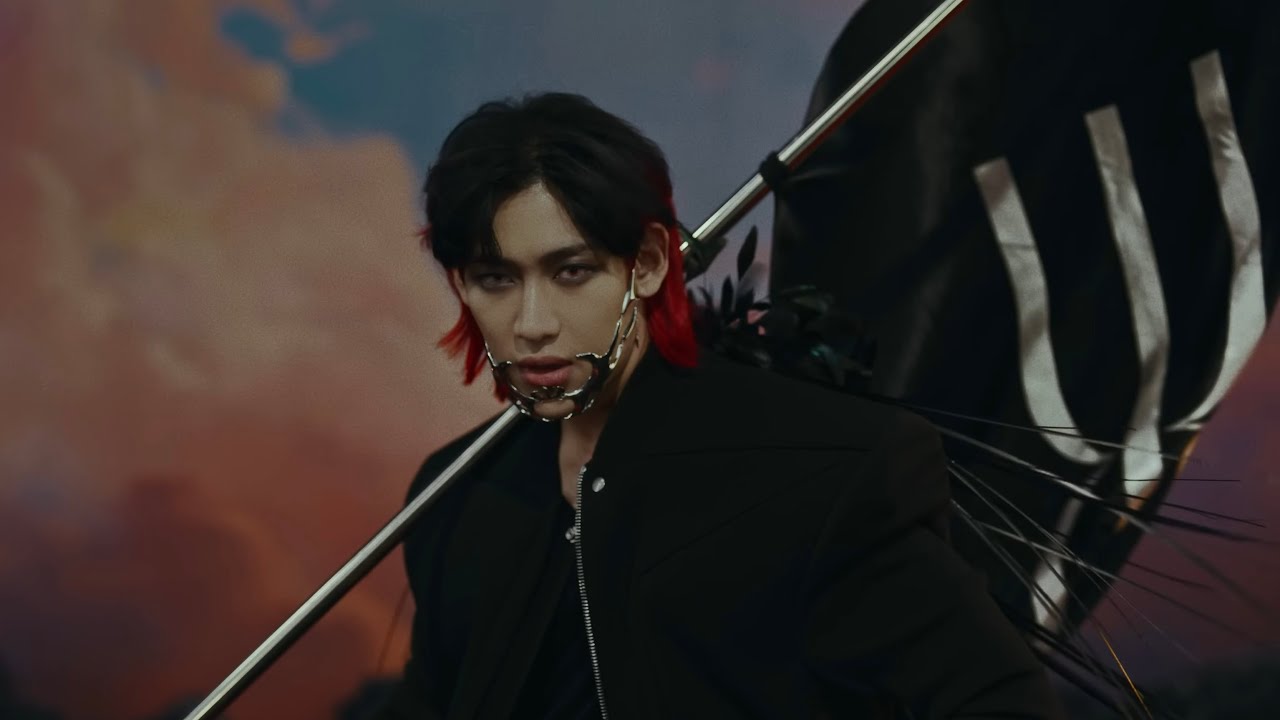
LAST PARADE: BamBam Built a Villain Procession and Invited the Beat
BamBam walks into his own villain procession with enough theatrical control to make menace fun—then keeps the beat sharp enough that costume never replaces performance.
Release file
Released: August 8, 2024
Runtime: 3:16
Artist / channel: BamBam Official / GOT7
Exact-file focus: The exact official LAST PARADE music video, not a performance clip, stage, teaser, short, fan edit or another BamBam release.
BamBam did not make an entrance song. He made an entrance system. “LAST PARADE” takes brass, low percussion, clipped chants and a camera trained to expect a coronation, then lets him play the ruler, the threat and the person amused by both roles. The concept is fun because it knows grandeur becomes camp the second nobody inside it is smiling. BamBam smiles.
The beat arrives wearing boots
The production works through weight and interruption. A marching pulse promises forward motion, but the arrangement keeps cutting holes into the procession so BamBam can change posture. Brass does not simply make the chorus “epic”; it gives the vocal something arrogant to lean against. The lower percussion makes each return feel less like a loop and more like another section of the crowd turning the corner.
His voice is mixed as character rather than proof of range. Dry, close phrases make the larger instrumental feel even larger. When layers widen, the song is not suddenly asking him to out-sing the parade. It is showing that the parade has accepted his command. That distinction saves the track from the exhausting inflation that ruins many villain concepts.
BAMESIS is a name and a production brief
The BAMESIS title combines BamBam with nemesis, but “LAST PARADE” is more playful than a revenge manifesto. Its villainy lives in silhouettes, processional geometry and the pleasure of taking up space. He is not asking the audience to believe he became dangerous overnight. He is asking whether danger can be another costume worn with enough specificity to reveal something true.
That truth is scale. BamBam has spent years learning how a Thai superstar, Korean idol and global fashion figure can occupy the same frame without one identity becoming an explanatory subtitle for another. The video turns that negotiation into architecture: corridors, ranks, elevated positions and bodies organized around a center that knows it is being watched.
The camera understands the joke
A weaker video would photograph the styling and call the result a concept. This one uses movement to keep testing authority. Low angles grant power; wider frames reveal how carefully that power has been staged. Cuts arrive on percussive punctuation, while formation shots let BamBam’s smaller gestures travel through the dancers around him. The spectacle works because the edit can distinguish command from noise.
His best expressions are not the most aggressive ones. A glance that lingers half a beat too long, a shoulder settling after the formation has snapped into place, or a smile that admits the whole empire is a pop set gives the video replay life. Those choices turn a mood board into a performance.
What the song proves about BamBam
GOT7 gave BamBam a shared performance grammar: speed, humor, rhythmic speech and the ability to remain readable beside six very different performers. Solo work asks what happens when he controls the negative space. “LAST PARADE” answers by making the space part of the persona. The beat leaves openings because he knows how to fill an opening without throwing ten gestures into it.
That restraint is easy to miss when the clothing, sets and brass are shouting. Follow only his hands on replay. Then follow only the changes in his walk. The performance is calibrated, not merely expensive. He is controlling how much of the joke the audience receives at once.
The one place I wanted more
The arrangement could afford a stranger bridge. Once the song has established its march and its ruler, a breakdown that temporarily emptied the palace would give the final return more danger. Instead, the track protects its momentum. That makes it immediately replayable but slightly less narratively disruptive than its imagery promises.
Still, “more experimental” is not automatically “better.” The song knows its job: announce BAMESIS, give BamBam a performance structure sturdy enough for stages, and leave a hook that can survive outside the video. It completes all three without confusing lore density with depth.
Quick verdict
“LAST PARADE” works because BamBam treats villain grandeur as a rhythm problem. The brass provides the crown; his timing decides whether anybody believes he owns it.
The beat is heavy, the concept is knowingly fun, and the performance has enough small choices to reward a second pass. This is not BamBam borrowing darkness to look mature. It is BamBam making darkness participate in his sense of theater.
Replay section
- First replay: listen for the holes in the percussion and how his shortest phrases occupy them.
- Second replay: watch the formation edges instead of the center; the dancers show how authority travels through the frame.
- Third replay: track BamBam’s hands and walking speed. The scale changes without the edit needing to explain it.
- Fourth replay: compare the dry close vocal to the widened chorus layers. The mix turns one performer into a procession.
Canonical artist and group trail
- BamBam artist and GOT7 member profile
- GOT7 group profile
- PYTHON in-depth React
- Exact official LAST PARADE videoDaily+981Total views7.9M
Sources and receipts
Why the parade metaphor earns its keep
A parade is public power with a route. It needs repetition so spectators recognize the formation, but it also needs escalation so the same formation does not become traffic. “LAST PARADE” uses that structure musically: marching weight establishes the route, brass announces each new block, and BamBam’s changes in delivery keep the procession from feeling automated.
The “last” in the title adds useful instability. Is this a victory lap, a final warning, or a ruler performing confidence because the walls are already closing? The video does not lock the answer. That ambiguity gives the styling somewhere to go beyond “BamBam looks expensive and dangerous.” A final parade is spectacle with an ending hiding inside it.
Costume is doing character work
The clothing is not a sequence of unrelated luxury flexes. Hard lines, dark surfaces and ceremonial details keep placing BamBam between commander and ornament. That tension suits him. He can appear completely in control while also letting the audience see that control is a performance constructed from fabric, bodies, lenses and editing.
This is where his fashion career becomes relevant without turning the review into a brand list. He understands silhouette as timing. A coat changes how long a turn appears to take; a rigid shoulder changes how much movement a small head tilt seems to contain. Styling modifies choreography before the dancer moves.
The GOT7 connection
BamBam’s role in GOT7 trained him to make a specific personality readable among six other strong identities. Solo work removes that competition but increases the burden: now every empty part of the frame is also his responsibility. “LAST PARADE” answers by surrounding him with a disciplined ensemble instead of filling the screen with random luxury objects.
The connection runs back the other way through WINTER HEPTAGON. BamBam produced “PYTHON,” whose controlled repetition and slinky negative space reveal an ear related to the visual instincts here. The songs are not twins, but both understand that command becomes more convincing when the arrangement knows what to leave alone.
Does it earn another play?
Yes. The first play sells impact; later plays reveal calibration. The hook survives without the video, while the video supplies enough spatial detail to make returning worthwhile. Most importantly, the concept remains fun. Darkness without pleasure would make this much sillier than the production intends.
I would still take a more disruptive bridge. A moment with the brass removed, the ranks broken and BamBam briefly alone could make the final formation feel like a choice rather than an inevitability. But the absence is a missed opportunity inside a successful record, not a structural failure.
Final replay verdict
“LAST PARADE” belongs on the repeat list for the beat first and the concept second. The bass and march make the body answer before the lore arrives. Then the staging gives the listener a reason to watch how BamBam converts rhythmic confidence into a whole public mythology.
Bottom line
“LAST PARADE” gives BamBam exactly the scale his timing can carry. The procession, styling and repeated hook make a convincing entrance, while the beat keeps the concept from becoming an empty costume march. It is swagger with enough musical spine to survive the visuals.
What changed every time I replayed it
The second replay follows the percussion and bass before the villain styling gets to claim every decision. The third watches how BamBam changes gait, face and vocal attack to keep the procession moving as performance rather than costume display. The fourth maps camera distance and the ensemble’s role in building threat. The fifth asks where camp sharpens menace and where it safely contains it. By the sixth, the concept feels fun because BamBam never begs me to mistake darkness for depth; he treats villainy like a role with blocking, rhythm and an exit cue.
Lyrics and meaning
The parade turns public judgment into a procession the accused person controls. Instead of asking to be welcomed back into somebody else’s moral story, BamBam stages the alleged villain as master of ceremonies. That is not proof every criticism is false, and the video does not need that lazy defense. Its pleasure comes from reclaiming theatrical authorship: if people insist on writing menace onto him, he will decide the lighting, tempo and route.
RaeRae verdict
LAST PARADE is theatrical, ridiculous in the right places and disciplined underneath the cape. BamBam sells the villain pose because his timing stays exact when the concept gets loud. I like the beat, the procession and the refusal to confuse darkness with seriousness. The best part is control: he enters as the spectacle, commands the route and leaves before the costume starts wearing him.