
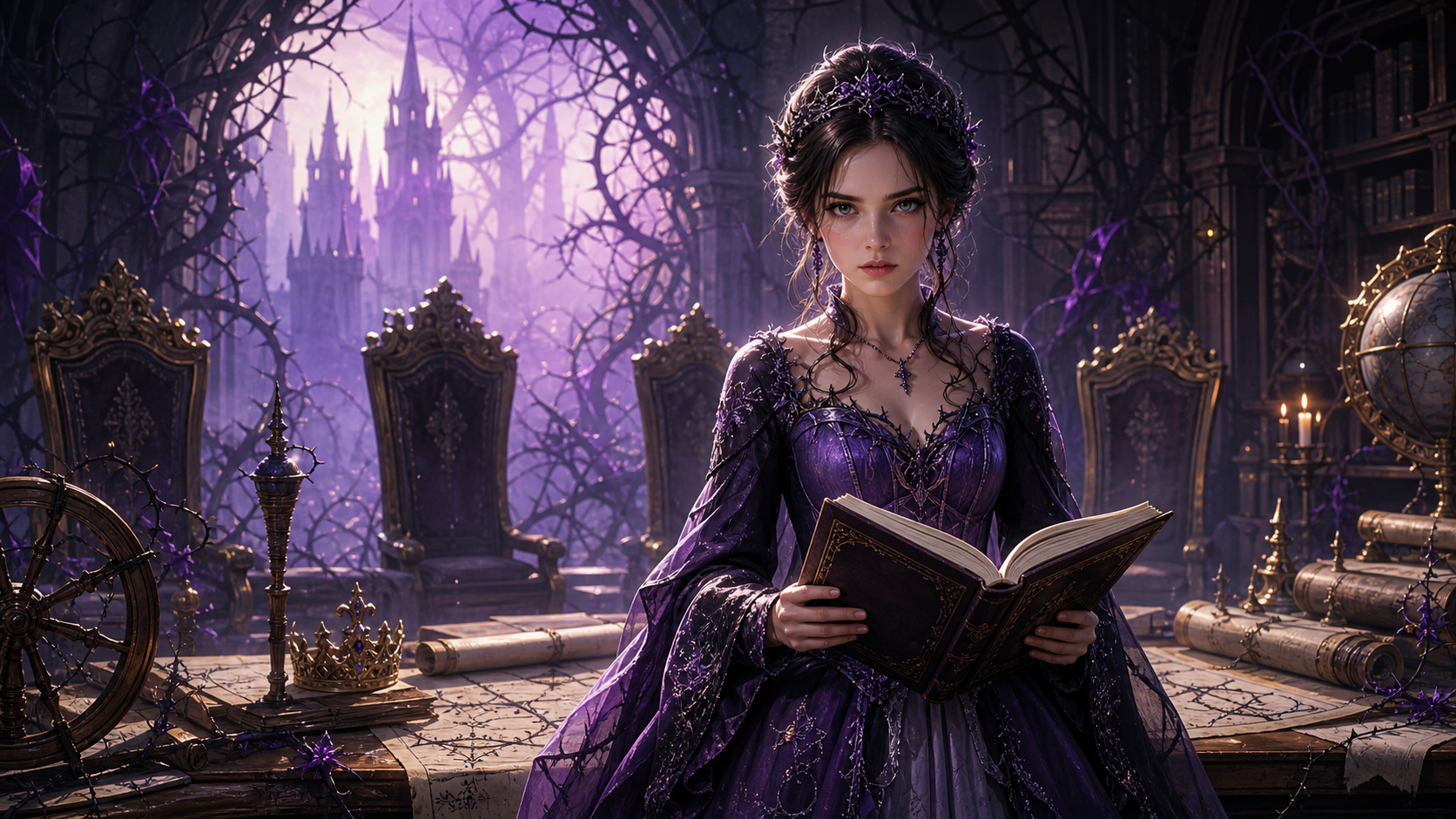
RAERAE RANT · AURORA, AGENCY, AND THE ADULTS WITH PLANS · ICONIC BY MISTAKE FORMAT
Aurora Is Treated Like Evidence in Her Own Movie, and I Am Tired of Everybody Calling That a Personality
The baby gets cursed, the girl gets hidden, the princess gets promised, the bride gets negotiated, and then people ask why she did not display a stronger personality during the decisions nobody let her make.
Let me say the part everybody keeps decorating around
Aurora is the title character and everybody else gets the verbs. Maleficent curses. Flora plans. Merryweather modifies. Stefan orders. Hubert negotiates. Phillip fights. In the live-action branch, Maleficent regrets, Diaval watches, Stefan militarizes, Ingrith plots, Philip proposes, and entire kingdoms use Aurora’s relationships to test whether peace is possible. Aurora smiles beautifully while the plot turns her life into a referendum.
Then somebody opens a ranking and calls her boring. Boring compared with whom? The dragon with an animation department? The three fairies carrying the actual rescue plot? The king who gets to weaponize sixteen years of panic? Aurora is not empty because softness lacks content. The movie keeps confiscating the information and choices that would let content become action.
She is cursed before she has language
The first major event in Aurora’s life happens while she is an infant. Maleficent punishes an invitation decision made by adults through a baby who cannot know the room exists. The curse assigns a death date before Aurora can form a preference. Her body becomes the parchment where two powerful sides write their conflict.
Merryweather softens death into enchanted sleep, another decision made over the cradle. The change saves Aurora and still belongs to the pattern. Nobody can ask the baby whether a kingdom should organize sixteen years around secrecy, whether every spindle should burn, or whether her future should depend on a prince. Adults call the plan protection because babies cannot object.
The gifts sound lovely until you notice the assignment
The fairies give Aurora beauty and song. Those qualities become central to how the film represents her, which means people later blame Aurora for the narrowness adults magically assigned. She did not stand at the christening and request an identity built around appearance and voice. Gifts can still become expectations when a whole kingdom repeats them as destiny.
Where is discernment? Where is political education? Where is the ability to detect manipulation? Merryweather uses her remaining gift to prevent death, so I am not blaming the woman doing emergency curse triage. I am blaming a social imagination where beauty and singing arrive before knowledge, resources, boundaries, or the right to say no.
Her parents send her away
Stefan and Leah agree to hide Aurora with the three fairies. The danger is real. The plan also removes their daughter from her name, rank, family, court, history, and future obligations for sixteen years. Protection is doing a lot of work in that sentence. Safety requires sacrifice, but children should not become the only people paying.
The adults never build a truthful transition. Aurora grows up believing her parents are dead. Her caregivers know the lie. Her parents know the location. Everybody has a reason. Nobody gives the girl a path for understanding why grief was manufactured around living people. When truth arrives, the story treats shock like a scheduling inconvenience before the birthday party.
Briar Rose is a whole life, not a costume
Briar Rose wakes, works, sings, gathers berries, talks to animals, and experiences the forest as home. She knows the fairies as aunts. She has routines, private dreams, and a social world created under concealment. Princess Aurora is a title waiting elsewhere. The cottage identity contains the life she actually remembers living.
Adults reveal that Briar Rose is supposedly not her real name and expect gratitude because a palace exists. Excuse me? A legal identity can be hidden. A lived identity cannot be dismissed like wardrobe from the first act. The franchise should let Aurora mourn Briar Rose instead of treating rank as automatic upgrade.
The forest meeting is one choice she actually makes
Aurora meets Phillip without knowing his title and chooses to speak with him after initial caution. She enjoys the encounter, agrees to meet again, and imagines a relationship formed outside court arrangement. The scene matters because preference briefly belongs to her. She likes a person before anybody tells her whom a princess should marry.
The reveal crushes that agency from two directions. She learns she is already betrothed, and she believes the man she chose is unavailable. Viewers know the men are the same person, but Aurora does not. Dramatic irony gives the audience comfort while the girl receives grief without enough facts to resolve anything.
The betrothal was arranged while she was a baby
Stefan and Hubert plan Aurora’s marriage to Phillip before either child can consent. The arrangement joins kingdoms and makes political sense to two fathers celebrating succession. None of that turns infant silence into agreement. Fairy-tale romance later makes the match feel harmless because the pair happens to like each other.
Luck is not consent policy. Aurora and Phillip choosing each other as adults can validate the relationship. Their attraction cannot retroactively make the original arrangement ethical. The movie escapes the conflict through coincidence and teaches audiences to mistake a happy result for proof that power was used responsibly.
She gets one devastating cry and the plot moves on
Aurora weeps after learning her identity and betrothal. The scene gives Mary Costa room for shock, then the fairies escort her toward the castle. Her grief is treated as something to survive on schedule. Nobody pauses the ceremony, renegotiates the plan, or asks what she needs before entering a family she cannot remember.
A developed paragraph of dialogue could change the entire character conversation. Let Aurora ask why her parents never visited. Let her ask whether Rose remains her name. Let her refuse the dress for one hour. Agency does not require a sword. Agency requires the story to remain in the room after she says the plan hurt.
Maleficent reaches her through isolation
The fairies leave Aurora alone in a tower room while grief remains fresh and the curse deadline approaches. Maleficent’s magic draws her toward the spindle. The sequence looks dreamlike, but vulnerability has practical roots. Aurora lacks information, support, and control after a life-changing reveal. The curse enters through the gap adults created.
Nobody intends the isolation as punishment. Intention does not repair design. A security plan built around secrecy collapses when secrecy produces emotional shock at the most dangerous moment. Aurora becomes evidence that protection without communication can manufacture the vulnerability a threat needs.
Then she sleeps through the climax because of course she does
Phillip escapes, the fairies equip him, Maleficent grows thorns, the dragon appears, and a sword flies through the air while Aurora lies unconscious. The animation is spectacular. The structure means every active climax belongs to people fighting over whether she will wake. Her body is the objective marker.
I do not need Aurora to defeat the dragon with a chair. I need the film to recognize that the title character has been removed from her own resolution. Give her an aftermath with choices, questions, anger, or terms. Waking up and walking into a restored betrothal cannot carry everything the story did to her.
Maleficent gives Aurora more life and still uses her
The 2014 film expands Aurora’s curiosity, movement, and relationship with Maleficent. She explores the Moors, sees magical creatures, and chooses trust. The revision gives her more than the animated film. The same revision uses her as proof that Maleficent can love again. Aurora’s goodness becomes treatment plan for another woman’s trauma.
That maternal relationship can be moving without turning Aurora into emotional medicine. She deserves desires beyond helping Maleficent heal. What does she want to learn? How does she understand the Moors politically? What does she think about being watched for years without knowing? The film keeps answering what Aurora means to Maleficent before asking what the relationship means to Aurora.
Stefan hides the crime and Aurora inherits the danger
Live-action Stefan mutilates Maleficent, lies about killing her, and builds a reign around fear of retaliation. Aurora receives the curse. Aurora receives exile. Aurora receives a childhood built on false orphanhood. Aurora returns to a father who locks her away instead of explaining why a fairy hates their family.
Men create the original violence, and the daughter becomes the negotiation surface between injured woman and guilty king. Aurora can love Maleficent and still deserve rage about the curse. She can grieve Stefan and still condemn him. The story should not force her to simplify everybody else’s morality so the ending can feel clean.
True love works because the mother changed, not because Aurora was passive
Maleficent’s kiss wakes Aurora because years of care transformed their relationship. The choice revises the romantic shortcut and gives motherhood narrative power. I like that. I also notice Aurora remains unconscious while somebody else proves character over her sleeping body. The test belongs to Maleficent.
Aurora’s earlier love matters because trust grew between them, but the magical mechanism only measures the giver of the kiss. A fuller ending would let Aurora wake and choose whether reconciliation continues. Forgiveness should not be assumed by consciousness returning. Love becomes ethical when the person harmed can answer.
Mistress of Evil finally makes her a ruler and immediately makes her a bride
Aurora begins the sequel as Queen of the Moors, a position with real obligations. Philip proposes, and marriage becomes the frame for human-magical unity. Her rule should drive negotiations. Instead, palace customs, family approval, and wedding planning pull attention toward whether she can enter Ulstead correctly.
The title changes, but the old pattern survives. Aurora becomes evidence that coexistence works. If she smiles at dinner, peace looks possible. If Maleficent objects, family looks broken. If the wedding succeeds, centuries of displacement appear solved. One young woman’s relationship becomes a workload no romance should carry.
Ingrith spots the hunger for belonging
Aurora lost her human parents, grew up outside court, and enters Ulstead without a stable model for human motherhood. Ingrith offers clothes, etiquette, approval, and the language of a real family. The manipulation works because the need is real. Aurora is not foolish for wanting a doorway into part of her own identity.
The problem is conditional belonging. Ingrith welcomes the version of Aurora willing to separate from Maleficent, soften the Moors, and accept Ulstead’s definitions. Approval becomes leash. Aurora needs enough narrative interiority to recognize that choosing human connection should not require performing gratitude toward control.
The wedding is foreign policy in a dress
Aurora and Philip love each other, but their marriage joins rulers connected to land, subjects, borders, armies, and histories. The sequel uses wedding imagery to make political consolidation feel romantic. The couple can consent to each other. They cannot consent on behalf of every fairy, Dark Fey community, or Ulstead resident.
I am not anti-wedding. I am anti-using a dress and flowers to skip governance. Where is the treaty? Where is representation? Who controls the Moors after marriage? Who protects Dark Fey sovereignty? Aurora deserves a love story that does not make her body the border agreement.
Aurora discovers the plot because she finally follows her own doubt
The sequel improves when Aurora investigates. She notices contradictions, enters hidden spaces, finds the spindle and red dust, and recognizes Ingrith’s plan. Knowledge becomes action. For once, the girl is not waiting for adults to explain a room. She reads evidence and chooses resistance.
That version of Aurora should have been present earlier and more often. Her curiosity is not a new superpower. The franchise simply allows curiosity to affect the plot. Agency can look like opening a door, believing discomfort, and refusing the story a queen prepared for public consumption.
She saves people, and the movie still rushes past her politics
Aurora works to free magical guests and expose the attack. She rejects Ingrith’s conditional motherhood and stands with the Moors. Those choices matter. The final phoenix spectacle returns attention to Maleficent because the film carrying Maleficent’s name follows its protagonist. Aurora still deserves aftermath as a ruler whose wedding was used for attempted genocide.
What security changes does she demand? Does she postpone the marriage? How does she address survivors? What authority does she keep? The ceremony resumes too quickly because fantasy endings love visual unity. Aurora’s political maturation needs more than walking toward an altar after surviving a trap.
Stop confusing gentleness with lack of thought
Aurora is warm, trusting, curious, affectionate, and hopeful. None of those qualities equal intellectual vacancy. Viewers have absorbed a strange rule where a woman must display sarcasm, combat, or refusal in a familiar register before agency counts. Quiet characters receive less interpretive generosity than loud adults who control them.
Gentleness can be strength. Gentleness can also become a trait the story exploits by withholding conflict. The answer is not turning Aurora into Maleficent with different hair. The answer is giving her gentle choices consequences, letting her anger remain gentle if that fits, and allowing a soft voice to change policy.
Stop blaming the character for the screenplay’s rationing
When a character lacks dialogue, perspective, and decisions, criticism should identify writing. Too often, audiences treat absence as psychological fact. Aurora barely speaks, so Aurora supposedly has nothing to say. The screenplay did not give her lines. Those statements are not interchangeable.
We can critique what exists and still ask why so little exists. Mary Costa’s performance, visual animation, songs, and live-action relationships create texture. The texture cannot replace missing interior life. A fair reading sees both without making Aurora responsible for studio priorities set decades before she was drawn.
Every adult calls control protection
Stefan burns spinning wheels. The fairies hide magic. Parents erase identity. Live-action Stefan locks Aurora away. Maleficent watches her without disclosure. Ingrith redesigns her clothes and future. Philip imagines marriage uniting kingdoms. Each adult can produce a reason connected to safety or love.
Aurora becomes the person expected to understand everybody’s reason. Who understands the cost to her? Protection without consent may be necessary for an infant during immediate danger. Sixteen years later, continued control needs scrutiny. The franchise keeps extending emergency authority past the moment Aurora can speak.
What a real Aurora-centered story would ask
A real Aurora-centered story would ask what she remembers about Briar Rose, what she believes about monarchy, how she processes two mothers, whether she forgives the fairies’ lie, how she grieves Leila and Stefan, and what rules she creates after learning secrecy nearly killed her twice.
The story would give romance space without making romance the constitution. Aurora might keep separate sovereignty, create a council, protect the Moors, restore Dark Fey land, and visit the cottage because home can remain plural. She could be gentle through every choice and still direct the plot.
The title owes her more
Calling a film Sleeping Beauty centers a condition rather than a person. The title remembers what happens to Aurora’s body and forgets most of what happens inside her mind. The 1959 movie follows the fairies because they carry action. The live-action films follow Maleficent because they announce a new protagonist. Aurora remains the bridge every version walks across.
A bridge supports movement and rarely receives permission to go anywhere. That metaphor is exactly the problem. Aurora should not exist primarily to connect king and fairy, human and magical, mother and redemption, prince and alliance. She is allowed to have a destination that belongs to her.
Mary Costa gives the silence more feeling than the script earns
Mary Costa’s voice carries warmth, caution, delight, and sudden grief through material that does not give Aurora enough time to process anything. Once Upon a Dream is remembered as romance, but the performance also establishes a young woman capable of imagining connection before she knows court rules already arranged the answer. Costa creates interior motion inside a character structure built around stillness.
That work deserves credit without turning performance into excuse for the screenplay. An actor can imply thought. The story still needs to let thought become decision. Aurora’s vocal grace has been used for decades as proof of ideal princess softness, while the emotional intelligence inside the performance receives less attention than the sound of the high notes.
A symbol can be transferred because nobody asks what she owns
Animated Aurora symbolizes innocence worth protecting. Live-action Aurora symbolizes the love capable of healing Maleficent. Sequel Aurora symbolizes coexistence between species and kingdoms. Every adaptation gives her a larger public meaning while remaining vague about personal ownership of land, title, history, and future. Symbolic importance grows faster than individual authority.
That imbalance makes her easy to transfer between adults. Parents send her to fairies. Fairies return her to parents. Stefan locks her inside royal security. Maleficent brings her into chosen family. Philip invites her into Ulstead. Ingrith tries to absorb her politically. Aurora keeps crossing systems because each system believes loving her grants a claim. Love should create responsibility toward her freedom, not a new route for possession.
My final receipt
Aurora learns on her sixteenth birthday that her name, parents, rank, home, and marriage plans differ from everything she believed that morning. By night, the curse takes her body. If somebody experienced that sequence in a modern drama, nobody would call the character boring because she cried. We would call the adults reckless.
So no, I am not accepting another conversation where Aurora’s thin writing becomes evidence that gentle women lack depth. The franchise repeatedly turns her into proof for everybody else: proof of a curse, proof of true love, proof of maternal redemption, proof of human-magical peace. Give the girl the evidence. Give her the full file. Then let her decide what story the receipts actually support.
Sources and receipts
The rant follows the 1959 Sleeping Beauty film, Maleficent, and Maleficent: Mistress of Evil, with official Disney film materials and the completed CVM Sekai reviews used for chronology. Interpretation, irritation, and every side-eye about adults calling control protection remain RaeRae’s.
Aurora is hidden from danger and from her own history
The fairies protect Aurora by removing every fact that could help her understand her life. She does not know her name, parents, rank, curse, deadline, or why the women raising her react to the world with constant caution. The secrecy may be tactically necessary, but protection becomes a complete childhood organized around withheld identity.
When the truth finally arrives, Aurora receives the information as a finished decision. She will return to parents she cannot remember and marry a prince selected before she could speak. The film asks her tears to carry the shock, then moves immediately toward the curse. Her grief becomes transition rather than a subject the story allows her to examine.
Briar Rose has relationships the princess title interrupts
Aurora believes Flora, Fauna, and Merryweather are her aunts. She has a home, routines, forest paths, animal companions, and a private imagination built inside that identity. Learning that Briar Rose was a cover story should create questions about which parts of her life remain hers.
The restoration of Princess Aurora is presented as returning the rightful person to history. Yet Briar Rose is also real because Aurora lived her. A fuller character arc would let her integrate both names rather than treating the cottage identity as scaffolding removed when the palace needs its heir.
The arranged marriage is discussed around her
Stefan and Hubert celebrate the betrothal as political continuity, while Phillip objects because he believes he has met another woman. Nobody asks Aurora what marriage means after sixteen years without human peers. The romantic coincidence solves consent mechanically by making the forest stranger and official fiancé the same man.
That coincidence creates a happy ending but avoids the institution. Aurora does not choose between duty and desire because the screenplay arranges for both to share a face. Her lack of conflict becomes evidence of fairy-tale destiny when the more revealing fact is how carefully the plot prevents her from having a decision that might inconvenience the kingdoms.
The spindle turns her body into proof
Maleficent needs Aurora less as a person than as evidence that Stefan cannot control fate. The fairies need Aurora to survive as evidence that their protection worked. Phillip needs to kiss her as evidence of true love. The kingdoms need her awakening as evidence that succession and peace remain intact.
Every faction reads meaning through Aurora’s body while she sleeps. The image is beautiful because Eyvind Earle’s design gives stillness ceremonial weight. The beauty also risks making political use look natural. A woman lying silent becomes the surface on which everybody else’s moral victory is displayed.
A few lines of dialogue could have changed the balance
Aurora does not need sword fights to become central. She needs scenes where information reaches her early enough to shape action. Let her question the fairies, confront her parents, choose how to meet Phillip, describe what the curse felt like, or decide what parts of cottage life will enter the palace.
Agency is not measured only by changing the ending. A character becomes present when the story allows her interpretation to affect how viewers understand events. Aurora’s point of view is not absent because she lacks potential. The screenplay repeatedly cuts away at the moment that point of view would complicate the elegant design.
The Maleficent films prove Aurora can carry political choices
The live-action films give Aurora relationships with the Moors, Maleficent, Diaval, Phillip, and competing kingdoms. The writing remains uneven, but Aurora is allowed to misunderstand, investigate, forgive, govern, and reject inherited hostility. Those actions do not betray the fairy tale. They reveal how much narrative space the animated film left unused.
More dialogue does not automatically create depth, and the newer films sometimes use Aurora as another bridge between powerful adults. Still, her choices have consequences beyond whether she awakens. The comparison confirms that gentleness and agency were never opposites.
My final receipt on the evidence
Aurora is kind, curious, musical, lonely, frightened, and capable of affection. The problem is not that the movie gives her no personality traits. The problem is that the story values what she represents more than what she understands.
A future adaptation should stop treating her as the certificate proving other people learned the lesson. Give Aurora the history before the deadline, let her name what was taken, and allow the kingdom’s happy ending to depend on a choice she can remember making.
The title character should receive part of the ending
Aurora’s absence also changes how viewers assign credit. The fairies receive justified praise for raising her, hiding her, rescuing Phillip, and defeating Maleficent’s physical obstacles. Phillip receives the climactic action. Maleficent receives the visual force. Aurora becomes the reason everybody acts rather than an actor whose interpretation reorganizes the conflict. That structure can produce a compelling ensemble, but the title character pays the cost. Even the famous Once Upon a Dream sequence gives Aurora a desire shaped by an image she cannot identify. She expresses longing beautifully and then discovers the stranger already belongs to a political arrangement planned by men she has never met. A deeper story would ask what Aurora wants after the coincidence is revealed. Does she want time before marriage? Does she return to the cottage? Does she feel betrayed by the fairies and grateful to them at once? Does she understand Maleficent only as evil, or does she question why her father’s court created an enemy powerful enough to target a child? None of those questions requires turning Aurora cynical. Gentleness can survive knowledge. In fact, gentleness becomes more meaningful when chosen after a person understands the full shape of what happened.
Aurora deserves a future remembered through her decisions, not only through the beautiful image everybody else needed her sleeping body to provide.
Keep exploring
Return to the Sleeping Beauty hub for films, profiles, reviews, rants, and guides.
Aurora deserves an argument that begins with Aurora
The princess should not exist only as proof that Stefan failed, Maleficent changed, Phillip loved, or the fairies succeeded. Aurora has grief, curiosity, desire, anger, and two identities forced together in one day. Any adaptation claiming to deepen the fairy tale must let those experiences generate consequences instead of using her awakening as everybody else’s moral certificate.