

Character File · The Little Mermaid · Full Franchise
Ariel
She did not fall in love with one man and accidentally discover a world. She had already built an archive, asked forbidden questions, and decided the border was too small.
Quick file
Franchise: The Little Mermaid. Primary screen versions: 1989 animated feature, 1992–1994 television series, 2000 sequel, 2008 prequel, stage adaptations, and 2023 live-action reinterpretation. Primary performers: Jodi Benson in the animated franchise, Sierra Boggess in the original Broadway production, and Halle Bailey in the 2023 film.
Core relationships: King Triton, Ursula, Eric, Sebastian, Flounder, Scuttle, her sisters, and later Melody. Defining conflict: curiosity becomes dangerous when her father treats knowledge as betrayal and a sea witch turns the need for autonomy into an exploitative contract.
The part people remember and the person underneath it
Ariel is remembered through red hair, a green tail, a shell silhouette, a fork, and “Part of Your World.” Those images are powerful enough to become shorthand, but shorthand can shrink the character into a teenager who abandons everything for a handsome stranger. She wants Eric. Her desire for the human world begins before she sees him.
The grotto is evidence. Ariel collects tools, books, art, containers, and objects because she is conducting unsupervised cultural research. Her conclusions are sometimes wrong because Scuttle is a terrible source, not because curiosity is shallow. The archive shows sustained attention to a world Triton has forbidden her to study.

Curiosity is her first political act
Ariel’s questions challenge a border maintained through fear. Triton does not merely dislike one shipwreck. He governs a society where contact with humans is treated as contamination. Ariel’s collecting therefore violates family authority and public ideology at once.
The film romanticizes exploration, but it also understands that information control produces bad decisions. Because Ariel cannot study humans openly, she relies on scavenged objects and unreliable interpretation. Prohibition does not end curiosity. It removes the conditions under which curiosity could become knowledgeable and safe.
1989 chronology: from concert absence to contract
Ariel misses the royal concert while exploring a shipwreck with Flounder. A shark attack proves the surface world contains danger, yet danger does not answer whether an entire people should remain forbidden. Sebastian discovers the grotto and eventually brings Triton into the conflict.
The storm and shipwreck allow Ariel to rescue Eric. She sings while he is barely conscious, creating the memory Ursula later weaponizes. Triton destroys the grotto after learning about the encounter. Grief, rage, and betrayal leave Ariel vulnerable to Flotsam and Jetsam’s offer of an alternative authority.

The contract is valid theater and predatory consent
Ursula states terms: Ariel receives legs for three days, must earn true love’s kiss, and pays with her voice. Ariel signs. Formal agreement does not make the bargain fair. Ursula approaches immediately after Triton destroys Ariel’s archive, knows the family conflict, controls information, and intends to prevent success.
The scene is an excellent example of coercive consent without physical compulsion. Ariel chooses, but the choice is engineered inside crisis. Ursula treats bodily transformation, communication, and future ownership as commodities. The signature records assent while the surrounding power imbalance destroys the idea of an ordinary bargain.
Voice is body, identity, labor, and evidence
Ariel’s voice identifies her to Eric, carries her interior life to the audience, and becomes Ursula’s tool of impersonation. Losing it is not merely a dating obstacle. It removes the ability to narrate herself inside a new culture.
The film lets gesture, expression, and action sustain personhood without speech. Ariel remains curious, funny, strategic, and emotionally legible. Eric’s fixation on the remembered song still demonstrates how easily one sensory marker can replace attention to the person directly present.

A new body does not make the human world automatically free
Ariel receives legs and immediately has to learn balance, clothing, eating, travel, and social expectation. The transformation gives access while making her dependent on strangers. Her body is treated as proof of belonging even though she lacks language and context.
The 1989 film converts much of this adaptation into comedy. A deeper reading keeps vulnerability in frame. Ariel has surrendered movement native to her, communication, family access, and legal control over her future for a time-limited test designed by an enemy.
Eric is not the whole dream, but he changes its urgency
Eric represents a person and a route into the human world. Ariel rescues him before he can reward her. She is drawn to his face, voice, and position in the world she studies. That attraction becomes attached to a larger longing already articulated in “Part of Your World.”
The romance remains accelerated. They know little about each other, and the contract turns courtship into deadline. The film creates chemistry through shared exploration and near communication, then relies on villain interference to prevent the kiss. Love works as plot while cultural migration carries the deeper cost.

Triton loves Ariel and still abuses authority
Triton’s fear has context in later franchise material, including conflict with humans and loss. Context explains intensity. It does not make destroying Ariel’s collection protective. He enters a private archive and uses state power to obliterate objects because they represent disobedience.
The scene matters because love and harm coexist. Ariel does not need to prove Triton never cared in order to name the violation. His eventual transformation of her body is meaningful only after he recognizes that control cannot preserve relationship.
Ursula understands the family system better than anyone
Ursula knows Triton’s authority, Ariel’s hunger, and the political value of the king’s child. She frames herself as the adult willing to listen after the father refuses. Manipulators often succeed by accurately identifying a wound and lying about the cure.
Her performance turns appetite, body, glamour, and theatrical excess into power. Criticism should resist treating fatness or femininity as the source of evil. Ursula is dangerous because she builds contracts to seize agency, not because she occupies space loudly.

The climax restores voice before it restores family
When Vanessa’s shell breaks, Ariel’s voice returns and Eric recognizes her. The sequence repairs identity stolen through magic. It does not erase his earlier failure to notice the person without the remembered sound.
Triton’s transformation into a polyp exposes the contract’s political purpose. Ursula wants sovereignty. Ariel and Eric defeat the immediate threat together, but Triton chooses whether the family border will change afterward.
The ending is permission, migration, and a loss the film scores as triumph
Triton gives Ariel a human body and she marries Eric. The image reads as fatherly acceptance. It also means Ariel leaves the sea, her siblings, language, mobility, and culture for a human kingdom she has known only briefly.
The film emphasizes chosen future and minimizes migration grief. A stronger continuation would show Ariel maintaining active ties, learning human politics, correcting Scuttle’s misinformation, and building mutual contact rather than completing assimilation through marriage.

The television series gives her a life before the bargain
The animated series takes place before the 1989 feature and expands Atlantica, her sisters, friendships, music, enemies, and encounters. Prequel continuity can be inconsistent, but the branch proves Ariel has adventures and commitments beyond Eric.
The series also complicates claims that she had no knowledge of humans or conflict before the film. Treat it as its own official screen branch and note contradictions rather than forcing every episode into a perfectly sealed timeline.
Ariel’s Beginning and the family history of forbidden music
The 2008 prequel connects Triton’s prohibition of music to grief after Queen Athena’s death. Ariel’s resistance becomes a defense of memory and communal expression. The father again turns pain into policy.
The pattern clarifies the 1989 conflict. Triton repeatedly tries to manage fear by banning the object associated with loss. Ariel repeatedly restores relationship with what he forbids. Her rebellion is not random temperament. It is a challenge to grief becoming law.
Return to the Sea makes Ariel the frightened parent
As an adult mother, Ariel hides Melody’s mermaid heritage and helps build a wall against the sea after Morgana threatens the child. The decision repeats Triton’s central error: protection through secrecy, prohibition, and separation from part of the self.
The sequel is valuable because liberation does not immunize a person against inherited behavior. Ariel understands why her father feared and reproduces the method from the other side. Melody’s defiance becomes the evidence that a family boundary built from fear cannot remain stable.
The 2023 Ariel is a distinct performance, not a replacement argument
Halle Bailey’s Ariel brings a Black screen presence, copper locs, a different vocal texture, and a performance shaped for live-action proximity. Casting expanded who could occupy a globally recognizable princess role and exposed racist assumptions often disguised as concern for fidelity.
The adaptation revises agency in several places, including Ariel’s participation in defeating Ursula and a broader interest in exploration. It also inherits the central problem of trading voice and culture under a romantic deadline. Representation deserves specific praise without pretending every remake choice is automatically stronger.

Jodi Benson, Halle Bailey, and the work of making voice character
Jodi Benson’s performance joins theatrical clarity with conversational vulnerability. “Part of Your World” grows from observation into need without making Ariel sound detached from the life she has. Across sequels and series work, Benson supplies continuity while the character moves through different ages and roles.
Halle Bailey’s voice carries agile ornament and emotional immediacy while her spoken performance uses stillness appropriate to camera scale. Comparing performers should describe interpretation, arrangement, and medium. Ranking one as the real Ariel turns adaptation into ownership warfare.
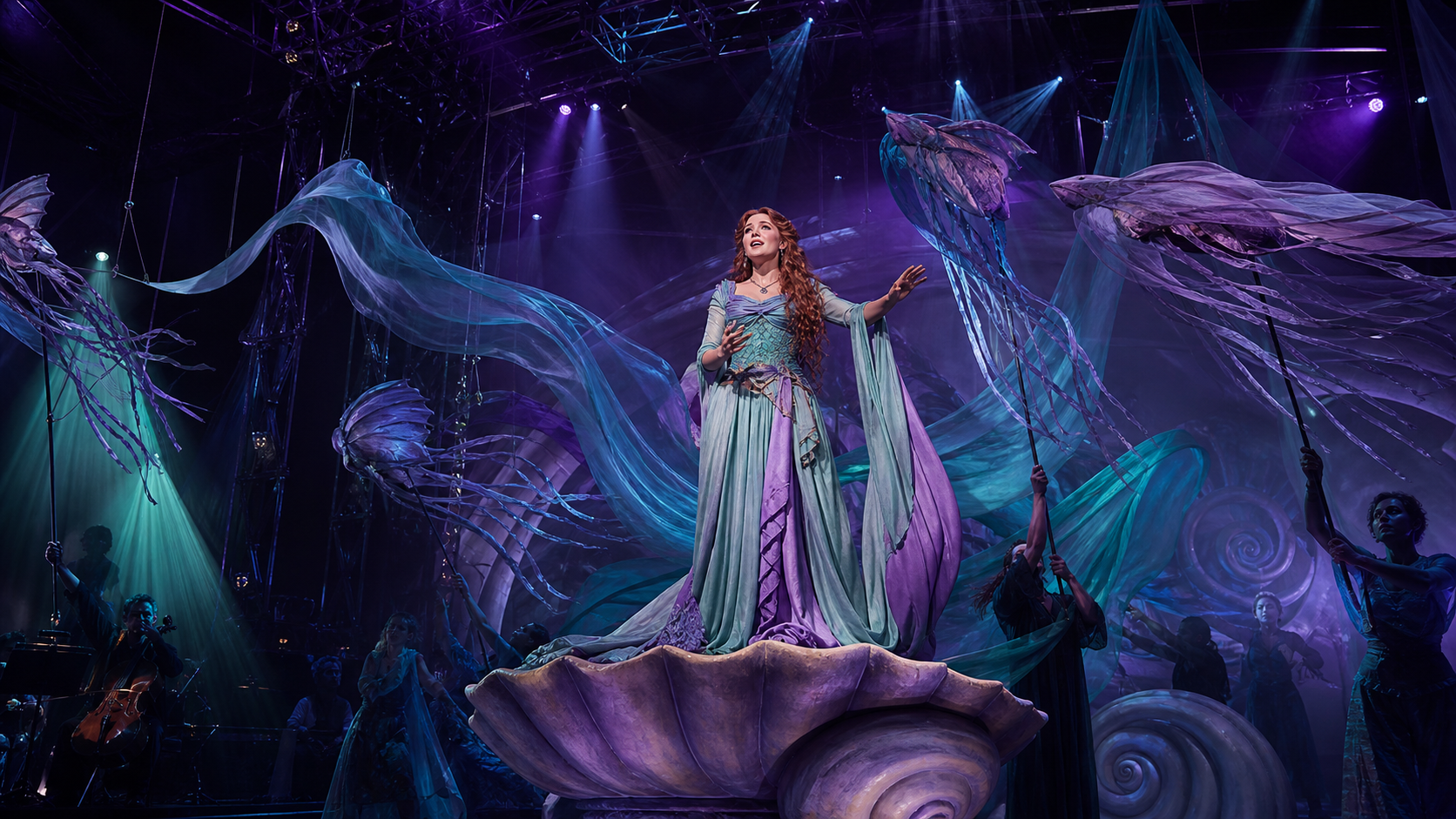
Stage Ariel has to make swimming and silence visible
The stage musical cannot rely on camera cuts or fluid simulation. Movement systems, fabric, lighting, rigging, ensemble work, and vocal staging create water. New songs give Ariel interior material that film pacing could not hold.
Sierra Boggess originated Ariel on Broadway and helped define how the role could expand through live performance. Stage adaptations are alternate interpretations, not deleted-scene proof about film canon. Their value lies in what theater chooses to make audible and embodied.

Andersen’s mermaid wanted an immortal soul, not only a prince
Hans Christian Andersen’s 1844 tale gives the mermaid desire for the human world, the prince, and an immortal soul. Transformation brings pain. The prince marries another woman. The mermaid refuses to kill him, becomes sea foam, and continues as a daughter of the air within a moral framework tied to eventual spiritual attainment.
Disney removes theological probation, self-dissolution, and the failed romance, then builds a comic adventure ending in marriage. The adaptation preserves longing and voice loss while changing what sacrifice earns. Reading the source prevents the brand from becoming the only version people know.
Criticism: age, sacrifice, and the myth that wanting more is selfish
Ariel is sixteen in the 1989 film, which makes the contract, marriage, and family conflict more troubling than versions that age her upward. Viewers can love the character while noticing how quickly the story rewards permanent migration after a three-day bargain.
Criticism often swings too far and treats curiosity as childish ingratitude. Ariel can love her family and reject its border. The problem is not wanting another world. It is having no safe, informed path to explore it without surrendering voice to an adult predator.
Legacy and future
Ariel helped restart Disney’s animated-musical era and remains central to the studio’s princess economy. Her songs, silhouette, hair, and objects became global icons. That industrial importance should not replace analysis of what the story teaches about voice, consent, migration, and parental power.
The most interesting future is not another wedding. Ariel could become translator, archivist, navigator, ambassador, mother repairing inherited fear, and scholar correcting decades of misinformation between sea and shore. The archive should finally become public knowledge rather than contraband.
Final character receipt
Ariel is not admirable because every choice is wise. She is compelling because curiosity survives ridicule, prohibition, bodily change, manipulation, and family rupture. She acts, misjudges, learns, and keeps insisting that a border is not an answer.
Her deepest conflict is not mermaid versus human. It is whether love requires silence. Triton says protection requires obedience. Ursula says desire requires surrendering voice. Eric initially recognizes a sound before the person. Ariel’s story becomes whole only when voice, body, family, and exploration can coexist without ownership.
Ariel as an archivist, not a tourist
The grotto is usually described as a collection, which makes it sound like a teenager storing souvenirs. Look at what the room actually does. It gathers evidence from shipwrecks, preserves objects that would otherwise decay, and gives Ariel a place to compare materials from a civilization she cannot visit openly. She does not have a museum label system, but she has made the beginnings of an archive under conditions of censorship. That distinction changes the moral weight of Triton’s destruction. He does not merely break clutter. He destroys the only body of research Ariel has been able to assemble about the people beyond his border.
Her mistakes with the fork and pipe are also useful. They show what happens when artifacts are separated from living communities and interpreted through a confident but unreliable intermediary. Scuttle fills gaps with performance. Ariel accepts bad conclusions because Atlantica provides no legitimate scholar, traveler, or exchange program that could correct them. The joke lands because his explanations are ridiculous. The political point lands because isolation creates exactly this kind of misinformation. Ariel needs better sources, not less curiosity.
That is why a future built around exploration makes more sense than treating marriage as the final form of her ambition. Ariel has the temperament of a field researcher. She notices objects, remembers details, takes physical risks, asks follow-up questions, and returns to the same subject over time. The romance gives her a human partner. It should not erase the intellectual project that existed before his ship entered the story.
What the sisters reveal about family and succession
Ariel’s sisters are often reduced to the concert she misses and the exasperated family waiting for her. Their presence still establishes an important fact. Ariel is not the only daughter in a royal household. She grows inside a large sibling group with ceremonial expectations, public performances, and a father whose authority reaches beyond ordinary parenting. Missing the concert therefore has two meanings. She lets down her sisters during shared work, and she refuses a role designed to display the king’s harmonious family to Atlantica.
The film does not spend enough time on how her departure affects those sisters or how they understand the human ban. Later material gives them more personality, but the franchise rarely lets the family debate policy as a family. That absence protects the clean father-daughter arc. It also keeps viewers from asking whether Triton governs every daughter through the same fear, whether some agree with him, or whether Ariel’s rebellion opens possibilities they privately wanted too.
A JIN-level profile has to keep those relationships visible because individual courage never happens in a vacuum. Ariel’s freedom changes the rules for everybody who remains underwater. If Triton can transform one daughter and bless contact with humans, then the old prohibition was not natural law. It was policy. Policies can be challenged, revised, and remembered by the people who lived under them.
Sebastian and Flounder carry different kinds of loyalty
Flounder joins Ariel’s explorations even when he is frightened. His loyalty is intimate and immediate. He wants her safe, but he does not assume safety gives him the right to control her. Sebastian begins from the opposite position. Triton assigns him surveillance and containment, so affection develops inside a job that requires reporting Ariel’s behavior. He becomes ally, accomplice, and conscience while still carrying the habits of a court official.
That difference matters when adults describe Ariel as impulsive. Flounder sees the risks she takes up close. Sebastian understands the political consequences of those risks. Neither reduces her to a romantic punch line. Their help during the three-day deadline keeps the contract from becoming a private test between Ariel and Eric. A community of animals does emotional, strategic, and musical labor to give her a chance against a rigged bargain.
The comedy can hide how much Ariel depends on that labor after losing her voice. Sebastian interprets situations, organizes “Kiss the Girl,” and attempts to manage a world unfamiliar to him too. Flounder remains connected to the sea life Ariel may lose. They are not accessories. They are the bridge network that makes migration survivable.
The body politics of mermaid, human, and princess branding
Ariel’s body changes category more than once across the franchise. Mermaid form marks her as daughter, subject, and outsider to the human world. Human form gives access while taking away the movement she mastered. Princess branding then freezes both bodies into marketable silhouettes, with the red hair and green tail often carrying more public recognition than any specific choice she makes. The character becomes an image people believe they already understand.
The 2023 film challenged that visual ownership by casting Halle Bailey and redesigning the hair, coloration, and movement around a Black performer. Much of the backlash revealed that some viewers treated the 1989 palette as racial law rather than one adaptation’s design. Defending Bailey does not require pretending corporate representation solves every story problem. It requires naming the difference between analyzing a performance and policing who is allowed to embody fantasy.
The transformation plot also invites a disability and communication reading, though it should be handled carefully. Ariel enters a society where she cannot use her familiar mode of movement and cannot speak. The film makes her expressive rather than empty, yet everyone around her controls the pace and terms of communication. Her successful personhood never depends on speech. Her legal and romantic predicament does. That gap is where the contract does its cruelest work.
Music does narrative work before it becomes nostalgia
“Part of Your World” is not an interchangeable wish song. Its inventory of objects proves Ariel has already been studying human life, while the repeated questions expose how little reliable knowledge she possesses. The melody lets desire expand without turning immediately into spectacle. Ariel is alone with the collection, so the performance reads as private thought before it becomes a franchise anthem.
The reprise after rescuing Eric shifts that broad desire toward a specific person and a declared future. “Poor Unfortunate Souls” answers with a sales pitch that mocks language, praises bodily presentation, and treats silence as feminine advantage. “Kiss the Girl” then tries to solve the communication problem through atmosphere and peer pressure. The songs argue with one another about whether desire requires speech, performance, or recognition.
Later adaptations revise lyrics, add songs, and alter the balance between interior monologue and plot. Those changes are not cosmetic. A lyric can redistribute agency, explain a motivation, or blunt a disturbing implication. The right question is never only whether a new song is catchy. It is what the new musical structure permits Ariel to think, say, remember, or choose.
Motherhood turns the original victory into an ethical test
Ariel’s decision to hide the sea from Melody is painful precisely because she once understood the damage of prohibition. The sequel does not need her to become stupid or hypocritical. Trauma can make a person repeat a method they hated when danger arrives in a new form. Morgana threatens an infant. Ariel responds by turning the border into architecture and keeping the reason secret. Fear wins before reflection catches up.
Melody then collects evidence of the forbidden world just as Ariel collected human objects. The direction reverses while the family pattern remains. A daughter experiences part of herself as contraband, seeks information outside official channels, trusts a manipulative sea witch, and crosses the boundary alone. The parallel is not subtle, but it is dramatically honest. Parents do not escape inherited control merely because they remember being controlled.
Ariel’s repair requires more than admitting she loves Melody. She has to remove the wall and accept that relationship cannot survive on curated truth. This makes adult Ariel more interesting than a permanently triumphant princess. She can cause harm while trying to protect, recognize the repetition, and choose a different family system.
Easter eggs, callbacks, and the danger of confusing reference with meaning
The franchise rewards close watching with recurring objects, musical echoes, visual callbacks to the grotto, and appearances that connect Ariel to the broader Disney animation catalog. Viewers often spot Mickey-shaped arrangements, familiar paintings or statues, reused storybook imagery, and character cameos in crowded royal scenes. Those details can be delightful, but every claimed Easter egg needs a verifiable frame, production source, or credited statement before this site presents it as fact.
A callback matters most when it changes interpretation. Melody handling a forbidden object echoes Ariel’s archive because it reveals repetition across generations. A reprise matters because the same melody now carries different knowledge. A visual quotation from the 1989 film in a later adaptation can announce continuity, disagreement, or simple brand recognition. Listing references without asking what they do turns close reading into trivia inventory.
For reviews, the standard is therefore receipts first. Confirm the object is on screen. Separate intentional homage from audience theory. Credit designers, animators, performers, and filmmakers when documentation exists. Then explain why the reference matters to character, craft, or franchise memory. Ten thousand words of unverified Easter-egg folklore would still be shallow.
The final judgment on Ariel’s agency
Ariel has agency because she initiates action and pursues a sustained desire, not because the narrative protects every choice from criticism. She explores the wreck, rescues Eric, defies Triton, signs the contract, adapts to land, confronts Ursula, and continues building a life across later branches. Some decisions are reckless. Several happen under adult manipulation. Agency describes participation in causality. It does not mean perfect information or moral immunity.
The strongest criticism asks why a sixteen-year-old has so few safe options between obedience and an exploitative bargain. Triton controls knowledge and mobility. Ursula offers access at predatory cost. Eric’s kingdom accepts Ariel without understanding her history. The happy ending solves immediate permission through paternal magic but leaves the institutions around her mostly unexamined.
That is why Ariel keeps generating argument decades later. She can be read as a girl punished for curiosity, a migrant crossing cultures, a young woman negotiating bodily autonomy, a daughter inside authoritarian love, a romantic heroine, a queer-coded figure seeking another world, or a corporate icon whose image exceeds her story. The readings overlap. None requires flattening her into either foolish teenager or flawless rebel.
Keep exploring The Little Mermaid
Return to The Little Mermaid hub for film branches, reviews, Reacts, rants, lore, guides, and the full character directory.